‘Sylvia Sylvia Sylvia’ review: Sylvia Plath haunting flounders
Poor Sylvia Plath has found little rest in the afterlife.
The New Yorker’s Janet Malcolm had choice words for the army of Plath’s biographers. She likened this species of writer to “the professional burglar, breaking into a house, rifling through certain drawers that he has good reason to think contain the jewelry and money, and triumphantly bearing his loot away.”
Plath, the deserted wife of fellow poet Ted Hughes, mother of two young children, died by suicide at age 30, leaving behind a collection of poems that anatomized her mental descent in scorching language that secured a permanent place in American letters. More than 60 years have passed since her death in 1963, yet the literary myth that has taken the name Sylvia Plath lives on.
I confess I’m not impervious to the posthumous allure. When visiting friends who were staying in the Primrose Hill area of London a few years ago, I would pass by the flat that Plath shared with her husband there and stare wonderingly at the town house, adorned with a blue plaque commemorating its former resident.
“Sylvia Sylvia Sylvia,” a new play by Beth Hyland that opened Thursday at the Geffen Playhouse, is set in a different apartment that the couple shared. This cozily claustrophobic home is located in Boston’s historic Beacon Hill district in the period before they had children and were striving anxiously to realize their early promise.
As Sylvia (Marianna Gailus) and Ted (Cillian O’Sullivan) confront the problems that will eventually drive them apart, two contemporary married writers who have taken up residence at the Boston address grapple with many of the same issues (marital discord, competitive egos and mental health woes) as their more famous literary predecessors.
World premieres are risky, and the writing for this one hasn’t yet settled. The play’s split focus, moving between 1958 and the present, is a sign of conceptual ambition. But Hyland struggles to find the pacing and rhythm of her complicated vision.
Sally (Midori Francis), a writer whose first book was a big hit but whose second book is long overdue, and Theo (Noah Keyishian), who just found out he won a major literary prize for his first novel and is now up for a game-changing job at Columbia University, are at different points in their careers. Sally is processing both the shock of a miscarriage and her ambivalence about her marriage.
She’s also worried that her publisher is going to make her pay back the advance for the book about Plath and Hughes that she’s been unable to make any headway on. “I have to finish the draft,” she tells Theo. “If I can’t do that when I’m living in their apartment, I should honestly just kill myself.”
Clearly, Sally is having a hard time holding it together. The precarious state of her mind forces us to question whether Sylvia and Ted are ghosts, hallucinations or literary inventions sprung to life. But these characters are initially presented as objectively real. We meet them before we meet Sally and Theo, and whether they are figments or not, they are unmistakably haunting the new occupant who’s writing about them.
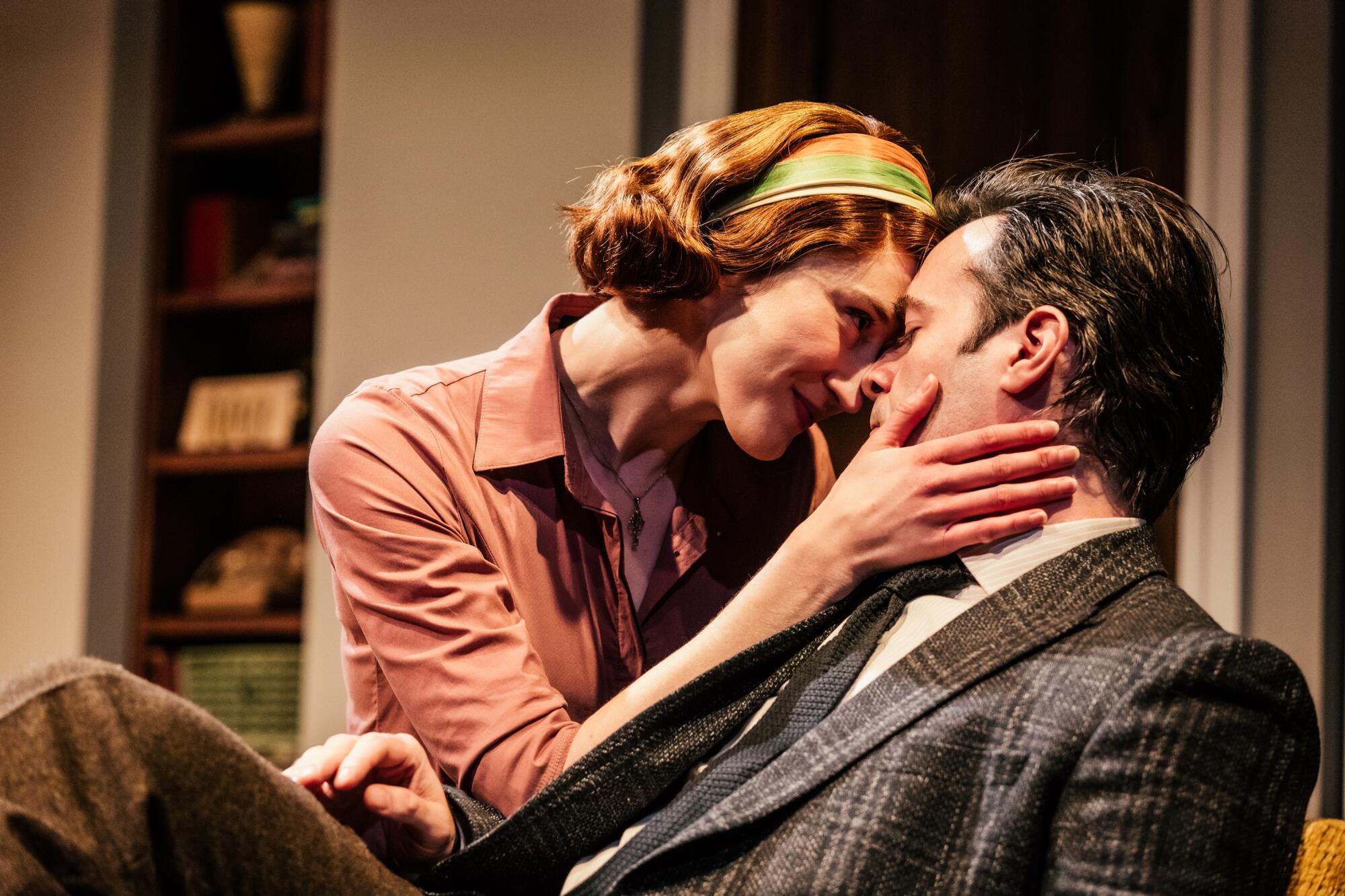
Unfortunately, these illustrious figures are badly written and stiffly played. O’Sullivan can’t keep Ted’s accent straight, and Gailus seems to be offering a Ryan Murphy version of Plath.

Marianna Gailus, left, and Cillian O’Sullivan in “Sylvia Sylvia Sylvia” at Geffen Playhouse.
(Jeff Lorch)
Sally may be struggling to give Sylvia and Ted life on the page, but Hyland is having her own trouble ushering them to the stage. The word “factitious” kept coming to mind. Artificiality might be the point, but it’s not one that gives much pleasure in the theater.
Who wants to sit through a fictitious novelist’s clumsy drafts? The scenes between Sally and Theo are more convincing, but the dynamic between them grinds on snappishly. Theo tries his best to be a sensitive and supportive husband, but Sally can’t seem to get what she needs from him. And as her marriage and literary career fall apart, her psychiatric problems intensify.
Writing in a desperate junk-food-fueled all-nighter, Sally appears to have entered a manic phase. Theo, terrified that she might make another suicide attempt, looks on helplessly. Their small, spare yet tasteful apartment (the work of the collective Studio Bent) turns into a marital pressure cooker as Theo’s fortunes rise and Sally’s self-belief craters.
Hyland captures the parallels between the two couples. Her Ted is a patriarchal monster, controlling, moody and sexually malignant. Theo is far more psychologically evolved, but he has his own blind spots that provoke Sally, who’s more emancipated than Sylvia but less professionally assured and just as unstable.
The times are vastly different, but the balance of power between these married writers remains precarious. There might be a fascinating play here, but the amorphous scenes that Hyland provides lack a dramatic through line.
As the play flounders, director Jo Bonney casts about for solutions. A playful ghost story that has Sylvia entering and exiting through the refrigerator takes a bloody turn. As Sally spirals, the set turns crimson. This detour into horror is only temporary, but there’s no clear destination in sight.
The unstoppable force of Sally’s resentment and the immovable object of Theo’s perseverance are not an ideal dramatic combination. Francis bravely doesn’t soften Sally’s prickly nature, but she doesn’t give us much reason to sympathize with her character either. Keyishian’s gentle Theo is so solicitous that Sally’s abrasiveness begins to feel abusive, not to say theatrically off-putting. Perhaps that too is intentional. But just as there’s a difference between depicting chaos and depicting chaotically, there’s a difference between presenting theatergoers with a realistic image of mental illness and driving an audience nuts.
Ted is a cartoon creep with an Oxbridge hauteur, but Theo’s shortcomings may be too subtly rendered for a play that cries out for more definition. (Even his betrayal, involving the use of private marital material for literary purposes, seems equivocal.)
Hyland can’t resolve her shapeless play, so she has Sally talk her way into the future in a rambling monologue that’s a complete cop-out.
Sylvia warned Sally that if she tried to write about her, she would do everything in her power to stop her. The ghost of Plath, however, has nothing to worry about. “Sylvia Sylvia Sylvia” conks out on its own.
‘Sylvia Sylvia Sylvia’
Where: Gil Cates Theater at Geffen Playhouse, 10886 Le Conte Ave., L.A.
When: 7:30 p.m. Wednesdays-Thursdays, 8 p.m. Fridays, 3 and 8 p.m. Saturdays, 2 and 7 p.m. Sundays. Ends Mar. 8
Tickets: $45 – $139 (subject to change)
Contact: (310) 208-2028 or www.geffenplayhouse.org
Running time: 1 hour, 45 minutes (no intermission)