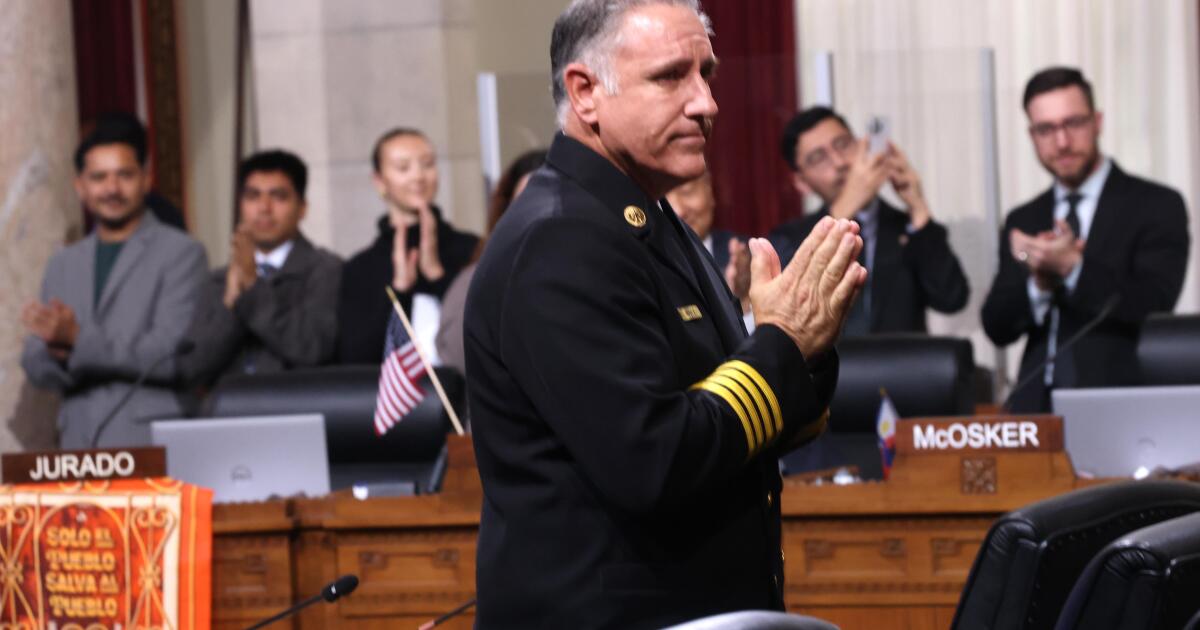
fire chief

LAFD chief will make $473,600 a year to run an embattled department

Los Angeles Fire Department Chief Jaime Moore has taken over an agency under intense scrutiny — and he’s getting paid handsomely to do it.

Moore, who was appointed by Mayor Karen Bass in October, will earn $473,600 a year, the City Council decided Tuesday — $18,000 more than his predecessor, Kristin Crowley, made when she was ousted by Bass in February 2025 for her handling of the Palisades fire.

The LAFD and the mayor continue to face intense scrutiny over their handling of the Palisades fire, which killed 12 people and destroyed thousands of homes in January of last year, as well as the watering down of the LAFD after-action report on the fire.

When Crowley started as fire chief in 2022, her annual salary was $367,100.

Soon after that, the city amended its salary ranges for department heads to keep up with inflation, said Matt Szabo, the city’s top budget analyst.

Crowley, the city’s first female and first LGBTQ fire chief, received annual merit raises, according to Szabo.

On Monday, Crowley filed a whistleblower lawsuit claiming that Bass “orchestrated a campaign of retaliation” to protect her own political future and paper over her failures during the Palisades fire.

The LAFD did not immediately comment on Moore’s salary, which was recommended by the mayor and the City Council’s Executive Employee Relations Committee before going to the full council on Tuesday.

“Investing in strong and experienced leadership fortifies public safety for residents,” said a spokesperson for council President Marqueece Harris-Dawson, who chairs the employee relations committee.

Moore’s salary is fairly comparable to that of other city and county public safety leaders.

The chief of the Los Angeles County Fire Department, Anthony Marrone, made $475,000 in base pay in 2024, according to county data.

Los Angeles Police Chief Jim McDonnell was sworn in at a $450,000 salary in 2024 — less than the $507,500 the Board of Police Commissioners had initially recommended. McDonnell’s salary as of Tuesday was still about $450,000.

McDonnell’s salary was a significant jump over the initial pay of his predecessor, Michel Moore, who earned $350,000 when he first assumed the position in 2018.

The LAFD has about 3,200 uniformed fire personnel, while the LAPD has about 8,700 sworn officers.

Both McDonnell and the new fire chief make far less than Janisse Quiñones, general manager of the Department of Water and Power, who was sworn in at $750,000 a year. Salaries for DWP executives must remain competitive with those of utility company execs to retain top talent, according to the city’s Office of Public Accountability, which recommended Quiñones’ salary.

She makes much more than Marty Adams, the previous department head, who earned about $447,000 a year when he departed.

Moore, a 30-year LAFD veteran, has spent his first months as chief dealing with persistent questions about the department’s management of the Palisades fire.

A week after the fire, a Times investigation found that top LAFD officials did not fully staff up and pre-deploy all available engines and firefighters to the Palisades and other high-risk areas, despite a forecast of dangerously high winds.

Bass cited the failure to keep firefighters on duty for a second shift as one reason she dismissed Crowley.

The new chief has swerved between candid reflection over the department’s failures during the Palisades fire and lashing out at the media over what he has called a “smear” campaign against firefighters who bravely worked to put out the catastrophic blaze.

Moore appeared to be referencing a Times report that a battalion chief ordered crews to roll up their hoses and leave the area of the Jan. 1 Lachman fire, even though firefighters had complained that the ground was still smoldering and rocks remained hot to the touch. Days later, the Lachman fire reignited into the Palisades fire.

Moore has also tried to walk a fine line on the LAFD’s after-action report, which was meant to spell out mistakes and suggest measures to avoid repeating them.

The author of the report, Battalion Chief Kenneth Cook, declined to endorse the final version because of changes that altered his findings and made the report, in his words, “highly unprofessional and inconsistent with our established standards.”

The most significant change to the report involved downplaying LAFD officials’ pre-deployment mistakes.

Moore has admitted that the report was watered down to “soften language and reduce explicit criticism of department leadership,” while saying he would not look into who directed the watering down. But Moore has also said that he will not allow similar edits to future after-action reports.

Bass has repeatedly denied that she was involved in any effort to water down the report. But two sources with knowledge of Bass’ office have said that Bass wanted key findings about the LAFD’s actions removed or softened.

Bass has called The Times’ reporting “dangerous and irresponsible.”
Source link

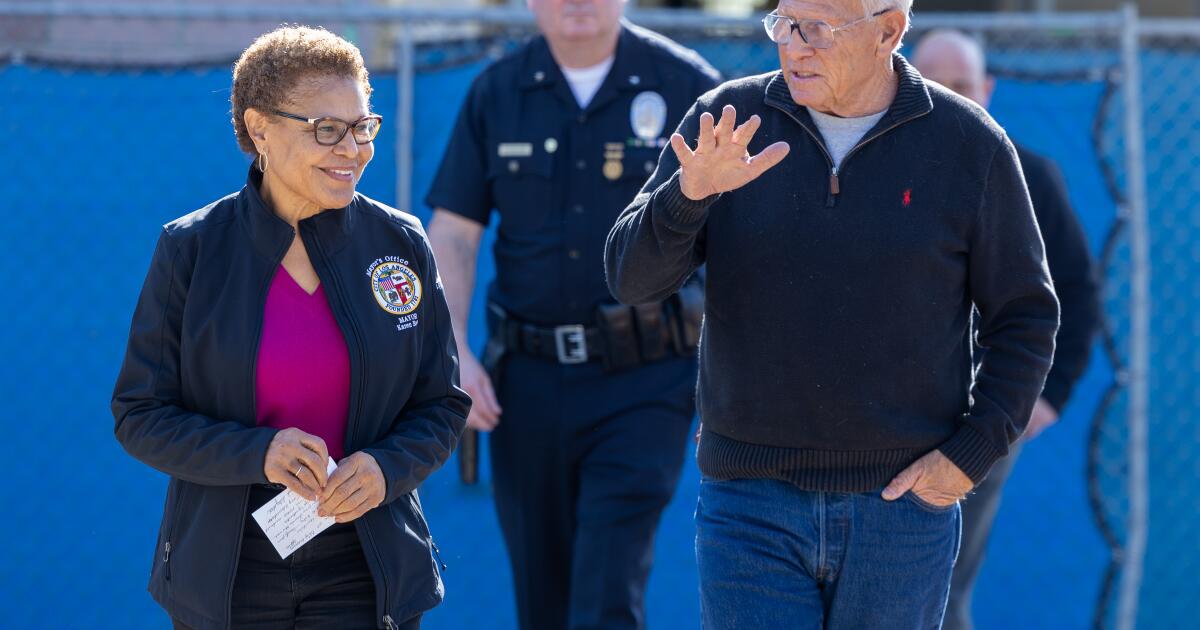
L.A. Mayor Karen Bass directed Palisades fire damage control, email shows

A day after federal prosecutors announced that the catastrophic Palisades fire was caused by the rekindling of a smaller arson fire days earlier, Los Angeles city officials were in damage control mode.

The ultimate authority on how to handle the deluge of media inquiries was Mayor Karen Bass, according to an internal email reviewed by The Times.

The carefully coordinated approach led by Bass also involved the release of the highly anticipated Palisades fire after-action report, hours after the prosecutors’ announcement and as the Los Angeles Fire Department was facing criticism for not putting out the earlier blaze.

“Any additional interviews with the Fire Chief would likely depend on the Mayor’s guidance,” LAFD spokesperson Capt. Erik Scott wrote in an Oct. 9 email to a Bass aide, then-interim Fire Chief Ronnie Villanueva and others. “Regarding a press conference, I would be cautious as it could invite a high volume of challenging questions, and this would also be contingent on the Mayor’s direction.”

The behind-the-scenes perspective into the city’s media strategy comes as Bass has denied a story published in The Times last week in which unnamed sources said she directed changes to the after-action report over concerns about legal liabilities. Revisions that downplayed failures by the city and the LAFD in handling the disaster were first revealed in a Times investigation published in December.

In one instance, LAFD officials removed language from the “failures” section saying that the decision not to fully staff up and pre-deploy all available crews and engines ahead of a forecast of dangerously high winds “did not align” with the department’s policy and procedures during red flag days.

The final report said that the LAFD “balanced fiscal responsibility with proper preparation for predicted weather.” Elsewhere, it said that the number of engine companies rolled out ahead of the fire “went above and beyond the standard LAFD pre-deployment matrix.”

That passage in the “failures” section, which was renamed “primary challenges,” was being revised by LAFD officials up until at least two days before the report was released on Oct. 8, according to emails reviewed by The Times.

“I added Chief Robert’s verbiage to replace CHALLENGES 1 on page 44. I made some other formatting edits,” an LAFD administrative aide wrote in an Oct. 6 email to several people, including an LAFD official named Eric Roberts. Roberts did not respond to an email from The Times requesting comment.

Yusef Robb, an advisor to the mayor, said Thursday that Bass is customarily involved with the decision-making of city departments. She has criticized the LAFD’s pre-deployment decisions and would have no reason to soften the after-action report’s language on that topic, Robb said.

“From Animal Services to the Zoo, the Mayor’s Office is in contact with every city department on issues large and small, and so obviously and appropriately the Mayor’s Office engaged with LAFD about the rollout of the report,” Robb said in an email. “What did not happen is the illogical and false assertion that the Mayor sought to soften critiques in a report that she herself demanded and on issues of which she has been publicly critical for more than a year.”

Scott said Thursday that he did not “have anything further to add beyond what was already shared.”

Two sources with knowledge of Bass’ office said that after reviewing an early draft, the mayor told Villanueva that the report could expose the city to legal liabilities. The sources said Bass wanted key findings about the LAFD’s actions removed or softened before the report was made public.

The sources told The Times that two people close to Bass informed them of the mayor’s role in watering down the report, which was meant to spell out mistakes and to suggest measures to avoid repeating them. One source spoke to both of the people; the other spoke to one of them. The sources requested anonymity to speak frankly about the mayor’s private conversations with Villanueva and others.

Bass last week called the Times story “completely fabricated.”

“There was no cover up on my part,” she said. “There was absolutely no reason or desire that I would want to water down this report.”

She added: “I do not have the technical expertise to make any sort of substantive changes to anything.”

Last summer, LAFD officials formed an internal crisis management team and brought in a public relations firm — paid for by the nonprofit LAFD Foundation — to help shape its messaging about the fire, which killed 12 people and destroyed thousands of homes. The emails reviewed by The Times show that the firm, the Lede Co., had a role in reviewing and suggesting edits to the after-action report.

Other internal emails reviewed by The Times show that Bass met with Villanueva about the after-action report in mid-July.

“The FC had a meeting with the Mayor this afternoon where she discussed the Palisades internal AAR,” Kairi Brown, Villanueva’s chief of staff, wrote on July 17, referring to the fire chief and the after-action report. “She asked for him to put together … answers to other questions.”

Scott’s Oct. 9 email, whose recipients also included at least one member of the LAFD’s crisis management team and the outside public relations consultants, sought guidance on how to manage the “abundance of requests” from news reporters, referencing a shared Google document where all “current inquiries and notes” were compiled.

He suggested a “three-prong approach” to contextualizing the topic of “holdover” fires. The Palisades fire was a holdover from the Jan. 1 Lachman fire, which continued to smolder and burn underground until kicked up by heavy winds on Jan. 7.

Scott said that the team should outline the LAFD’s efforts to extinguish the Lachman fire, define the “holdover phenomenon” and highlight new policies and procedures to prevent it from happening in the future.

LAFD leaders had already been under intense scrutiny for missteps before the Palisades fire, while commanders had insisted that they did everything they could to put the Lachman fire out.

Weeks after the Oct. 8 announcement about the Lachman fire by federal prosecutors, The Times reported that a battalion chief ordered firefighters to roll up their hoses and leave the burn area on Jan. 2, even though crews warned that the ground was still smoldering. The LAFD also decided not to use thermal imaging technology to detect heat underground.

The author of the after-action report, Battalion Chief Kenneth Cook, declined to endorse the final version because of changes that altered his findings and made the report, in his words, “highly unprofessional and inconsistent with our established standards.”

Even with the deletions and changes, the report delivered a harsh critique of the LAFD’s performance during the Palisades fire, pointing to a disorganized response, failures in communication and chiefs who didn’t understand their roles. The report found that top commanders lacked a fundamental knowledge of wildland firefighting tactics, including “basic suppression techniques.”

A paperwork error resulted in the use of only a third of the state-funded resources that were available for pre-positioning in high-risk areas, the report said. And when the fire broke out the morning of Jan. 7, the initial dispatch called for only seven engine companies, when the weather conditions required 27.

There was confusion among firefighters over which radio channel to use. The report said that three L.A. County engines showed up within the first hour, requesting an assignment and receiving no reply. Four other LAFD engines waited 20 minutes without an assignment.

As Scott looked to the mayor for guidance on whether Villanueva would participate in more media interviews, he wrote in the Oct. 9 email that on social media, the LAFD should consider highlighting favorable coverage of interviews with the fire chief.

A day later, the LAFD notified The Times that Villanueva and other top fire officials “are not planning any additional interviews regarding the incident.”

Robb said Thursday that Bass did not restrict Villanueva from doing interviews.

“The Mayor’s Office, as it frequently does with all city departments, made it clear that LAFD needed to make sure the information it provides was accurate and that the personnel providing information were well prepared to provide accurate information,” Robb said. “Ultimately, how they did that was up to them.”

Former Times staff writer Paul Pringle and Times staff writer David Zahniser contributed to this report.

Source link