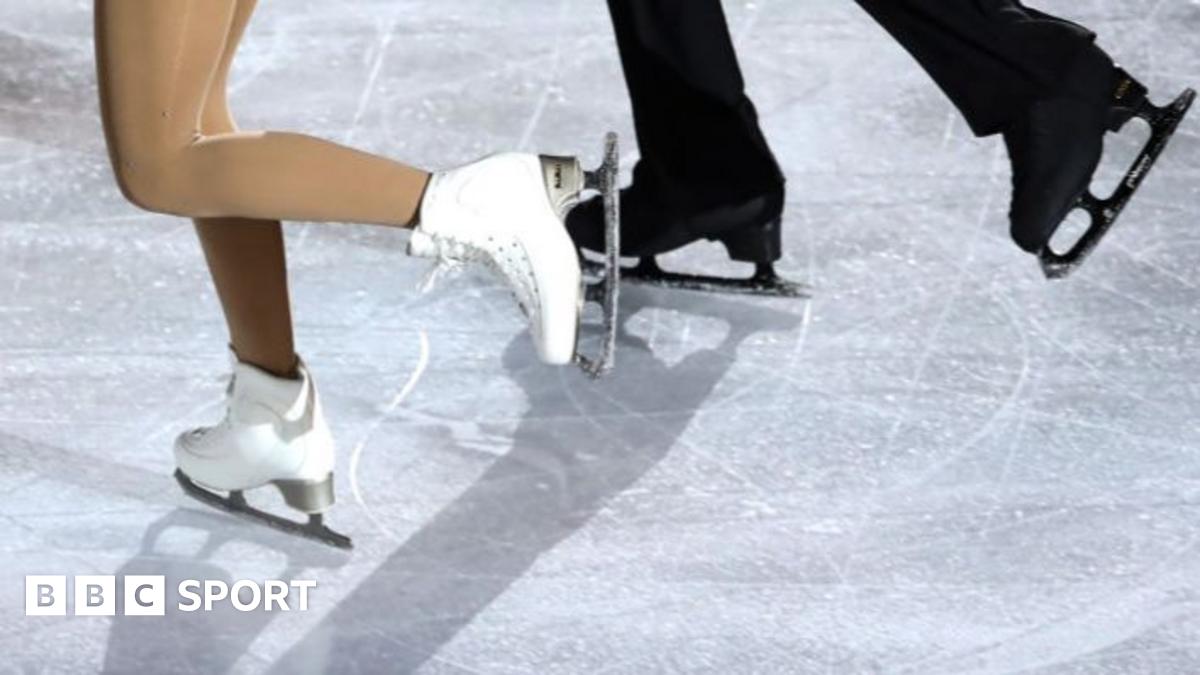
GB's Fear & Gibson miss out on figure skating medal
Lilah Fear and Lewis Gibson miss out on becoming the first British figure skaters in 32 years to win an Olympic medal, as they fail to make the ice dance podium.
Source link
Lilah Fear and Lewis Gibson miss out on becoming the first British figure skaters in 32 years to win an Olympic medal, as they fail to make the ice dance podium.
Source link
Kate Ferdinand has shared her concerns about the growing pressure on people to use the so-called “skinny jab”.
Showing off her toned physique in an exclusive new shoot with Women’s Health, the 34-year-old opened up about her worries surrounding weight-loss medication.
Donning sportswear for the shoot, the reality star, who is married to former Manchester United footballer Rio Ferdinand, admitted she fears the impact of the rising popularity of GLP-1 drugs.
Speaking about the pressure she believes some women are feeling, Kate said: “I know a lot of people who do them, and if it makes them happier, then great.
But I think it’s become this thing where the woman who doesn’t want to jab feels pressure to do so because everyone else is.
“And it can feel harder for them to do things in the natural way – to exercise and eat well – because it takes so much longer and the results aren’t as immediate.”
READ MORE ON KATE FERDINAND
In the accompanying photos, Kate is seen posing in a white tennis skirt and sports bra, with a towel draped around her neck.
She credits her own physique to a holistic approach to health and fitness.
“I want to look good and I’m happier when I look good, I have to be honest.
“But I would always choose to exercise because I work out for my mental health, too.
“I also want to be a healthy role model for my children: they see me working hard in the gym and that makes a difference…I’m quite aware of how I feel and what I need to do in order to make myself feel better.
“If I need help, I’ll have therapy. If I’m struggling, I’ll go outside and go for a walk, I’ll talk to people.”
Kate is the current Women’s Health cover star and a guest on its Just As Well podcast.
Meanwhile, Rio has teamed up with his wife to front the men’s edition of the magazine, Men’s Health.
The Ferdinands are the first British couple to appear on the covers of Women’s Health and Men’s Health UK simultaneously.
The couple recently moved to Dubai, a move that Kate has admitted she has struggled to adjust to.
Kate got emotional during a recording of her podcast Blended as she admitted it’s not been easy for her.
Starting off positively, she said: “I think it’s an amazing place to live, I think it’s amazing for the children. The children are thriving and happy and living a life of just outside freedom.
“Rio loves it so much. I am enjoying it, but I miss home quite a lot. I can’t talk about it because I get upset,” said Kate as she grappled with tears.
Kate and Rio have a blended family of five children, which consists of their two kids Cree and Shae, and Rio’s children Lorenz, 19, Tate, 17, and Tia, who he welcomed with his late wife Rebecca.
The latest issue of Men’s Health UK and Women’s Health UK go on sale on 10 February.

Media mogul Jimmy Lai (C), seen here in February 2021, was sentenced to 20 years in prison on Monday. File Photo by Jerome Favre/EPA-EFE
Feb. 8 (UPI) — A Hong Kong court on Monday sentenced Jimmy Lai, a prominent pro-democracy figure and the founder of the now-defunct progressive Apple Daily, to 20 years in prison on charges stemming from protests that brought the Chinese territory to a standstill in 2019 and 2020.
Lai, 78, has been in police custody since the summer of 2020 and was convicted in mid-December following a 156-day trial that tested three charges that alleged he and his publication produced articles that encouraged foreign countries to sanction the city.
“Having stepped back and taking a global view of the total sentence for Lai’s serious and grave criminal conduct, applying the totality principle, we are satisfied that the total sentence for Lai in the present case should be 20 years’ imprisonment,” the High Court of the Hong Kong Special Administrative Region said in its order.
The sentencing is expected to draw staunch criticism from human rights and pro-democracy advocates and condemnation from Western nations who have denounced his December conviction, trial and the National Security Law he was charged under.
“Today is a very dark day — for Jimmy Lai and his family, for his friends, supporters and advocates worldwide, and for all who cherished the rights and freedoms that were once enjoyed by Hong Kongers, but are now dismantled by the draconian National Security Law imposed on the city by Beijing,” Benedict Rogers, co-founder and chair of the Trustees of Hong Kong Watch, a Britain-registered charity, said in a statement.
“This outcome was predetermined. The trial of Mr. Lai was never fair or just, and never in line with the common-law protections central to Hong Kong’s judicial system prior to 2020.”
This is a developing story.
MILAN — Believe in the Quad God.
Ilia Malinin’s clutch free skate that scored 200.03 points gave the United States its second consecutive team figure skating gold medal Sunday at the Milan-Cortina Olympic Games.
After Amber Glenn fought through a shaky free program that finished third and lost the United States its two-point lead, Malinin stepped up as only he could. He executed five quad jumps and won by nearly six points, even if he did not perform his signature quad axel. He even put his hand down after a jump, but the mistake only seemed to fuel him as he finished with a flourish, changing the back-half of his program to earn back extra points.
His U.S. teammates, cheering from the sideline box rose to their feet and pumped their fists after each of Malinin’s jumping passes. When he landed his back flip, skating flawlessly through one foot, the packed crowd at Milano Ice Skating Arena roared.
While Japan’s Shun Sato scored a season’s best to finish the competition, he could not match the technical prowess of Malinin, who is also the favorite to win individual gold this week.
In front of a raucous home crowd, Italy held off Georgia for the bronze medal behind a dazzling free skate from Matteo Rizzo, who dropped to his knees on the ice and cried after his performance had fans chanting “Italia!” before he even finished. He cried into the Italian flag in the kiss-and-cry after his season’s best 179.62 points.
With the first figure skating medal of the Milan-Cortina Games on the line, every skater fought for every fraction of a point. U.S. pairs skater Ellie Kam went deep into a one-legged squat to hold on to the first throw jump. The United States led by five points entering the final day, but still had no room for error as Japan finished first in qualifying in all of Sunday’s disciplines. With the dominance of Japan’s Riku Miura and Ryuichi Kihara in pairs, Kam’s partner Danny O’Shea knew the strategy for the U.S. pair was to simply try to stay as close as possible.
Ellie Kam and Danny O’Shea perform in pairs figure skating during the team competition at the Milan-Cortina Games on Sunday.
(Stephanie Scarbrough / Associated Press)
Kam fought for the landing on a throw loop so hard that she could feel her leg cramping.
“I was like, ‘I’m not going down,’” Kam said, “I got this. We got this.”
They looked at each other before their next element and said “calm.” Their message cut through the energized crowd that cheered louder and louder with each jump. At the end, Kam’s and O’Shea’s celebratory screams simply joined the crowd’s roar. As they saluted the crowd, O’Shea pointed toward Kam to acknowledge her effort.
The pair’s fourth-place finish in the free program was a one-point improvement from their qualifying spot, earning a slim, but vital cushion entering the men’s and women’s free skates.
Instead of sending world champion Alysa Liu back for the free skate after she performed the short program, the U.S. selected the three-time national champion Glenn. The 26-year-old was making her Olympic debut.
On the Olympic stage for the first time, Glenn has tried to embrace the opportunity while treating the competition as if it were any other one. But the larger stage has created additional stress for Glenn after she was asked in a news conference about President Trump’s approach to the LGBTQ+ community in recent years and how it’s affected her personally.
U.S. figure skater Amber Glenn competes during the team competition on Sunday at the Milan-Cortina Games.
(Ashley Landis / Associated Press)
Glenn, who identifies as bisexual and pansexual, encouraged people in the queer community to “stay strong in these hard times” and recognized that it wasn’t the first time the community had to unite to “fight for our human rights.” Glenn then received threats on social media after the news conference and posted on Instagram that she would be taking a break from social platforms to focus on the competition.
But it wasn’t the social media hate that rattled Glenn, she insisted. She was simply tired, sore and disoriented from the unfamiliar Olympic team competition format.
All of Glenn’s other competitors did the short program portion of the competition on Friday. She came in with several good days of training at the venue, but did not get the same kind of opportunity to get used to the stage. Glenn fought through a shaky triple axel to open her program and stepped out of a triple flip that prevented her from completing a planned combination for her second jumping pass.
Waiting in the kiss-and-cry, Glenn bowed her head and stared at the ground. She struggled to muster even a fake smile.
“I’m grateful that the team is so supportive.” said Glenn, who finished behind Japan’s Kaori Sakamoto and Italy’s Lara Naki Gutmann. “But I do feel guilty that I could be the reason that we don’t win the gold, and I don’t know how I will ever apologize for that.”
Glenn clasped her hands in her lap waiting for Sato’s score after the Japanese skater performed a clean program that had his teammates in tears. But his technical score was about five points less than Malinin’s. Glenn was the first skater to hug Malinin in the United States’ team celebration, lifting him off the ground as he extended arms out wide.
MILAN — Alysa Liu glided past her boards and held her hand out. She high-fived her coaches with a wide smile on her face.
She was ready.
Liu calmly skated through minor technical missteps on two jumps in her short program of the team competition at Milano Ice Skating Arena to finish second and earn nine points for the United States that leads the team competition after the first day.
Led by 10 points from rhythm dance leaders Madison Chock and Evan Bates, the United States has 25 points entering Saturday’s men’s short program to lead over second-place Japan (23 points) and third-place Italy (22). Japan’s Kaori Sakamoto finished first with a score of 78.88 ahead of Liu’s 74.90.
After the men’s short program, the top five teams advance to the long program portion. The United States selected two-time world champion Ilia Malinin to skate in the men’s short program.
Liu, competing in her second Olympics, was selected for the team competition for the first time. The reigning world champion worked through slight errors, including on her tricky triple lutz, triple loop combination. Her coach Phillip Diguglielmo grabbed the arm of choreographer Massimo Scali nervously as Liu floated through the air on the crooked loop. When she finished her program to a loud ovation, Diguglielmo wiped his brow in relief.
Liu was the second world champion competing for the United States on Friday. Chock and Bates edged out French pair Laurence Fournier Beaudry and Guillaume Cizeron by less than two points in an early showdown of individual gold medal contenders.
In March 2025, Fournier Beaudry and Cizeron rocked the ice dance world by announcing their partnership. He was the reigning Olympic champion. She was a former Canadian champion. But it wasn’t just that the pair became instant gold medal contenders 11 months before the Olympic Games. The reason for the sudden pairing caused a stir.
Madison Chock and Evan Bates of the U.S. finished first in the ice dance portion of the team competition Friday.
(Stephanie Scarbrough / Associated Press)
In October 2024, Fournier Beaudry’s partner Nikolaj Sorensen was suspended by Skate Canada for at least six years for alleged sexual assault. The pair competed for both Denmark and Canada over their decade-long partnership, winning three Danish championships and a Canadian national title and placing ninth in the 2022 Olympics.
Cizeron hadn’t skated since 2022. He and his ice dance partner of 20 years Gabriella Papadakis announced their retirement in December 2024, but wanted to return to competition. He had trained in Canada for more than a decade and maintained a friendship with Fournier Beaudry. The opportunity was open, but it would be complicated.
After pairing with Fournier Beaudry to launch Cizeron’s comeback, the new team expressed support for Sorensen in an interview with Canadian French-language newspaper La Presse. Fournier Beaudry continues her romantic relationship with Sorensen.
When asked of the allegations Friday, Fournier Beaudry said she did not have anything to add to her previous comments. The pair proceeded through the mixed zone.
Since teaming up, Fournier Beaudry and Cizeron have won five of six competitions, a nearly inconceivable rise for such a new pair. The only blemish is a silver medal finish at the Grand Prix Final.
Chock and Bates’ 15-year partnership has yielded three world championships, a record seven U.S. titles and four trips to the Olympics. On one of the most talented teams the United States has ever sent to an Olympic Games, Chock and Bates still stand out for their experience. Of the 14 other U.S. figure skaters, only Liu has participated in the Games before.
“I think we have the best generation of figure skaters within the U.S. right now,” said pairs skater Danny O’Shea, who finished fifth with his partner Ellie Kam to earn six position points toward the team total. “Amazing people helping each other, supporting each other, and Madi and Evan leading the charge being the just experienced elders.”
O’Shea, making his Olympic debut at 34, laughed as he clarified Chock, 33, is younger than him.
“Huge thank you to everyone who reposted, shared and supported,” Sabate said.
“Because of you, Universal Studios reconsidered and officially granted the rights for this one special occasion.
“There are still a couple of things to be tied up with the other two music of the program, but we are so close to accomplishing it! And it’s all thanks to you.
“I’m so happy to see that the Minions hitting Olympic ice is becoming real again!”
The routine in Sabate’s short program – the first of two routines in singles figure skating – has proved a hit in competitions, including in Sheffield at this year’s European Figure Skating Championships, where he finished 18th but became a fan favourite.
Sabate, a six-time Spanish champion set to make his Olympic debut in Milan, said he followed all required procedures and submitted the music through the International Skating Union’s (ISU) ClicknClear system in August.
If he is unable to perform to the Minions mix, he may use music by the Bee Gees for his short program, as this was the routine he performed to in 2024-25.
The men’s event starts in Milan on Tuesday.
“As soon as we have more details on this specific case, we will share them as appropriate,” read an ISU statement.
“Copyright clearances can represent a challenge for all artistic sports.”
Who’s ready for a Minions happy dance?
Spanish figure skater Tomàs-Llorenç Guarino Sabaté said Tuesday that he may be able to skate his Minions-themed program at the Olympics after all. He shared on Instagram that Universal is allowing him to use the music from its popular animated franchise for the “special occasion” and said he is working to clear the remaining hurdles.
“There are still a couple things to be tied up with the other 2 musics of the program but we are so close to accomplishing it!” Guarino Sabaté wrote in his update thanking his supporters. “I’m so happy to see that the minions hitting Olympic ice is becoming real again!! I’ll keep you posted!”
A six-time Spanish national champion, Guarino Sabaté said on Monday that he had been informed Friday — exactly a week before the opening ceremony of the Milan-Cortina Games — that the medley of “Minions” music he had skated to, while dressed in blue overalls and a yellow shirt, through the entirety of the season could not be used at the Olympics due to copyright issues. This meant that Guarino Sabaté, who had been set to make his Olympics debut with his Minions-themed short program on Feb. 10, would need to change his plans last minute. How bananas.
The cheery yellow creatures are a signature of Universal and Illumination’s “Despicable Me” film franchise. NBCUniversal owns the U.S. media rights to the Olympics.
“Finding out about this … so close to the most important competition of my life, was incredibly disappointing,” Guarino Sabaté wrote in his post sharing the initial news. “This season I competed with my Minions short program to bring joy and playful style to the ice while still meeting every required element to show that skating as a male Olympic figure skater can be fun. … Nevertheless, I will face this challenge head on and do my best to make the best of it.”
The Olympian said then that he had followed the proper procedures and submitted his music through the International Skating Union’s recommended rights clearance system in August. The situation has brought to attention to the complexities of music licensing and how it affects artistic sports like figure skating. Contemporary music is not in the public domain and skaters are responsible for clearing their own music.
For now, fans will just have to remain hopeful that Guarino Sabaté’s dream of bringing joyous Minion mayhem to the Olympic ice will come true in the end.
Interiority is a concept that multimedia artist Sarah Sze has been fixating on lately.
“So much of what we experience is actually interior,” Sze said in a recent video interview. “We’ve become so exterior focused. We’re so outward looking.”
At a time when it’s all too easy to consume a never-ending stream of social media images, the celebrated New York-based artist is more interested in scrolling through the images stored inside her own mind.
Her new show, “Feel Free,” champions the mind’s eye, in all its random, fragmented glory. It brings a collection of new paintings and two immersive video installations to Gagosian Beverly Hills.
Sze is known for her unconventional sculptures and large-scale paintings, which she’s shown in such venues as the Museum of Modern Art, LACMA and the U.S. Pavilion at multiple Venice Biennales. In 2023, she left her mark on both the inside halls and the exterior walls of the Guggenheim Museum, and her public sculptures have transformed a grassy hillside as well as a pine grove and an international airport.
Sarah Sze’s Gagosian Beverly Hills show “Feel Free” is meant to feel intimate.
(Ariana Drehsler/For The Times)
At the Gagosian show, Sze leaned into the intimate and fragile, while continuing her signature experimental streak.
In one of her newest pieces, “Once in a Lifetime” — part sculpture, part video display — precarious clusters of bric-a-brac form a mechanical marvel that appears to defy gravity.
A stack of small projectors is cradled inside of a fantastical tower fashioned out of crisscrossed tripods, metal poles and ladders festooned with an assemblage of toothpick structures, empty cardboard containers that once held crayons and Lactaid, dangling prisms, arts & crafts scraps, and paper cut-outs of deer and wolves (figures that appear throughout the show).
The bare gallery walls surrounding the monument flash with rotating projections of construction sites where buildings are being erected and demolished, clouds drifting across tranquil blue skies, and city lights twinkling then slowly dissolving into floating fractals. The Dadaist piece is every bit as off-kilter and fascinating as the Talking Heads song that inspired its title.
“Once in a Lifetime” is part video display and part sculpture, made of tripods, toothpicks, lights, cardboard boxes and projectors that flicker images on the gallery walls. (Ariana Drehsler/For The Times)
“The most important thing about my show is that I hope it’s really challenging and exciting and gives young artists license to do what they want to do,” Sze said.
“When they come in and say, ‘Wait … I didn’t know you could put up toothpicks going to the ceiling and throw a video through it and make it into a movie. I didn’t know you could put a pile of things on the floor in front of a painting.’ It’s like, ‘OK! Yes, you can!’”
Meanwhile, large canvases in the main gallery space are covered with oil and acrylic paints and printed backdrops dotted with an assortment of images: sleeping female figures; hands pointing, drawing and flashing peace signs; the sun at different stages of setting; birds in flight; wolves and deer in their natural habitats. Layered on top are paint splotches and streaks, as well as taped-on paper and vellum, blurring and obscuring the collage of figures underneath.
“Escape Artist,” left, “White Night” and “Feel Free,” are new paintings by Sarah Sze at Gagosian Beverly Hills.
(Ariana Drehsler/For The Times)
“One of the things I was thinking about was when we dream and then we wake up, there’s this extreme, fleeting moment where you’re trying to grasp the dream,” Sze said. “The dream is disappearing at the same time, and you’re trying to re-create those images.”
She went on to describe “a landscape turning into a different landscape, and then you’re falling, and then you’re turning, and then someone appears that you didn’t expect to be there.”
In addition to this spree of the subconscious, the artist offers glimpses of her creative process. Pooled on the ground below the canvases (and even dangling from the rafters above) is an assortment of the tools of her trade — from tape measures to paint scrapers. Brushes, pens and pencils lie next to the ripped cuffs of cotton workshirts, and drops of blue and white paint are splattered on the floor, extending the artwork beyond the wall.
Sze spent five days installing the show inside the gallery and the commonplace supplies incorporated into the pieces are what she dubbed “remnants of the workspace.”
“Sleepers,” a video installation Sze debuted in 2024, plays with the light entering through a gallery window. Images of sleeping heads and forest animals play amid the sound of cello notes and deep breathing.
(Ariana Drehsler/For The Times)
If the paintings act as snapshots of dreamscapes, “Sleepers,” the video installation she debuted in 2024, sets those images in motion. Dozens of hand-torn paper fragments connected by rows of string become miniature projection screens, each flashing with images of the same sleeping heads, busy hands and forest animals. These are interspersed with flashes of TV static and ocean waves, all set to the sounds of humming, disjointed cello notes and deep breathing.
“Feel Free” by Sarah Sze
When: Tuesday-Saturday, 10 a.m. to 5:30 p.m., through Feb. 28
Where: Gagosian Beverly Hills, 456 N. Camden Drive in Beverly Hills
Directly in the center, a slender vertical window — part of the gallery’s architecture — illuminates the otherwise darkened room with a pillar of natural light, further contributing to the ethereal nature of the piece.
Viewed at the right angle, the piece resembles a giant eye. It’s the perfect visual cue to get visitors thinking about what we see and how we see it.
The seventh in an occasional series of profiles on Southern California athletes who have flourished in their post-playing careers.
Tai Babilonia’s life changed forever when she was asked to hold a boy’s hand.
At first she resisted.
“I didn’t want to,” she remembered. “He’s a yucky boy.”
But Mabel Fairbanks, Babilonia’s skating coach, wouldn’t take no for an answer, bribing the 8-year-old with stickers and a Barbie doll if she would just reach out and grab the hand of 10-year-old Randy Gardner.
It would be another 40 years before she let go.
By then Tai Babilonia and Randy Gardner had become one of the most decorated pairs in U.S. figure skating history, their individual names eventually melding into one.
“My last name is ‘and Randy,’” Babilonia said. “And I embrace it.”
U.S. pairs figure skating duo of Tai Babilonia and Randy Gardner in 1979.
(Tony Duffy / Getty Images)
As a pair “Tai and Randy” won five U.S. championships, medaled in three world championships and qualified for the Olympics twice, all before Babilonia’s 21st birthday. Their success also pushed open doors that had long been closed since Babilonia, Black on her mother’s side and part Filipino and Native American on her dad’s side, was the first U.S. skater from any of those ethnic groups to compete in the Olympics or win a world title.
Among those to follow her were Debi Thomas, a two-time U.S. champion and a bronze medalist at the 1988 Winter Olympics, and Elizabeth Punsalan, a two-time Olympian and five-time national champion in ice dancing.
At about the same time Babilonia and Gardner were moving from competitive skating and the Olympics to the Ice Capades, another young girl was just starting to pursue her own Olympic dreams. Tiffany Chin would go on to win a national championship, two Skate America titles and just miss a medal in the 1984 Winter Games, retiring before she was old enough to legally drink.
In that brief but brilliant career, Chin changed U.S. figure skating forever. She was the country’s first Asian American national champion and first Chinese American Winter Olympian, paving the way for Olympic medalists Kristi Yamaguchi, Nathan Chen, Michelle Kwan and siblings Alex and Maia Shibutani.
After retiring from skating, Babilonia, now 66, dabbled in coaching and sportswear design, became a motivational speaker, an activist and, most importantly, a grandmother. But the legacy Babilonia and Chin created will be on display in Italy this month when the U.S. fields one of the most eclectic Olympic figure skating teams ever, with 12 of the 16 athletes having immigrant parents.
Five of the six singles skaters — Alysa Liu, Isabeau Levito, Ilia Malinin, Maxim Naumov and Andrew Torgashev — are first-generation Americans while the other, women’s national champion Amber Glenn, identifies as pansexual. Pairs skaters Emily Chan, Spencer Howe and Ellie Kam and ice dancers Anthony Ponomarenko, Christina Carreira, Vadym Kolesnik and Emilea Zingas are also immigrants or first-generation Americans while Madison Chock, the reigning Olympic champion in ice dancing, has Hawaiian, Chinese, German, English, Irish, French and Dutch ancestry.
At a time when diversity, equity and inclusion programs are being dismantled, immigrants are being attacked and diversity is labeled a weakness, America’s Olympic figure skaters have come to mirror the country at large.
“It’s wonderful and so important,” said Babilonia. “Especially now.”
Nearly 60 years after Babilonia and Gardner skated together for the first time, the decision to pair them seems inspired, even providential.
It was neither. Fairbanks, Babilonia learned later, simply needed a couple to skate in a club show at the Culver City Ice Arena.
“We just happened to be similar in height. And I guess we were cute,” Babilonia said last month during a lengthy interview at the Colonial Revival-style mansion in the West Adams District that houses the LA84 Foundation.
Gardner was already an excellent skater, as strong and athletic as he was outgoing and friendly; Babilonia was shy and far less steady on the ice. But that wasn’t the only thing that made their pairing unusual.
Gardner was white and Babilonia was Black. And in 1968, asking them to hold hands in public was scandalous, even in Culver City. However, Fairbanks, a legendary coach who had spent much of her life pushing back against convention, didn’t see color. She focused only on talent.
Randy Gardner and Tai Babilonia roller skating together in May 1979.
(Tony Duffy / Getty Images)
“Mabel was the coach who taught all races, Hispanic, Black, mixed, Jewish,” Babilonia said. “Mabel broke down that wall.”
Fairbanks, who was Black and Seminole, was born in the Deep South at a time when ice rinks were segregated. Even after moving to New York, where she bought a pair of skates for $1 at a pawn shop, then taught herself how to use them, she skated mostly in nightclub shows, where she was limited to jumps and moves that wouldn’t show up the white skaters.
She soon moved to Los Angeles, touring internationally with the Ice Capades and Ice Follies, before becoming a coach and mentoring hundreds of young skaters, including Olympic medalists Scott Hamilton, Yamaguchi and Thomas.
“If it weren’t for Mabel Fairbanks, you wouldn’t have any color in the predominantly white skating world,” said Babilonia, who is shopping a biopic of Fairbanks, who died in 2001.
“People don’t really know her. She’s like a hidden figure.”
Yet three years after Fairbanks made Tai and Randy a pair, they left her for John Nicks, who was coaching at the Paramount Iceland.
“He took our skating to a whole different level. And it happened really quick,” said Babilonia, who still calls her former coach Mr. Nicks. “That’s when we started winning and improving and just really became a great pair of skaters.”
Two years later Babilonia and Gardner won the U.S. junior nationals and three years after that they won the first of five national championships, qualifying for the 1976 Winter Olympics in Austria, where they finished fifth. Gardner wasn’t old enough to vote and Babilonia didn’t have a driver’s license. But together they were holding their own against the best pairs skaters in the world.
“Such an incredible year,” Babilonia said. “We won our first U.S. title, became Olympians, I got my learner’s permit and had a crush on Peter Frampton.”
But they were just getting started. Gardner and Babilonia wouldn’t lose in the U.S. championships for the rest of the decade. And 11 months before the next Olympics, they won their first world championship, then celebrated by skating for the queen of England at Wembley Stadium.
Tai Babilonia and Randy Gardner compete at the World Figure Skating Championships in Tokyo in March 1977.
(Tony Duffy / Getty Images)
With the Winter Games coming back to the U.S. at Lake Placid, the Americans were favored to keep the Soviet Union off the top step of the medal platform for the first time since 1960, the last time the Olympics were held in the U.S.
Only they never made it to the ice.
Nicks had moved his skaters from Paramount to the Ice Capades Chalet, a buff-colored concrete-block building in Santa Monica, five blocks from the Pacific Ocean. During a training session there, Gardner inflamed a groin injury that had plagued him for months.
It got worse when they got to Lake Placid and Gardner had a Xylocaine injection, but the anesthetic was too strong and it only made things worse; the pain was gone, but now Gardner couldn’t feel his leg at all. They pulled out of the competition moments before it was supposed to begin.
The next morning, with the skaters, their parents and their coach perched on the stage at a high school auditorium for a hastily arranged news conference, hundreds of reporters tried to get a shattered Babilonia to turn on her partner. She didn’t take the bait.
“She totally had my back,” Gardner said. “There was so much camaraderie and trust and love between the two of us. She understood that it was a major injury and it was devastating. It changed the path of our career.”
“I’m not going to say it ruined it,” he added. “It just changed the path.”
Two months after leaving Lake Placid in sorrow, Gardner and Babilonia, who had gone from “Tai and Randy” to the “Heartbreak Kids,” turned pro, signing a three-year contract with the Ice Capades that included endorsement deals.
They never skated in the Olympics again. And while the money was good, the pace was punishing, with eight shows a week on a 30-week tour.
“You’re performing every night, weekends two shows a day,” Babilonia said. “If you don’t pace yourself, which I didn’t, it will rock your world in a negative way.
“You can’t do all the tricks you did as a teenager every night.”
Tai Babilonia and Randy Gardner skating in 1979, the same year they won the pairs world championship.
(Tony Duffy / Getty Images)
Babilonia had never truly dealt with the emotional pain of the Olympic withdrawal. Now she was also dealing with the strain and fatigue of the ice show schedule as well as an identity crisis.
“Randy figured out how to put Tai and Randy in a box and leave them there and go on with his life,” Babilonia said. “I didn’t know how to separate them from me.”
So she sought answers in amphetamines, heavy drinking and a number of brief but high-profile romances before hitting rock bottom just before her 29th birthday, when she tried to kill herself with an overdose of sleeping pills. Her recovery started seven months later with an emotional first-person account of her fall in People magazine.
“I did it because I knew I had to,” Babilonia, still fit and youthful, said of a confession in which she blamed no one but herself. “I had to stop what I was doing and this was part of my recovery process. I couldn’t say yes quick enough.
“Something inside of me said, ‘This is your moment. Get it out. It may help some people,’” she continued. “And it did.”
The magazine cover story was followed 19 months later by the prime-time NBC movie “On Thin Ice,” which went over much of the same territory, with Babilonia and Gardner playing themselves in many of the skating scenes.
“It took me a while to watch the whole thing. Some scenes were hard,” said Babilonia, who speaks in a confident, careful cadence. “It was just part of my recovery process.”
She’s been sober 17 years and her relationship with Gardner, who came out as gay in 2006 — also in People magazine — has lasted longer than her marriage. Along the way, Babilonia matured from the shy withdrawn child who refused to hold a boy’s hand into a bold, strong and confident woman.
“She’s totally mature. She is worldly. And she’s an advocate for equality in sports, people of color and all that,” said Gardner, 68, whose home in Manhattan Beach is about 10 miles from the Culver City ice rink where he and Babilonia learned to skate once stood.
The former teammates still meet at least once a month and talk on the phone frequently, although they haven’t been on the ice together since Gardner underwent surgery on his back a year ago.
Flames from a olympic torch passes in front of Tai Babilonia at LA84 Foundation in January.
(Ronaldo Bolanos / Los Angeles Times)
When she stopped skating Babilonia tried coaching, but that didn’t work because she didn’t know how to teach the moves she had so easily mastered. Instead, she launched a clothing line, became a motivational speaker, volunteered with various groups promoting diversity on and off the ice, co-hosted a TV interview show taped in Santa Barbara and, for the last nine years, has co-hosted a holiday skate party for kids from the Union Rescue Mission. She also continues to skate in charity events.
All that in addition to her work with Atoy Wilson, a former U.S. novice champion, on the Mabel Fairbanks biopic, tentatively titled “Black Ice: The Mabel Fairbanks Story.”
“I want to try everything,” she said. “I want to experience everything.”
But her real job, she quickly adds, is being a grandmother to Ryett, her son’s 2-year-old boy in Arizona.
“I love being a grandmother,” she said. “Absolutely love it.”
She is also a prolific presence on social media, where most of her posts are either trenchant comments on the politics of today or black-and-white photos from back in the day, when she and Gardner — Tai and Randy — were winning medals and opening doors, helping to change U.S. figure skating forever.
“I appreciate what we did more as I get older,” Babilonia said. “We were pretty good and we made our mark. We worked hard. We became two-time Olympians. We met the queen of England.
“It’s just wild.”