Relations strain further as Afghanistan and Pakistan trade accusations over terrorism and cross-border violence.
Published On 27 Sep 202627 Sep 2026
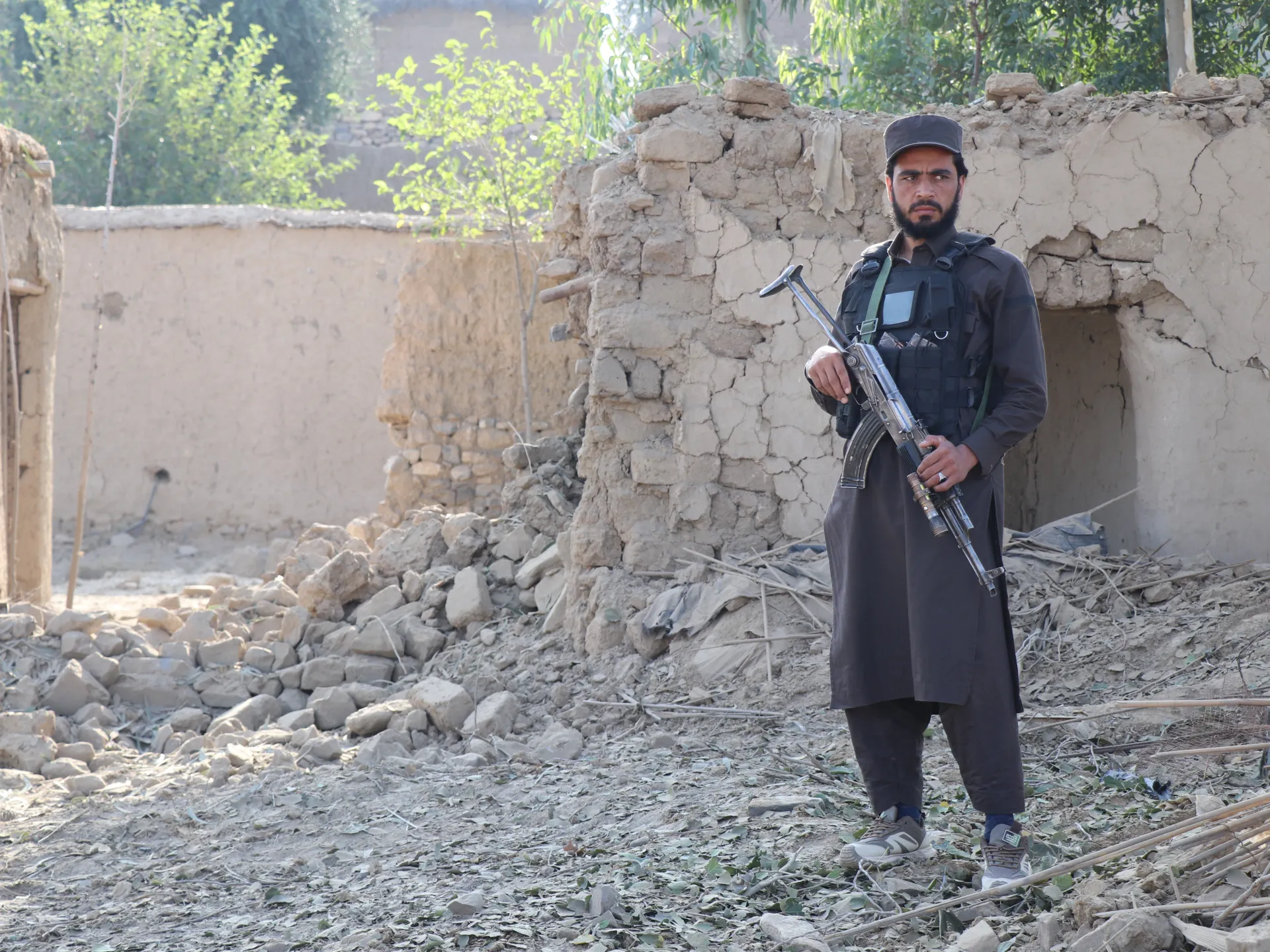
Afghanistan’s Ministry of Defence said its forces killed 28 fighters in the eastern province of Nuristan who had crossed the border from Pakistan.
In a statement posted to X, the Taliban’s defence ministry confirmed it had engaged in clashes with the opposing group on Sunday.
Recommended Stories
list of 3 itemsend of list
The defence ministry alleged that most of the fighters were former Afghan government security personnel recruited by Pakistan’s intelligence services with promises of asylum and well-paid employment in foreign countries.
The defence ministry claimed the fighters included ISIL (ISIS) fighters who were supported by Pakistani militias.
Pakistan’s Ministry of Information and Broadcasting rejected the allegations, describing them in a post on X as “frivolous, baseless and devoid of any truth”.
Pakistan denied that its security forces or intelligence agencies were involved in clashes in Nuristan, had recruited or trained former Afghan security personnel, or had facilitated ISIL (ISIS) or other armed groups in Afghanistan.
Pakistan’s information ministry also said the Taliban “should take credible and verifiable action against terrorist organisations operating from its territory” and fulfil its obligation so that “Afghan soil will not be used for terrorism against Pakistan or any other country rather than attempting to deflect responsibility through fabricated accusations”.
Escalating tensions
The clashes follow increasing tension between the two countries.
Last week, Pakistan launched air strikes on 10 locations in Afghanistan it said were used to store and launch drones, some of which were used in cross-border attacks.
The Pakistani air strikes on Thursday killed at least four people, a spokesman for the Afghan Taliban government said while promising to deliver an “appropriate response”.
Pakistan has repeatedly accused Afghanistan of sheltering fighters who attack its territory, a charge Kabul denies.
Sunday’s incident also follows Pakistani air strikes in Afghanistan on September 21 that Islamabad said killed 28 fighters. Afghan officials said civilians were killed and the U.N. mission in Afghanistan confirmed three civilian deaths.
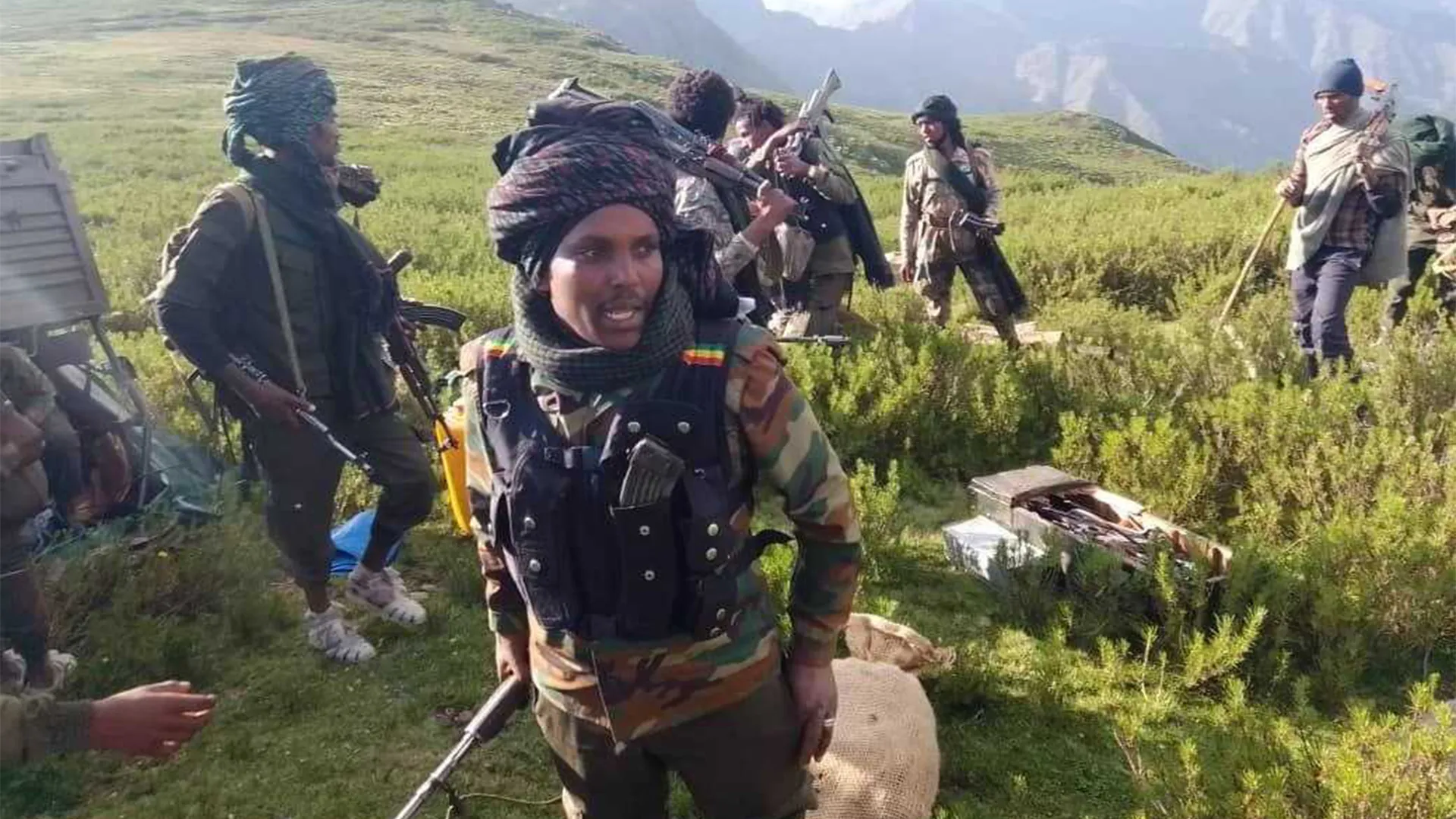
Armed fighters from Ethiopia’s Fano movement claim to have seized more than 10 military trucks carrying ammunition, machine guns and mortar shells in the Amhara region. Fighting in the country has intensified following the formation of a new alliance of seven armed groups seeking to overthrow Prime Minister Abiy Ahmed’s government.
Pakistani security forces report ongoing cross-border fire in latest escalation in fighting between the neighbours.
Published On 25 Sep 202625 Sep 2026
Pakistan has foiled an “attempted Afghan aggression” on the Pakistan-Afghan border.
Pakistani security sources said several Afghan members of the Taliban were killed in an intermittent exchange of fire in the Gulistan area of the border on Friday and that fighting was ongoing.
Recommended Stories
list of 3 itemsend of list
There has been no official confirmation from either country involved.
The Afghan government said on Thursday that it would deliver an “appropriate response” to Pakistani air attacks on 10 locations in Afghanistan earlier in the day.
The strikes were in response to a “deliberate and unlawful incursion into Pakistan by drones” on Wednesday, Pakistani Information Minister Attaullah Tarar said on Thursday.
Tarar said in a post on his X account that Pakistan’s aerial and drone attacks hit “terrorist hideouts and support infrastructure including drone launching and storage sites”.
He also posted a video said to show the military strikes on the Afghan sites.
Afghanistan’s government spokesperson Zabihullah Mujahid said the air strikes targeted Kandahar, Paktia and Khost provinces.
Taliban officials denied that their government launched drones against Pakistan on Wednesday.
The air raids on Thursday were carried out amid growing tensions between the former allies over attacks by armed groups in Pakistan, which triggered their worst fighting in years in February.
Islamabad accuses Kabul of harbouring fighters who stage cross-border attacks, but Afghanistan’s government denies harbouring anti-Pakistani armed groups and says the attacks are Pakistan’s internal problem.
The escalation threatens mediation efforts by China, Turkiye, Qatar and Saudi Arabia to broker a lasting peace between the two neighbours.
Tigray People’s Liberation Front says in a ‘situation of full-blown war’ with Ethiopia’s government.
Published On 24 Sep 202624 Sep 2026
Ethiopia’s army says it has killed at least 272 fighters from the Tigray People’s Liberation Front (TPLF) in a counter-offensive in the country’s northwest Amhara region.
The Ethiopian National Defence Force said on Thursday that another 260 Tigrayan fighters were wounded and several were captured.
Recommended Stories
list of 3 itemsend of list
“Government forces launched a counter-offensive that inflicted heavy personnel and equipment losses on the TPLF” after the group and its allies attacked several areas of North Wollo, a region of Amhara that borders Tigray, the army said in a statement on Facebook.
The intensification came days after TPLF and six other armed groups from across Ethiopia announced the formation of the Ethiopian Peoples’ Forces Alliance for Survival, which committed itself to removing Prime Minister Abiy Ahmed’s government.
The coalition brought together the newly-formed Amhara Fano National Movement, the Oromo Liberation Army and other movements from the Somali, Afar and Benishangul-Gumuz regional states.
Ethiopian Prime Minister Abiy Ahmed [File: Sergei Bulkin/Sputnik via AP Photo]
‘Full-blown war’
“We are in the situation of full-blown war now,” TPLF Vice President Amanuel Assefa told AFP news agency on Thursday.
He confirmed that Tigrayan forces were fighting alongside local armed groups in Afar and Amhara.
The alliance marks a striking realignment that had been almost a year in the making, bringing together armed groups with very different histories and grievances against the central government, including forces with histories of conflict among themselves.
In a statement issued as the fighting widened on Wednesday, the alliance said the federal government was attacking its forces on several fronts and presented their response as part of the broader struggle that had brought the coalition together.
Meanwhile, the escalation has disrupted air travel, as Tigrayan forces seized three local airports in the region.
Flights to Lalibela, a UNESCO-listed site in Amhara known for its medieval rock-hewn churches, were suspended on Thursday, according to Reuters news agency.
AFP also received reports of fighting around Lalibela, causing its airport to close. The area has often been targeted by the Fano, a local armed group that is now operating alongside the TPLF.
Ethiopia’s President Taye Atske Selassie Amde speaks during the United Nations General Assembly, September 23, 2026 [Seth Wenig/AP Photo]
Wider regional rivalries
TPLF last went to war with the Ethiopian federal government in 2020, leading to a devastating two-year conflict that ended with a peace deal in 2022.
In his address at the UN General Assembly on Wednesday, Ethiopia’s President Taye Atske-Selassie Amde blamed the escalation on “the forces of destruction and mayhem” and “interference in our internal affairs by adversarial elements”.
He said Ethiopia had exercised “immense restraint” and made progress with its neighbours.
Analysts say the Tigray rebels have support from Eritrea, which fears landlocked Ethiopia is planning to invade its territory to gain access to the Red Sea.
The TPLF’s Assefa told AFP “we have no information about Eritrea’s plan”. Asked if they would request Eritrean intervention, he said: “Not yet.”
Ethiopia’s domestic conflicts are becoming harder to separate from wider rivalries in the Horn of Africa, particularly Addis Ababa’s deteriorating relationship with Eritrea and Sudan’s civil war.
Sudan’s army chief Abdel Fattah al-Burhan has visited Asmara twice since July for talks with Eritrean President Isaias Afwerki, while Sudan’s paramilitary Rapid Support Forces (RSF) commander Mohamed Hamdan Dagalo, known as Hemedti, reportedly visited Addis Ababa in late August.
The newly released picture from General Atomics’ Aeronautical Systems, Inc. division (GA-ASI), seen at the top of this story, shows an FQ-42 in flight together with an F-35A Joint Strike Fighter and an F-15E Strike Eagle. The company has also disclosed the delivery of another Vengeance drone to the Air Force, this time to the service’s main drone operations hub at Creech Air Force Base in Nevada.
“The FQ-42 that arrived at Creech will continue regular test and evaluation operations with the Air Force aimed at experimentation with the new aircraft,” according to a press release GA-ASI put out today. “Previous efforts with Vengeance and other GA-ASI jets, including [the] XQ-67A Off-Board Sensing Station and MQ-20 Avenger – have found the trio of combat jets flying in various scenarios that push the boundaries of combat aviation. GA-ASI’s jets have flown semi-autonomously and autonomously with various AI pilots and under collaborative control of human fighter pilots operating F-22 Raptor and F-35 Lightning II jets.”
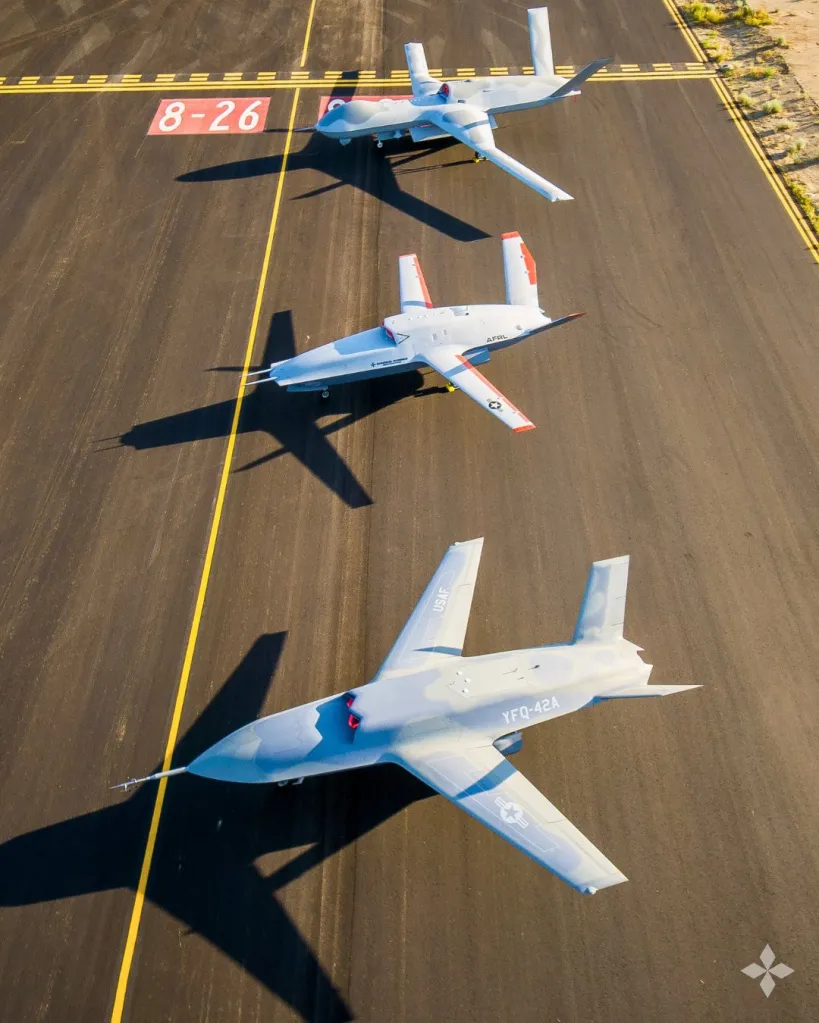
From top to bottom, General Atomics MQ-20 Avenger, XQ-67 OBSS, and YFQ-42 drones. GA-ASI
As mentioned, the Air Force is steadily working to broaden the scale and scope of testing involving the FQ-42 and FQ-44 to include more and more operationally relevant scenarios. Both types are set to make their first appearance at a large-force employment (LFE) exercise in December, offering a valuable new opportunity for deeper and more realistic integration with crewed fighters.
The Air Force otherwise continues to lay the groundwork for future CCA operations, including through a major round of testing at Creech in July, which TWZ was first to report on. The service is heavily focused now just on figuring out how the drones will be deployed, launched, recovered, supported, and otherwise operated on a day-to-day basis. A dedicated test squadron called the Experimental Operations Unit (EOU), established at Nellis Air Force Base in Nevada, has been leading those efforts.
Work is also underway to demonstrate tactical capabilities, such as the FQ-44 launching an AIM-120 Advanced Medium-Range Air-to-Air Missile (AMRAAM) for the first time earlier this year.
New test footage: first missile shot from YFQ-44A.
YFQ-44A executed an end-to-end, beyond-line-of-sight strike against a simulated target.
“We’re on path right now to do our air-to-air shot coming up here in the near future,” Mike Shortsleeve, Vice President for Strategy Business Development at GA-ASI, told TWZ‘s Jamie Hunter on the floor of the Air & Space Forces Association’s (AFA) 2026 Air, Space & Cyber Conference last week.
Last week, GA-ASI separately announced a new demonstration of semi-autonomous air-to-air combat capability involving crewed F-5AT Advanced Tiger jets belonging to private adversary air contractor Tactical Air Support, Inc. and an unspecified “CCA test aircraft.” The company did use a picture of an Avenger drone to illustrate the press release. The F-5s and the CCA surrogate were equipped with infrared search-and-track sensors (IRST) during the testing.
The stock picture of an Avenger drone that General Atomics used to illustrate its press release last week. General Atomics
“The live exercise proved that a CCA and a manned fighter can collaborate to fuse sensor data from AMS-GRA-compliant sensors to track, engage, and eliminate an airborne target while using a Beyond Line of Sight (BLOS) data link to accomplish seamless coordination between the two aircraft,” according to the GA-ASI release.
“The demonstration utilized BLOS communication between the CCA and the airborne F-5, enabling the Advanced Tiger to send data about targets from an AMS-GRA-compatible system. These commands were relayed to the CCA’s TacACE [Tactical Autonomy Ecosystem software] system,” the release added. “This flight showed that many companies’ platforms can interoperate using the plug-and-play government reference architectures ecosystem. The U.S. Air Force isn’t locked into using a single vendor or system.”
IRSTs are especially valuable for helping spot stealthy targets with features designed to reduce their radar cross-sections since they detect and track infrared emissions. By extension, IRSTs are also immune to radio frequency electronic warfare jamming. As passive sensors, they do not emit their own signals that could alert a target to the fact they are being tracked, either. IRSTs can still be used to cue or otherwise be linked to other sensors, including active electronically-scanned array radars. Fusing data from multiple sources can provide higher fidelity tracks of multiple targets, as well as improved situational awareness overall.
An Avenger drone with a podded IRST sensor under its wing. General Atomics
Air-to-air combat is expected to be the primary mission set, at least initially, for Air Force CCAs. At the same time, an air-to-ground role for the FQ-42 and FQ-44, and/or other future CCA-type drones the Air Force might acquire, is emerging on the horizon. Anduril has already fit-checked a variety of air-to-ground ordnance on Fury.
As it stands now, the Air Force is looking to have its first operational CCAs in service toward the end of the decade. The service is also presently aiming to have a total fleet of at least 500 CCAs of all types by 2032.
“If we can’t be ready, then certainly you’re not going to have the forces that you need and the numbers that you need going forward. This signifies that mass is certainly important again, but also autonomy is just as important,” General Atomics’ Shortsleeve told us last week in talking about the Air Force’s CCA fleet size target. “So the ability to have these autonomous systems, whether they’re bringing in additional weapons, sensing capability, whatever it is, all of those working in a collaborative environment, whether it’s manned, unmanned teaming, or unmanned and unmanned capabilities, that right there is what’s going to help the warfighter in the future.”
FQ-42 Vengeance fighter drone update from General Atomics
“And when we say autonomy, it’s not just strictly this is going to go off and do its own thing. It’s going to be directed,” he added. “Whether it’s on the ground, in the air, [it] makes no difference to the system itself. It’s going to work hand-in-hand [with humans]. So that human-machine teaming, that’s what they’re really focusing on. There is figuring out how to best use this capability in the advancement of actually having to employ it in [the] real world.”
Though just flying in formation is very different from collaboration with a high degree of autonomy, the new picture of the FQ-42 together with the F-35A and the F-15E is a window into the future teamed operations the Air Force is hoping to build.