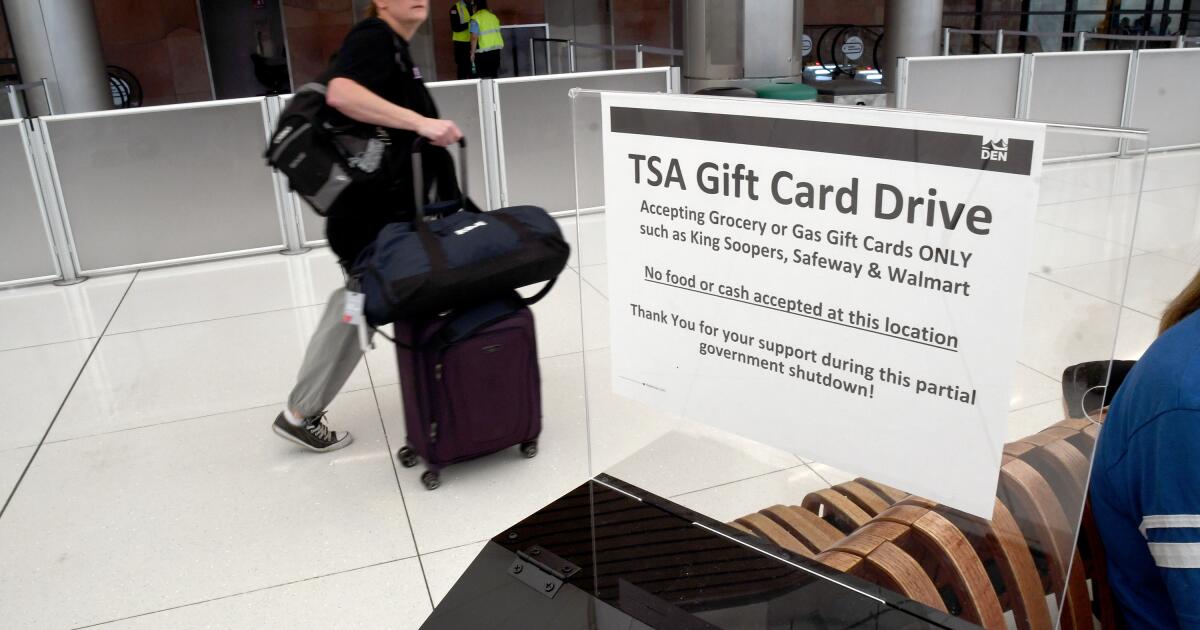
Across the country, collections are popping up to help Transportation Security Administration officers who have been without full pay for more than a month due to the partial government shutdown affecting the Department of Homeland Security.
The charity World Central Kitchen, more accustomed to feeding those in war zones and disaster areas, started providing meals to Washington, D.C.-area airports after many TSA officers missed their first full paycheck.
On Thursday, Feeding San Diego began distributing 400 boxes with pasta, beans and peanut butter as well as fresh produce such as strawberries and potatoes to affected agents near the airport after a request from TSA and the San Diego County Regional Airport Authority.
Nonprofits are stepping in to help and coordinating with airports and local TSA offices because ethics rules around giving gifts to federal employees make it difficult for those affected by the shutdown to receive help directly.
Carissa Casares from Feeding San Diego said communicating with the airport means they can better tailor their resources and response to TSA workers’ needs.
“We need to work directly with the people who have direct access to these employees and get this food to them at a time and location that is most convenient to them,” Casares said.
Sunday marks the 37th day that the Department of Homeland Security has been shut down after Democrats refused to fund Immigration and Customs Enforcement and Customs and Border Protection without changes to their operations after the killings of Alex Pretti and Renee Good in Minneapolis. Democrats this weekend tried to advance a bill to fund TSA separately, but Republicans balked, saying all of Homeland Security needed to be funded.
More than 120,000 Homeland Security employees are working without pay, including roughly 50,000 TSA officers, as negotiations between lawmakers and the White House on limits to immigration enforcement drag on.
The funding lapse comes just months after a 43-day government shutdown, the longest in the nation’s history, which caused long lines at food banks across the U.S. as more than 700,000 federal workers worked without pay.
Rules limit what help TSA officers can accept
For those wanting to help, it’s not as simple as going to the airport and giving cash or gift cards directly to TSA officers, who are prohibited from accepting gifts at screening locations, according to a Homeland Security spokesperson.
But Aaron Barker, president of the AFGE Local 554 in Georgia, said TSA officer unions don’t have the same restrictions and can accept donations to distribute to their members. Barker recommends those who want to donate look up their local union district on the AFGE website, or give through their local labor council.
“For some people it can be life or death,” said Barker. “It’s just sad and terrible that this is happening.”
Union members have told Barker they’re unable to cover utility bills or pay for their children’s medical procedures. They’ve received eviction notices or had cars repossessed, and they’re having trouble affording routine items.
“People don’t think about the things they just naturally have in their home, like toothpaste, bathroom tissue, milk, detergent, dish liquid,” he said. “I’m sure those things are a necessity for every TSA officer.”
Nonetheless, no donation can be as effective as an end to the shutdown. “The first thing they want is their paycheck,” said Barker. “The money is the most immediate need.”
Coordination between nonprofits and TSA
Operation Food Search is working closely with TSA to safely deliver food and set up a temporary pantry at St. Louis Lambert International Airport.
The Missouri hunger relief nonprofit’s chief executive, Kristen Wild, said it is the first time the group has distributed directly to TSA employees where they work.
“It removes their need to make an extra trip and drive here,” Wild said. “So we’re really excited that the airport allowed us to directly serve right there.”
They gave away just over half their 400 prepared food bags during a two-hour period last week, according to Wild. Each bag contained nearly $20 worth of nonperishables such as apple sauce, pasta, rice and beans. Rules prohibit federal employees from soliciting or accepting gifts or items of monetary value greater than $20 if the gift is related to their government position.
Wild said she thought the $20 limit might be waived since they were distributing food through airport-approved channels.
“We didn’t know for sure,” she said. “But to play it safe we just kept it right under the $20 per bag amount so there would be no challenge to it.”
Airport communities band together
Seattle-Tacoma International Airport officials were fielding PETA donations and local food banks’ pallets on Friday afternoon as they stocked their private pantry for off-shift TSA staff.
But they’ve also seen dining vendors, usually tasked with feeding hungry travelers, step up. Airport tenants have offered discounts and donated through TSA to cover entire shifts’ meals, according to airport spokesperson Perry Cooper.
“You know a lot of these people,” Cooper said. “You see faces … throughout the day as you’re wandering through. And then to realize that some of these folks are here and they’re not getting paid, you know, really tugs at your heart to think what’s a way that we can help.”
The airport community’s support adds to the roughly $6,000 they’ve received in cash and gift cards plus another $10,000 worth of food and household products, Cooper said. That includes donations from the labor union for air traffic controllers, whose jobs are unaffected by this partial shutdown but understand the strain of working without pay, as they did during last year’s full government shutdown.
More than 460 people picked up fresh produce when local nonprofit Food Lifeline brought a truckload recently, according to Cooper. Most of the attendees were TSA staff, Cooper said, though some might have been homeless. Boxes including pineapples and broccoli lined folding tables along the airport’s main drive.
Regular travelers like Musie Hidad said he thinks about the TSA agents working unpaid every time he enters through security.
“The work they are doing is serious and they aren’t getting paid for it,” said Hidad, an Amarillo, Texas, resident, who was traveling to Ohio for work. “My heart goes out to them.”
Angueira, Beaty and Pollard write for the Associated Press. AP video journalist Patrick Aftoora-Orsagos in Columbus, Ohio, contributed to this report.