Big assertions, sharp exchanges, little clarity define DOJ election battle with California
First came the letter from acting Deputy Atty. Gen. Trent McCotter — just three weeks before the Nov. 3 election — demanding that Los Angeles County’s top elections official launch a sweeping investigation into thousands of voters the Trump administration alleges are “likely noncitizens” and withhold their ballots in the meantime.
The letter arrived with a thumb drive purporting to contain the list of voters in question, and a handwritten note providing the password. Dean Logan, head of the L.A. County Registrar-Recorder/County Clerk’s office, said accessing the device broke security protocols, and he wouldn’t open it.
Then came an Excel spreadsheet, listing some 20,000 voters by name, date of birth and address. It appeared to contain voters from across the state of California, not just L.A. County, and provided no information on the Trump administration’s methodology for questioning those voters. Logan’s office again pushed back.
“We cannot withhold or refuse to count ballots based solely on unverified allegations, nor can we disregard the legal requirements governing our election — and we certainly have no authority to act on records that are outside of our jurisdiction,” Logan said.
On Friday, the back and forth escalated yet again, when the Justice Department warned in a letter to L.A. County attorneys that county elections officials who tabulate ballots from the flagged voters could face criminal prosecution for being “aiders and abettors to a federal crime.”
For the last week, Trump administration officials and California election leaders have been locked in a fiercely contentious standoff over alleged election fraud that independent elections experts say is like nothing they have ever seen before.
The battle — which escalated into a federal lawsuit filed Thursday by the Justice Department against the state, Secretary of State Shirley Weber and Logan — features striking assertions of official misconduct. They include willful indifference to systemic election fraud among California officials, as alleged by Trump officials, and a nefarious effort by the administration to “lay the groundwork” for questioning any unfavorable election results next month, as alleged by California leaders and independent elections experts.
With little public clarity around the voters whose registration is being contested and how the administration came to question their eligibility, the debate has centered instead on the efficacy of vetting voter rolls right before an election and the increasingly bitter claims of political meddling from the many federal, state and local officials involved.
“More dangerous nonsense from a President losing his grip on reality,” Gov. Gavin Newsom posted on X.

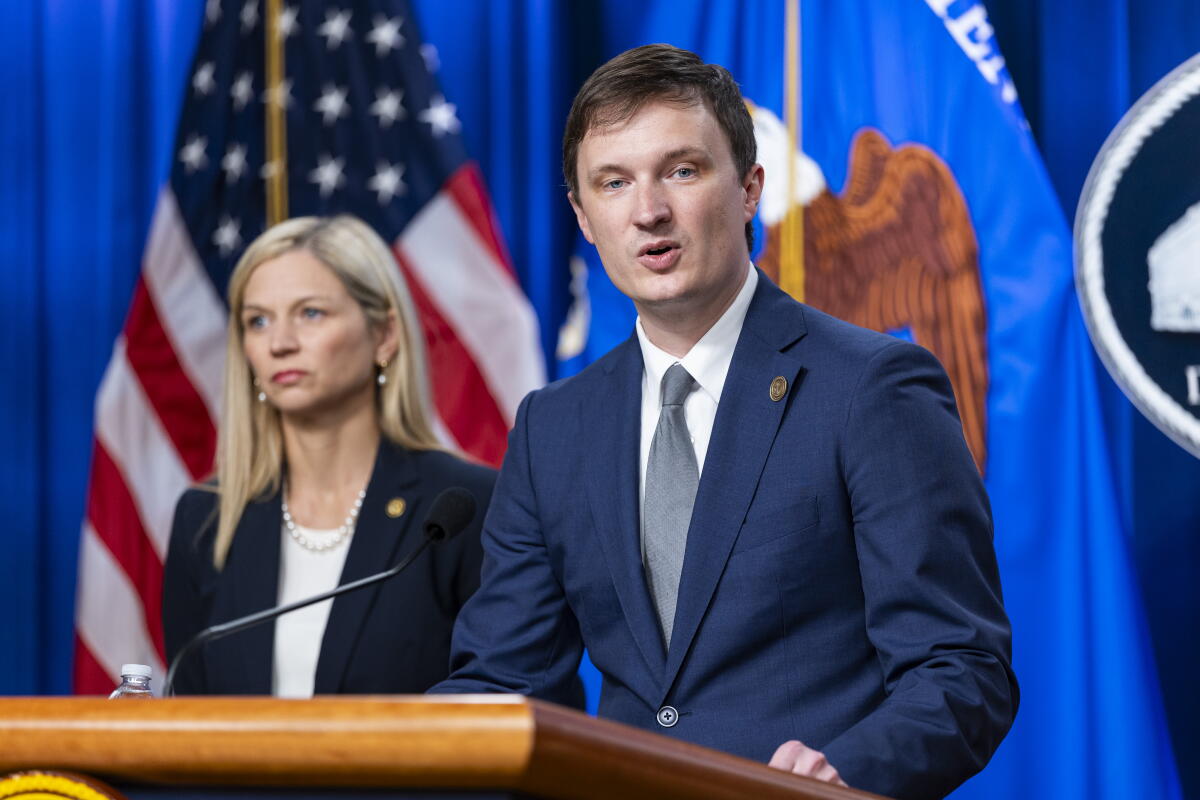
Acting Deputy Atty. Gen. Trent McCotter sent a letter demanding that L.A. County’s top elections official investigate thousands of voters the Trump administration alleges are “likely noncitizens.”
(Finn Gomez / Getty Images)
“No, Governor. You are violating federal law by facilitating voting by noncitizens,” responded First Assistant U.S. Atty. Bill Essayli, the top federal prosecutor in Los Angeles, whose office is leading the lawsuit.
“Mail ballots are already in most voters’ hands, and Election Day is less than three weeks away. Every count, recount, hand count, lawsuit, and audit has found that there’s no widespread voter fraud in the U.S. The Trump Admin’s last-minute demands are meritless, and we look forward to making our case in court,” California Atty. Gen. Rob Bonta wrote on the same platform.
“We produced a list of 20,000 noncitizens on your voter rolls, and your response is ‘it’s too late’ because you already mailed the ballots. Not good enough,” Essayli shot back. “It’s a violation of the U.S. Constitution and federal law for California to dilute the votes of American citizens.”
Both sides have accused the other of being unreasonable and of ignoring practical concerns about voting and election security, though in very different ways.
Trump administration officials have said their effort “should not be controversial,” and reflects a common-sense approach to election oversight. “The law is clear, aliens in the United States cannot vote in federal elections,” McCotter said.
In its lawsuit, the Justice Department argued it is “not practicable or feasible” for the federal government to investigate “thousands, let alone tens of thousands, of individuals” before the November election alone, so California and local officials should be required to help them do it.
California officials — joined by independent elections experts — have accused the Trump administration of breaking the law to bolster a grand election conspiracy the president has propped up for years without evidence, including by trying to purge voters from rolls right before an election.
David Becker, executive director of the nonpartisan Center for Election Innovation & Research, said the National Voter Registration Act prohibits states from conducting systemic maintenance of voter lists within 90 days of an election, and that the U.S. Supreme Court recently affirmed that limit.
Bonta said the timing of the Justice Department’s demands “reeks of desperation and bad faith.”

Dean Logan, head of the L.A. County Registrar-Recorder/County Clerk’s office, attends the opening of a new ballot processing center in City of Industry in 2024.
(Irfan Khan / Los Angeles Times)
State officials and election experts also have questioned why Homeland Security Secretary Markwayne Mullin suggested California had some 190,000 noncitizen voters on its rolls as recently as July if the number now stands at 20,000.
“What happened to the 170,000? You just got those wrong?” Bonta said. He also noted with derision that the administration’s lawsuit repeatedly hedges its assertions by saying that federal officials “believe” that noncitizens “may be” registered in California.
“You believe, or you know?” Bonta said. “They may be or they are?”
Kiersten Pels, a Justice Department spokesperson, said the 20,000 flagged voters “are the ones that have been manually verified” as ineligible, but that number “can and will go up” as federal authorities continue their work. She referred additional questions about the figures to Homeland Security, which did not respond to questions.
Becker said the administration’s figures “should be treated with serious skepticism,” given similar claims falling apart elsewhere. He cited a Homeland Security claim of about 16,000 noncitizens on Nevada voter rolls dropping to 185 voters before Nevada officials investigated and found every single one of those voters was a citizen.
California officials have not shown a similar interest in launching their own investigation.
In a letter to McCotter, Weber wrote that treating the 20,000 voters on the Justice Department’s list as “ineligible until proven otherwise” would not only violate the 90-day quiet period before an election, but amount to “an unprecedented suspension — and even denial — of voting rights.”
She said if the Trump administration has any proof for its claims, California would “review that evidence and any supporting data or methodology” and “take the appropriate steps in compliance with federal and state law” to address any problems. “However, I will not disenfranchise thousands of Californians — or order any county elections official to do so — based solely upon an unsupported and likely inaccurate ‘belie[f]’ that certain voters are ‘likely’ noncitizens.”
A spokesperson for Logan’s office said Friday that it was reviewing the Justice Department’s spreadsheet — in part to determine how many of the voters are actually in L.A. County — but had yet to receive requested information on the methodology used for flagging those voters.
Nevada Secretary of State Cisco Aguilar, chair of the Democratic Assn. of Secretaries of State, said the Trump administration’s efforts in California are “another attempt by the federal government to harass and intimidate elections officials,” and that their timing is “obviously a political attempt” to prevent voters — particularly Latino voters —from holding the Trump administration accountable for its failed leadership.
But he also said that California officials — to the extent they can under the law, and working closely with Bonta — should work to refute the Trump administration’s claims through their own review of the data, just as Nevada officials did.
“We are not afraid to defend our elections,” he said. “And California should take that same approach. You cannot be reactive to these situations. You have to be strategic.”