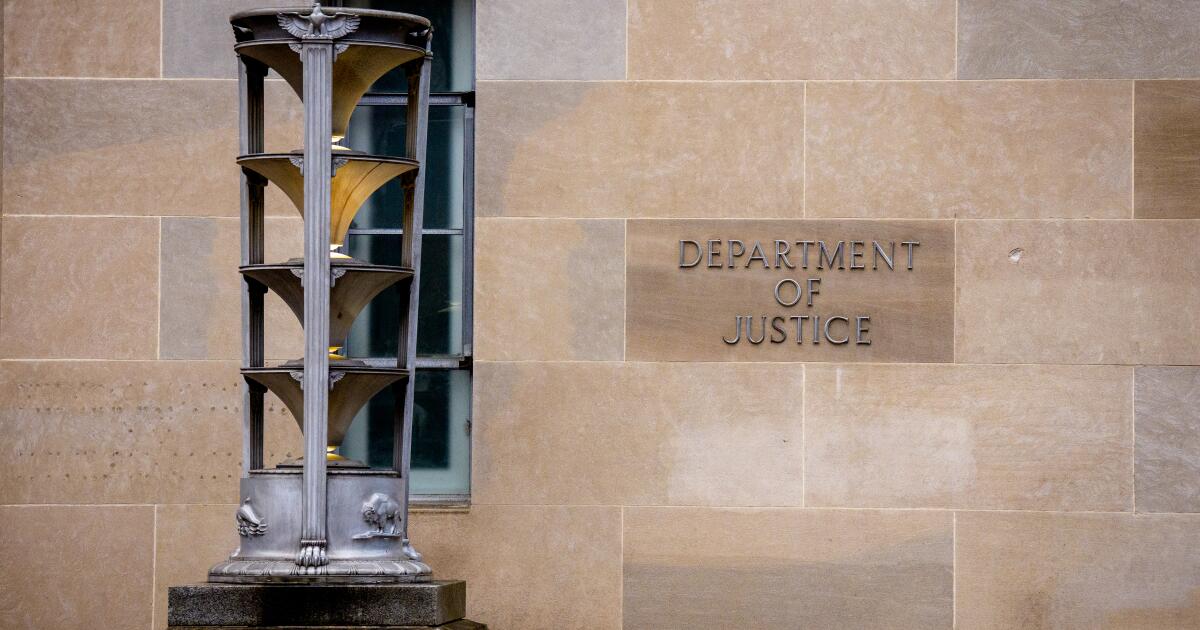
Justice Department releases Epstein files, with redactions and omissions
WASHINGTON — The Justice Department released a library of files on Friday related to Jeffrey Epstein, partially complying with a new federal law compelling their release, while acknowledging that hundreds of thousands of files remain sealed.
The portal, on the department’s website, includes videos, photos and documents from the years-long investigation of the disgraced financier and convicted sex offender, who died in federal prison in 2019. But upon an initial survey of the files, several of the documents were heavily redacted, and much of the database was unsearchable, in spite of a provision of the new law requiring a more accessible system.
The Epstein Files Transparency Act, which passed with overwhelming bipartisan support in Congress, unequivocally required the department to release its full trove of files by midnight Friday, marking 30 days since passage.
But a top official said earlier Friday that the department would miss the legal deadline Friday to release all files, protracting a scandal that has come to plague the Trump administration. Hundreds of thousands more were still under review and would take weeks more to release, said Todd Blanche, the deputy attorney general.
“I expect that we’re going to release more documents over the next couple of weeks, so today several hundred thousand and then over the next couple weeks, I expect several hundred thousand more,” Blanche told Fox News on Friday.
The delay drew immediate condemnation from Democrats in key oversight roles.
Rep. Robert Garcia (D-Long Beach), the ranking member of the House Oversight Committee, and Rep. Jamie Raskin (D-Md.), the ranking member of the House Judiciary Committee, accused President Trump and his administration in a statement Friday of “violating federal law as they continue covering up the facts and the evidence about Jeffrey Epstein’s decades-long, billion-dollar, international sex trafficking ring,” and said they were “examining all legal options.”
The delay also drew criticism from some Republicans.
“My goodness, what is in the Epstein files?” Rep. Marjorie Taylor Greene (R-Ga.), who is leaving Congress next month, wrote on X. “Release all the files. It’s literally the law.”
“Time’s up. Release the files,” Rep. Thomas Massie (R-Ky.) wrote on X.
Already, congressional efforts to force the release of documents from the FBI’s investigations into Epstein have produced a trove of the disgraced financier’s emails and other records from his estate.
Some made reference to Trump and added to a long-evolving portrait of the social relationship that Epstein and Trump shared for years, before what Trump has described as a falling out.
In one email in early 2019, during Trump’s first term in the White House, Epstein wrote to author and journalist Michael Wolff that Trump “knew about the girls.”
In a 2011 email to Ghislaine Maxwell, who was later convicted of conspiring with Epstein to help him sexually abuse young girls, Epstein wrote, “I want you to realize that the dog that hasn’t barked is trump. [Victim] spent hours at my house with him … he has never once been mentioned.”
Maxwell responded: “I have been thinking about that…”
Trump has strongly denied any wrongdoing, and downplayed the importance of the files. He has also intermittently worked to block their release, even while suggesting publicly that he would not be opposed to it.
His administration’s resistance to releasing all of the FBI’s files, and fumbling with their reasons for withholding documents, was overcome only after Republican lawmakers broke off and joined Democrats in passing the transparency measure.
The resistance has also riled many in the president’s base, with their intrigue and anger over the files remaining stickier and harder to shake for Trump than any other political vulnerability.
It remained unclear Friday afternoon what additional revelations would come from the anticipated dump. Among the files that were released, extensive redactions were expected to shield victims, as well as references to individuals and entities that could be the subject of ongoing investigations or matters of national security.
That could include mentions of Trump, experts said, who was a private citizen over the course of his infamous friendship with Epstein through the mid-2000s.
Epstein was convicted in 2008 of procuring a child for prostitution in Florida, but served only 13 months in custody in what was considered a sweetheart plea deal that saved him a potential life sentence. He was charged in 2019 with sex trafficking, and died in federal custody at a Manhattan jail awaiting trial. Epstein was alleged to have abused over 200 women and girls.
Many of his victims argued in support of the release of documents, but administration officials have cited their privacy as a primary excuse for delaying the release — something Blanche reiterated Friday.
“There’s a lot of eyes looking at these and we want to make sure that when we do produce the materials we are producing, that we are protecting every single victim,” Blanche said, noting that Trump had signed the law just 30 days prior.
“And we have been working tirelessly since that day to make sure that we get every single document that we have within the Department of Justice, review it and get it to the American public,” he said.
Trump had lobbied aggressively against the Epstein Files Transparency Act, unsuccessfully pressuring House Republican lawmakers not to join a discharge petition that would force a vote on the matter over the wishes of House Speaker Mike Johnson (R-La.). He ultimately signed the bill into law after it passed both chambers with veto-proof majorities.
Rep. Ro Khanna (D-Fremont), who introduced the House bill requiring the release of the files, warned that the Justice Department under future administrations could pursue legal action against current officials who work to obstruct the release of any of the files, contravening the letter of the new law.
“Let me be very clear, we need a full release,” Khanna said. “Anyone who tampers with these documents, or conceals documents, or engages in excessive redaction, will be prosecuted because of obstruction of justice.”
Given Democrats’ desire to keep the issue alive politically, and the intense interest in the matter from voters on both ends of the political spectrum, the fact that the Justice Department failed to meet the Friday deadline in full was likely to stoke continued agitation for the documents’ release in coming days.
In their statement Friday, Garcia and Raskin hammered on Trump administration officials — including Atty. Gen. Pam Bondi — for allegedly interfering in the release of records.
“For months, Pam Bondi has denied survivors the transparency and accountability they have demanded and deserve and has defied the Oversight Committee’s subpoena,” they said. “The Department of Justice is now making clear it intends to defy Congress itself.”
Among other things, they called out the Justice Department’s decision to move Maxwell, who is serving a 20-year sentence for sex trafficking, to a minimum security prison after she met with Blanche in July.
“The survivors of this nightmare deserve justice, the co-conspirators must be held accountable, and the American people deserve complete transparency from DOJ,” Garcia and Raskin said.
Sen. Adam Schiff (D-Calif.), in response to Blanche saying all the files wouldn’t be released Friday, said the transparency act “is clear: while protecting survivors, ALL of these records are required to be released today. Not just some.”
“The Trump administration can’t move the goalposts,” Schiff wrote on X. “They’re cemented in law.”