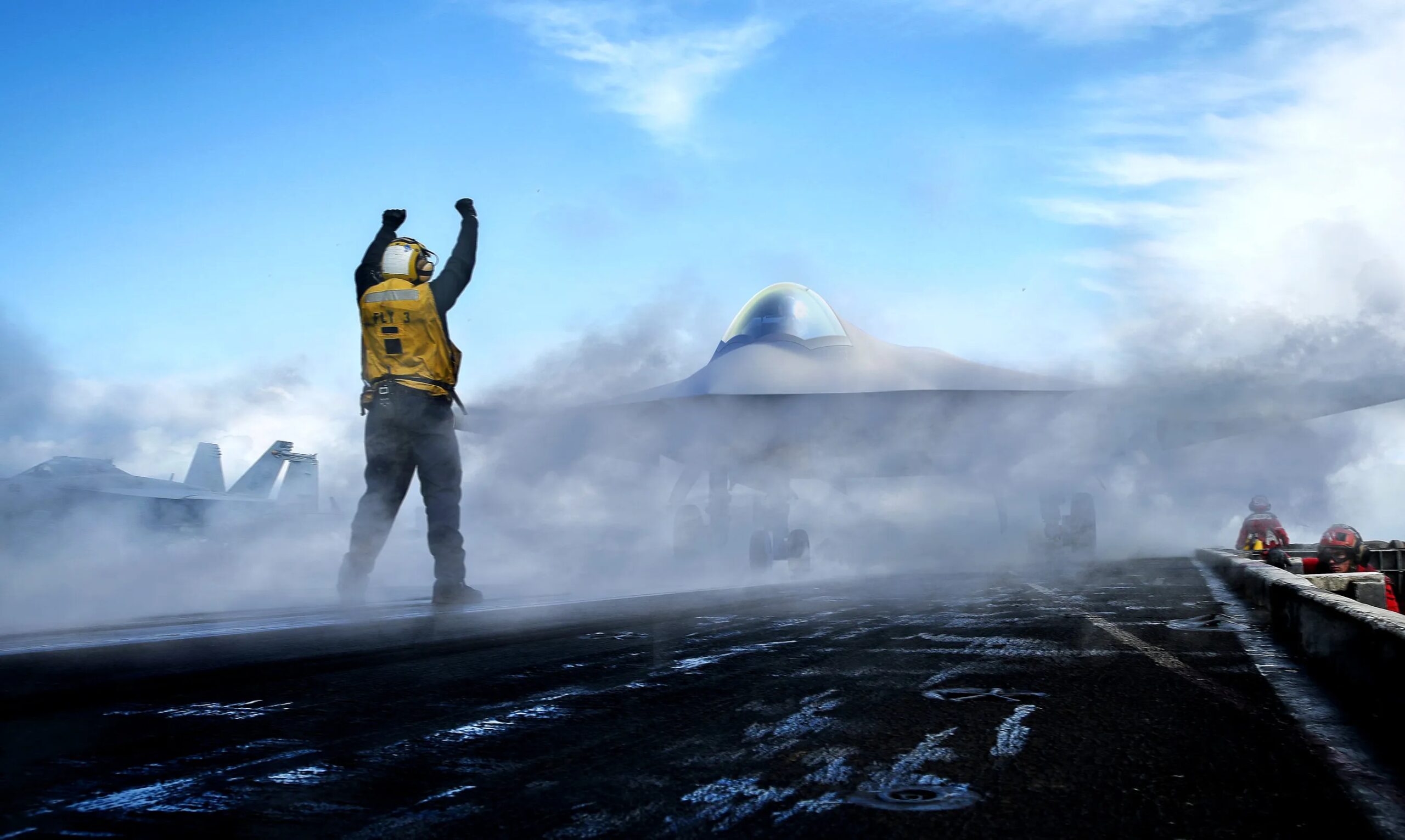
Boeing Wins F/A-XX Next Generation Navy Stealth Fighter Contract (Updated)
After blowing past a self-imposed August deadline, the U.S. Navy has finally announced Boeing as the winner of its F/A-XX next-generation carrier-based fighter competition. F/A-XX has become one of the most hotly anticipated U.S. defense procurement decisions in recent memory after the Pentagon tried to shelve the program indefinitely last year.
Boeing had been competing against Northrop Grumman for the F/A-XX contract. An earlier down-select reportedly eliminated Lockheed Martin back in March 2025.
TWZ has now published an initial analysis of Boeing’s winning F/A-XX design based on what can be seen in the new rendering, which you can find here.
As mentioned, the Pentagon had moved to freeze the F/A-XX program in June 2025. Three months earlier, Boeing had won a separate U.S. Air Force competition to produce what is now called the F-47. U.S. military officials had argued that the U.S. industrial base lacked the capacity to support work on two next-generation fighters simultaneously.

Congress subsequently intervened to keep the F/A-XX program running, but its future had remained very murky until earlier this year. In April, Chief of Naval Operations (CNO) Adm. Daryl Caudle said that a winner of the competition would finally be announced in August. Secretary Pete Hegseth and Acting Secretary of the Navy Hung Cao both publicly committed to that same timeline later that month. There had been concerns that the program might have slipped back into limbo after that deadline came and went. Adm. Caudle told Aviation Week‘s Brian Everstine that he himself was no longer aware of when this decision might come on the sidelines of the Tailhook Association’s annual convention last month.
Just two weeks ago, Air Force Gen. Dale White, the service’s Direct Reporting Portfolio Manager for Critical Major Weapon Systems, reiterated concerns about industrial capacity in response to a question about potential challenges in building F/A-XXs at the same time as F-47s. White also acknowledged that these concerns were “not unique” to F/A-XX and F-47.
In this context, Boeing’s win today is perhaps unsurprising. The company will be able to leverage design work it has already been doing in relation to the F-47 program, as well as relevant production experience and supply chains. TWZ had previously highlighted similarities between what was seen in a rendering the company released of its F/A-XX proposal and official renders of what it is building for the Air Force. We still have yet to learn just how closely related the two designs are.

It is also worth noting here that Boeing previously pushed back publicly on the assertion that it was not ready to meet Air Force and Navy needs at the same time.
Regardless of any industrial base considerations, top Navy officials have been consistently vocal about the need for F/A-XX, even after the Pentagon’s move to put the program on ice last year. The service has presented the next-generation fighters as essential for staying ahead of top global competitors like China and Russia, as well as smaller adversaries, such as Iran.
“I know these things are expensive, and I know the defense industrial base is compressed, but we have got to figure out how to walk and chew gum here with aircraft,” CNO Caudle said in January, just weeks before the start of major combat operations against Iran. “The folks that used to be not in [the] headspace that I needed a stealth aircraft of this level to fly a mission into their country, will gain capability that the F-18 [F/A-18E/F Super Hornet] will not match against.”

“This is an ever-evolving theme, and when you’ve got partnerships … well coupled with each other across China and Russia and Iran and North Korea, and terrorist groups that are getting that kit from all of those through back-channel ways, our ability to fly with impunity with our existing airframes is fleeting,” he added at that time. “So, if I don’t start building that [F/A-XX] immediately, you’re not going to get it for some time.”
The conflict with Iran, where U.S. crewed and uncrewed aircraft have now been lost to that country’s air defenses, adds a certain weight to Caudle’s comments here.
The selection of Boeing for F/A-XX also comes now as the Navy is making new moves regarding other aspects of its future carrier air wing plans. In particular, the service is increasingly solidifying its vision for new carrier-based Collaborative Combat Aircraft (CCA) drones. Acting as airborne controllers for advanced drones has long been understood to be a key mission for the Navy’s forthcoming sixth-generation crewed fighters.
Update: 5:52 PM ET –
The Pentagon has now issued a full press release for the F/A-XX contract award to Boeing, which is valued at approximately $20 billion. The deal covers the “full-scale development phase” and includes the procurement of “multiple test aircraft for ground, airworthiness, systems, and weapons integration testing.”
“The F/A-XX is a critical pillar in our commitment to maintaining peace through strength. F/A-XX will dominate contested airspace, extend operational reach, and deliver a decisive combat advantage for the warfighter,” Michael P. Duffey, Under Secretary of War for Acquisition and Sustainment, has said in a statement. “The F/A-XX platform represents a crucial, non-negotiable investment in America’s national security and long-term air combat capabilities. We are joining forces with Boeing to field these capabilities rapidly, ensuring our warfighters possess the lethal and highly networked systems required to deter aggression, project undisputed power, and secure absolute air superiority.”
“This achievement marks a new era for the U.S. Navy,” Acting Secretary of the Navy Hung Cao also said in a statement. “The Sixth-Generation fighter is a generational leap in air superiority and will provide the world’s best aviators with unparalleled capabilities to fight, win, and come home safe. We are excited to partner with Boeing, and for our warfighters to continue to dominate the skies and defeat our nation’s enemies.”
“The F/A-XX will provide advanced carrier-based power projection that extends the range of the most agile and survivable airfields: U.S. Navy carriers. In addition, F/A-XX will be interoperable with manned and unmanned platforms such as Collaborative Combat Aircraft (CCA) and increase the capability of every CCA it teams with,” the press release adds. “Following this contact award announcement, Boeing will deliver the platform to augment and eventually replace legacy F/A-18E/F Super Hornets and EA-18G Growlers beginning in the 2030s, and operate alongside the F-35C.”
The Navy has not yet announced a formal designation for the F/A-XX aircraft. If Boeing’s base design does share significant DNA with the F-47, it is possible that the designation for the new sixth-generation carrier-based fighter could reflect that.
It is also worth noting how muted the F/A-XX announcement has been across the board given how hotly anticipated it was. The contrast with the F-47 contract announcement, which was a live-broadcast event headed up by President Donald Trump from White House, is particularly striking.
Update: 6:14 PM ET –
Boeing has now put out its own press release regarding the F/A-XX contract award, which notes that “technical and programmatic details” about the aircraft “remain classified under U.S. national security and export laws.”
“It’s an honor to be selected to produce the Navy’s first sixth–generation platform,” Steve Parker, President and CEO of Boeing Defense, Space & Security, said in a statement. “Backed by decades of work, bolstered by game-changing innovations and solidified by the investments we’ve made in new facilities uniquely suited to build multiple products with next generation capabilities, our dedicated and talented team is ready to execute this critical program.”
“Delivering two advanced fighters in parallel was always our plan, and we invested accordingly,” Parker added. “We are ready and able to build multiple concurrent future combat aircraft franchise programs.”
Boeing’s release explicitly highlights a major ongoing expansion of its production and other facilities in St. Louis, Missouri. That work is also widely understood to be supporting the F-47 program, as TWZ reported separately just earlier today.
“Investment in facilities is just one part of the story,” Boeing’s Parker also said. “We’re also investing in technology and people so that we can deliver for our customers.”
As an aside, Boeing also received a separate contract today from the Navy, valued at $16,667,607, to support the final shutdown of the production line for the F/A-18E/F Super Hornet fighter and EA-18G Growler electronic warfare jet.
Contact the author: joe@twz.com