The Women Who Keep Vigil on Their Farms in Adamawa
Kolo Askumto sits on a small mat outside her makeshift shelter, a shawl draped around her shoulders for warmth. Her eyes remain fixed on the farmland ahead, not out of desire but necessity. Rows of guinea corn and beans stretch into the darkness. While she scans the fields, careful not to blink for too long, her ears strain at every unfamiliar rustling of leaves.
It is midnight, and Kolo is at the Lainde fields in Mayo-Ine, a community in Fufore Local Government Area of Adamawa State, in North East Nigeria.
The 55-year-old has been living on her farm during every harvest season for the past three years. Before 2022, guarding her ripe beans or guinea corn was never a concern. That changed when thieves began invading their fields at night, carting away crops — sometimes even those already harvested and packed, waiting to be transported home.
Kolo lives with her family at the Malkhohi displacement camp in Yola, the state capital. She managed to secure farmland in Lainde after fleeing Madagali in Borno State due to Boko Haram attacks. Since 2016, subsistence farming has helped her support her husband in providing for their family.
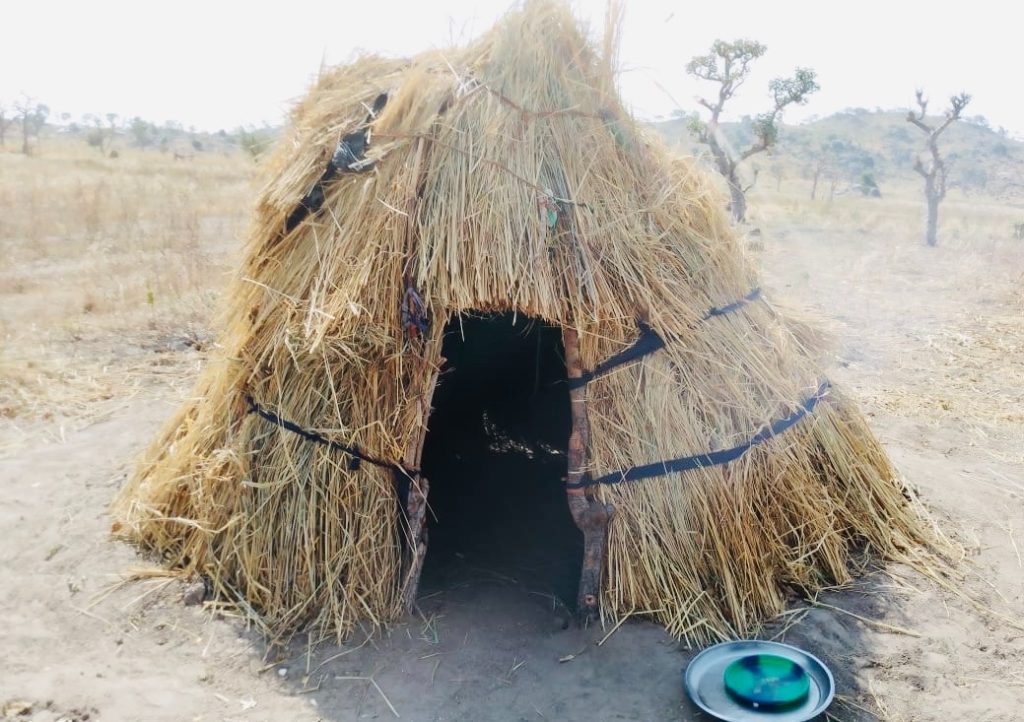
This year, Kolo has slept on her farm for more than two weeks. Every night, she spreads her blanket on her mat, switches on her torch, and scans her surroundings like an owl. When the night deepens, she retreats to her thatched tent but barely blinks while she’s there.

She is not the only one keeping watch. The isolation of the area adds to the danger. Located on the outskirts of the Mayo-Ine area, Lainde lie far from residential settlements, with only a few people living there permanently. There is no police station nearby, farmers said, except in the main village several kilometres away, leaving those who sleep on the fields largely on their own through the night.
The vigil
Every night, several farmers keep watch across open fields. Some sit in small groups, whispering as they stay awake until dawn. At sunrise, some resume their harvest, while others head home to return by evening for the night shift. The women mostly stick together.
To stay awake, the farmers told HumAngle that they drink herbal concoctions believed to chase sleep from their eyes. Sometimes, they light a fire and huddle around it for warmth.
“We pray that God should protect us before we sleep, but we wake up to every sound we hear,” Kolo said.
Though the vigil has helped keep her farm safe this year, fear still lingers. Two years ago, criminals struck in the dead of night and stole all the grains she had packed in sacks. She was not physically harmed, but the memory of that night has never left her. Since then, she sleeps with a machete by her side.
Unlike some women who return home during the day to rest, Kolo plans to remain on the farm for nearly a month — until the crops are fully harvested. The journey from the IDP camp is long and exhausting. “If we are to trek before we get here, we will be tired, and we will not have enough strength to work,” Kolo said. It takes about an hour to reach Lainde from Yola by tricycle, and much longer on foot.
While she has not encountered any security problems this year, she fears she might encounter the same group that robbed her the last time. However, Kolo says she is willing to go to any length to protect her farm. “If we don’t sleep here, we can lose everything,” she said.
“We can’t afford to pay”
Not every farmer in Lainde stays on the field all night. Some pay guards, mostly young men, to keep watch on their behalf. It costs around ₦60,000 to ₦70,000 monthly. In some cases, the guards are paid with a bag or two of harvested crops.
For many women, that option is simply out of reach. “We have to buy fertilisers, herbicides, and other inputs,” Kolo explained. “There is nothing left to pay guards.”
Elizabeth Joseph has farmed maize, groundnuts, and beans in the Lainde fields for three years. Every harvest season, she says, comes with anxiety. Once, she harvested several bags of beans and left them in the field while she went to find transport. When she returned, everything was gone. Not even a single grain remained.

In 2024, a bag of beans sold for between ₦110,000 and ₦130,000, while a bag of maize cost about ₦60,000; losing even a few bags can undo months of back-breaking work for these small-scale farmers. That loss left her with little choice but to keep watch herself.
But the vigil is exhausting.
“If I have money, I won’t have to come to the farm. I will just assign labourers to do the work for me, and I will just come during the harvest season. I will even pay those who will harvest, and there won’t be any stress, but since I don’t have the money, I have to come and guard myself,” Elizabeth added.
Although her husband could sleep on the farm while she managed the household, they switched roles. According to Elizabeth, men are more likely to be attacked or killed by thieves at night. Her fear is not unfounded.
Recently, in Bare, another community in Adamawa State, twelve young men working on a farm at night were attacked; three of them were killed. Even on the Lainde fields, such attacks that claimed lives have occurred.
Such thefts are not isolated to Lainde or Bare. Across the BAY states — Borno, Adamawa, and Yobe — farmers have repeatedly reported nighttime farm thefts and attacks during harvest seasons. Communities continue to call on authorities to address the insecurity, saying the losses threaten their livelihoods and food supply.
These threats compound the vulnerability of rural communities to hunger and poverty. Nearly 35 million people in Nigeria, particularly in the BAY states, are facing acute food insecurity, according to the World Food Programme. Displacement, rising food prices, and ongoing violence have further worsened the risk of malnutrition in the region.
Living with danger
However, the robbers are not the only thing farmers are afraid of; they face other threats such as snakes, scorpions, cold weather, and isolation.
Zara Abba, who began farming in Lainde in 2023, said the environment becomes frightening after sunset. “By 7 p.m., everywhere looks like it is midnight; the whole place gets dark,” she stated.
Like Kolo and Elizabeth, Zara cannot afford night guards. A mother of four, she brings her children to the farm and lives with them in a thatched tent. At night, the children sleep while she stays awake, watching the fields.
Zara said the women had once raised their concerns with the community leader, hoping for intervention or improved security. But nothing changed.

“If I could afford guards, I would stay home with my children,” she said. “But I don’t have a choice.” She carries gallons of water, cooking utensils, and clothes, staying on the farm for nearly a month until the harvest is complete.
“The other women, too, have been sleeping here for a long time,” she said. “We decided to come here because if we don’t, we will lose our harvest.”
As someone who has lost her ripened crops to thieves in the past, Zara says she does not mind living on the open field with her four children, where she can keep an eye on all of them.
While they continue to find ways to adapt, the women who spoke to HumAngle said staying on the fields has impacted their other responsibilities, especially for those who can’t bring their children to the open fields. “When coming to sleep here, we leave the children at home and make sure we give them food that would sustain them with the older ones who take care of them before we get back,” Kolo said.
Though the routine has become familiar, it remains exhausting.
“The nights are harsh, and sometimes we feel like not selling our farm produce because of the suffering, but we end up selling it at a cheaper price sometimes,” Elizabeth lamented. The exposure often leaves them with flu. “Every harvest season comes with its stress.”
Elizabeth is also frightened by snakes and scorpions; people have been bitten in the fields in the past. To protect herself, she keeps a machete by her side.
As the harvest season draws to a close, the women of Lainde fields look forward to when they can return home, carrying the fruits of both their labour and sleepless nights. Yet even as they prepare to leave, another harvest season will come, and they will be forced to face long nights under open skies again.