Resilient win for the Lakers
From Broderick Turner: In their first meeting of the season on Christmas Day, Lakers coach JJ Redick said the Lakers were “punked” by the Houston Rockets and vowed not to let it happen again.
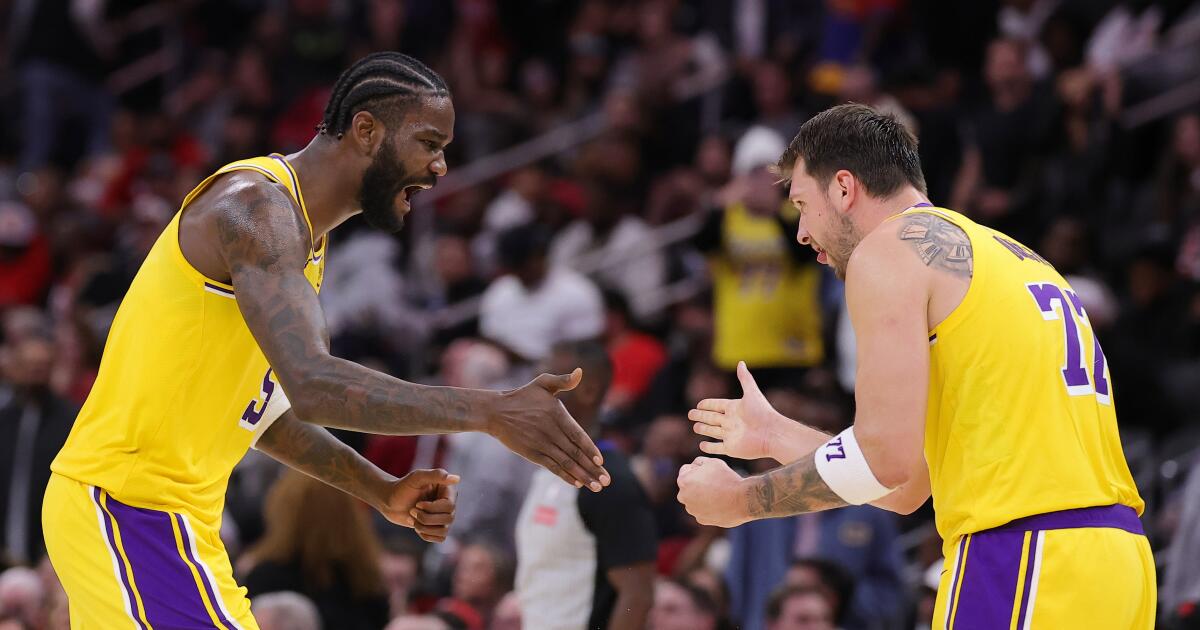
On Monday, the Lakers displayed their toughness in a 100-92 win over the Rockets at Toyota Center.
Even when they missed 14 straight shots at one point in the fourth quarter, the Lakers showed their resilience with a gritty defensive effort that kept them in the game. The Lakers scored just 17 points in the fourth, but they held the Rockets to just 12 points en route to their sixth consecutive win.
“They’re a really good basketball team and they make you either play hard and match their physicality, and how they muck the game up, or you can lay down,” Redick said. “And we didn’t lay down tonight. Had a deficit there in the third quarter. Our guys just kept playing.”
Luka Doncic led the Lakers with 36 points, six rebounds and four assists. LeBron James scored 18 points and Austin Reaves had 15 points.
But three big baskets from Deandre Ayton (seven points, 11 rebounds) and a big three-pointer by Marcus Smart (11 points) helped the Lakers open their six-game trip with a win.
Continue reading here
Lakers box score
NBA standings
Clippers edged by Spurs
Victor Wembanyama had 21 points and 13 rebounds and the San Antonio Spurs overcame an early 14-point deficit before blowing most of a 24-point lead and recovering to hold off the Clippers 119-115 on Monday night at Intuit Dome.
Stephon Castle had 23 points, eight assists and seven rebounds to lead the Spurs (50-18), who reached 50 wins for the first time since 2016-17 and trail the first-place Thunder by three games in the West. Devin Vassell added 20 points.
Fighting to secure a spot for the play-in tournament, the Clippers’ second straight loss dropped them back to .500 with Kawhi Leonard watching from the bench. The NBA’s sixth-leading scorer sat out with a sprained left knee.
Continue reading here
Clippers box score
NBA standings
Yamamoto to start on opening day
From Jack Vita: It’s only fitting that the pitcher who recorded the Dodgers’ final eight outs of the World Series will take the mound on opening day, as the club tries to pick up where it left off in 2025 and chase a third straight championship in 2026.
Dodgers manager Dave Roberts said Monday that World Series MVP Yoshinobu Yamamoto will toe the rubber for the March 26 opener at Dodger Stadium against the Arizona Diamondbacks — the second straight year he’s had the honor and the first time at home, after pitching last season’s opener in Tokyo against the Chicago Cubs.
Roberts added Yamamoto is expected to return to Camelback Ranch soon, after participating in the World Baseball Classic with Team Japan. The Samurai Warriors, seeking a second straight WBC title, were eliminated by Team Venezuela Saturday night in the quarterfinals.
Continue reading here
Dodgers reportedly agree to deal with Uniqlo for naming rights to Dodger Stadium field
Dodgers star Shohei Ohtani apologizes for ‘shortcomings’ in Japan’s early exit from WBC
Venezuela defeats Italy to set up WBC title showdown with U.S.
March Madness analysis
The NCAA men’s tournament bracket is set and the games are set to begin Tuesday with the First Four.
Here’s a rundown of the players to watch, potential underdog teams and what to know about the 2026 NCAA men’s basketball tournament.
Click here to continue
————
The NCAA women’s basketball tournament bracket is set and the games will begin Wednesday with the start of the First Four.
Here’s a rundown of the players to watch, potential dark horse teams and game previews for every region in the 2026 NCAA women’s basketball tournament.
Click here to continue
Kings defeat Rangers
Alex Laferriere had a goal and two assists to lead the Kings to a 4-1 win over the New York Rangers on Monday night.
Drew Doughty, Mikey Anderson and Trevor Moore also scored for the Kings, who have won three of five.
Darcy Kuemper stopped 21 shots.
Despite 22 saves from Igor Shesterkin, New York’s four-game winning streak ended.
Continue reading here
Kings summary
NHL standings
This day in sports history
1897 — Bob Fitzsimmons knocks out Jim Corbett in the 14th round to win the world heavyweight title in Carson City, Nev. It’s the first boxing match photographed by a motion picture camera.
1908 — Tommy Burns knocks out Jene Roche in 80 seconds at the Royal Theatre in Dublin, Ireland, to retain the world heavyweight title.
1939 — Villanova wins first game of the men’s NCAA basketball tournament, defeating Brown 42-30 in Philadelphia. Ohio State beats Wake Forest 64-52 in the second game of the doubleheader.
1940 — For the first time in NHL history, one line — The Kraut Line of Milt Schmidt, Woody Dumart and Bobby Bauer — finish 1-2-3 in NHL scoring when the Boston Bruins score five goals in the third period to defeat the Montreal Canadiens 7-2.
1955 — Canadien fans riot in the streets of Montreal protesting NHL President Clarence Campbell’s suspension of Maurice “Rocket” Richard the previous day. The Canadiens forfeit the game to the Detroit after a smoke bomb goes off in the Forum and crowds spill into the streets, setting fires, smashing windows and looting.
1961 — Manhattan District Attorney Frank S. Hogan arrests two pro gamblers, Aaron Wagman and Joseph Hacken, and implicates Hank Gunter and Art Hicks of Seton Hall in a collegiate point shaving scandal.
1993 — Dallas snaps a 19-game losing streak with a 102-96 win over visiting Orlando. The Mavericks were one game away from tying the 1972-73 Philadelphia 76ers for the longest single-season losing streak in NBA history.
2001 — Connecticut cruises to a 101-29 win over Long Island University in the first round of the East Regional, the best defensive effort in the history of the women’s NCAA tournament. Connecticut’s 72-point victory also ties the second-biggest margin in tournament history.
2006 — Jermaine Wallace hits a fadeaway three-pointer with a split-second left, and little Northwestern State pulls off a shocker with a furious rally, beating No. 3 seed Iowa 64-63 in the first round of the men’s NCAA tournament.
2012 — Lindsey Vonn sets a women’s record for the most World Cup points in a season after finishing eighth in a slalom won by Austria’s Michaela Kirchgasser at Schladming, Austria. Vonn reaches 1,980 points to beat the mark of 1,970 set by Janica Kostelic of Croatia in 2006.
2016 — Little Rock advances with an out-of-nowhere comeback that leads to an 85-83 double-overtime victory over Purdue in the first round of the NCAA tournament.
2018 — The UConn Huskies open their NCAA Women’s tournament with a record-setting 140-52 rout of Saint Francis (Pa.). The tournament’s top seed sets a record for points in a tournament game and all-time NCAA records for points in a period (55 in the first) and a half (94 in the first).
2020 — French Open becomes first Grand Slam tennis tournament to be postponed due to COVID-19 pandemic.
Compiled by the Associated Press
Until next time…
That concludes today’s newsletter. If you have any feedback, ideas for improvement or things you’d like to see, email me at houston.mitchell@latimes.com. To get this newsletter in your inbox, click here.