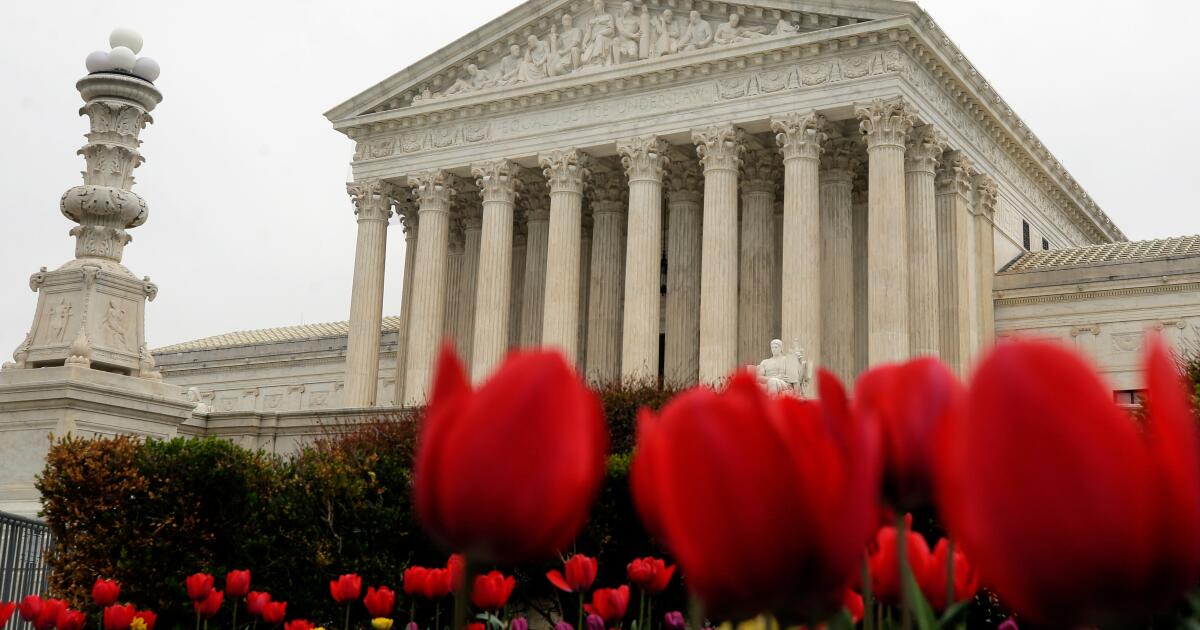
WASHINGTON — Supreme Court Justice Samuel A. Alito Jr. fell ill at an event in Philadelphia last month and was treated for dehydration before returning home to suburban Washington, the court’s spokeswoman said Friday.
Alito’s illness did not require an overnight hospital stay and he was back on the bench the following Monday, spokeswoman Patricia McCabe said in a statement.
Alito was an active questioner during arguments that day in an important case about mailed ballots and participated in all the court’s hearings over the ensuing two weeks.
Alito, who turned 76 on Wednesday, is the second-oldest member of the court, after 77-year-old Justice Clarence Thomas.
The episode was first reported by CNN, which also said the treatment was administered at a Philadelphia hospital. The court did not say where Alito had been taken.
The incident is the latest example of the justices’ reticence to discuss their health, at least until the news somehow leaks.
In 2020, the court confirmed that Chief Justice John G. Roberts Jr. had spent a night in the hospital after a fall that required stitches in his forehead, only after the Washington Post reported it first.
Alito was driven by his security detail from Washington to what CNN said was a dinner following a Federalist Society panel that looked at his 20 years on the court.
When he didn’t feel well in the evening, “he agreed with his security detail’s recommendation to see a physician before the three-hour drive home” to northern Virginia, McCabe said. He was given fluids for dehydration, she said.
While the justice has not said anything about retirement, speculation has swirled that Alito might soon step down, which would give President Trump the chance to appoint a fourth justice, after the three who were confirmed during his first term.
While Alito is young by Supreme Court standards, he might not want to stay around and gamble on the possibility of Democrats flipping the Senate in the November elections and seeing a Democrat capture the White House two years later.
Retiring in the summer would allow Trump to name a similarly conservative but much younger replacement who would almost certainly win confirmation from the Republican-led Senate.
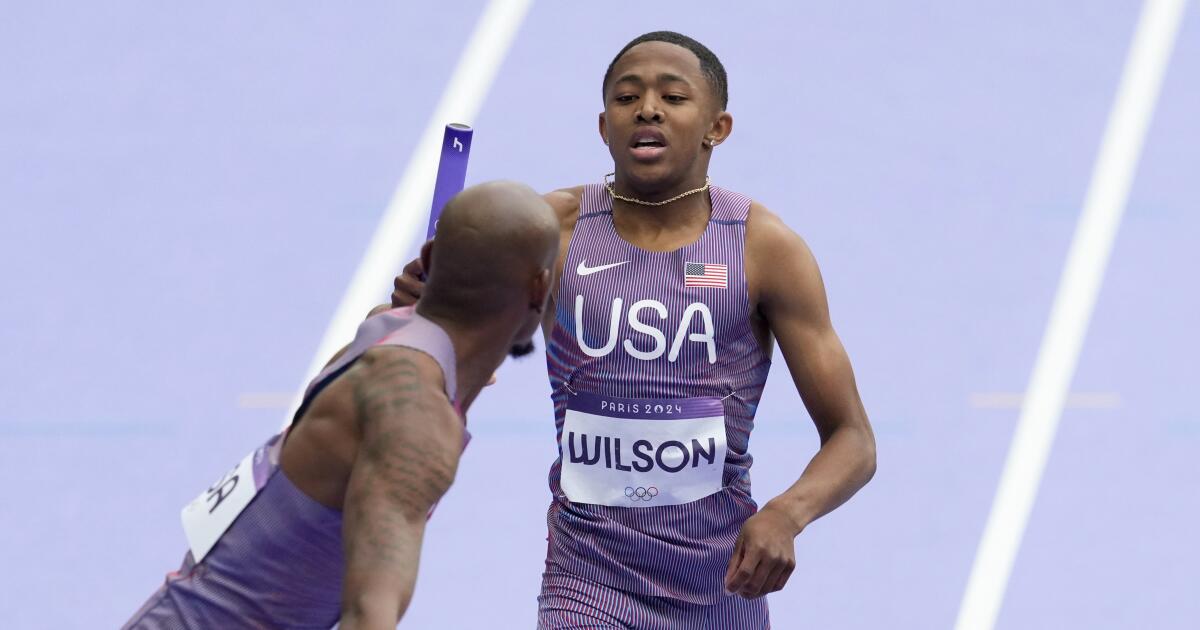
Now he’s pulled off the track equivalent with the announcement that 2024 Olympian Quincy Wilson, from Bullis School in Potomac, Md., is coming on April 11 to compete at the Arcadia Invitational at Arcadia High.
Wilson competed at the 2024 Olympic Games as a 16-year-old running a leg in the qualifying for the 4×400 relay and earning a gold medal when the team won in the finals. The 400 meters is his specialty, and he’s scheduled to run in that event along with the school’s 4×100 and 4×400 relay teams. That means he’ll get to face Servite, which has California’s best 400-meter relay team. It also means no one is going to leave the meet early since the final event is the 4×400 relay. Loyola, Servite and Long Beach Poly will be challenging Bullis.
Another star committed is from the girls ranks, Natalie Dumas from Eastern Regional High in Voorhees Township, N.J. She’s coming to try to break the national record in the 300 intermediate hurdles held by Sydney McLaughlin-Levrone.
Wilson is committed to Maryland and Dumas to Arkansas.
The meet begins at 5 p.m. on April 11. Tickets will go on sale this week.
This is a daily look at the positive happenings in high school sports. To submit any news, please email eric.sondheimer@latimes.com.
PRAGUE — Ilia Malinin is back on the top step of the podium.
Six weeks after a disastrous skate knocked the Olympic gold-medal favorite off the podium, the “quad god” reeled off one huge jump after another, and a backflip for good measure, to retain his world championship title for the third year running.
Malinin shouted and punched the air with relief after finishing a skate that showed he had achieved his desire to “move on” from the Olympics after days tormented by his mistakes.
He praised the crowd’s support, saying: “It was really challenging, really hard but with you guys I was able to make it through.” His aim, he added, had simply been to get through the free skate “in one piece.”
Skating last after leading the short program, just as he did in Milan, Malinin landed five high-scoring quadruple jumps but not his pioneering quad axel, a jump he didn’t attempt at the Olympics.
Malinin scored 218.11 in the free skate for a total 329.40, far ahead of silver medalist Yuma Kagiyama of Japan on 306.67. Another Japanese skater, Shun Sato, was third on 288.54.
Ilia Malinin performs a backflip during his free skate at the World Figure Skating Championships on Saturday in Prague.
(Petr David Josek / Associated Press)
Kagiyama beat his personal-best free skate score but still had to make do with a fourth career world championship silver in a career which includes four Olympic silvers and five total worlds medals, but no gold from either event. He still embraced Malinin after his skate and they jumped together in celebration.
In a showcase of top-level skating, there was no podium spot for France’s Adam Siao Him Fa, who had been in second after the short program but dropped to fifth overall after a fall. Estonia’s Aleksandr Selevko also fell dropped from third to sixth.
Malinin had no rematch with Mikhail Shaidorov, the skater from Kazakhstan who won the Olympic gold, because he opted against competing again this season.
That’s relatively common in figure skating for gold medal winners who face a rush of media and commercial opportunities after a grueling four-year Olympic buildup.
Malinin becomes the first skater to win three consecutive men’s world titles since fellow American Nathan Chen, who achieved the feat in 2018, 2019 and 2021 after the 2020 event was canceled because of the COVID-19 pandemic.
The last competition of the championships is the free dance portion of the ice dance event later Saturday. France’s Laurence Fournier Beaudry and Guillaume Cizeron are in the lead after Friday’s rhythm dance.
“What happened to my dreams? Simply put: they changed,” reads Phil Augusta Jackson aloud to a crowd in a furniture store. Tonight’s theme is change. From a podium, the television writer reflects on the long, thorny odyssey of his career. A pinball machine blinks in the background. Behind him, dreamy abstract prints hang on the wall, their shapes seeming to melt in the unseasonable spring heat.
Alongside mid-century furnishings and art in Echo Park, siblings Madeline Walter and Evan Walter host their wildly popular reading series, Essays. It’s a warm spring night. In a tender essay, Evan considers what he’s inherited from his idiosyncratic father. “I scream-sneeze like him now,” he reads. “It feels like a mess figuring out what parts of your parents you’re going to keep.”
In March 2024, the Walter siblings began the reading series in a friend’s backyard. “It was cold and wet, and we were so nervous nobody would come,” says Madeline. Since then, the show has moved through a series of venues before settling into a home at The Hunt Vintage. In just two years, it has grown into a local phenomenon, regularly drawing crowds of more than 150 people into the singular space.
The idea for Essays took shape during a conversation about creative constraints. Both writers and comedians, the siblings wanted to host a show that pushed beyond snappy punchlines and polished half-truths. “The objective is different from just being funny,” Madeline says. “It’s to tell me about yourself. Tell me something you’re thinking about.”
Siblings Madeline and Evan Walter host a popular monthly reading series called Essays at Echo Park’s Hunt Vintage.
(Ryan Wall )
Like many readings across Los Angeles, Essays taps into a growing appetite for sincerity. “People are really craving a space where you can be funny, be vulnerable, laugh at yourself — and where there’s an earnestness,” Evan says. That sensibility feels familiar to them. They grew up in what Madeline describes as a “very NPR-coded household that loved David Sedaris-style stuff.” She adds: “Doing something in the essay space feels like a surprising return to form.”
“One of my roommates describes it as a church-like experience, because everything is just so emotionally0driven and connective,” says Kaitlyn Kilmer, a longtime attendee.
The legacy of the series has begun to ripple outward. Their reading series has created a complementary Substack. Kilmer is now hosting a reading in her living room among friends.“We decided that we wanted to do our own, so I gathered a few friends who had been fans of the Essays show,” she says.
Essays exists in a larger network of reading series that make up Los Angeles’ diverse and ever-evolving literary scene. “There are so many readings now,” explains non-fiction writer Diana Ruzova, who frequently attends readings. “I’m not mad at it, though, mostly grateful that L.A. has a thriving literary community.”
In Los Feliz, Skylight Books continues to host intimate book launches for some of the most anticipated literary releases, drawing local favorites and celebrities.
“Our vibe is cozy,” says Mary Williams, general manager of Skylight Books. “We set up chairs under the big tree that grows in the middle of the store, and we hope this is a go-to place for our community to see their favorite authors while mingling with other book lovers.”
Elsewhere, at Heavy Manners Library, the tone of literary events leans more toward the experimental. “Experimental, unpolished writing can be shared and reflected on in an accessible, communal setting,” says program assistant Jane Shin.
This spring, literary events across the city run the gamut — from independent book fairs to poetry workshops, from the bizarre to the deeply vulnerable — welcoming everyone from curious newcomers to die-hard bookworms.
• The Academy Awards will move from the Dolby Theatre to L.A. Live in downtown Los Angeles beginning in 2029 under a new agreement with AEG that runs through 2039.
• The shift to L.A. Live will place the ceremony within a larger, campus-style complex, allowing the red carpet, show, press operations and post-show events to be staged in a more centralized footprint with increased capacity.
• The move will coincide with the Oscars’ shift to YouTube, part of a broader reset for the ceremony as it looks to expand its global reach after years of declining television viewership.
The Oscars are leaving Hollywood — or at least Hollywood Boulevard.
Beginning in 2029, the Academy Awards will move from the Dolby Theatre, their home for nearly a quarter century, to L.A. Live in downtown Los Angeles, the Academy of Motion Picture Arts and Sciences and AEG announced on Thursday. The ceremony will be held in the theater currently known as the Peacock Theater, which is expected to be renamed before the Oscars arrive as part of a new naming rights deal.
The new agreement runs through 2039. Discussions about the move have been underway for the last couple of years, according to people familiar with the planning who were not authorized to speak publicly.
The change in venue comes as the Oscars are also moving away from their traditional home on broadcast television. Earlier this year, the Academy announced that the ceremony will begin streaming live worldwide on YouTube in 2029, ending a five-decade run on ABC.
Since 2002, the show has been closely associated with Hollywood Boulevard, where the red carpet runs alongside the Walk of Fame and, for one night a year, the area becomes the symbolic center of the film industry. The Dolby Theatre sits at the corner of Hollywood and Highland, inside a retail and entertainment center near the TCL Chinese Theatre and the El Capitan.
L.A. Live offers a more centralized, campus-style setting, with venues and event spaces clustered together. The complex is adjacent to Crypto.com Arena and the Los Angeles Convention Center and is part of a larger sports and entertainment district developed and operated by AEG that regularly hosts concerts, sporting events and awards shows, including the Emmys and the Grammys. AEG has recently proposed adding a new hotel, residences and additional entertainment space to the complex, part of a longer-term expansion of the site.
In some ways, the move out of the Dolby is less a break than a return: The ceremony was staged for years in downtown L.A. at the Dorothy Chandler Pavilion and at the Shrine Auditorium before settling at the Dolby.
At the Oscars’ new home, the red carpet, ceremony, press operations and post-show events can all be staged within a compact footprint that includes the adjacent JW Marriott hotel and its ballroom. The theater itself is expected to undergo upgrades to its stage, sound and lighting systems, allowing it to be configured more specifically around the show. The move is also expected to increase capacity, a growing consideration as the academy’s ranks have expanded significantly in recent years, now numbering more than 11,000 members.
At the Dolby, space has long been tight. Each year, multiple blocks of Hollywood Boulevard are shut down for days at a time, rerouting traffic and turning the area into a heavily secured zone — conditions that were even more restrictive this year with security tightened further amid the war in Iran, including a one-mile police buffer around the theater.
The Academy had been looking for a venue that offered greater control over how the show is staged, including how the audience is arranged and how the room is used for both the broadcast and the live event. The new venue is expected to provide more room for press areas, green rooms and backstage operations, along with upgraded technical infrastructure for staging the ceremony.
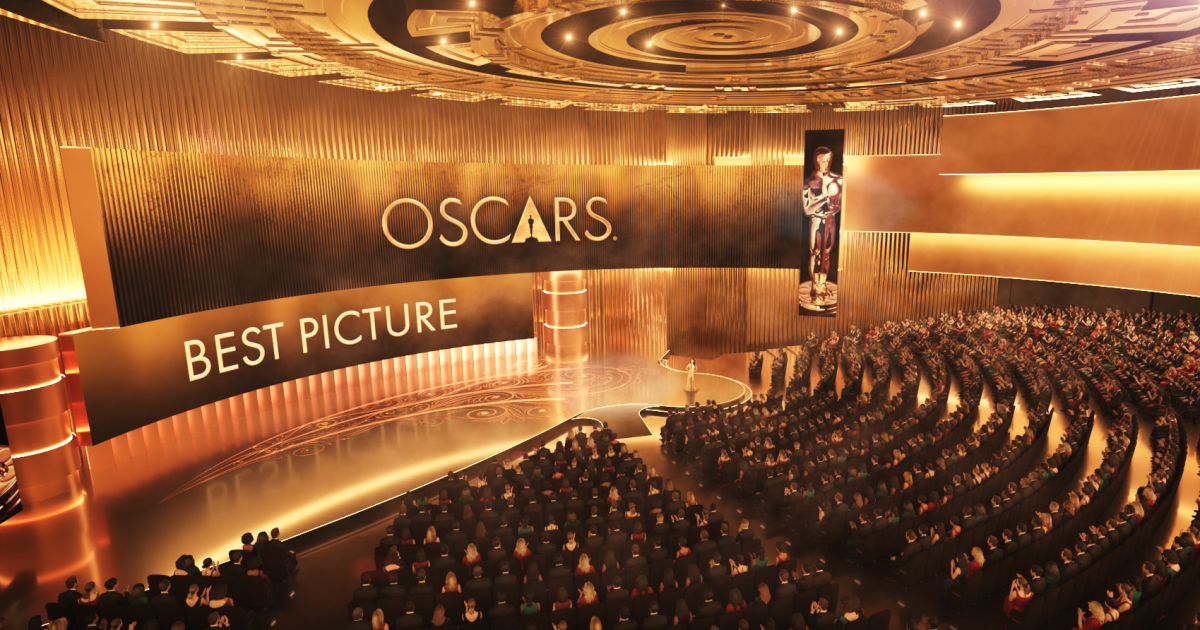
Early design renderings released by the academy suggest that, for viewers at home, the Oscars may not look all that different. The stage retains the sweeping, curved proscenium that has defined the Dolby Theatre era, suggesting a similar visual approach at a larger scale, with expanded screen space and a more immersive ceiling design.
For both the academy and AEG, which owns and operates the complex, the appeal is in keeping everything in one place — arrivals, ceremony, the Governors Ball and afterparties — rather than spreading events across multiple locations. The setup also creates new opportunities for hospitality and sponsorship tied to the broader campus.
“L.A. Live was built to host the moments that define culture and there is no greater global stage than the Oscars,” said Todd Goldstein, AEG’s chief revenue officer. “Together, we will create an environment that celebrates creativity, honors excellence and delivers an unforgettable experience for movie fans everywhere.”
Taken together, the changes amount to a significant reset for the Oscars, which have seen their audience decline from more than 40 million viewers in the late 1990s to 17.9 million this year, down 9% from the previous year. Moving to YouTube offers a way to reach a broader, more global audience at a time when traditional television viewership has declined.
The Oscars will remain at the Dolby through the 100th ceremony in 2028 before making the transition the following year.
“For the 101st Oscars and beyond, the Academy looks forward to closely collaborating with AEG to make L.A. Live the perfect backdrop for our global celebration of cinema,” Academy Chief Executive Bill Kramer and President Lynette Howell Taylor said in a statement.
GRAPEVINE, Texas — Conservatives are holding one of their largest annual gatherings at a perilous political moment for President Trump and with open division on the right over the war he launched in Iran.
While Trump maintains broad support among conservatives, the war in Iran is more than a wrinkle for activists drawn to his “America First” campaign pledge against getting involved in foreign conflicts. A new AP-NORC poll shows about 59% of Americans think the military action in Iran is excessive. The debate will be a subtext — and likely flare publicly — as thousands of activists, influencers and Republican lawmakers gather at the Conservative Political Action Conference that begins Wednesday outside Dallas.
The event also comes a day after a Democrat flipped the Florida state legislative seat that’s home to Trump’s Mar-a-Lago estate.
The gathering will be a contrast to the celebratory meeting one year ago when Trump, newly returned to office, vowed to “forge a new and lasting political majority” and Elon Musk wielded a chain saw to symbolize how the Republican administration was slashing the government workforce and red tape.
This year, neither Trump nor Vice President JD Vance has been publicly announced as speaking to the gathering. But among those who are slated to speak are big names in the MAGA movement who have voiced conflicting views on the Iran war.
“This is obviously going to be a hot topic,” said John Gizzi, a CPAC veteran and columnist for the conservative media outlet Newsmax, who noted the possibility of greater U.S. involvement over an uncertain length of time.
Some featured speakers are divided over Iran and Israel
Among the featured speakers scheduled at the four-day event is longtime Trump ally Steve Bannon. Bannon said during his “War Room” podcast this month that should the war become “a hard slog,” it could cost the GOP conservative voters ahead of the midterms.
“We are going to bleed support,” Bannon said.
Texas Sen. Ted Cruz, who supports the war, also is on the agenda at the Gaylord Texan Resort and Convention Center.
“I think President Trump was exactly right to act to protect Americans,” Cruz said last week in a CBS News interview.
Former Florida Rep. Matt Gaetz’s scheduled speaking slot is a reminder of the disagreement among some conservatives about the U.S. military alliance with Israel against Iran.
Gaetz, host of a show on the conservative One America News Network, has said the U.S. has been too cozy with Israel as popular conservative personalities such as Tucker Carlson have challenged conservatives’ longtime bond with the country, prompting criticism from GOP groups, including pro-Israel Republicans, of antisemitism.
Others scheduled to speak include Trump border czar Tom Homan and former Republican National Committee Chairman Michael Whatley, who is running for the U.S. Senate in North Carolina.
Trump’s standing is strong among his base
A year after Trump presided over the group’s jubilant conference upon his return to office, he is in a much different place.
At war while worries about jobs and household costs linger, his approval is down. His signature domestic policy, aimed at tightening voting rules ahead of November’s midterm elections, has stalled in a Congress his party controls, while the House Republican majority is in jeopardy and the party’s hold on the Senate is less certain than a year ago.
Despite the dividing lines, Trump enjoys enduring approval from his party’s right flank. Eighty-six percent of conservatives said they approved of the president’s job performance in a February AP-NORC poll.
And while Trump’s supporters remain devoted, some within the most conservative circles say division over Iran could signal trouble for Republicans in November.
Texas Rep. Steve Toth, who plans to attend CPAC, suggested that Trump’s support remains robust among conservatives but that Republican messaging on the war could be stronger.
“From MAGA people, for the most part, I don’t hear frustration with the president,” said Toth, who beat incumbent Republican Rep. Dan Crenshaw in Texas’ March 3 primary. “I don’t know that we’re doing a great job at communicating the full ramifications.”
Texas’ GOP Senate primary is a lingering issue
Another stark reminder of the contrast with last year is Texas’ unresolved Senate primary, a particular political headache for Trump.
Texas Attorney Gen. Ken Paxton, who is challenging four-term GOP Sen. John Cornyn, not only is attending the event but also has one of the event’s premier speaking roles, the Ronald Reagan Dinner on Friday evening. Cornyn is not attending the Texas conference.
Trump said three weeks ago he would soon endorse one of them after Paxton finished narrowly behind Cornyn in the March 3 primary, though neither received a majority to avoid a May 26 runoff.
Trump implored whoever didn’t get the endorsement to drop out, writing in a social media post that the bitter contest “cannot, for the good of the Party, and our Country, itself, be allowed to go on any longer.”
The deadline for candidates to remove their names from the May 26 runoff ballot passed last week, as Paxton and Cornyn were launching stepped-up attack ads targeting one another.
Beaumont and Catalini write for the Associated Press. Catalini reported from Morrisville, Pa. AP writer Amelia Thomson DeVeaux in Washington contributed to this report.
A proposed gubernatorial forum hastily cobbled together in the hours after USC canceled its Tuesday debate fell apart because the candidates of color who were excluded from the previously planned event were unable to show up in person at KNBC-TV’s studio in Universal City, according to multiple sources.
Facing mounting pressure that its debate selection criteria excluded every candidate of color, the university canceled its debate late Monday. On Tuesday morning, billionaire Tom Steyer — a Democrat — proposed holding an alternative face-off, with KNBC moderating. But the candidates who had not been invited to the USC debate had already made other commitments.
“A lot of this came out of nowhere — there’s a debate and you’re not invited, followed by there’s no debate, and then maybe we should all hang out and have a conversation,” said Kyle Layman, a strategist advising former U.S. Health and Human Services Secretary Xavier Becerra.
USC officials declined to comment on Tuesday’s developments — as did KABC-TV, one of the broadcast partners of the canceled debate. KNBC did not respond to a request for comment, but someone involved with planning a potential debate there said pulling together such an event in just a few hours was impossible, and also unfair to the candidates who had made other plans after initially being excluded from the USC debate.
“We looked into the possibility of doing something. It just wasn’t possible because of the last-minute logistics. It was not feasible,” said the person, who asked for anonymity to speak candidly. “We couldn’t get everybody here.”
The fact that the candidates excluded from the USC debate couldn’t find a way to participate in Tuesday evening’s alternative forum irritated some people involved in the planning, however. Becerra, state Supt. of Public Instruction Tony Thurmond, former Los Angeles Mayor Antonio Villaraigosa and former state Controller Betty Yee had loudly protested not being invited to the USC event.
“This is like probably one of the last opportunities they have to be with other leading contenders of the race, so why not take this opportunity?” said someone who took part in conversations about the proposed last-minute debate, who asked for anonymity to speak openly. “If the whole thing is about bringing your message to the voters, making sure voters have as much information as possible, talking about the issues that matter, wouldn’t you want to take every opportunity to do that?
“If you’re going to talk a big game about taking your message to voters, the importance of debates, why not do it?” this person said.
Becerra, Thurmond, Villaraigosa and Yee have reportedly formed an informal pact not to participate in any debate that does not include all of them, which Yee referenced in a Tuesday afternoon news conference.
“The idea that none of the candidates of color are going to be joining a debate is just inappropriate for a state like California,” Yee said. “We also need to have a commitment from all of the debate sponsors that they will include all of us going forward.”
Yee and Thurmond were not invited to the next major televised debate, which will take place April 1 at Fresno State University. Becerra and Villaraigosa had previously confirmed their attendance, according to a news release from the Western Growers Assn., one of the event’s sponsors.
And all four candidates of color, along with San José Mayor Matt Mahan, were not invited to a debate on April 22 in San Francisco that will be hosted by KRON-TV and broadcast on Nexstar Media Group stations throughout California.
“We don’t need gatekeepers,” Mahan said in a statement Tuesday evening. “I’m calling on my fellow candidates to work together to organize our own debates — so we can take our ideas for a better California to every corner of California. Let’s let the voters truly decide.”
The scrapped USC debate was going to be hosted by the institution’s Dornsife Center for the Political Future and co-sponsored by KABC and Univision. Six candidates had been invited to participate: Democrats Rep. Eric Swalwell (D-Dublin), former Orange County Rep. Katie Porter, Mahan and Steyer; along with the leading Republicans, conservative commentator Steve Hilton and Riverside County Sheriff Chad Bianco.
Candidates and elected officials called the criteria used to determine participation in the debate biased because it included Mahan, a white candidate who is polling near the bottom of the pack but is supported by notable names in the USC community. Hours after the debate was canceled, Steyer’s campaign sought to create an alternate event that would include all of the candidates.
“We were trying to do the right thing upon learning that the debate was canceled at USC,” said a member of Steyer’s campaign who asked for anonymity to speak candidly. “Tom immediately was like, ‘We can do something alternative.’ People want to hear from the gubernatorial candidates. It was on the table. It was offered.
“NBC couldn’t get all the candidates here, but we tried,” this person said. “Given the short amount of time we were trying to put this together, it ultimately could not happen because not all the candidates could get to the studio.”
Thurmond, who was in Sacramento and Richmond on Tuesday, joined a political influencer on YouTube Tuesday evening, while Yee attended previously scheduled events with the East Area Progressive Democrats and a women’s group in the L.A. area. Villaraigosa had lined up other interviews at his Wilshire campaign office, Becerra was traveling, and Porter was scheduled to host a livestream on her Instagram account Tuesday evening.
Keeping and maintaining friends as an adult is hard, especiallywith the demands of life, travel and work. In volunteering, I encounter more people like myself, which is nice, but sometimes it’s difficult to participate without a lot of commitment to the organizations. I’m wanting to explore smaller, intimate groups to build community with people who I share similar values with. I’m interested in self-growth, psychology, games, mindfulness and yoga. I loved the L.A. Times story “Awaken your inner child at this welcoming collage club for adults” and I would love to know about similar activities. Thanks! —Marlen I.
Looking for things to do in L.A.? Ask us your questions and our expert guides will share highly specific recommendations.
Here’s what we suggest:
Marlen, I couldn’t agree more. As we get older, it can feel more and more difficult to sustain friendships, especially in Los Angeles, where people live so far apart and have busy lives. This struggle is exactly why so many social clubs have been sprouting up in L.A. over the last few years. From board game clubs to junk journaling meetups, there’s so many different ways to connect and maybe try something new. I’ve compiled a list of social clubs and community spaces that I think you’ll enjoy.
Since you’re already familiar with Art+Mind Studios, you should definitely check out Junk Journal Club. Junk journaling is essentially a craft practice that combines elements of collaging, journaling and scrapbooking. With the rise of junk journaling content on social media, the once solo pastime has turned into a lively social scene. Junk Journal Club, dubbed “the original junk journal club,” hosts monthly meetups, which can be found on its Instagram page. When my colleague Malia Mendez went to an event recently, people told her that attending Junk Journal Club “has made befriending strangers easy,” and many of them stay in touch.
Another craft-centered event that’s worth exploring is the Crafters Clubhouse, which founder Victoria Ansah calls “a creative third space for adult makers.” She hosts monthly arts and crafts workshops including activities like scrapbooking, punch needle embroidery and clay art.
Given that you’re interested in yoga and mindfulness, you may like WalkGood LA, a community-centered wellness organization that hosts a variety of activities including a run club and accessible yoga classes. During the pandemic, I found solace in attending their weekly yoga classes called BreatheGood. The outdoor sessions take place every first Sunday at Kenneth Hahn State Recreation Area and feature free chiropractic adjustments and healthy food vendors. The vibe of the intergenerational event feels warm and welcoming. All you have to do is show up with your yoga mat. The organization also hosts various classes including yoga, breath work, mindful meditation, mat Pilates and step aerobics at their studio, the WalkGood Yard, in Arlington Heights.
Another social club I recommend is Love, Peace & Spades, which my friend Kevin Clark started in 2022, to create a space where people could play the card game with others. With music provided by a live DJ, the monthly game night feels like being at a family cookout. Spades can be extremely intimidating to start as a beginner playing with pros. But don’t worry. Love, Peace & Spades has instructors who can teach you how to play.
If you’re interested in chess, L.A. Chess Club is “an event with the laid-back ease of a chill game night and all the social and romantic possibility of a night out on the town,” according to Times contributor Martine Thompson, who wrote a story about the event. At the weekly gathering, which features a food vendor, cocktails, tattoo artists and DJs, you can “competitively play chess, learn the game, meet new friends or mingle as a single person,” Thompson shares. Another fun event is RummiKlub, a monthly Rummikub game night that takes place in elevated, design-forward spaces across the city.
L.A. also has several fun creative venues that regularly bring people together, such as Junior High, a nonprofit art gallery and inclusive gathering space that hosts artist showcases, comedy nights, pottery workshops and more. There’s also Nina in Atwater, which holds a variety of gatherings including a monthly series that focuses on mindfulness called “Be Here Now: Simple Tools for an Everyday Nervous System Reset.”
I hope that these suggestions are a good starting point for finding the group, or several groups, that are an ideal fit for you. Just by putting yourself out there and being open, you are bound to build and find community. Best of luck on your journey!
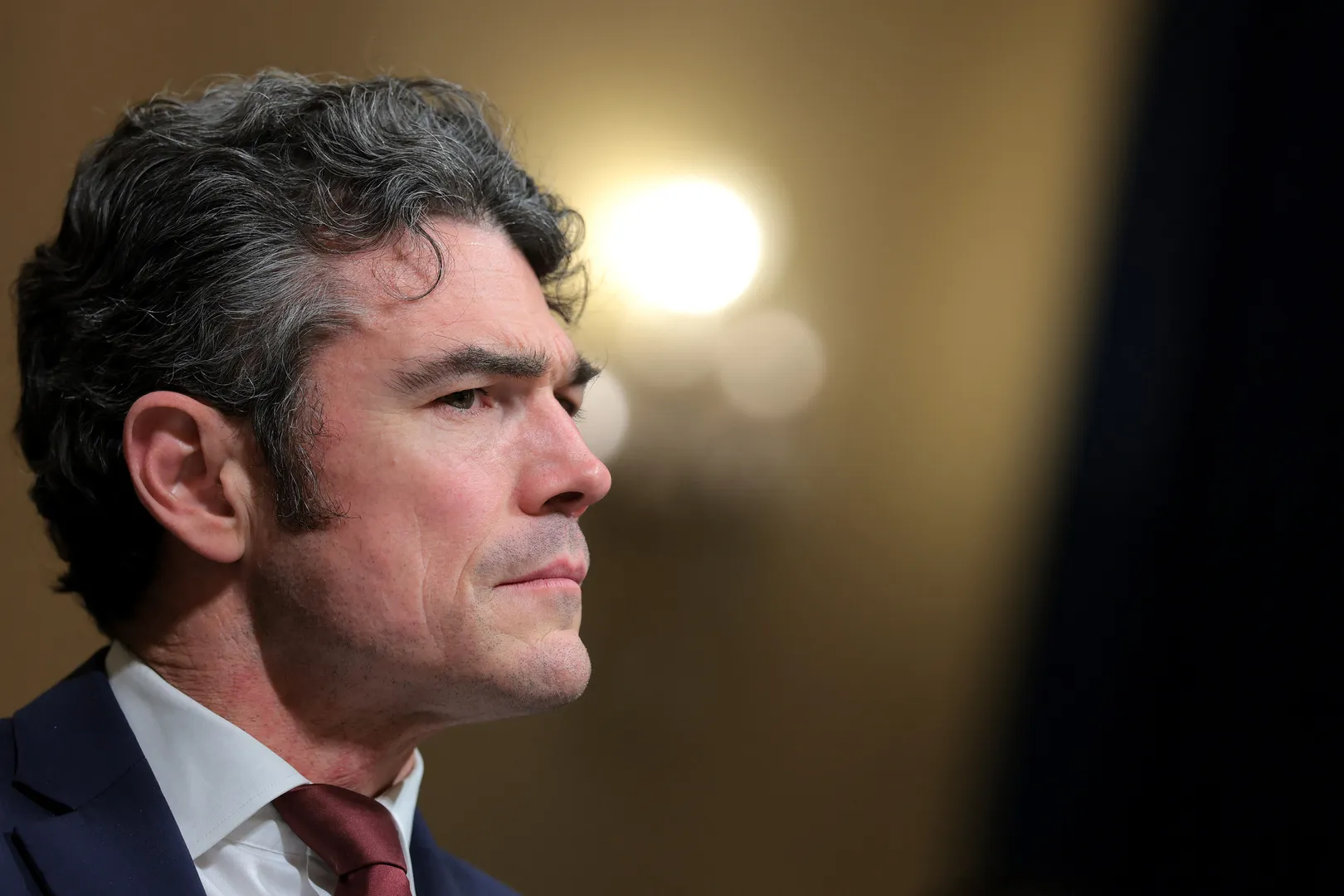
Joe Kent says he resigned as director of the US National Counterterrorism Center over opposition to the war in Iran, telling an audience at a Washington prayer event that he couldn’t “send young men and women off to die on foreign battlefields” in “good conscience.”
Community tensions – and reports of both antisemitism and Islamophobia – have been rising in Australia since Hamas attacked Israel on 7 October 2023, killing more than 1,200 people and taking 251 others hostage. Israel’s offensive in Gaza has led to more than 72,000 Palestinian deaths, according to the Hamas-run health ministry.
There’s still nine months to go before audiences can return to Arrakis. Until then, Warner Bros. has released a trailer to hold us over.
“Dune: Part Three,” which takes place nearly two decades after the events of the sequel, promises more political upheaval, introduces a ruthless new villain and teases Paul and Chani’s future child, according to a trailer released Monday.
“Dune” stars Zendaya and Javier Bardem joined Denis Villeneuve to preview the trailer for the conclusion to his famed sci-fi trilogy. New cast members Anya Taylor-Joy and Robert Pattinson were also in attendance at the AMC event while Timothée Chalamet, Florence Pugh and Jason Momoa sent video messages.
“It’s a trailer launch? It looks like a premiere,” Villeneuve said during the event, which included a Q&A with the cast and was met by thunderous applause from the audience.
Zendaya, who stars in the films as Chani, a Fremen warrior, expressed excitement about the upcoming film, saying the “movies have meant so much to me over the years. I’ve literally been able to grow up in my entire 20s doing them, and so they have such a special place in my heart.”
Here’s everything to know about “Dune: Part Three.”
What is ‘Dune 3’ about?
The trilogy’s final installment picks up 17 years after the second movie, though the trailer hints at continued war and political turmoil in Arrakis and beyond.
Paul Atreides, played by Chalamet, is dealing with the consequences of defeating the Harkonnens and becoming emperor, struggling with his role as the Fremen’s messiah.
The trailer hints at a possible future child between Paul and Chani. The pair, who are introduced as potential love interests in the first movie, were split up at the end of the second film, with Paul marrying Princess Irulan, played by Pugh, in a political move to ensure his ascension to the throne.
In the trailer, Chani asks Paul, “If we have a girl, what will we name her?” hinting at a possible reconciliation. In a pre-recorded video played during the event, Pugh addressed the love triangle, and asked Zendaya what her character thinks of Irulan’s marriage to Paul.
“You guys will just have to see for yourself what happens, because it’s quite the journey,” Zendaya said during the event.
At the heart of the third movie, Villenueve said, is a love story, adding that “the heartbeat of the film is still the relationship between Paul and Chani,” according to Deadline.
The trailer also offers a sneak peek at continued battles in the universe, even years after Paul, the “chosen one,” becomes emperor.
Jason Momoa returns as Hayt in “Dune: Part Three,” a clone of Duncan Idaho.
(Warner Bros. Pictures)
When will ‘Dune 3’ be released?
The final installment of the trilogy will hit theaters Dec. 18.
“Dune: Part Three” is inspired by “Dune Messiah,” the second novel in Frank Herbert’s “Dune” series. The first two films were adapted from the first novel.
Villeneuve had planned to temporarily step away from the “Dune” universe, but “felt a responsibility to finish the story” after seeing audience excitement for the second film, which was released in 2024, he said during the trailer launch. The first two movies were box-office hits, collectively grossing more than $1.1 billion worldwide. “Part Two” won two Oscars, and the first film earned six Oscars out of 10 nominations, primarily in the technical categories.
“It’s a good idea to come back to those worlds, not by nostalgia, but by urgency,” he said. “If the first movie was contemplation — a boy exploring a new world — and the second one is a war movie, this one is a thriller. It is action-packed and tense. More muscular.”
Robert Pattinson plays shape-shifting villain Scytale in “Dune: Part Three.”
(Warner Bros. Pictures)
What have ‘Dune’ stars said about the film?
The trailer’s exclusive screening was introduced via a video message by Chalamet, who said Villeneuve’s third film is “a true act of cinema.”
“This film would not exist without the master of cinema, the great artist that is Denis Villeneuve,” Chalamet said. “I’m not alone in saying thank you to Denis for his dedication in bringing the ‘Dune’ films to life — and now the ‘Dune’ trilogy to life.”
Momoa, who starred in the first film as Duncan Idaho before his character was killed off, will be back in the third installment, he announced in a video at the event. Taylor-Joy, who had a brief cameo in the second movie, will return as Paul’s younger sister Alia.
Pattinson will take on the role of shape-shifting villain Scytale. Pattinson said he got the job just months after he asked Zendaya how he could join the “Dune” cast while on set filming their black comedy “The Drama.” (The A24 movie opens April 3.)
“Everybody wants to work with Denis. He’s a master,” Pattinson said during the event. “When you see the scope and scale and ambition of these movies, like on set, you get why they feel like this on the screen. It’s just extraordinary.”
ABC’s Sunday telecast of the 98th Oscars averaged 17.9 million viewers, ending a four-year streak of audience increases.
The figure from Nielsen is down 9% from the 19.7 million viewers who watched the telecast on ABC and Hulu in 2025.
After ratings for the Oscars cratered to an all-time low of 10.5 million viewers in 2021, the event’s audience levels ticked back up in recent years.
But the show has not topped 20 million viewers since 2019, as younger viewers are content to watch highlights of the ceremony on social media, rather than sit through a three-hour-plus telecast on traditional TV.
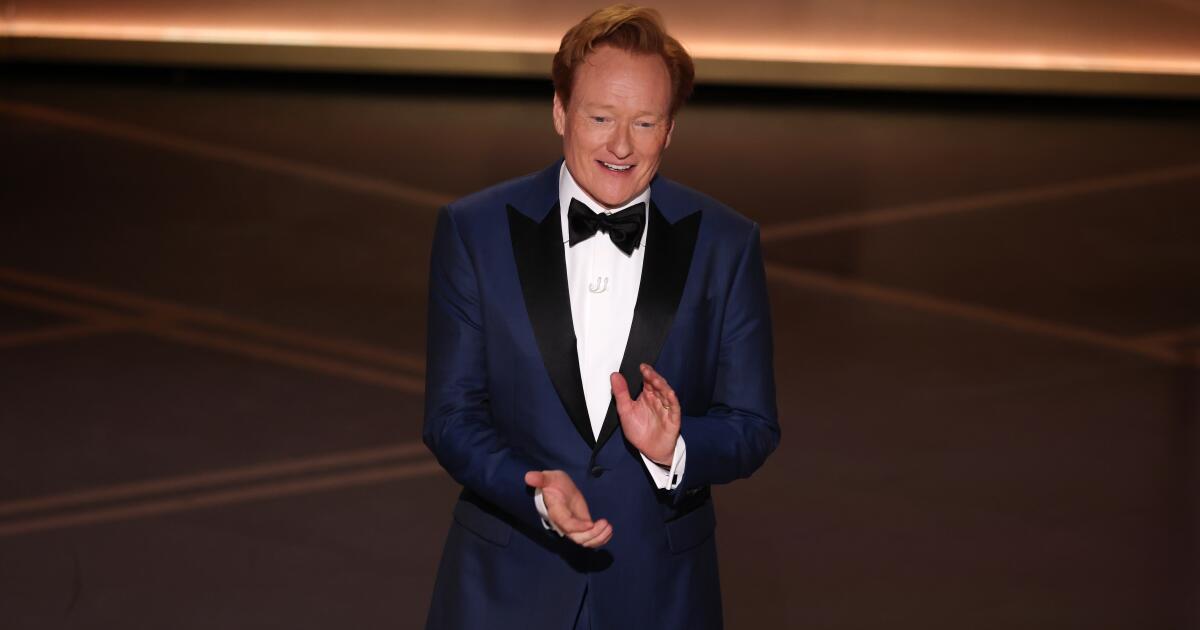
The awards held at the Dolby Theatre in Hollywood honored “One Battle After Another” for best picture, Michael B. Jordan for lead actor in “Sinners,” and Jessie Buckley for lead actress in “Hamnet.” Conan O’Brien was the host for the second straight year.
Critics said the ceremony was light on political statements about President Trump, whose name was not mentioned during the telecast. The show’s highlight was an extended “In Memoriam” segment that gave extra tribute to legendary actor and filmmaker Robert Redford and slain actor, director and producer Rob Reiner.
ABC had success in selling out the commercials for the Oscars, which is perennially the most watched non-sports telecast of the year. But the network will only have the event for two more years as the Academy of Motion Picture Arts and Sciences chose to take a better financial offer from YouTube for the rights to the telecast starting in 2029.
O’Brien poked fun at the YouTube move. He closed with a video that shows him being appointed Oscars “host for life.” As he takes in the honor, poison gas seeps into the office he is given. After O’Brien’s lifeless body is wheeled out, a name plaque with a new host is put on the door. His successor is YouTube star Mr. Beast.
The United Farm Workers said it would not participate in celebrations of its founder Cesar Chavez amid what the labor union described as “troubling allegations” against the iconic Chicano figure.
The union, in a statement released Tuesday, did not detail the accusations against Chavez but said they were concerning enough for the organization to take action. But several events around the country honoring Chavez including events in Tucson, Houston, Corpus Christi, San Antonio and San Bernardino have been canceled in recent weeks, with little explanation given by organizers.
The claims against Chavez “are incompatible with our organization’s values. Some of the reports are family issues, and not our story to tell or our place to comment on. Far more troubling are allegations involving abuse of young women or minors. Allegations that very young women or girls may have been victimized are crushing. We have not received any direct reports, and we do not have any firsthand knowledge of these allegations,” the union said.
Canceling events, the union said, would “provide space for people who may have been victimized to find support and to share their stories if that is what they choose.”
Chavez is a towering national figure credited with organizing and raising the lives of migrant farmworkers in California and beyond and giving voice to the struggles of Mexican Americans.
Bursting into national prominence in the mid-1960s in the San Joaquin Valley, Chavez galvanized public support on behalf of them after organizing community groups across Central and Southern California. For decades, agricultural laborers had lived in substandard housing and were paid terrible wages. Efforts to organize migrant laborers were usually crushed violently by farmers and local law enforcement.
Chavez and his associates joined a grape pickers’ strike in 1965 launched by Filipino organizers centered around Delano, the heart of California’s table grape crop. Those early years were marked by bitter and sometimes brutal incidents involving picketing farmworkers who screamed “Huelga!” — “Strike!”—and growers who vowed never to give in to Chavez and his movement.
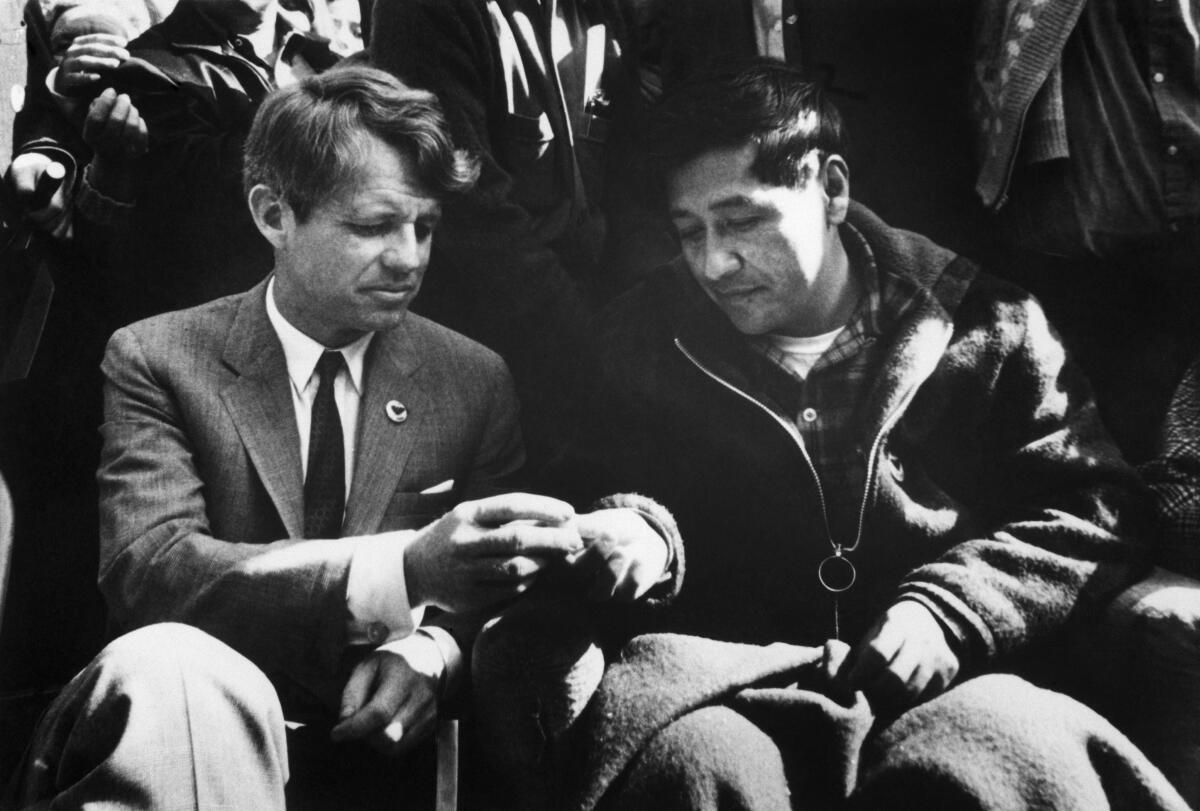
Sen. Robert Kennedy and Cesar Chavez as Chavez ended a 25-day fast.
(Bettmann Archive)
That eventually transformed into a boycott that earned international attention. Chavez, drawing on his Catholic faith, fasted for 25 days in 1968 to draw attention to the violence swirling around the effort, ending it by sharing bread with then-presidential candidate Robert F. Kennedy. Two years later, the UFW was able to secure contracts for more than 10,000 grape pickers.
Those successes made Chavez an almost mythic figure. The UFW flag — a stylized black Aztec eagle against a red background — became synonymous with the Chicano movement that was emerging at the same time. Posters and murals featuring Chavez’s beatific face sprouted in the Southwest and beyond. He traveled across the United States espousing his philosophy of nonviolence, union and dignity for farmworkers.
But Chavez’s legacy became increasingly tarnished as the years went on. Labor victories became fewer and fewer. His fierce criticism of illegal immigration — Chavez argued that they undercut his unionization efforts — put him at odds with immigration activists. A 2006 Times investigation detailed how dozens of former associates and workers left the UFW because of what they described as Chavez’s increasingly autocratic ways.
Cesar Chavez talks to striking Salinas Valley farmworkers.
(Sakuma / Associated Press )
When the Los Angeles County Board of Supervisors decided to change the name of Brooklyn Avenue in East Los Angeles and Boyle Heights to Cesar Chavez Avenue after the labor leader’s death in 1993, many in the community opposed it, citing the economic burden businesses would undergo to update their addresses and the erasure of the community’s history on the street.
Yet his standing among Latinos nationwide was such that schools, streets and parks were renamed in his honor in the years after his death. In 2012, President Obama went to tiny Keene, Calif. — where Chavez had set up both his home and the operational headquarters of the United Farm Workers — to dedicate the César E. Chávez National Monument.
It’s unclear the source of the new allegations or when they might become public. But there has been rumbling for weeks among activists that something about Chavez was coming.
Huerta is not commenting on the issue at this time, said Eric Olvera, spokesperson for Huerta.
The news comes two weeks before Cesar Chavez Day, observed March 31.
Local organizers in Los Angeles haven’t announced whether they will cancel their events.
The UFW was vague about the claims but suggested they were serious enough for extreme action.
“These allegations have been profoundly shocking. We need some time to get this right, including to ensure robust, trauma-informed services are available to those who may need it.
“We understand this will be tremendously painful for many and we encourage our community to seek mental health support if they experience distress.”
Tuesday morning, the Cesar Chavez Foundation said in a statement that it had “become aware of disturbing allegations that Cesar Chavez engaged in inappropriate sexual behavior with women and minors during his time as President of the United Farm Workers of America.”
The foundation said it was working with leaders in the farmworker movement to be responsive to these allegations and support the people who might have been harmed.
“In partnership with the UFW, we are establishing a safe and confidential process for those who wish to share their experiences of historic harm, and, if they choose to, participate in efforts toward repair and reconciliation,” the statement said. “In addition, we are investing time and resources to ensure the Foundation promotes and strengthens a workplace culture that is safe and welcoming for all.”
In the 48 hours before the UFW and Cesar Chavez Foundation made their statements, La Unión del Pueblo Entero, a community-based union and nonprofit in the Rio Grande Valley of Texas, which was founded by Huerta and Chavez, erased the names and affiliation with the leaders from its website.
The new allegations could have implications beyond Chavez’s place in history. If he has been accused of sexual abuse, a legal expert said it could spark legal claims against the union he ran for so long.
In California, Assembly Bill 250 opened a two-year window to file sex assault claims beyond a previous statute of limitations. The Catholic Church, Scouting and public school districts, as a result, have been hit hard with lawsuits.
“It is [a] matter [of] who knew what and when,” said John Manly, a sexual abuse attorney, adding that Chavez’s leadership role could create liability for the UFW.
Athletes in T-shirts, fans applying suncream – have these been the Summer or Winter Paralympics?
If you were to listen to American Patrick Halgren, who called the conditions at the Milan-Cortina Games “tropical” and “like surfing”, you would think the former.
Until you were told he is a skier.
Since the 1992 Games, the Winter Paralympics have always been held in March, usually starting just shy of a fortnight after the conclusion of the Winter Olympics.
That means conditions during the Games have often been more spring-like than winter, with temperatures peaking at 26C four years ago in Beijing.
While such temperatures have not been felt in Cortina, it has been warm, and until a huge dump of snow fell the night before Sunday’s final day of competition, snow had only been seen on the groomed competition pistes.
A blazing sun on several days of competition, mixed with some rain, had caused snow on the courses to turn soft and slushy, which in turns sticks to athletes’ skis and snowboards.
Last weekend a third official training session for the Para-alpine skiing downhill events was cancelled in a bid to maintain the piste conditions.
While many athletes have praised the efforts of organisers to keep the tracks in as good a condition as possible, conditions on Friday during the men’s giant slalom events were far from ideal, with British visually impaired skier Fred Warburton describing it as a “bathtub of Slush Puppie”.
His guide, James Hannan, said: “The snow surface was changing every single gate, so we never knew how the ski was going to react.
“It was almost like survival of the fittest.”
It certainly proved that way during the sitting event, which followed the visually impaired and standing races: 18 athletes from a field of 37 failed to make it to the bottom of the course.
“The organisers need to look at scheduling with obvious changes of the climate that we’re experiencing,” said Warburton.
“Both the Olympics and Paralympics want to be top spectacles of skiing and allow athletes to put their best work down.
“We need to look at the schedule and move it forward in future. That’s way beyond my pay grade, but it seems pretty logical to me.”
Warburton’s words echoed those of retired American Paralympic snowboarder Amy Purdy, who this week said in a video on TikTok: “I don’t believe that the Paralympics should be happening right now.”
Her comments came after the snowboard cross course had to be adjusted following numerous crashes in training, partly because of its design but also the warm conditions.
The event will feature authors, poets, artists and podcasters across panels, book signings, cooking demonstrations and screenings. This year’s lineup includes comedian Larry David, actor and Booker Prize judge Sarah Jessica Parker, musician Lionel Richie, Beyoncé’s mother and multihyphenate Tina Knowles, bestselling author and social critic Roxane Gay and News & Documentary Emmy- and Peabody-nominated scholar Reza Aslan, among others.
Scheduled for April 18 and 19, the literary festival will feature more than 550 storytellers and nearly 100 panels across the University of Southern California’s campus.
Other notable personalities include: Pat Benatar, Blippi, Mark Harmon, David Duchovny, Susan Lucci, Jennie Garth, Hannah Brown, Anne Lamott, Chanel Miller, Lisa Rinna, Stephanie Garber, Jon Klassen, Mac Barnett, Meghan Quinn, Hayley Kiyoko, Megan McDonald, Elyse Myers, Eli Rallo, Raegan Revord and Molly Jong-Fast.
As part of the Ideas Exchange speaker series, Richie will sit down with Times Pop Music Critic Mikael Wood, to discuss “Truly,” Richie’s new memoir. The book explores the singer’s upbringing in Alabama and his rise to stardom, including performing with the Commodores.
This year’s event will debut the Audiobook and Podcast Stage presented by Spotify, hosting talent like “Crimes of The Times” host and Times writer Christopher Goffard and “Remarkably Bright Creatures” bestselling author Shelby Van Pelt. The festival will also screen a preview of the Hulu show “Rivals,” which will be followed by a discussion between producer and writer Dominic Treadwell-Collins and actor Nafessa Williams.
At the Times Food Stage, Cassandra Peterson, known for her work as Elvira, will be demoing from her book “Elvira’s Cookbook From Hell.” Culinary influencer Cassie Yeung will also be stopping by to discuss recipes from her new Asian takeout cookbook “Bad B*tch in the Kitch.”
The festival will kick off April 17 with The Times hosting the 46th annual L.A. Times Book Prizes at Bovard Auditorium. The ceremony will honor Amy Tan with the Robert Kirsch Award for lifetime achievement, We Need Diverse Books with the Innovator’s Award and Adam Ross with the Christopher Isherwood Prize for Autobiographical Prose. The prizes recognize 61 works in 13 categories.
General admission to the festival is free. Friend of the Festival packages, which include panel reservations, parking and merchandise, are currently on sale.
Tom Brady‘s return to the football field will take place on U.S. soil.
Right here in Los Angeles, to be specific.
The Fanatics Flag Football Classic, featuring Brady and a slew of other NFL stars and athletes, will take place March 21 at BMO Stadium, the venue that is also slated to host flag football during the 2028 Summer Olympics.
The event was originally scheduled to take place on the same date, but at a location more than 8,000 miles away at Kingdom Arena in Riyadh, Saudia Arabia.
No official reason for the relocation has been given, although the move was made amid increased tensions in the Middle East after the United States and Israel began military strikes against Iran this month. Last week, Iran used two drones to strike the U.S. Embassy in Riyadh, Saudi Arabia’s capital city.
The event will feature three 12-player teams. Brady, the retired seven-time Super Bowl champion and minority owner of the Las Vegas Raiders, and Philadelphia Eagles quarterback Jalen Hurts will co-captain the Founders FFC team, which will be coached by Denver Broncos’ Sean Payton.
A second team, Wildcats FFC, will be co-captained by Cincinnati Bengals quarterback Joe Burrow and Washington Commanders quarterback Jayden Daniels, with San Francisco 49ers’ Kyle Shanahan coaching. During a March 18 draft, the two teams will be built from a pool of athletes that include Philadelphia Eagles running back Saquon Barkley, Cleveland Browns defensive end Myles Garrett, former Rams receiver Odell Beckham Jr., four-time Super Bowl-winning tight end Rob Gronkowski and WWE star Logan Paul.
The third team in the event is the U.S. national flag football team, the reigning IFAF flag football world champion coached by Jorge Cascudo and captained by Aamir Brown and Darrell “Housh” Doucette.