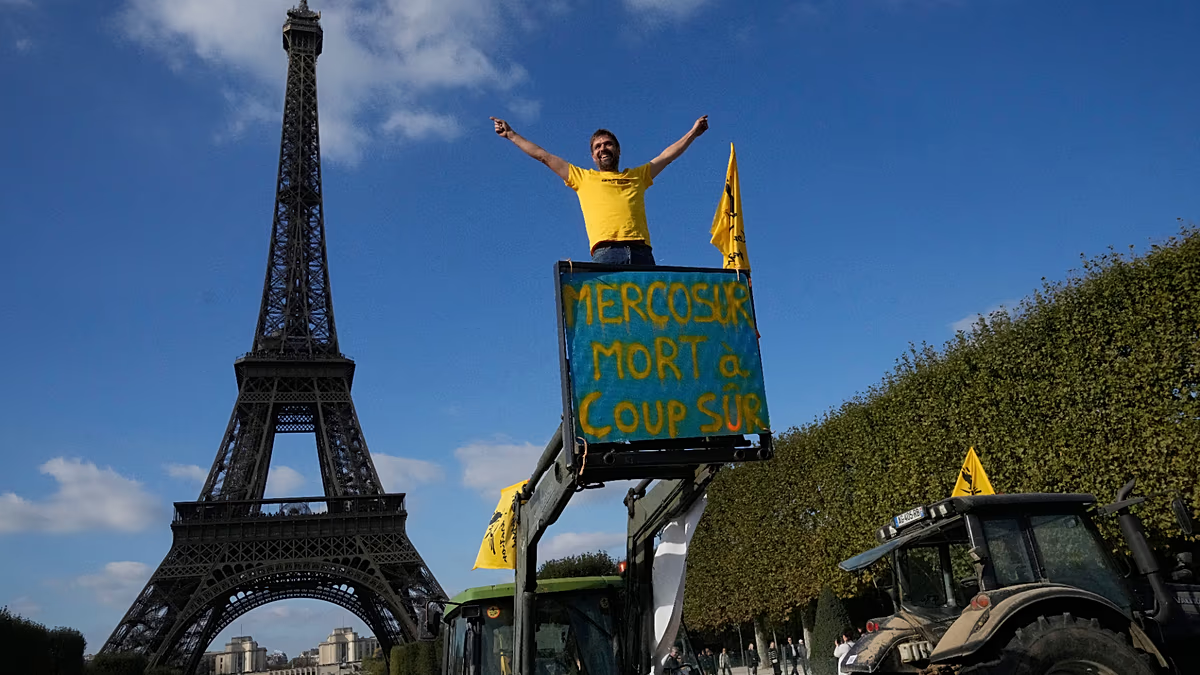
EU bets on Mercosur as geopolitics clash with eurosceptic backlash
Signed on Saturday with Argentina, Brazil, Paraguay and Uruguay, the EU-Mercosur deal is designed to bolster the EU’s geostrategic position. Yet it has already exposed deep political fault lines inside the bloc, with France emerging as the most vocal opponent.
“We choose fair trade over tariffs, we chose a productive long-term partnership over isolation,” European Commission President Ursula von der Leyen said at the ceremony in Asuncion, Paraguay.
She called the agreement, “25 years in the making”, an “achievement of a generation”, for “the benefit of generations to come”, in her message on X.
That, however, goes against the wishes of Paris, which voted against the agreement in a key Council vote on 9 January, even as a majority of member states backed the deal, a split that risks fuelling a narrative that the Mercosur agreement is being imposed on France by Brussels.
Supporters argue the agreement, which would create a transatlantic free-trade zone, is critical to counter China’s growing influence in Latin America.
Commission figures show the EU’s share of Mercosur imports was about six times larger than China’s in 2000. Today, China’s share is roughly 40% higher than the EU’s.
In Brussels, the deal is also seen as essential to diversifying EU trade ties as the US tightens market access and Beijing continues to weaponise European dependencies on Chinese materials and technology.
“Given the geopolitical and geo-economic context – where, for instance, Donald Trump is imposing insane tariffs on us – what we want is not the law of the strongest, but to negotiate, as the European Union has always done, with our partners,” Spanish MEP Javier Moreno Sánchez (S&D) told Euronews.
The debate in Paris grows increasingly heated
After 25 years of negotiations led by the Commission, the agreement has been approved by a majority of member states and formally signed. On Monday, it will be taken to the European Parliament for the final steps of its ratification.
Lawmakers are already divided along national lines, mirroring the 9 January Council vote. France, Poland, Hungary, Ireland and Austria opposed the deal, while Belgium abstained. Supporters hope last week’s approval will build momentum in Parliament, though attention is focused on a resolution to be voted next week seeking to challenge the deal before the EU’s top court – a move that could still draw backing from hesitant supporters.
In France, the Mercosur saga has turned into a political flashpoint that could deepen euroscepticism in a country whose largest delegation in the Parliament already comes from the far-right Rassemblement National (RN), which is ahead in the polls of the next presidential election.
After Paris failed to assemble a blocking minority against the agreement, RN leader Jordan Bardella initiated a no-confidence vote in the European Parliament that is scheduled for next week. He also filed a no-confidence motion in France’s National Assembly this week, which was rejected.
The debate in Paris is increasingly heated, with political forces across the spectrum opposing the deal. Critics argue it would expose EU farmers to unfair competition from Latin American imports that do not meet the bloc’s production standards.
Supporters counter that France’s agricultural woes are home-grown and that the EU-Mercosur agreement has become a convenient scapegoat.
“The blame is a purely a French one, because the problems are French,” Jean-Luc Demarty, former director-general for trade at the European Commission, told Euronews. “After 15 years of absolutely lamentable national agricultural policy – and economic policy as well – the competitiveness of French agriculture has deteriorated considerably. The Mercosur (deal) is a scapegoat.”
Opponents have nonetheless secured key environmental provisions, tariff-rate quotas on sensitive products such as beef and poultry, and safeguard clauses to prevent market disruption. The Commission has also pledged €45 billion in support for EU farmers from 2028 – commitments that helped sway Italy’s crucial position into backing the deal. But not France.
Paris points now the limited economic gains of the deal. On 8 January, French President Emmanuel Macron cited Commission estimates in a post on Xshowing the agreement would lift EU GDP by just 0.05% by 2040.
Tariffs on EU cars – currently at 35% and a key driver of German support – would be phased out only over 18 years, by which time Chinese automakers may have already secured significant market share in Mercosur countries.
EU companies wait for the deal’s implementation
MEPs backing the deal say other sectors stand to gain in areas including services, dairy, wine and spirits, while EU firms would gain access to public procurement markets.
“We have a large majority of industrial players and service providers who are waiting for this agreement and are keeping a low profile,” Moreno Sánchez said.
Those arguments have struggled to gain traction in France, where resistance to free-trade deals runs deep. The EU-Canada trade agreement (CETA), provisionally in force since 2017, has yet to be ratified by the French parliament, and the Senate voted against it in 2024.
German MEP Svenja Hahn (Renew) noted that fears may be overstated. “Only 2% of the quotas that are in the CETA for beef have been used,” she told Euronews.
In countries opposed to the Mercosur deal, supporters have found it hard to be heard after years of vocal criticism.
“In a number of countries, there was a narrative portraying this agreement as something that had to be fought against in order to secure certain concessions,” Eric Maurice, an expert at the Brussels-based European Policy Center, told Euronews. “It was therefore initially presented in a negative light, before its benefits were later defended.”
More than two decades after talks began, the Mercosur deal risks fuelling especially untimely resentment towards the EU.