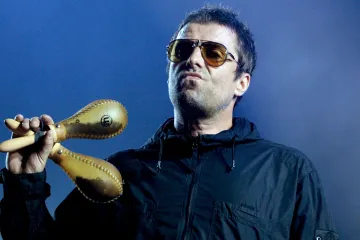
From Oasis to the Spice Girls, the Euros, films & fashion… why I think 1996 was the wildest year of the greatest decade
IT was an era of Men Behaving Badly on TV and men behaving badly in life, Don’t Look Back In Anger, Union Jack guitars and dresses, rock stars thinking they were politicians and politicians believing they were rock stars.
It may now be 60 years since Beatlemania mesmerised the planet and Bobby Moore lifted the 1966 World Cup but, to many of my vintage, the most significant year came three decades later as Cool Britannia and Britpop turned London into the coolest city on Earth.
In 1996 I was handed an access-all-areas pass to chronicle that fabled Nineties apex, joining The Sun as a showbiz reporter exactly 30 years ago.
I was in the right place at the right time, with a ringside seat as Madchester’s Maine Road and Knebworth were slain by Oasis, Robbie Williams became a solo star and the Spice Girls were born.
It was also a time when club and alternative culture fused, Britain’s fashion and art movements rose in tandem, New Labour blossomed and England came mighty close in Euro 96 during a balmy summer.
As we reach the 30th anniversary of that astonishing moment in Britain’s creative history, I have been revisiting it all for my memoir 1996: My Backstage Pass To The Wildest Year Of Britain’s Wildest Decade.


Creative alchemy
Permit me to escort you back to a rather more carefree time when the average annual wage came in at £17,500, a pint was £1.74, only four per cent of the population had access to the internet and AI was nothing more than a friendly Geordie greeting.
It appears a simpler era, the world less divided, free from the poison of social media, when Britain felt safer and the drum of political correctness was yet to beat so loudly.
Britain’s population then was 58million, more than ten million fewer than today, but The Sun newspaper, which I had just joined in January that year, was shifting close to five million copies some days — not related to my arrival, I might add.
The country swarmed to newsagents to devour revelations about their nation’s new breed of idols, inhabiting the worlds of football, music, politics, food, film and television, but with working-class artists like Damien Hirst and Tracey Emin breaking into the mainstream, alongside designers Stella McCartney, Alexander McQueen and model Kate Moss.
The Sun, alongside its fierce print rivals, jostled to capture something of a zeitgeist which sadly doesn’t seem to exist in Britain any longer.
The crucible of this creative alchemy bubbled earlier in the decade as club culture, led by figures like DJ Paul Oakenfold, alongside Madchester’s Stone Roses and Happy Mondays, gave confidence, authority and a strut to a new generation of normal kids from places like Lancashire, Sheffield, Leeds, Colchester, Brum and my home town Bristol.
With New Order penning their epic theme tune, Gazza’s magical England had reshaped modern football at Italia 90, sparking the formation of the Premier League in 1992.
Sky TV’s millions helped spawn a swarm of rock star footballers, led by Manchester United and Fergie’s Ryan Giggs and then, of course, David Beckham, soon to be cautioned by the fashion police for modelling matching leather suits with Cool Britannia’s very own Posh Spice.
Two significant deaths in 1994 also altered Britain’s social path to 1996. Nirvana’s Kurt Cobain blew his brains out on April 5 and I, an embryonic journalist in his early 20s, wrote his obituary in the Sunday Mirror, mainly because nobody else there really knew who he was.
Six days later, Oasis released their inaugural single Supersonic, Mancunia’s council estate ruffians killing off grunge as Britain’s youth searched for something home-grown and relatable.
Then, a month later, Labour Party leader John Smith had a heart attack aged 55, The Sun reporting that “Britain’s next Prime Minister died yesterday”.
By 1996, our generation had grown tired of grey, post-Thatcher conservatism and yearned for a more modern, dynamic society — and Smith’s successor, football-heading Tony Blair, was the right man in the right place.
Superstar chefs were born, such as Gordon Ramsay and Marco Pierre-White, who had ripped up the recipe book, and were snapped gracing the front rows of McQueen or McCartney’s fashion shows. The Cool Britannia ecosystem nailed right there.
Our hair grew longer and our clobber cooler. My former colleagues’ Planet Hollywood leather jackets and loafers were definitely out.
Burberry shirts and Clarks Wallabees definitely in, no maybe.
The Spice Girls were ubiquitous that summer, on TV music shows, radio, and even storming The Sun’s offices.
Dominic Mohan
Who needed Yank creations like Stallone, The Terminator and New Kids On The Block when we could celebrate scruffy Jarvis Cocker, Trainspotting and a tipsy Alex from Blur?
Noel Gallagher’s songwriting at this time was peerless, and his band’s moment of recognition came in February 1996 at the Brit Awards.
I’d been tipped off that the band would be celebrating early before the ceremony and I asked if we might be permitted to take a photograph to mark what would inevitably be the biggest night of their career.
They immediately agreed and brought girlfriends Patsy Kensit and Meg Mathews with them. Bingo!
They cleaned up that night.
The ceremony itself was tumultuous. TFI Friday’s Chris Evans, who then embodied lad culture on telly and radio, hosted.
Noel — who had apparently necked three ecstasy tablets, according to his label boss Alan McGee — hailed from the podium leader-in-waiting Tony Blair, presenter of an award to David Bowie, then insulted INXS singer Michael Hutchence and Blur.
The unknown Spice Girls, dancing on the cusp of global domination, watched on disbelievingly as Pulp crooner Jarvis stormed the stage and mooned at Michael Jackson, whose team subsequently called the Old Bill.
Incredibly, Jarvis was arrested but became a national hero.
That anarchic awards night typified the cultural wave of creativity, hedonism, humour, stupidity, arrogance and sparkle which had enveloped us.
But Oasis’s true moment of storming glory would come at their beloved Manchester City’s Maine Road in April for two mythical gigs.
I was dispatched and the city was absolutely buzzing and bulging with pride as its biblical sons came home.
Sandwiched between Maine Road and those epic nights at Knebworth was the trifling matter of the Euro 96 football tournament on home soil.
Preparations hadn’t exactly gone swimmingly — Gazza was punched in the face by a fed-up air steward on the way out to a cocktail-soaked Far East tour and, aslumber on the flight home, had his eyebrows shaved off.
The Sun’s headline was DISGRACEFOOL with wide-ranging demands for the twinkle-toed midfield general’s expulsion from the team — but redemption was at his feet as he netted his greatest career goal against the Scots and was, later, inches from propelling Engerland into the final.
I wrote a story before the tournament announcing the FA’s official song, something called Three Lions, featuring the Lightning Seeds alongside Fantasy Football League Show hosts David Baddiel and Frank Skinner, thinking it a terrible idea.
But, as I stood alongside the crooning comedians, Liam, Robbie and a load of mulleted Teutonic types in that epic semi-final on June 26, I will never forget the crowd’s thundering chorus as we sang together under Wembley’s fading Twin Towers.
Free from Take That, Robbie launched his solo career at midnight straight after the match and we trudged to Lancaster Gate to cover his midnight press conference where, bleary-eyed, and wearing a Bobby Moore shirt, he attempted a bit of “football’s coming home” to a weary room of jaded journalists.
He informed us he was releasing a cover of George Michael’s Freedom, and everyone assumed it would be a shoo-in for No1 — until five working-class wannabes appeared.
The Spice Girls were ubiquitous that summer, on TV music shows, radio, and even storming The Sun’s offices.
Wannabe topped the UK charts for seven weeks — holding off Robbie’s debut — and did the same in dozens of other countries, even Zimbabwe.
Collective explosion
In August, the biggest-ever British concerts were staged at Knebworth, while Kate Moss, Chris Evans, England hero Stuart Pearce, actress Anna Friel, Ant and Dec, Simply Red’s Mick Hucknall and John Squire of The Stone Roses gathered to pay homage.
We sneaked 22 friends into the free VIP bar. The Prodigy and The Chemical Brothers supported, emphasising that stunning collision of dance culture and alternative music.
The new superclubs like Ministry and Cream were heaving, and Paul Oakenfold became the world’s first superstar DJ. Alternative culture went mainstream in 1996 and the media I inhabited was madferit.
It was a relentless haze of cigarettes and alcohol, footie, clubbing and gigs in a Britain that seemed prosperous and comfortable with its creatives, writers, politicians and royals — particularly Diana as, tragically, she entered her final year of life.
In a fractured world where tech is king, of culture wars and real ones too, I’m not convinced that a moment like 1996 could ever happen in the same way again.
Music, entertainment and media are consumed in radically different ways in 2026, and the conditions for such a collective explosion seem impossible to reach.
It is a time for which many yearn today, as illustrated by the frenzy around the Oasis reformation last year, and the scores of reunion tours of Nineties bands and artists set for 2026.
But don’t look back in anger — let us celebrate a golden and magical period of British popular culture.
l 1996: My Backstage Pass To The Wildest Year Of Britain’s Wildest Decade by Dominic Mohan (HarperCollins, £20) will be published on April 23.