error

Ireland Cricket: Rebecca Stokell in ‘voluntary suspension’ after medication error

Ireland cricketer Rebecca Stokell said she will “fully accept” responsibility for an inadvertent breach of reporting requirements regarding the use of prescription medication and has begun a “voluntary suspension”.

The International Cricket Council (ICC) confirmed the 26-year-old was drug tested and “returned an adverse finding for a specified substance” after her side’s defeat by Sri Lanka at the 2026 Women’s T20 World Cup in June.

Although the substance was not performance-enhancing, Stokell has acknowledged she did not adhere to reporting requirements over the use of prescription medication and has started a voluntary period of suspension while waiting for the outcome of an ICC investigation.

“I fully accept my mistake and have voluntarily entered into a period of suspension ahead of the findings being returned,” said Stokell in a statement.

“While this was not performance-related in any way, I understand that I am responsible for following the anti-doping guidelines and I hope that I can be back playing for Ireland as soon as possible.”

Graeme West, the director of high performance at Cricket Ireland, added: “While we feel very sorry for Rebecca and have provided the level of support appropriate in these circumstances, this incident does serve as a reminder to all our international players that the anti-doping rules are in place to protect both the sport and the athletes themselves.

“All players must adhere to the standards and responsibilities expected, and we will continue to educate our players regularly on these matters and why they are important.”

Stokell made her international debut in 2017 and has featured 109 times for Ireland across all formats.

Source link

The Chase’s Paul Sinha admits ‘it’s haunted me ever since’ after ‘ignorant’ error

Paul Sinha, known as The Sinnerman on The Chase, has spoken about an awkward moment he suffered a few years ago, one which he said had forced him to learn the hard way about preparing for the show

The Chase star Paul Sinha has provided some insight into how he prepares for his role on the famous ITV programme. Paul, 56, joined the programme in 2011 and has gone on to become a fan favourite.

Before he was a television star and stand-up comedian, Paul was a GP and professional quizzer. Earlier this month, he sat down with fellow former medical professional, and current comedian, Harry Hill, 62, for an interview.

Appearing on The Harry Hill Show podcast, the pair discussed a variety of topics, but it was after a discussion about some of his scores at the World Quizzing Championships, that Harry asked Paul what sort of preparation he had to do for The Chase, where he is known as The Sinnerman.

In response, Paul said: “Practically, try not to look ignorant, like old and ignorant. Years ago I said, ‘I’ve never heard of John Legend’ on The Chase, and it’s haunted me ever since that I could appear on television as a quiz expert and not have heard of John Legend.”

He added: “So the most important thing is to just keep up with the things that would make you look old if you reveal you don’t know anything about it…I learn stuff every day, every afternoon, every evening.”

Harry followed up his first question by asking if Paul put “time aside” to learn, to which he said: “No….Life’s too short.”

This isn’t the first time Paul has spoken about what life is like behind-the-scenes of The Chase, with the former Taskmaster contestant admitting that although he is competitive whilst playing the game, some parts of it are harder than others.

In an interview with the Metro, in which he touched on his approach to contestants who take on the Chasers, he said: “I don’t mind if they win and it’s close, but if I’m going to stop some real human beings winning money that could change their lives.

“I want it to be as uncontroversial as it’s possible to be, because it’s horrible. But for me, it’s always hard watching the disappointment in their eyes as a large amount of money slips away. I’d much rather not a close thing.”

However, Paul added that, in some cases, he will speak to some of the contestants afterwards, particularly if all four players have won, but not if only one of them has lost.

Ensure our latest Celebrity News headlines always appear at the top of your Google Search by making us a Preferred Source. Click here to activate or add us as Preferred Source in your Google search settings

Source link

World Series Game 2: Brewers rally from 4 runs down to beat Rays

Sal Frelick tied the score with his first home run in three months, Cooper Pratt hit a go-ahead single in the seventh inning and the Milwaukee Brewers stunned the Tampa Bay Rays 5-4 on Saturday night for a 2-0 World Series lead by overcoming a four-run deficit for the second time in the postseason.

Tampa Bay, which won the AL pennant by forcing opponents into mistakes, committed one error, made two other misplays that could have been charged as errors and had a runner thrown out at the plate.

Down 4-0 in the first inning, Milwaukee rallied for its seventh comeback win of this postseason. The Brewers also rebounded from a 4-0 deficit to beat the Dodgers 6-4 in Game 4 of the NL Championship Series, completing a four-game sweep.

After losing Friday’s opener 3-2, the Rays burst ahead against rookie Logan Henderson, but the Brewers started to claw back with two runs in the bottom half against Tampa Bay ace Drew Rasmussen.

David Hamilton cut the deficit to 4-3 with a run-scoring grounder in the fourth and Frelick capped a nine-pitch at-bat against Ian Seymour in the sixth by driving a fastball over the center-field fence.

Frelick had gone 103 plate appearances without a home run since his July 11 drive off Pittsburgh’s Braxton Ashcraft and had not gone deep against a lefty pitcher since opening day against Tyler Gilbert of the Chicago White Sox. Frelick sped around the bases in 18.72 seconds, half the time of some theatrical trots this postseason.

Screaming fans at the second game of Milwaukee’s first World Series since 1982 were fired up during the seventh-inning stretch, dancing to the “Beer Barrel Polka” played by Mike Schneider, an accordionist from Clinton, Wis.

Brice Turang doubled against losing pitcher Tyler Wells on the second pitch of the bottom half, advanced on Garrett Mitchell’s flyout to right and scored when Pratt, a 22-year-old who debuted in June, looped a sinker from Kevin Kelly into short right field.

Abner Uribe pitched 1⅓ hitless innings for the win.

Jonny DeLuca doubled off Aaron Ashby starting the ninth, then Victor Mesa Jr. struck out when he couldn’t check his swing. Pinch-hitter Ben Williamson’s groundout advanced the runner and Yandy Díaz struck out when he couldn’t check his swing on a full-count pitch.

Ashby has three saves in the postseason while not allowing a run.

Milwaukee won its seventh straight game, becoming the fifth team to twice overcome four-run deficits for victories in a single postseason and the first since Philadelphia in 2022.

Game 3 of the matchup between teams seeking their first title is Monday night at Tropicana Field in St. Petersburg, Fla. where the Brewers last played in 2023.

Of the 57 previous teams to take 2-0 World Series leads, 46 claimed the championship.

Tampa Bay took a 4-2 lead in the highest-scoring Series first inning since 1993’s Game 4 as teams combined for seven hits, tying the most in an opening inning.

Still, Milwaukee improved to 13-0 in games started by Henderson, dating to his 2025 debut. He followed Jacob Misiorowski in the Brewers’ rotation, the first time teammates 24 or younger started the first two games of the Series since Cincinnati’s Gary Nolan and Ross Grimsley in 1972.

Henderson started on 11 days’ rest and struggled as the Rays fouled off 13 of 35 pitches in the first. He gave up four runs — three earned — in three innings.

Given an extra day of rest, Rasmussen gave up three runs and six hits over 3⅔ innings in his shortest start since July 9.

Pratt made his fourth error of the postseason at shortstop, the Brewers’ ninth in 10 games, bouncing his throw past first baseman Jake Bauers on a leadoff grounder by Díaz. Chandler Simpson and Junior Caminero followed with RBI singles, and Liam Hicks hit a two-run homer.

Jackson Chourio and Bauers started the bottom half with singles and first baseman Jonathan Aranda allowed Contreras’ one-out foul pop to bounce out of his mitt near netting in front of the seats.

With Bauers running on a full-count pitch, Contreras bounced an RBI single to the left of second baseman Richie Palacios, who had taken a step toward the base. Mitchell’s two-out single cut the deficit to 4-2.

Hamilton hit an RBI grounder in the fourth that bounced under Aranda’s legs for an error.

Chourio threw out Hicks from left for the final out of the sixth when third base coach Brady Williams waved the slow-footed catcher to try to score from second on Mesa’s single.

Blum writes for the Associated Press.

Source link

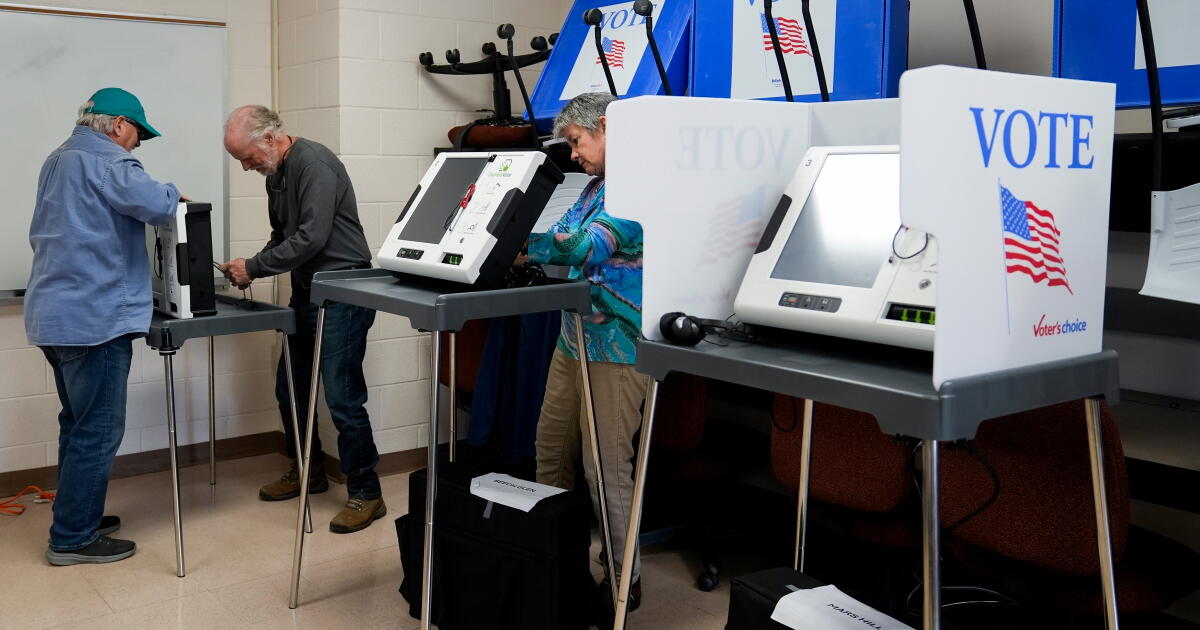
Why reported challenges with touchscreen voting machines don’t signal election rigging

The reports erupt on social media every election year: Voters say they tapped a candidate’s name on a touchscreen voting machine, only for the wrong person to light up as their selection.

With some trial and error, and occasionally help from poll workers, the voters are generally able to cast their intended ballots. Nevertheless, some come away from the experience assuming the worst — that the anecdotal issues are proof of a partisan election-rigging scheme.

As early voting in November’s midterm elections gets underway in most states, with soaring turnout in many of them, the claims have returned in force, with voters — especially Democratic ones — in Kansas, Ohio, South Carolina, Tennessee and Texas documenting difficulties with the ballot marking devices.

Many voters have described their experiences on social media, with some falsely interpreting the troubles as attempts at election tampering to favor Republicans. The claims come as an AP-NORC poll shows many Democrats have lost trust in election results over the last four years, with many seeing the president interfering with the vote as a major concern.

Election officials say the touchscreen challenges are almost always the result of user error or an easily fixed screen miscalibration, and say the number of complaints this year isn’t higher than it has been in years past, despite the outsized attention on social media. They emphasize that voters can select a candidate as many times as needed, consult a poll worker for help and review selections before submitting their ballot.

Elections in the U.S. are decentralized, with thousands of election jurisdictions controlling the vote, each with different rules set by state and sometimes local governments. That structure makes the nation’s voting process extraordinarily complicated. It also shields it from widespread fraud.

“Almost all of the claims of vote flipping are understandable human error,” said David Becker, executive director of the Center for Election Innovation and Research, who noted disinformation purveyors often seize on well-meaning concerns to sow doubt in the voting process. “Is there one of us who hasn’t had a butt dial or mistyped something on our phones? It is not nefarious.”

Many voters, including Dolly Parton’s sister, report issues

The complaints about touchscreen machines switching votes have gathered tens of thousands of likes, shares and views on social media in recent days, popping up in various high-population areas across the country, including Tennessee’s Williamson and Davidson counties, homes to Franklin and Nashville.

Stella Parton, the sister of the late country singer Dolly Parton, wrote in a Facebook post on Wednesday that at her polling place near Nashville she had to “go back three times and correct my vote” because it kept defaulting to Republican Sen. Marsha Blackburn.

She added: “I’m putting this out here because when we vote, we take it seriously but we try not to hold up the long lines. Do it anyway. Don’t let them rig this election.”

Chad Gray, election administrator in Williamson County, said officials there had found no discrepancies in the voting equipment. If problems or questions do arise, he said, people from each party will examine the devices and make sure they are working properly.

Tennessee Elections Coordinator Mark Goins told WSMV in Nashville that the issues reported in his area were “not a vote-flipping situation.” “It’s more like an unintended touch that they may not even realize,” Goins said.

Another Facebook user explained in a video that when his mother-in-law attempted to vote for Democratic candidates in Kendall County, Texas, the machine kept selecting Republicans. He said she was ultimately able to vote as desired and contended that it could have been user error, but still concluded people were “jacking with our elections.”

Staci Decker, elections administrator in Kendall County, said “100% of the time” the issue can be attributed to a voter tapping the wrong part of the box onscreen or from voters tapping the screen too hard, causing it to become miscalibrated. She said her policy is for staff to recalibrate the screens every few days to ensure the accuracy of the touchscreen.

“This is part of an attempt at every election (especially the bigger ones) to scare voters away,” Decker said in an email. “Every single piece of equipment used in our election is tested before it can be used in an election.”

Reports of voting machine errors common during high-turnout elections

In South Carolina, where an X user said a machine made it hard for her to vote for Democratic Senate nominee Annie Andrews, state election officials haven’t seen any unusual increase in reports of voters having trouble making selections, said Sydni Bain, a spokesperson with the state’s election commission.

“We commonly receive some of these reports during elections, particularly statewide elections with high turnout,” she said. “We encourage all voters to be careful in making their selections and to review their ballot before it is cast.”

In Bexar County, Texas, where an X user reported having to tap the screen forcefully to get the machine to register her choice of Democrat James Talarico instead of Republican Ken Paxton for Senate, election officials said they couldn’t confirm any equipment issues.

“This could possibly be user error,” said John Moreno, the county’s assistant public information officer. “If a voter has concerns about their ballot, they should bring it to the attention of the on-site judge.”

Kristin Miles, president of the Texas Assn. of County Election Officials and election administrator in Bastrop County, said “vote-switching” claims come up every election cycle.

“Nearly every case comes back to the screen calibration on older touchscreen machines, not a change to anyone’s vote,” she said.

Officials emphasized that machines are tested before each election and that in most jurisdictions, there is a postelection audit that consists of a manual hand count of a sample of paper ballots.

Voting machine company explains what to do if you encounter problems

Voters across the country cast ballots in various ways, including with ballot marking devices that print a paper record or with paper ballots they fill out by hand.

The counties where most of the recent vote-flipping social media reports are concentrated use ExpressVote ballot marking devices from a company called Election Systems & Software. The machines let voters make their selections on a touchscreen. Then, a paper record is typically printed for review before the votes are tabulated.

Katina Granger, senior manager of public relations for the Nebraska-based ES&S, said the company works closely with election officials and provides technical support when needed but has not been made aware of any widespread issue with voting machines this cycle.

She said when a voter is having difficulty, they should ask a poll worker for assistance. If they’ve already printed a ballot that doesn’t reflect their intended selections, “they should notify a poll worker rather than cast it so the jurisdiction can follow its procedures for replacing the ballot.”

Swenson and Goldin write for the Associated Press. AP writers Anna Wilder in Austin, Texas, and video journalist Kristin M. Hall in Nashville contributed to this report.

Source link

Thousands of California voters got duplicate vote-by-mail ballots

The Tulare County elections office in the Central Valley was suddenly getting peppered with questions from baffled voters.

On the afternoon of Oct. 13, residents began calling and showing up in person at the registrar of voters’ office in Visalia, worried they would be accused of committing fraud by trying to vote twice.

That’s because, much to the surprise and chagrin of county elections staff, thousands of voters had accidentally been mailed duplicate ballots for the Nov. 3 midterm election.

In the agricultural city of Tulare, a place surrounded by walnut and almond orchards as far as the eye can see, 7,791 voters received extra ballots because of an error by the private printing vendor, said Michelle Baldwin, the county registrar of voters, who noted that safeguards were in place to keep the extra ballots from being counted.

The county’s longtime ballot printer, Porterville-based ProVote Solutions, “has accepted full responsibility for the mistake,” she said.

ProVote Solutions did not immediately respond to a request for comment.

“It is unfortunate that it happened,” Baldwin said. “Of course, we would have preferred this didn’t happen, but it did, and we tried to get right on it and respond within 24 hours.”

It’s the kind of error that, in most election years, probably would be just a minor news story. County elections officials would be trusted with their explanation for the mistake, said David Becker, executive director of the Center for Election Innovation & Research and a former senior trial attorney overseeing voting enforcement for the Department of Justice’s Civil Rights Division.

But this midterm has been beset by a growing distrust in the integrity of mail-in ballots following President Trump’s attempt to restrict them before the November election — an effort that was blocked last month by the U.S. Supreme Court.

Trump, who remains fixated on his 2020 election loss, has repeatedly alleged — without providing evidence — that voting by mail leads to widespread cheating and fraud. He has focused specifically on California, where every registered voter automatically receives a ballot in the mail. Seven other states do the same.

On Monday, federal officials charged 28 people with election-related crimes in California, including fraudulent voter registration and making false statements in a naturalization application. Among them were several green card holders, some of whom said they had no recollection of registering to vote, as Trump administration officials accuse them of doing.

In this tense political climate, Becker said, even straightforward election mistakes are magnified on social media and become the subject of conspiracy theories, making the job of local elections officials much more difficult.

“Accidents do happen,” Becker said. “Our elections are incredibly decentralized, run by hundreds of thousands of human beings. As a result, we know there is going to be human error, but our elections are not designed to be perfect. That’s impossible. What they are designed to do is be resilient against human error.”

Becker said it is not unheard of for a voter to receive two ballots. Sometimes, a voter will call the local registrar to request a new one because theirs has not arrived by mail — only to have the original eventually show up. And in other states where voters are required to formally request a mail ballot, they may forget they have done so and show up to vote in person.

That’s why, he said, there are well-established checks to protect against double voting. When a voter casts a ballot, they are “marked immediately” in statewide systems that show they’ve done so, he said.

Ballot errors are rare but not unheard of.

On Monday, the Imperial County registrar of voters announced that a “mailing error” caused duplicate ballots to be sent to 160 voters who requested confidential voter status, meaning that, for safety reasons, their identity and contact information are kept off public voting rolls.

“The error occurred as the Registrar of Voters’ Office was updating its procedures to follow changes in California law,” the elections office said in a statement, adding that, on Jan. 1, elected officials and candidates for public office became eligible for confidential voter status, “requiring changes to how their ballots are processed and mailed.”

Tulare County is a mostly rural place that voted for Trump in the last three presidential elections. Portions of the city of Tulare — population 74,000 — are in the redistricted but perennially competitive 22nd Congressional District, where a close race between Rep. David Valadao (R-Hanford) and Democratic challenger Randy Villegas, a political science professor at College of the Sequoias in Visalia, could determine the balance of power in Congress.

Robert Jones, a strategist for the Valadao campaign, told The Times on Tuesday that the campaign had been in close communication with the registrar’s office and was not overly concerned.

“We have a lot of faith in the Tulare County registrar and elections office,” Jones said, “and we would imagine that, with the extra scrutiny, it will be diligent in making sure that only registered voters vote and that they vote only one time.”

Villegas’ campaign did not immediately respond to a request for comment.

Mark Martinez, a political science professor at Cal State Bakersfield, said conspiracy theories about the error in Tulare add to what is already a tense political climate in the Central Valley, where a recent surge in Immigration and Customs Enforcement operations has disrupted agricultural communities, sent families scrambling to find detained loved ones, and led to a drop in school attendance.

“People will walk away, stay away or avoid political events especially if you look like me — if you look brown or Latino,” Martinez said.

The duplicate-ballot error in Tulare last week quickly went viral in conservative social media circles, with claims that something nefarious was going on in the middle of a House battleground district. One post on X by right-wing media personality Eric Daugherty said, “Trump is right, this is the MESS mass mail-in voting creates!” and “Stop the cheat!” It was viewed more than 450,000 times on that platform, and screenshots of the post were widely shared on Facebook with additional commentary.

The Republican-leaning city of Tulare has just over 34,500 registered voters, according to the California secretary of state’s office. Not all of them are in Valadao’s district.

About 23% of voters in the city received duplicate ballots.

Countywide, about 3% of the 227,000 registered voters were affected.

Baldwin said that as soon as residents started reporting their duplicate ballots, elections staffers immediately contacted the vendor, which confirmed the evening of Oct. 13 that the batch of nearly 7,800 ballots had been accidentally reprinted and mailed.

The vendor, she said, quickly printed postcards explaining what happened and drove them more than three hours to a postal facility in Sacramento so they would be promptly processed and received by voters by the end of the week.

The mailer, in English and Spanish, instructs those who got two ballots to “securely destroy the duplicate ballot” instead of returning it.

Baldwin said that if anybody submits two ballots, “it will be flagged” by safeguards already in place.

The barcode on each voter’s mail return envelope is connected to his or her voter record, she said. Before a mailed ballot is accepted for counting, elections staff scan the barcode, record that the ballot has been received, compare the envelope signature with the signature on a person’s voter record, and check to see if the person has already voted.

“Your vote stays private,” Tulare County elections staff wrote in a Facebook post explaining safeguards against voting more than once. “After verification, your ballot is separated from the return envelope before counting. The envelope barcode tracks your ballot’s return, not your voting choices.”

In the comments section, one resident was frustrated but circumspect.

“I am livid this happened THIS YEAR OF ALL YEARS!!” the resident wrote. “And also, glad there are protections in place in case any fools try to use both. Good grief!!”


Source link