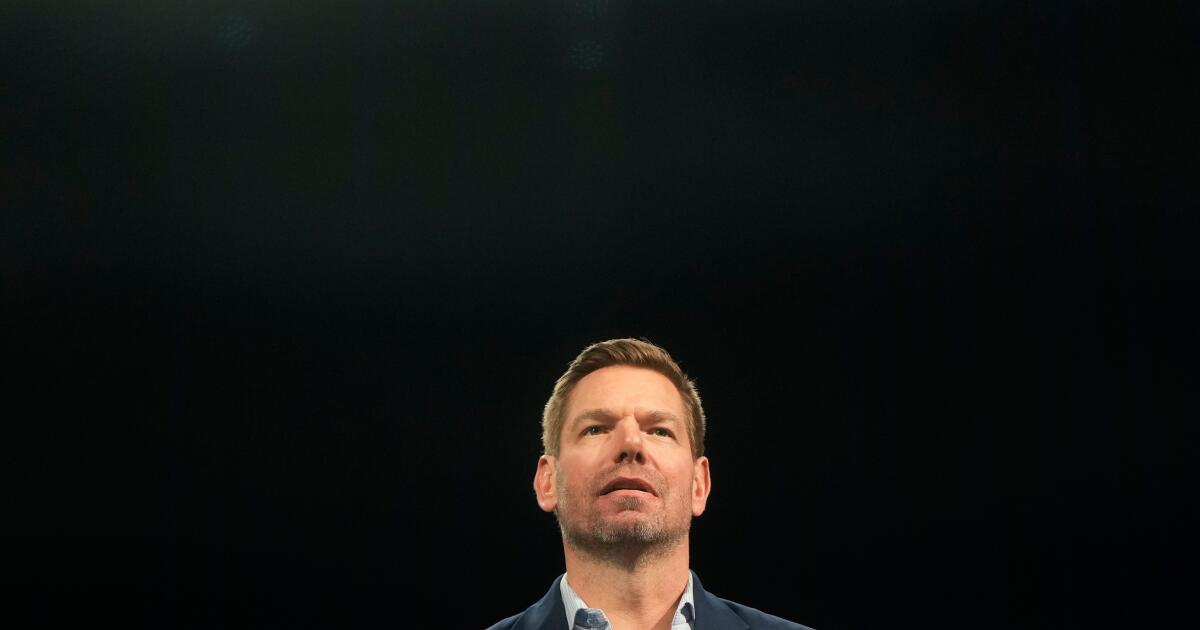
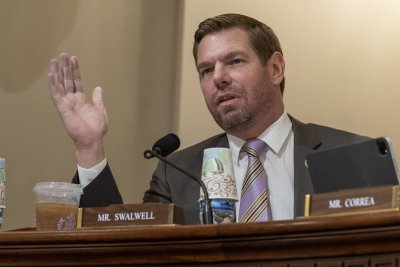
April 13 (UPI) —Eric Swalwell, the Democratic congressman running for California governor, announced that he was suspending his gubernatorial campaign as he faces accusations of sexual misconduct and assault from several women, including a former staffer.
“To my family, staff, friends and supporters, I am deeply sorry for mistakes in judgment I’ve made in the past,” Rep. Swalwell said Sunday night in a social media statement announcing his campaign’s suspension.
“I will fight the serious, false allegations that have been made — but that’s my fight, not a campaign’s.”
The statement did not mention his House position, which many colleagues, including members of his own party, have asked him to step down from.
“Good first step,” Rep. Nancy Mace, R-S.C., responded to Swalwell’s announcement on her personal X account.
“Now resign from Congress or face expulsion.”
Allegations of sexual misconduct, including rape, by four women against Swalwell were first reported Friday by CNN and the San Francisco Chronicle. One accuser, a former staffer, alleged she was raped by the 45-year-old congressman while she was drunk in 2024. She said she was left bruised and bleeding after trying to resist.
On Saturday, the Manhattan district attorney’s office confirmed to The Washington Post that it had opened an investigation into the allegations.
Swalwell refuted the allegations in a weekend video statement, framing them as political.
“For nearly 20 years, I have served the public — as a prosecutor and a congressman — and have always protected women,” he said. “I will defend myself with the facts and, where necessary, bring legal action.”
The suspension of his campaign came after a series of high-profile resignations and rescinded endorsements.
Rep. Jimmy Gomez, D-Calif., resigned as his campaign’s co-chair, while Rep. Adam Gray, D-Calif., his other co-chair, said he withdrew his support for Swalwell.
Sen. Adam Schiff, a veteran Democratic lawmaker from California, also withdrew his endorsement, as did Sen. Ruben Gallego from Arizona.
On Sunday, more than 50 former Swalwell staffers signed a letter stating the allegations against the House member were “serious, credible and demand accountability,” while demanding that he suspend his gubernatorial campaign and resign from Congress.
“The people of California’s 14th Congressional District, and the people of this country, deserve representation from someone whose conduct reflects the values of public service,” the staffers said.
“Remaining in either role while these allegations hang unresolved is an insult to every person who has ever worked for him, reported to him or placed their trust in him.”
Rep. Anna Paulina Luna, R-Fla., said she will file a motion to expel Swalwell from Congress if he does not resign first.
“You have 24 hours to announce you are resigning,” she said late Sunday in a social media statement.
Swalwell was a leading Democratic candidate ahead of June’s gubernatorial primary election to replace incumbent Gov. Gavin Newsom, who is term-limited from running for a third time in the blue state. The gubernatorial election is scheduled for Nov. 3.
“I am suspending my campaign for Governor,” he said in a social media statement on Sunday.
Recommended Stories
list of 3 itemsend of list
“To my family, staff, friends, and supporters, I am deeply sorry for mistakes in judgment I’ve made in my past. I will fight the serious, false allegations that have been made – but that’s my fight, not a campaign’s,” the Democrat added.
Swalwell’s statement came after several influential Democratic Party lawmakers called on him to exit the race and resign from the United States Congress following reports from CNN and the San Francisco Chronicle that detailed alleged accounts of sexual assault from a former staffer and misconduct allegations from several other women.
“What he did is sick and disgusting,” Congressman Ro Khanna told the news programme Fox News Sunday, calling for investigations into the allegations by law enforcement and the US House of Representatives.
A March poll from Emerson College suggested that Swalwell was ahead of Democratic and Republican challengers by several points in the race to replace Governor Gavin Newsom.
But the reports shook his campaign, with powerful figures and organisations revoking their endorsements and calling for him to drop out over the weekend. The Manhattan District Attorney’s Office confirmed on Saturday that it was investigating the allegations.
Eric Swalwell appears at a town hall meeting in Sacramento, California, on Tuesday, April 7, 2026 [Rich Pedroncelli/AP Photo]
Republican US Representative Anna Paulina Luna said she would submit a motion to begin the process of expelling Swalwell, a move some Democrats in Congress said they could support.
“This is not a partisan issue,” Representative Pramila Jayapal said on Sunday. “This cuts across party lines. And it is the depravity of the way that women have been treated.”
Democrats have also called for the expulsion of Representative Tony Gonzales, a Republican from Texas, who is also facing sexual misconduct allegations.
Khanna and Republican Representative Byron Donalds have said they could support a bid to eject both Gonzales and Swalwell from Congress.
“As far as I’m concerned, both gentlemen need to go home,” Donalds said.
SACRAMENTO — There has never been a California governor’s race like this one. And that was even before the leading Democrat was shoved aside by shocking accusations of sexual assault.
For months, the contest has been uninspiring, unexciting and unwatchable. It really shouldn’t have been called a “race.” It was more like a slow trot. No candidate has drawn even 20% of voters’ support in independent polling. Half the 10 main candidates have been stuck in single digits.
And in less than a month, voters will start casting mail-in ballots.
“I have certainly made mistakes in judgment in my past, but these mistakes are between me and my wife. And to her I apologize deeply for putting her in this position.”
Sorry, congressman, but if someone is running for governor of the nation’s largest state, the mistakes aren’t just between him and his wife.
Former House Speaker Nancy Pelosi of San Francisco told Swalwell, in essence, that it’s his right to fight the accusations, but he should do it on his own time, not the Democratic Party’s. She was among the first of party leaders to call on him to abandon the race.
Bye, bye Eric. Might as well depart the House, too.
A leading candidate for California governor has never crumbled so fast. It was like a dam bursting.
Powerful interests and major politicians had been coalescing behind the 45-year-old congressman because he charmed them or they were loyal colleagues or — most important — he seemed like a potential winner.
Political players, including campaign donors, seek to invest their capital in anticipated victors. Their expected return is access and favors. And Swalwell had been racking up lots of endorsements.
Marital infidelity is one thing, but alleged sexual assault — rape — cannot be tolerated, especially by a party dominated by female voters.
Labor unions, other interests and influential politicians began backing off their endorsements. Many urged Swalwell to fold his campaign. And with his support collapsing, he really was left ultimately with no other choice.
So, now the most pertinent question is which candidate will replace Swalwell as the Democrat with the best chance of surviving the June 2 top-two primary and winning a spot on the November ballot.
If it’s a Democrat against a Republican in November–the most likely matchup–the Democrat is a virtual cinch to succeed the termed out Gov. Gavin Newsom. No Republican has won a statewide race in California in 20 years.
State Democratic Chairman Rusty Hicks — as part of his effort to pressure lagging candidates to exit the race and make more room for faster runners — released a nonpartisan, party-paid poll last week. It was conducted before Swalwell’s collapse.
It showed two Republicans tied for the lead with 14% each: Riverside County Sheriff Chad Bianco and conservative commentator Steve Hilton.
Among Democrats, Swalwell led with 12%, slightly ahead of billionaire hedge fund founder Tom Steyer at 11%. Former Orange County Rep. Katie Porter had 7%. Then came former U.S. Health Secretary Xavier Becerra, San José Mayor Matt Mahan and former Los Angeles Mayor Antonio Villaraigosa, each with 4%.
Former state controller Betty Yee and state schools chief Tony Thurmond barely registered at 1% each.
For weeks, it has been deemed conceivable that both Republican candidates would finish ahead of all Democrats in the June 2 primary. Democratic voters would splinter their support among the party’s crowded field. That would lock out Democrats from the November ballot and guarantee the election of a Republican.
But President Trump seemed to botch that for the GOP last week by endorsing Hilton. Trump presumably will help the former British politico draw votes from Bianco and indirectly assist a Democrat in finishing second.
There’s a new twist, however. Where will Swalwell’s votes go? If enough go to the Democratic laggers rather than the party frontrunners, both Republicans could still wind up one-two.
No gubernatorial contest in modern times has been this wide open.
These candidates’ failure to make waves isn’t all their fault. Some were slow diving into the water. But even those who tried to make a splash were inundated by Trump.
Practically all the public’s attention has been on the president and his oddball or vengeful or unprincipled actions.
Now the Democratic race is more wide open than ever.
Steyer — a liberal climate fighter — has run an energetic campaign, spending more than $100 million of his own money on TV ads. But will Californians elect a mega-rich governor? They never have.
Porter has been running better in polls than the latest Democratic survey showed. She’s straight forward on all the issues, but a bit too liberal and feisty for some establishment Democrats. Swalwell’s fall is her opportunity to rise.
Becerra — a former state attorney general and congressman — has an impressive resume, but was too slow out of the starting gate. This is his chance to sprint, if he can.
No candidate is more qualified to be governor than centrist Villaraigosa, a former state Assembly speaker. But voters apparently are looking for someone younger. He’s 73.
Mayhan is a moderate who started too late and has fallen far short of expectations. He now has a second chance.
It soon will all be in the hands of voters, whether they’re interested or not.
You’re reading the L.A. Times Politics newsletter
George Skelton and Michael Wilner cover the insights, legislation, players and politics you need to know. In your inbox Monday and Thursday mornings.
By continuing, you agree to our Terms of Service, which include arbitration and a class action waiver. You agree that we and our third-party vendors may collect and use your information, including through cookies, pixels and similar technologies, for the purposes set forth in our Privacy Policy such as personalizing your experience and ads.
SACRAMENTO — The fallout over sexual misconduct allegations against Rep. Eric Swalwell grew Saturday as his fellow gubernatorial candidates faced a new race and Democrats were forced into a rapid test of how they respond to accusations of sexual misconduct.
Within hours of the accusations against Swalwell being made public, the Northern California congressman’s campaign began to unravel and a chorus of top Democrats urged him to drop out. Staff members resigned, his fundraising website went offline and allies moved quickly to distance themselves from a candidate who had been gaining momentum as a front-runner in the race to lead the Golden State.
The repercussions extended beyond Swalwell’s campaign for governor. The Manhattan district attorney’s office opened an investigation into sexual assault allegations against Swalwell by a former staffer and issued a statement Saturday that urged “survivors and anyone with knowledge of these allegations to contact our Special Victims Division.” Rep. Anna Paulina Luna (R-Fla.) posted a video on X saying that she plans to force a House vote next week to expel Swalwell.
Swalwell has denied the allegations, calling them “flat [out] false.”
The upheaval has created an opening for lesser-known contenders to gain traction just as voters are beginning to turn their attention to the race — a spotlight now intensified by the controversy.
The speed and severity of the response underscores how quickly political support can erode — and reflects a broader shift in how such allegations are handled in the post-#MeToo era, which has been intensified by the scrutiny surrounding the late financier and convicted sex offender Jeffrey Epstein.
“Ask any woman staffer over the age of 45 what her experience was like, and this was a fairly prevalent sort of situation,” said Elizabeth Ashford, a veteran Democratic strategist. “It was allowed. I really think it shows a lot of growth on the part of political professionalism, that these things are taken seriously.”
As of Saturday afternoon, Swalwell ignored calls to drop out of the race and resign from Congress, even as outrage and criticism swelled. A Bay Area fundraiser was canceled and major institutional backers abandoned the campaign. The California Labor Federation withdrew its endorsement, SEIU California rescinded its backing and urged Swalwell to exit the race, and the California Police Chiefs Assn. suspended its support.
Speculation swirled Saturday about Swalwell’s whereabouts after the congressman announced that he intended to spend time with his wife.
A man who opened the door of Swalwell’s rental home in Livermore early Saturday refused to talk to a Times reporter. Swalwell has claimed that he rents space in the one-story house, located on a quiet cul-de-sac. He also owns a home in Washington, D.C., but no one inside responded when a reporter rang Saturday.
Livermore residents couldn’t escape news of the scandal. “Swalwell faces assault claims,” read the front page of the East Bay Times, stacked up at the Lucky grocery story around the corner from Swalwell’s rental home.
The most serious allegation against Swalwell is from a woman who worked for the congressman who said their relationship was at times consensual, but that he sexually assaulted her twice when she was too intoxicated to consent, according to the San Francisco Chronicle. Three other women have also accused Swalwell of sexual misconduct, including sending unsolicited nude photos, according to CNN.
The allegations prompted several members of his campaign to abruptly walk away from their jobs. One senior campaign staffer said they resigned after hearing the seriousness of the allegations, adding that they didn’t want to be put in a position where they were using their own credibility to defend Swalwell.
Former staffers in Swalwell’s congressional office traded messages in group texts after the news reports, with many expressing shock and horror at the allegations, according to two former employees.
A group of senior staff in Swalwell’s congressional office and campaign said in a statement Saturday that they “stand with our former colleague and the other women who have come forward” and that others “should stand with them, too.”
Kyle Alagood, an attorney who worked for Swalwell’s congressional office and his short-lived presidential campaign, told The Times he was “disgusted and pissed off.”
“I pray he has the decency to resign for the sake of his wife and kids,” said Alagood, adding that Swalwell must also “face the full legal consequences of his actions.”
Rob Stutzman, a longtime GOP strategist, said the impact of Swalwell’s political advisers quitting and his endorsements being yanked has sunk his chances in the governor’s race whether he stays in or not.
Stutzman advised former Gov. Arnold Schwarzenegger during the 2003 recall when The Times reported allegations of inappropriate behavior with women during his bodybuilding and film career. Stutzman said the severity of the allegations against Swalwell makes the situation very different from that involving Schwarzenegger, who didn’t lose endorsements.
“If this had been the circumstances … I would have quit,” Stutzman said. “They’re just not the same.”
While Swalwell’s political future hangs in the balance, political insiders are closely watching who will be the beneficiary of the chaos. There are eight Democrats running: billionaire Tom Steyer, former Orange County Rep. Katie Porter, state schools Supt. Tony Thurmond, former U.S. Health and Human Services Secretary Xavier Becerra, San José Mayor Matt Mahan, former Los Angeles Mayor Antonio Villaraigosa, former state Controller Betty Yee and Swalwell. There are two GOP candidates: Steve Hilton, a former Fox News commentator, and Riverside County Sheriff Chad Bianco.
Loyola Marymount University law professor Jessica Levinson said that with key endorsements, such as labor, now back up for grabs, anyone can jump to the front of the pack. She said the safest bet on who will gain an advantage is Porter and Steyer, who with Swalwell have been the top candidates in recent opinion polls.
“But, I think this is a race where there is no heir apparent,” Levinson said. “You can’t rule out surprises anymore in this race.”
Paul Mitchell, a veteran Democratic strategist, agreed that the upheaval benefits Porter and Steyer, adding that Swalwell’s chances have been reduced to zero.
“First off, I think that staying in the race is not tenable,” Mitchell said. “And so if he does drop out of the race, what it means is that you’re going to have a lot of progressive voters looking for somebody else to go to and the primary beneficiaries should be Porter and Steyer right now, because they’re the other two that are in that kind of first tier of Democratic candidates that have been splitting up that progressive base.”
Allegations of inappropriate behavior by Swalwell had circulated for weeks on social media and in political circles. Once the San Francisco Chronicle and CNN posted stories with details from women accusing Swalwell of sexual misconduct, including rape, the swift rebuke was likened by one political strategist to a bomb detonating.
Those media outlets reported that the staff member accusing Swalwell of rape was 21 when she began working for him in 2019 in his Castro Valley district office. She said Swalwell, who is nearly two decades older, quickly began sending her messages and then nude pictures on Snapchat, a platform in which messages and images disappear after being viewed.
She said that in September 2019 she had drinks with the congressman, blacked out and could tell she had had intercourse when she woke up naked in Swalwell’s hotel bed, according to the report. In a separate encounter years later, she said he forced himself on her while she was too intoxicated to consent and despite her protests.
She said she did not report the incidents to police, citing fears she would not be believed and concerns about professional repercussions.
Another woman who began messaging with Swalwell about her interest in Democratic politics last year said she met him for drinks and that she was attempting to fend off his advances without hurting potential job opportunities when she began feeling “really fuzzy” and intoxicated, according to CNN. She told the outlet that she ended up in Swalwell’s hotel room without a memory of how she got there.
Social media creator Ally Sammarco said Swalwell sent her unsolicited nude pictures in 2021, when she was 24 years old. Another woman in her 20s, who works in marketing, said the congressman sent her unsolicited videos of his penis.
Swalwell, who is married with three young children, posted a video on Instagram on Friday in which he called the accusations of inappropriate behavior “flat [out] false,” while also acknowledging unspecified poor behavior.
“I don’t suggest to you in any way that I am perfect or that I am a saint,” he said in the video. “I’ve certainly made mistakes in judgment in my past. But those mistakes are between me and my wife. And to her I apologize deeply for putting her in this position.”
Elias Dabaie, an attorney representing Swalwell, sent cease-and-desist letters to at least two people demanding that they stop accusing the congressman of sexual assault, according to CNN. Dabaie was asked by CNN whether the congressman’s comments can be construed as acknowledging that he cheated on his wife, while denying doing anything illegal.
“I’m not going to get into the details of that,” Dabaie said.
Times staff writers Melody Peterson and Gavin Quinton contributed to this report.
“These allegations are false and come on the eve of an election against the frontrunner for governor,” Swalwell said in a statement. “For nearly 20 years, I have served the public — as a prosecutor and a congressman and have always protected women. I will defend myself with the facts and, where necessary, bring legal action. My focus in the coming days is to be with my wife and children and defend our decades of service against these lies.”
The latest woman to make an allegation told CNN that Swalwell raped her when she was drunk and left her bruised and bleeding in 2024.
“I was pushing him off of me, saying no,” the woman told CNN. “He didn’t stop.”
She said another incident happened in 2019. She woke up naked in a hotel room with him after a night of drinking with no memory of what happened. She said she could feel physically that they had sexual contact.
On Thursday, Swalwell’s attorney sent the woman a cease-and-desist letter alleging that she “made false statements accusing Mr. Swalwell of sexual assault and nonconsensual sexual encounter.” The letter threatened to sue her, The San Francisco Chronicle reported. CNN reported another woman got a similar letter.
The attorney letters said the claims were “undermined” by their “voluntary and cooperative relationship with Mr. Swalwell over the course of many years” after the alleged incidents.
The attorney also sent CNN a letter saying that Swalwell has never had nonconsensual sex with any woman or had sex with any staff member.
Swalwell, 43, is married and has three young children. He was elected to Congress in 2012.
On Friday afternoon, Swalwell allies, including California Democratic Reps. Jimmy Gomez and Adam Gray, withdrew their endorsements and called on him to drop out of the race, The Chronicle reported. Former Speaker Nancy Pelosi, D-Calif., also called on him to leave the race, as well as Sen. Adam Schiff, D-Calif.
On Saturday, Rep. Anna Paulina Luna, R-Fla., announced on X: “I am filing a motion to expel Eric Swalwell from Congress.”
“I am extending a call to any Swalwell victims to contact my office with information,” she posted. “All victims deserve to be heard. I will be bringing a vote to expel Rep. Swalwell from Congress next week, will Democrats vote to protect this corruption? I am not going to serve with these sexual deviants, that is not what Congress is about.”
One woman said she met Swalwell online because she was interested in Democratic politics, CNN reported. She said she ended up extremely drunk inside his hotel room after a night out and didn’t remember what had happened. She said earlier in the evening he had kissed her and put his hand on her leg without consent.
Social media creator Ally Sammarco said she received unsolicited nude images from Swalwell, CNN reported. She had met him on Twitter to talk about politics.
Several organizations, unions and donors have rescinded their endorsements following the allegations.
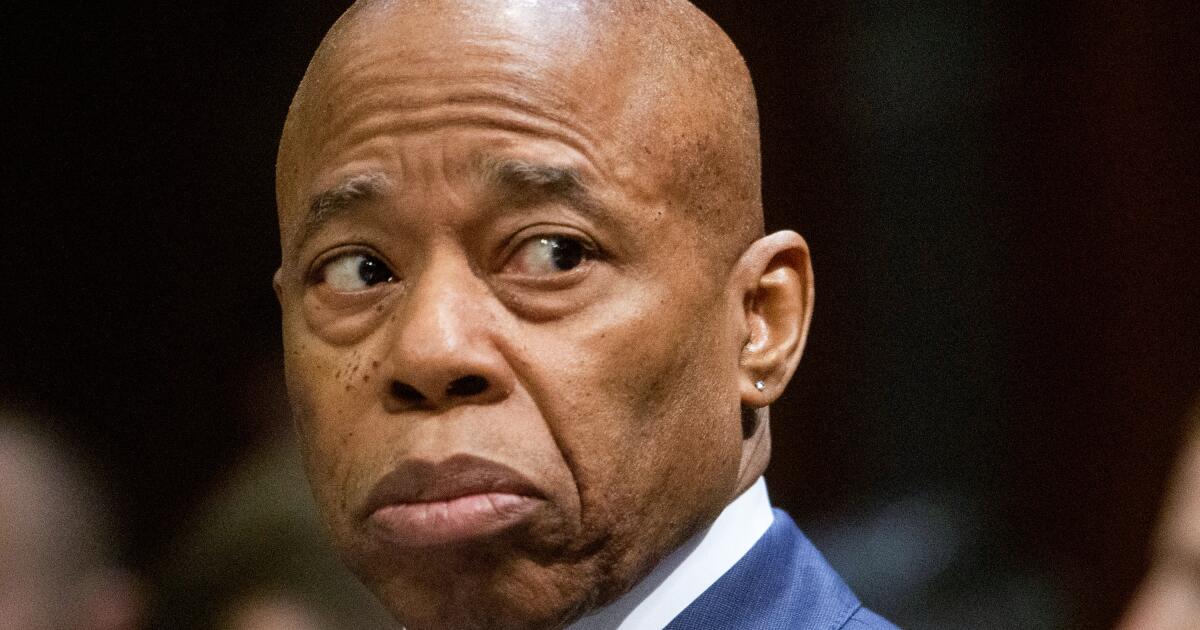
NEW YORK — Former New York City Mayor Eric Adams announced Friday that he had become a citizen of Albania, putting him one step closer to his oft-repeated dream of leaving politics behind for a life abroad.
Adams, a Democrat, received the honorary citizenship “at his request,” according to an official decree from the country’s president, Bajram Begaj.
The news was first reported in the Albanian press and confirmed by a spokesperson for Adams, who said the ex-mayor had “long been a friend and ally of the Albanian-American community.”
“The decision by the Republic of Albania to grant Mayor Adams citizenship reflects that enduring relationship and mutual respect,” the spokesperson, Todd Shapiro, said in a text message, adding that the recognition “further strengthens the bond between New York and Albania.”
Adams, who once described himself as an “international mayor,” has previously expressed an affinity for the small Balkan nation. His adult son lived in the country while competing in Albania’s version of “American Idol” and Adams traveled there himself in October — one of several international trips taken in his final months in office.
The purpose, he said at the time, was “to say hello to a friend and learn from a friend and build a relationship with the friendship that would not allow our oceans or seas to divide us.”
It wasn’t immediately clear what, if anything, Adams planned to do with his new citizenship. But he has previously expressed a desire to move far from his hometown of New York City.
“When I retire from government, I’m going to live in Baku,” Adams, then Brooklyn borough president, said at an event honoring the Azerbaijan community in 2018. A few years later, in an interview with a Jewish publication, Adams said he would like to retire in the Israeli-occupied Golan Heights.
As mayor, Adams’ penchant for international trips to Turkey prompted a federal indictment focused, in part, on allegations that he accepted improper travel benefits from foreign nationals.
Adams denied the allegations, and the case was later ordered dropped by President Trump’s Justice Department. Adams later met with Trump administration officials about the possibility of taking an ambassadorship, which did not materialize.
Shortly after dropping his ailing bid for reelection, Adams embarked on a four-day trip to Albania, meeting with the country’s Prime Minister Edi Rama and members of his Cabinet, along with local business leaders. The trip was paid for in part by the Albanian government.
Since leaving office, Adams has been spotted in Dubai and the Democratic Republic of Congo, though his day-to-day activities remain a source of some speculation.
In January, he launched a cryptocurrency coin that he said would beat back antisemitism and “anti-Americanism,” but it drew scrutiny after losing millions of dollars in value.
The last time Eric Idle’s “Monty Python and the Holy Grail” spoof musical “Spamalot” landed at a major L.A. venue a decade ago, he played the show’s tweedy historian, who sets the scene for the Arthurian legend with a seriousness entirely unfit for the absurdist romp to follow.
It was a perfect role for the “Monty Python’s Flying Circus” alum, to whom dry humor comes as naturally as breathing.
But when “Spamalot” makes its long-awaited return to L.A. Tuesday at the Hollywood Pantages, Idle will take the stage only briefly, and not as a cast member. His job is to pop on and “say something funny or rude, which sadly, comes quite easy to me,” he said in a recent interview at Written Hand cocktail lounge, located just north of the theater.
Over a margarita and a few chef’s olives, Idle recounted his earliest forays into comedy, his legendary run and subsequent break with his former “Monty Python” castmates, and why “Spamalot” arrives in L.A. at the perfect time.
Explaining his scaled-back involvement in this iteration of his meta-musical, Idle said that at the golden age of 82, “I can’t do anything eight times a week” — though his agenda that day begged to differ.
He’d woken up around 6 a.m. for his daily writing session, powered through a meeting with his book publisher and capped off the sunlight hours with some “Spamalot” promos and a photoshoot, all before sitting down to dinner.
Though his admin tasks may tire him, Idle said comedy never does. Recently, he ran into the actor who plays King Arthur in the Pantages production at their hotel bar and asked him for notes on the script.
“He said, ‘There’s one speech.’ I said, ‘I know exactly which one it is,’” Idle recalled. “Every time I hear it I go, I must rewrite that.”
So Idle workshopped it — did the algebra, as he described it — and wound up with a new, zingier joke he preferred. Reciting it at the dinner table, Idle snapped his fingers in time with the punchline.
“I’ve done it 62 years. It still fascinates me,” he said.
Idle’s lifelong fixation on comic craft began in his teenage years, when he saw “Beyond the Fringe,” the seminal British comedy stage revue that acted as a precursor to both “Monty Python” and “Saturday Night Live.”
“I didn’t know you could laugh at the monarchy, at religion, at the army, at the war,” Idle said, adding that he immediately purchased the sketch group’s record and learned all their bits.
From that moment, he said, “I wanted desperately to do comedy.”
“I love musical theater. I miss it,” Eric Idle said.
(Jason Armond/Los Angeles Times)
First with the Cambridge Footlights and later with the Pythons, Idle honed a linguistically-focused style that bridged highbrow absurdity and accessible, pop culture-driven humor. Then in the ’80s, he unlocked an affinity for musical theater while playing Ko-Ko in Jonathan Miller’s “The Mikado.”
Over the years, it became an established tradition that Ko-Ko rewrite his patter song, “I’ve Got a Little List,” to keep the operetta’s satire topical.
When Idle penned his own rewrite, he recalled thinking, “Woof, I like this.”
“It made me realize that I could write funny songs quite quickly,” he said. That epiphany in turn led him to meet with John Du Prez, who became the composer for “Spamalot.”
Idle and DuPrez wrote some 40 songs for the musical, many of them at a small studio in the Valley which they dubbed Killer Rabbit Studios. The idea was to compose a show that even those who weren’t “Monty Python” fans would enjoy, with hints of romance and sincerity absent from the source material.
Famed stage and screen director Mike Nichols made judicious cuts, Idle said, though occasionally changed his mind.
In an April 23, 2004, journal entry published in Idle’s 2024 book “The Spamalot Diaries,” the comic writes: “Mike also confesses to a dislike for the Knights of Ni, but when we act it out together, i.e. I say ‘Ni!’ and he pretends to be scared, it gets us both laughing uncontrollably and he is now convinced that it works.”
“I learned so much,” Idle said as he reminisced about those early years engineering the musical, which has appeared twice on Broadway and won three Tony awards during its inaugural run, including for best musical and direction. “I think it was the best fun of my life.”
The current “Spamalot” tour coming to the Pantages on Tuesday through April 12 remains a farce “lovingly ripped off” from “Monty Python” and featuring all the classic bits — flying cows, killer rabbits and the Lady of the Lake — but revamping its stage production with updated scenic and projection design by Paul Tate dePoo III. With Josh Rhodes directing, the new show brings a fresh take on the 2023 Broadway revival.
Idle said he’s especially excited to host a Saturday matinee attended by students from the Fernando Pullum Community Arts Center, which provides performing arts education to South-Central L.A. youth.
Each “Spamalot” production at the Pantages has been great, Idle added, but with all the upgrades, this one is “smashing.”
And it comes to L.A. at a critical time when joy is hard-fought, he said.
The Broadway revival of “Spamalot” opened in 2023 at New York’s St. James Theater.
(CJ Rivera / Invision / Associated Press)
“People really love this show because it makes you happy,” Idle said. “And these are the times when we need it really badly, because somehow, we’re being oppressed all the time.”
Despite his English roots, Idle after living in the U.S. for several decades is firmly entrenched in the country’s politics. As he’s watched the Kennedy Center drama unfold and arts infrastructure unravel, he said sitting among laughing audiences has been a balm — for himself and many others.
“It always goes well in a Republican war,” Idle observed about his show. “We opened during Bush and Cheney, when all these people were going off to war, and [‘Spamalot’] is about going off to war, really, rounding up the knights.”
It helps that the play’s script allows its actors to break the fourth wall and improvise dialogue that more closely speaks to the audience’s present moment.
As Idle talked about his show, he swelled with the same pride he said he has when he looks back on his time with the Monty Python troupe: “it makes me feel so warm towards them.”
“But those aren’t the same people we are now,” he said.
Preexisting tensions among the Pythons boiled over in recent years because of financial disputes, including a 2013 lawsuit over “Spamalot” royalties. Idle has for more than a decade been largely estranged from his former collaborators, but said he prefers not to linger on that fact.
“I think we were good, I really do,” he said, and that made for a great life. “But it doesn’t make you brothers.”
“Monty Python’s Flying Circus” original cast members John Cleese, from left, Terry Gilliam, Terry Jones, Graham Chapman, Michael Palin and Eric Idle pose on a beach.
(PBS / Associated Press)
Even while Idle was still with the troupe, being its only unpartnered writer made him feel distant from them, he said. It’s what he and Beatles lead guitarist George Harrison bonded over when they met.
“He was between two powerful people, and I was between two powerful groups,” Idle said. “So we played not dissimilar roles.”
The pair remained close until Harrison’s death in 2001.
“The worst thing about getting old is you lose all your friends,” Idle said somberly.
He wasn’t ready for Catherine O’Hara to go, nor Rob Reiner, who bade Idle a poignant farewell at a recent L.A. party.
The last thing the beloved director said to Idle was, “Goodnight, I’ll see you next year,” he recalled.
After dinner, Idle slung his Holy Grail-shaped bag — made by his daughter and lined with Spam-printed fabric — over his shoulder and left a voicemail for a friend he regularly jams with in L.A.
“Hey, Alex, I’m just finished what I was doing. I’m down by the Pantages. If you fancy a ding dong, give me a call. Otherwise, I’ll just head home.”