Blanche to face questions about his independence at attorney general confirmation hearing
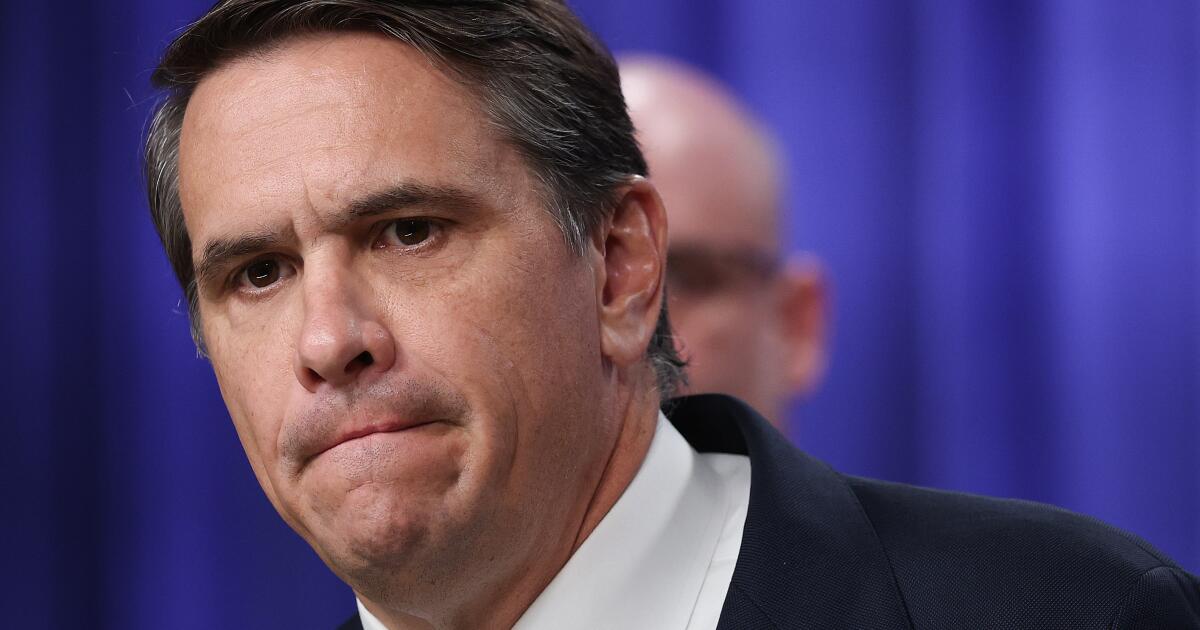
WASHINGTON — The Senate confirmation hearing Wednesday for Todd Blanche, President Trump’s pick for attorney general, will be a referendum on far more than his individual merits.
Blanche, the acting attorney general, served as Trump’s defense attorney before taking office and has been closely linked to many of the most consequential — and controversial — issues that have dominated the first two years of Trump’s second term.
Blanche is set to appear before the Senate Judiciary Committee, which will decide whether to approve his nomination and send it to the full Senate for a confirmation vote. The committee hearing will continue Thursday.
“I would expect committee Democrats to treat Mr. Blanche’s hearing as an opportunity to conduct oversight of the Department of Justice,” said Phil Brest, president of the American Constitution Society, a progressive legal nonprofit and a former top Democratic staffer on the committee. “It’s a test of the Senate’s willingness to probe the department’s operations and to actually serve as a check on the department and the administration more broadly.”
Democrats on the committee are expected to push Blanche on a host of topics, including the $1.8-billion “anti-weaponization fund” that critics derided as a slush fund for the president’s allies, the Justice Department’s rollout of the so-called Epstein files, and the department’s prosecution of several perceived enemies of Trump, notably former FBI Director James Comey.
“While deploying the Justice Department as a shield for the president and his cronies, Blanche has also used our top law-enforcement agency as a sword against Trump’s political opponents,” said Sen. Dick Durbin (D-Ill.), the ranking Democrat on the committee last month. “The independence of DOJ has been decimated under Blanche’s authority.”
Blanche was confirmed by the Senate as deputy attorney general in March, 2025, and was elevated to his current role after Atty. Gen. Pam Bondi was fired in April.
More critical to the success of Blanche’s nomination will be whether he can win the support of two lame-duck Republican senators, Thom Tillis of North Carolina and John Cornyn of Texas, who expressed some reservations about Blanche soon after his nomination was announced.
Cornyn raised concern about Blanche’s independence from Trump, while Tillis said Blanche’s stance on protesters who violently stormed the U.S. Capitol on Jan. 6, 2021, would be critical to his consideration.
Some of those Jan. 6 protesters were expected to be the beneficiaries of the $1.8-billion fund announced as part of a settlement to a lawsuit Trump and his sons and business brought against the IRS.
In a scathing ruling this week, the federal judge wrote that the lawsuit was improper and recommended sanctions against two Justice Department attorneys who worked on the case, though not Blanche himself.
Cornyn told Semafor on Tuesday that the ruling raised a number of issues, including “the potentially collusive nature of the lawsuit.”
He has said previously that he will hold off on making a decision about whether to approve Blanche until after the hearing.
Tillis, meanwhile, told CNN’s Manu Raju on Tuesday that the weaponization fund would need to be completely off the table for him to support Blanche’s nomination.
Trump touted Blanche’s record ahead of the hearing.
“Todd Blanche is doing a PHENOMENAL job as Acting Attorney General of the United States,” the president wrote on Truth Social. “He is a great lawyer, always very fair, and every Republican Senator should vote to CONFIRM Todd Blanche, ASAP!”
Sen. Lindsey Graham’s death means that Republicans currently only enjoy a one-seat majority, but a replacement for Graham on the committee could be in place before it votes on whether to move his nomination to the Senate floor, which will likely come two weeks after the hearing.
Blanche, 51, spent 12 years working for the U.S. attorney’s office for the Southern District of New York, working largely on drug and violent crime cases, and rose to the level of co-chief of the district’s White Plains division.
He left the office in 2014 for private practice and joined the prominent law firm Cadwalader, Wickersham & Taft in 2017 as a partner. He left the firm in 2023 and went independent after other partners expressed concern when he took Trump on as a client.
Blanche went on to represent Trump in several criminal matters, including the New York case about hush money payments to porn star Stormy Daniels, and cases brought by Special Counsel Jack Smith about Trump’s alleged efforts to block the transfer of power after the 2020 presidential election and his alleged retention of classified documents.
He listed all three as among the 10 most significant cases of his career in the questionnaire he completed ahead of the hearing, along with his work at the Justice Department on a lawsuit challenging the construction of a new White House ballroom.
A group of more than 1,200 former Justice Department attorneys wrote a letter opposing Blanche’s nomination, asserting that his leadership has resulted in mass departures of career staff. That has “meant that much of the department’s vital work isn’t being done, or isn’t being done as well – leaving communities less safe, Americans’ rights less protected, and our national security more vulnerable,” the lawyers wrote.
Former Justice Department pardon attorney Liz Oyer is scheduled to testify as a witness for Democrats on Thursday. She has said she was fired for refusing to recommend the restoration of actor Mel Gibson’s gun rights.
Oyer will be joined Thursday by Dani Bensky, one of many victims of the deceased sex abuser Jeffrey Epstein who has criticized Blanche’s handling of the release of the so-called Epstein files — millions of pages of records detailing the Justice Department’s investigations into Epstein’s crimes.
Numerous victims have said that their names and other sensitive information were not properly redacted in the files and criticized Blanche and the department for failing to investigate Epstein’s potential co-conspirators.
Blanche has also come under criticism from survivors of Epstein’s abuse for the interview he conducted in July, 2025, with Epstein accomplice Ghislaine Maxwell, who is serving a 20-year prison sentence for her role in facilitating and participating in Epstein’s abuse.
Days after their interview, Maxwell was moved from her prison in Florida to a minimum-security prison in Texas.