episode

How ‘Heated Rivalry’ changed the game for Canadian TV

How did a gay hockey romance made by a little-known Canadian streamer become a global cultural phenomenon?

The answer, as it turns out, was by leaning into female and queer audiences. Since the debut last November of “Heated Rivalry,” which chronicles the clandestine love story between two fierce hockey rivals, the drama series from Bell Media’s Crave has emerged as an unlikely success story, defying a broader industry trend of media consolidation and waning commitments to diversity in Hollywood.

The mastermind behind the show’s success is Jacob Tierney, who read author Rachel Reid’s “Game Changers” series during the COVID-19 pandemic and then optioned all of the books after reading a Washington Post story about the proliferation of romance novels. After writing a pilot on spec, he approached the executives at Crave — where he had previously produced “Letterkenny,” “Shoresy” and “Canada’s Drag Race” — about green-lighting a series. From the outset, the gay writer-producer had a clear idea of how he wanted to adapt the “smutty” story for TV, starting with casting relative newcomers Hudson Williams and Connor Storrie as Shane Hollander and Ilya Rozanov, respectively.

“Jacob was very open to our feedback, but his common [refrain] back to us was, ‘We need to be true to the source material because the built-in fan base will expect certain things from us, and that includes the appearances of these actors and their ages,’” says Justin Stockman, Bell Media’s VP of content development and programming. “He’s like, ‘We found them. These are the people from the book.’ And that’s where we had to trust him.”

Brendan Brady, Tierney’s producing partner through their Accent Aigu Entertainment banner, notes that the Canadian TV model diverges from the American one, in that the producer retains ownership of the IP while collecting a licensing fee from the broadcaster. To fund the series, Tierney and Brady reinvested their personal fees to cover about 10% of the budget, while another 30% was sourced from tax credits. This included the Canada Media Fund, a resource derived from government and industry contributions that national broadcasters can allocate at their discretion. The rest of the financing usually comes from third parties.

But Tierney recalls that the notes from potential financiers did not align with his creative vision. Some wanted to delay the graphic depictions of gay sex and expand the world to include more characters. Someone even suggested introducing Rose Landry (Sophie Nélisse) earlier and putting her in a love triangle with Shane and Ilya, because they believed “this show won’t work without a female entry point,” Tierney recalls. Ultimately, Bell Media opted against a co-financier, instead covering the remaining costs through its new distribution branch, Sphere Abacus. But, Brady says, the budget was still “far south” of CA$5 million (approximately $3.6 million) per episode. “It’s so much less than that, it’s almost silly,” Tierney adds.

Sean Cohan, an American executive who worked at A&E Network and Nielsen before being appointed president of Bell Media, does not think “Heated Rivalry” could have been made in the U.S. For starters, “green-lighting” stateside is a “slower” process; Tierney could have been stuck in development hell for years. The show also contains numerous Canadian references — cottage country, loons, McGill University — which would have not made sense outside of the Great White North.

Connor Storrie, Hudson Williams, Jacob Tierney and Brendan Brady on the set of Heated Rivalry.

From left, stars Connor Storrie and Hudson Williams, creator Jacob Tierney and executive producer Brendan Brady on the set of “Heated Rivalry.”

(Sabrina Lantos)

For his part, Tierney doesn’t believe that “Heated Rivalry” would have even been made at another Canadian network or streamer. “There’s lots of ways to put your fingers in and get them sticky and screw things up, and these executives wanted the same show that we wanted to make and they supported us 100%,” he says. Those executives were so confident in the show’s success that they decided to move up the premiere date from February to late November to take advantage of the increase in viewership around the holidays. The accelerated release schedule meant that Tierney delivered his cut of the Season 1 finale a week and a half before it aired.

At the time of our interview, Tierney was already trying to break the story for Season 2, which he and Brady say will not premiere until spring 2027. “As much as I appreciate how rabid and interested people are at this point, the first season worked because I trusted my gut with this, and I’m going to do that again,” Tierney says.

Like the audience, Bell Media executives are waiting with bated breath for the next chapter of “Heated Rivalry.” And given that Accent Aigu has optioned all of the “Game Changer” novels (including Reid’s forthcoming “Unrivaled”), everything is on the table — more episodes or seasons, one-off specials, maybe even a spin-off. “We’re open to anything that keeps the quality where it was, but also brings our show back as quickly as we can,” Stockman says. (HBO Max will not be involved financially and remains merely a distributor.)

Tierney declines to reveal whether he will split “The Long Game” into one or two seasons, but he volunteers that he does not see himself making more than six episodes per season. “I don’t need to do 10. I would always rather tighten the belt than get loosey-goosey,” says Tierney, who will have a co-writer for Season 2 but continue to direct all the episodes himself. “I would rather be like, ‘Let’s see how much story we can pack into these episodes.’”

“We want everybody to be left yearning,” Brady adds. “That’s what everybody loves about this show. Less is more!”

“Heated Rivalry” may center on Shane and Ilya, but there will “absolutely” be “diversions” to other characters in the canon. “Just like you can’t tell the story without Scott Hunter, you can’t really tell the story without Troy Barrett,” Tierney says, alluding to a character from Reid’s books who is yet to appear in the TV series. And while there may be a lot more incoming calls about higher-profile casting, he adds, “We need Canadian talent, and we love Canadian talent. It’s not a burden, but it’s also something we literally have to do to get our financing.”

For Cohan, “Heated Rivalry” is valuable proof of concept as he attempts to convince more Canadian creators to return to their roots, regardless of where they now live in the world. “It certainly helps to feel like we’ve got a dramatic illustration, a data point — a pretty good one too — to say, ‘Yeah, look, we Canadians, not just Bell, can make great, global and profitable [shows], and we can do it by being authentic,’” Cohan says.

Source link

Alexander Skarsgård and dad Stellan help ‘SNL’ hit 1,000th episode

Some actors who appear right on the edge of becoming household names and who happen to be hosting “Saturday Night Live” for the first time might be leery of letting a famous relative steal their spotlight.

Alexander Skarsgård let it happen twice in the same “SNL” episode when his father Stellan Skarsgård appeared in a returning sketch about immigrant fathers (in which Cardi B also appeared) and one about a Scandinavian film’s giggly production. To be fair, though, his dad is currently Oscar-nominated in the supporting actor category for “Sentimental Value.”

If the Alexander of the Skarsgård was bothered, it sure didn’t show; the first-time host of the 1,000th episode of “SNL” was loose and committed throughout, even if not all the sketches hit. And yes, before you go racing to Peacock to confirm, Alexander gave his father Stellan a big ol’ hug in the closing goodbyes. Aww.

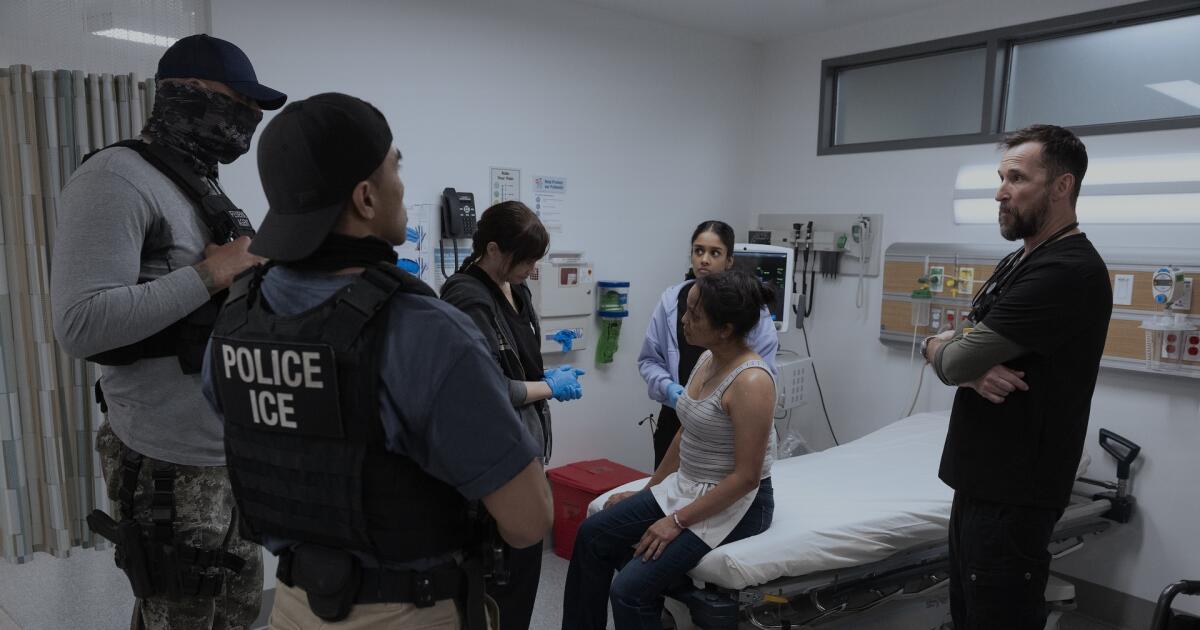
If “SNL” shied away last week from directly addressing the quickly devolving situation in Minneapolis last week, it found its footing with a cold open about ICE that didn’t rely on James Austin Johnson’s impression of President Trump. Instead, it featured former cast member Pete Davidson as border czar Tom Homan taking over command of clueless ICE officers. This was followed, after the monologue, by a well-executed sketch about a mom (Ashley Padilla) slowly changing her mind about the Trump administration.

Elsewhere, the guest host played a coach to a skittish Olympics luge athlete (Jane Wickline), a preteen girl with aggression issues, a Viking who feels like everyone is forming cliques during a bloody raid, a guy who uses Cards Against Humanity jokes to make himself seem funny, and Tarzan trying to get out of a relationship with Jane (Sarah Sherman).

As the younger Skarsgård’s career has shown (“Murderbot,” “True Blood,” “The Northman”), he’s used to playing odd, extreme characters and “SNL” was a nice fit.

Musical guests Cardi B performed “Bodega Baddie” and “ErrTime.” A tribute card for Catherine O’Hara, who died on Friday, was shown before the goodbyes. O’Hara hosted “SNL” in 1991 and 1992 and appeared in a short “SNL” film (with Laurie Metcalf!) in 1988.

For the first time in a while, Trump didn’t dominate the cold open of the show; instead, Davidson came back to the show, wearing a bald cap to portray Homan. Homan points out the irony that things have gotten so bad in Minneapolis with ICE that he’s now considered the voice-of-reason adult in the room. ICE commanders (Kenan Thompson, Andrew Dismukes, Johnson, Ben Marshall, Mikey Day and Jeremy Culhane) claimed their orders were “wildin’ out” and wondered if they’re supposed to be releasing the Epstein files. As Homan pointed out, the ICE raids were to distract from those, but now the Epstein files are being released to distract from ICE. Davidson is remembered more for his “Weekend Update” segments and his Chad character on “SNL,” but he does some nice work here even if he breaks character at one point.

Skarsgård’s could have spent his monologue discussing his TV and movie roles, like his upcoming film “Wicker” or his role in the new Charli XCX mockumentary “The Moment,” but instead he focused on the band members who appear on stage but rarely get to speak on the show. He interviewed some of the band members, poorly, and then grabbed a saxophone to do some inspired fake playing. It was silly and fun, a nice start to Skarsgård’s night.

Best sketch of the night: Mom’s having a change of heart, but you can’t say anything

For most of this season you can count on at least one sketch to feature a standout performance from featured player Ashley Padilla, who has become a ringer for playing women who are either very deluded and are trying to pretend they’re not, or who are trying to manage other people’s reactions to her odd behavior. For this sketch, she gets to do both, playing a mother who, after a lengthy preamble, reveals to her adult children and husband (Skarsgård) that she’s starting to change her opinion about Trump’s policies, from immigration to guns to trans people. As her kids struggle to hold back their reactions, lest she swing back the other way, her husband just wants to go to Red Robin for his birthday scoop. Best line: “If I hear a single ‘I told you so,’ I will go see the ‘Melania’ movie tonight!”

Also good: Having the right body shape for Olympics-level luge, even if it’s a corpse

Wickline, another featured player, has become a polarizing cast member among fans, some of whom simply don’t get her humor or appreciate her performances, while others love her quirky songs and see her as bringing a unique vibe to the show. For this Olympics-themed pre-taped piece, she gets to have a lot of fun as a reluctant luge competitor who is terrified to go down the mountain and tries to fake being sick to avoid going to Milan. This might remind you of Patti Harrison’s perfect performance in the “Capital Room” sketch on “I Think You Should Leave,” but Wickline manages to make the character her own.

‘Weekend Update’ winner: They scored again ahead of the Super Bowl

Sherman was promoted to “Weekend Update” weather correspondent in a segment that included a surprise appearance from “30 Rock” star Jack McBrayer, but it was Dismukes and Padilla as a couple who just had sex winning the week with their awkward, infatuated banter, which tied in nicely to a discussion about next week’s big game between the New England Patriots and the Seattle Seahawks. The couple predict that the Patriots will be on top the first half, but at some point the Seahawks will come from behind and dominate the Patriots for a little while. “Maybe the Patriots get tired and ask the Seahawks to play themselves for a while,” Dismukes suggests. Things go off the rails when he says no matter what happens, someone’s getting a ring, which puts tension on the budding relationship. “I didn’t say that night!” he explains to a disappointed Padilla. The two previously hooked up for the first time in the Glen Powell episode.

Source link

‘Wonder Man’ review: Grounded Hollywood story shows why MCU TV is best

Don’t stop me if you’ve heard this one before, since I’m admittedly something of a broken record on the subject, but I very much prefer Marvel’s television series, which tend to be fleet, original and unpredictable, to its movies, which tend not to be. “Loki,” “Ms. Marvel,” “Moon Knight,” “Echo,” “WandaVision” and its spinoff “Agatha All Along” — all (among others) are worth watching, even the ones that are dumped after a season.

Developing longer stories with less money, the TV shows makers need to be inventive, creative with their resources, so they invest in characters and ideas rather than special effects and action. They focus on secondary or ensemble figures who would never be given a theatrical feature of their own to carry, are particular about culture and family and place, and are often less contingent on the Marvel Cinematic Universe, with its phases and stages, its crossovers and cross-promotions and long-range marketing plans. At once higher concept and more grounded than the movies, they’re interesting on their own, to the point where, when they finally hitch on to the Marvel multi-mega-serial train, I find them disappointing.

“Wonder Man,” whose eight episodes premiere all at once Tuesday on Disney+, is perhaps the most grounded of these series. Created by Destin Daniel Cretton (“Shang-Chi and the Legend of the Ten Rings”) and Andrew Guest (who has written for “Community” and “Brooklyn Nine-Nine”), the series is a (generally) sweet, disarming tale of actors in Hollywood, tricked up with picture-business details that you don’t need to be au fait with the MCU to appreciate. There are things it might be helpful to know, but you can work out everything that matters through context. (Locals will enjoy playing Spot the Locations.)

Yahya Abdul-Mateen II plays Simon Williams, who as a child became a fan of a B-movie superhero called Wonder Man — not a “real” superhero, in this reality, merely a fiction. Now in his 30s, he’s a struggling actor in Hollywood, good enough to land a small part in an “American Horror Story” episode, but not clever enough to keep from slowing down the production with questions and suggestions when all he needs to do is deliver a couple of lines before a monster bites his head off. He loses the part and a girlfriend directly afterward.

Taking in a revival house matinee of “Midnight Cowboy,” he meets Trevor Slattery (Ben Kingsley), who is back from having played the Mandarin — that is, he acted the part of a terrorist called the Mandarin, believing it was just a job — in “Iron Man 3” and providing appealing comedy relief in “Shang-Chi and the Legend of the Ten Rings.” The character here is more fleshed out, something of a mess (but 13 years sober, he likes to point out), serious but not a joke. Before it all went wrong, Trevor played King Lear (in Croydon), appeared in “Coronation Street” and in a movie with Glenda Jackson, was off-off-off Broadway in “The Skin Our Teeth” and briefly had the lead in a hospital show with Joe Pantoliano, who’s very funny playing himself.

A man in a blue costume is embraced by a man in a blue robe, white T-shirt and khaki pants.

Trevor Slattery (Ben Kingsley), left, and Simon Williams (Yahya Adbul-Mateen II) team up in “Wonder Man.”

(Suzanne Tenner / Marvel Television)

Slattery tells Simon that European art director Von Kovak (Zlatko Burić) is rebooting Wonder Man, a role Simon feels born to play. He makes an end run around his unconvinced agent, Janelle (X Mayo), and wheedles an audition — where he again meets Trevor, auditioning for Barnaby, Wonder Man’s pal, or sidekick or something. There are wheels behind wheels in this setup, some of which could use a little grease, but for most of the series they do their squeaking off to the side. It’s a love story, above all — “Midnight Cowboy,” not an accidental choice, is more of a touchstone than any Marvel movie.

Simon does have powers — things shake, break or explode around him when he’s upset, and his strength can become super in a tight spot — which puts him in the sights of the Department of Damage Control, embodied by Arian Moayed as P. Cleary, who would like to contain him. But he struggles to keep them secret, especially in light of something called the Doorman Clause — its history established in a sidebar episode, a cautionary Hollywood fable with Josh Gad as himself — which prohibits anyone with super powers from working in film or television, all Simon lives for.

There is little in the way of action, and you won’t miss it. The fate of the world is never in question, but a callback for a second audition means everything. The only costumed characters are actors playing costumed characters; the only villains, apart from the bureaucracy that seeks to bring him in, are Simon’s own self-doubt and temper. As things progress, Trevor will become a mentor to Simon. As is common in stories of love and friendship, a betrayal will be revealed, but if you have seen even a few such stories, you know how that’s going to go, and will be glad it does.

Whether discussing acting techniques or the traffic they’re stuck in on Hollywood Boulevard (Trevor: “Probably the Hollywood Bowl.” Simon: “It’s too late for the Bowl.” Trevor: “It’s usually the Bowl. I remember seeing Cher there once — breathtaking. Chaka Khan, now there’s a woman”), Abdul-Mateen and Kingsley work well together; their energies are complementary, laid back and loose versus worked up and tight and, of course, each will have something to teach one another about who they are and who they could be. I was genuinely anxious for them, as friends, more so than just wondering how such and such a superhero (or team) might defeat such and such a supervillain (or team).

“Our ideas about heroes and gods, they only get in the way,” says Von Kovak, putting a room of hopeful actors through their paces, and essentially speaking for the series he’s in. “Too difficult to comprehend them. Let’s find the human underneath.”

Source link

Trump’s Greenland episode raises doubts about NATO’s future

The crisis touched off by President Trump’s demand to take ownership of Greenland appears over, at least for now. But the United States and its European allies still face a larger long-term challenge: Can their shaky marriage be saved?

At 75 years old, NATO has survived storms before, from squabbles over trade to estrangement over wars in Vietnam and Iraq. France, jealous of its independence, even pulled its armed forces out of NATO for 43 years.

But diplomats and foreign policy scholars warn that the current division in the alliance may be worse, because Trump’s threats on Greenland convinced many Europeans that the United States has become an unreliable and perhaps even dangerous ally.

The roots of the crisis lie in the president’s frequently expressed disdain for alliances in general and NATO in particular.

Long before Trump arrived in the White House, presidents from both parties complained that many NATO countries weren’t pulling their weight in military spending.

But earlier presidents still considered the alliance an essential asset to U.S. foreign policy and the cornerstone of a system that prevented war in Europe for most of a century.

Trump has never seemed to share that view. Even after he succeeded in persuading NATO members to increase their defense spending, he continued to deride most allies as freeloaders.

Until last year, he refused to reaffirm the U.S. commitment to help defend other NATO countries, the core principle of the alliance. And he reserved the right to walk away from any agreement, military or commercial, whenever it suited his purpose.

In the two-week standoff over Greenland, he threatened to seize the island from NATO member Denmark by force, an action that would have violated the NATO treaty.

When Britain, Germany and other countries sent troops to Greenland, he threatened to hit them with new tariffs, which would have violated a trade deal Trump made only last year.

Both threats touched off fury in Europe, where governments had spent most of the past year making concessions to Trump on both military spending and tariffs. When Trump backed down, the lesson some leaders drew was that pushing back worked better than playing nice.

“We do prefer respect to bullies,” French President Emmanuel Macron said.

“Being a happy vassal is one thing. Being a miserable slave is something else,” Belgian Prime Minister Bart De Wever said.

The long-term danger for the United States, scholars said, is that Europeans might choose to look elsewhere for military and economic partners.

“They just don’t trust us,” said Richard N. Haass, a former top State Department official in the George W. Bush administration.

“A post-American world is fast emerging, one brought about in large part by the United States taking the lead in dismantling the international order that this country built,” he wrote last week.

Some European leaders, including Macron, have argued that they need to disentangle from the United States, build military forces that can defend against Russia, and seek more reliable trade partners, potentially including India and China.

But decoupling from the United States would not be easy, fast or cheap. Europe and Canada still depend on the United States for many of their defense needs and as a major market for exports.

Almost all NATO countries have pledged to increase defense spending to 5% of gross domestic product, but they aren’t scheduled to reach that goal until 2035.

Meanwhile, they face the current danger of an expansionist Russia on their eastern frontier.

Not surprisingly for a group of 30 countries, Europe’s NATO members aren’t united on the question. Macron has argued for more autonomy, but others have called for caution.

“Despite all the frustration and anger of recent months, let us not be too quick to write off the transatlantic partnership,” German Chancellor Friedrich Merz said at Davos.

“I think we are actually in the process of creating a stronger NATO,” said Finnish President Alexander Stubb. “As long as we keep doing that, slowly and surely we’ll be just fine.”

They argue, in effect, that the best strategy is to muddle through — which is what NATO and Europe have done in most earlier crises.

The strongest argument for that course may be the uncertainty and disorder that would follow a rapid erosion — or worse, dissolution — of an alliance that has helped keep its members safe for most of a century.

The costs of that outcome, historian Robert Kagan warned recently, would be borne by Americans as well as Europeans.

If the United States continues to weaken its commitments to NATO and other alliances, he wrote in the Atlantic, “The U.S. will have no reliable friends or allies, and will have to depend entirely on its own strength to survive and prosper. This will require more military spending, not less. … If Americans thought defending the liberal world order was too expensive, wait until they start paying for what comes next.”

Source link