Yellow Envelope law boosts membership drive by major unions

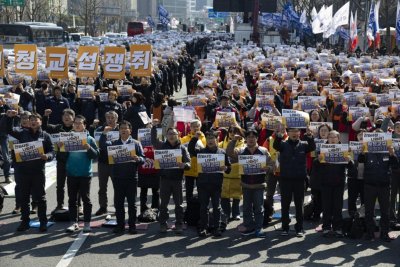
Members of the South Korean Confederation of Trade Unions (KCTU) shout slogans and hold up banners reading ‘Let’s fight for the basic rights of the Workers’ at a rally against the government’s labor policy in Seoul, South Korea, 10 March 2026. Photo by JEON HEON-KYUN / EPA
March 13 (Asia Today) — This commentary is the Asia Today Editor’s Op-Ed.
The atmosphere across industrial workplaces following the implementation of the so-called Yellow Envelope law is far from normal, with growing uncertainty emerging across the labor market.
Within two days of the law taking effect, 453 subcontractor unions representing nearly 98,500 workers filed collective bargaining requests against 248 prime contractor workplaces. With many unions closely watching the situation, the number of bargaining demands is expected to increase sharply once the first successful negotiations occur.
Most companies are struggling to respond effectively to the demands from subcontractor unions. Many firms believe the best course of action is to wait for decisions by the Central Labor Relations Commission and for court precedents to emerge through litigation.
Amid this uncertainty, attention is focusing on the activities of South Korea’s two major labor federations – the Federation of Korean Trade Unions and the Korean Confederation of Trade Unions – which have launched campaigns to expand their influence.
Both organizations view the new law as a major opportunity to increase union membership. With the national unionization rate hovering just above 10%, labor leaders believe the law could help reverse the trend.
The Federation of Korean Trade Unions, which had about 1.2 million members as of 2024, has launched an organizing task force with the goal of expanding its membership to 2 million.
The Korean Confederation of Trade Unions has also set an internal target of reaching 2 million members.
As the two federations compete for leadership within the labor movement, the revised labor law is emerging as a catalyst for organizational expansion. Subcontractor unions with limited bargaining power are increasingly turning to these larger labor groups for support.
The shift is already visible. The labor union at auto parts manufacturer Mando recently voted to rejoin the Korean Confederation of Trade Unions’ Metal Workers’ Union after 14 years.
Union leaders reportedly concluded that joining an industrywide union could help reduce job insecurity, particularly as corporate restructuring has become a potential subject of collective bargaining under the new law.
If even the union at a primary contractor such as Mando has decided to rejoin the federation, the choice for subcontractors, special employment workers and platform laborers with weaker bargaining power appears increasingly clear.
The public sector is also experiencing confusion.
While the government has stated that recognizing employer status in the public sector is generally difficult, President Lee Jae-myung offered a different message, saying the government should serve as a model employer.
As a result, collective bargaining demands are pouring in from outsourced workers and subsidiary employees affiliated with central and local governments as well as public institutions. Many of these public-sector unions are also expected to seek membership in the two major labor federations.
Subcontractor unions backed by the organizational strength and strike guidance of higher-level labor groups are likely to adopt a more aggressive stance in labor disputes.
In particular, the expansion of the Korean Confederation of Trade Unions – often criticized by companies for confrontational labor tactics – could undermine the stability of labor-management relations.
For companies operating in a rapidly changing business environment that demands specialization and efficiency, the situation presents growing challenges.
The competitiveness of government agencies and public institutions could also be affected.
If the government truly seeks to protect the livelihoods of citizens, it must prioritize the competitiveness of businesses and the national economy while taking steps to minimize disruption across industrial workplaces.
— Reported by Asia Today; translated by UPI
© Asia Today. Unauthorized reproduction or redistribution prohibited.
Original Korean report: https://www.asiatoday.co.kr/kn/view.php?key=20260312010003757