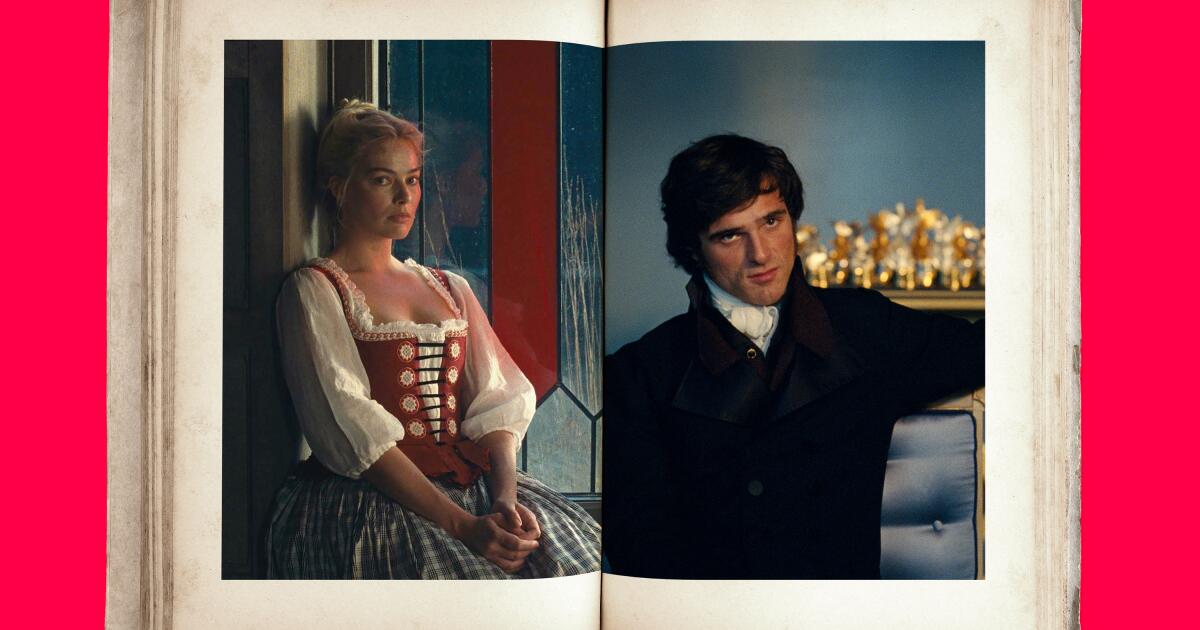
Emerald

‘Wuthering Heights:’ Emerald Fennell film vs. Emily Brontë novel

In its opening credits, Oscar-winning director Emerald Fennell’s “Wuthering Heights” self-identifies as “based on the novel by Emily Brontë.”

Yet as Fennell has proved in a slew of interviews about the already polemical film, released Friday, the relationship between Brontë’s Gothic epic and its latest adaptation is more complicated than that.

Penned by a young female author perpetually adrift in the dark world of fantasy, “Wuthering Heights” is a transgressive novel today and was exponentially more so at the time of its publication in 1847. Its protagonists are vengeful, and its romances — including Catherine Earnshaw (Cathy) and Heathcliff’s — are ridden with violence, both psychological and physical. While Fennell’s film anchors itself in Brontë’s narrative landscape, it also takes creative liberties in service of approximating the director’s personal experience reading it as a teen.

Whereas Brontë’s novel contains “mere glimmers of physical intimacy,” Fennell’s picture is erotic, laden with steamy scenes inserted from the director’s imagination.

“They’re part of the book of my head,” Fennell recently told The Times. “I think they’re part of the book of all of our heads.”

Some book purists beg to differ with Fennell’s interpretation. Well in advance of the film’s release, the director was criticized for casting her former “Saltburn” collaborator Jacob Elordi as Heathcliff, who is repeatedly described throughout Brontë’s novel as non-white. Brontë fans have also accused the director of reducing a complex work rife with social critique into a popcorn romance.

Perhaps anticipating such backlash, Fennell in a recent interview with Fandango explained her decision to enclose the film’s title in quotation marks, saying, “You can’t adapt a book as dense and complicated and difficult as this book.”

“I can’t say I’m making ‘Wuthering Heights.’ It’s not possible,” the director said. “What I can say is I’m making a version of it.”

Here are seven ways Fennell’s interpretation of “Wuthering Heights” differs from its source material.

Fennell’s Heathcliff is white

Brontë’s “Wuthering Heights” leaves Heathcliff’s racial identity ambiguous, with characters referring to him as a “gipsy brat,” “lascar” and “Spanish castaway” at different points throughout the novel. But one thing is clear: He is not white.

As the Lousiana State Unversity professor Elsie Michie writes in the academic journal article, “From Simianized Irish to Oriental Despots: Heathcliff, Rochester and Racial Difference,” Heathcliff’s racial othering is how “he becomes, for others, a locus of both fear and desire.” In other words, Heathcliff’s role in the novel, and thus his fraught romance with Cathy, is predicated upon his non-white identity.

Fennell’s film instead relies on class differences — and a meddling Nelly (to be discussed later) — to form the rift between its love interests.

Cathy’s brother dies young

When Mr. Earnshaw presents a young Cathy with her companion-to-be early in the film, she declares that she will name him Heathcliff, “after my dead brother.”

For the remainder of the film, Brontë’s character Hindley Earnshaw is subsumed into Mr. Earnshaw. Rather than Hindley, it is Mr. Earnshaw who devolves into the drunk gambling addict whose vices force him to cede Wuthering Heights to Heathcliff. Mr. Earnshaw’s abuse of young Heathcliff in the film makes the latter’s revenge plot more personal than his book counterpart’s against Hindley.

Cathy meets Edgar Linton as an adult

In Brontë’s novel, Cathy and Heathcliff first encounter their neighbors, the Lintons, after an outdoor escapade gone awry. Cathy gets bitten in the ankle by an aggressive dog and stays at the Lintons’ for a few weeks to heal.

Cathy sustains a similar injury in the film, but this time, she’s an adult woman, who falls from the Thrushcross Grange garden wall after attempting to spy on its grown residents Edgar and Isabella. (In the book, the two are siblings. Here, Isabella is referred to as Edgar’s “ward.”)

Aside from providing some comic relief, Fennell’s revision also fast-tracks the marriage plot that severs Cathy and Heathcliff.

Nelly is a meddler, and a spiteful one

Whereas Brontë writes Nelly as a largely passive narrator, Fennell abandons the frame narrative structure altogether and instead fashions the housekeeper into a complex character with significant control over Cathy’s life.

It is she who ensures Heathcliff overhears Cathy as she laments how marrying him would degrade her, causing him to flee Wuthering Heights and leave Cathy to marry Edgar. Nelly’s ploy comes shortly after Cathy demeans the housekeeper, claiming that she wouldn’t understand Cathy’s predicament given she’s never loved anyone, and no one has ever loved her. Thus, Nelly is characterized as vengeful toward Cathy — although, as the latter lies in her death bed, the two share a brief moment that complicates their relationship to each other.

Regardless, Fennell gives Nelly and Cathy’s relationship psychological depth that Brontë’s novel doesn’t seem to afford them.

Cathy and Heathcliff have sex (and a lot of it)

Brontë’s Cathy and Heathcliff never explicitly (in the text) consummate their professed undying love, save for a few kisses just before Cathy breathes her last.

Fennell’s “Wuthering Heights,” on the other hand, grants them an entire Bridgerton-style sex montage — they even get hot and heavy in a carriage. It’s nearly impossible to keep count of the “I love you”s exchanged during the pair’s rendezvous.

These smutty sequences certainly validate the Valentine’s Eve release.

Isabella is a willing submissive

One particular still of Alison Oliver’s Isabella is already making the rounds online, and for good reason. The shot, which depicts the young woman engaging in BDSM-style puppy play, is a stark contrast to Brontë’s characterization of Isabella as a victim of domestic violence.

In Brontë’s book, Isabella marries Heathcliff naively believing he might shape up into a gentleman and flees with their son when she realizes that is out of the question. In the film, Heathcliff is clear from their first romantic encounter that he does not love Isabella, will never love her and pursues her only to torture Cathy — and the young woman still chooses to be with him.

There is no second generation

Perhaps Fennell’s most glaring diversion from her source material is her complete omission of the second half of Brontë’s novel, which centers on a second generation comprised of Cathy and Edgar’s daughter Catherine Linton, Heathcliff and Isabella’s son Linton Heathcliff and Hindley and his wife Frances’ son Hareton Earnshaw.

In her introduction to the Penguin Classics edition of “Wuthering Heights,” Brontë scholar Pauline Nestor writes that many literary critics interpret the novel’s latter half as “signifying the restoration of order and balance in the second generation after the excesses and disruption of the first generation,” while others contend the violence that stains Cathy and Heathcliff’s relationship is bound to be replicated by their children. Either way, the structure of Brontë’s novel encourages readers to interpret each half through the lens of the other.

Fennell’s film instead ends where Brontë’s first act closes, hyper-focused on Cathy and Heathcliff. In the same way the doomed lovers see each other, Fennell figures them as the center of the world.


Source link

How Emerald Fennell pushed ‘Wuthering Heights’ to the ‘squeaking point’

Emerald Fennell’s adaptation of “Wuthering Heights” could only have been created by a true fan. The British filmmaker wanted to evoke her youthful experience reading Emily Brontë’s 1847 novel when she was 14, which she describes as “the most physical emotional connection I’ve ever had to anything.” Her bodice-ripping, visually sumptuous version, in theaters Friday, incorporates some essential literary elements, but also imagines what’s in between the lines of Brontë’s writing, including sultry moments between the protagonists.

“I’m fanatical about the book,” Fennell says. She’s speaking over Zoom alongside Margot Robbie, who stars as Catherine Earnshaw (and who also produced the film), and Jacob Elordi, who plays Heathcliff. “I’m as obsessive about Emily Brontë as everyone else. She gets inside you.”

The director, 40, recalls going to the Brontë Festival of Women’s Writing in West Yorkshire, England, in 2025 and feeling completely at home. “I was like, ‘These are my chicks,’” Fennell says. “We all want to sleep in a coffin.” Robbie laughs, despite likely having heard the story before.

“We are, all of us, breathless, up against a rock,” Fennell continues, referencing a particularly evocative scene she imagined for her film. “I care so deeply about this that I couldn’t hope to ever make a perfect adaptation because I know my own limits.”

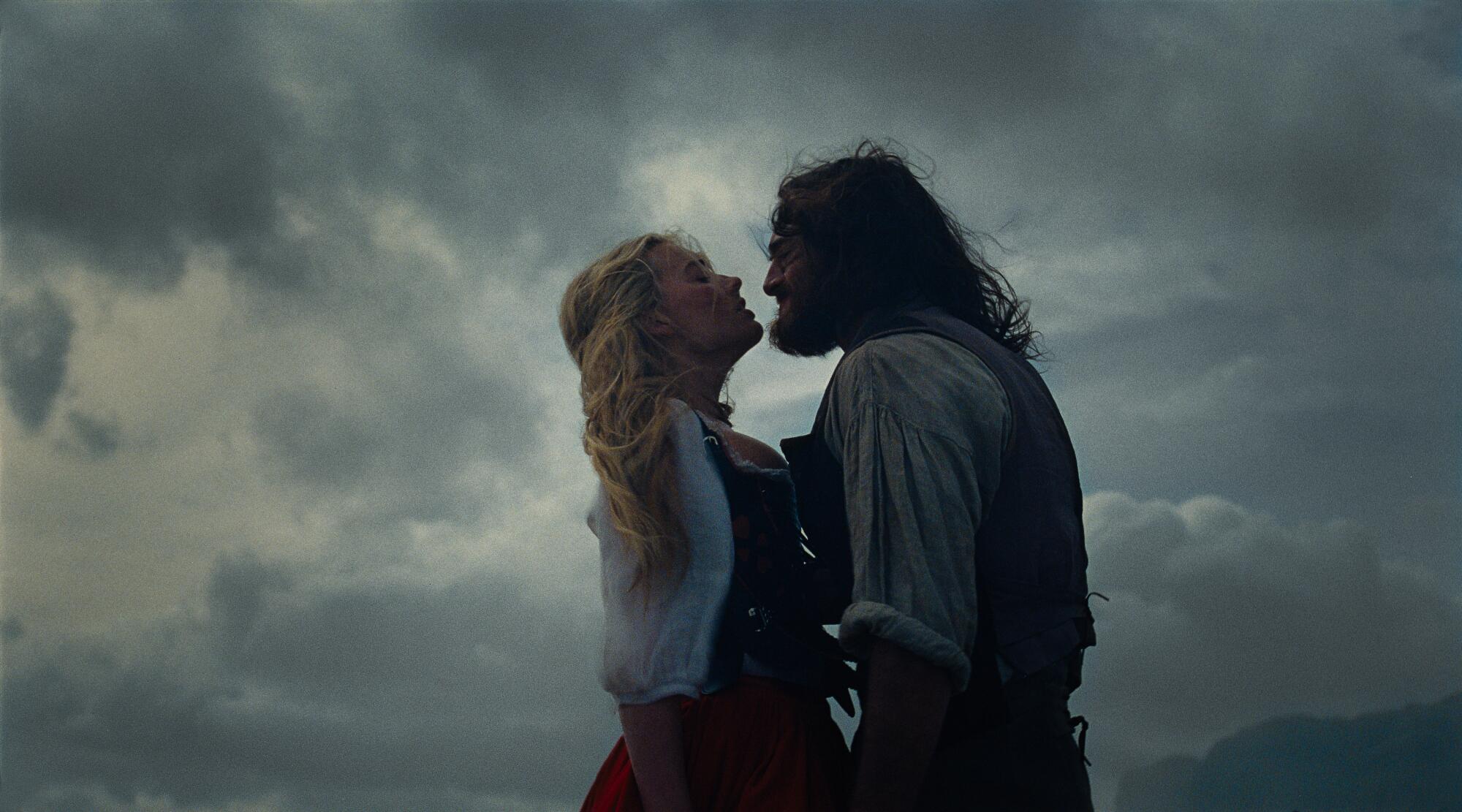
A woman and a man embrace on a stormy bluff.

Margot Robbie and Jacob Elordi in the movie “Wuthering Heights.”

(Warner Bros. Pictures)

What she could do is make a film that recalled the visceral feeling of reading the novel as a teen. “That would mean it had a certain amount of wish fulfillment,” she admits. The novel is famously austere, with mere glimmers of physical intimacy. “The Gothic, to me, is emotional and it’s about the world reflecting everyone’s interior landscape. This is my personal fan tribute to this work.”

“Wuthering Heights” marks the third collaboration between Robbie’s production company, LuckyChap Entertainment, and Fennell. Robbie, 35, produced Fennell’s 2020 feature debut “Promising Young Woman,” which earned Fennell the Oscar for original screenplay, and 2023’s class-envy thriller “Saltburn.” Her style is confrontational and seemingly fearless, often provoking hugely divergent reactions from critics and fans. She’s a filmmaker who goes full-on.

Despite their history, however, Robbie had never acted in one of Fennell’s films.

“When I read this script, I did find I was putting myself in Cathy’s shoes and reading the lines and thinking, ‘How would I play it?’” Robbie says. “I do that often when reading scripts, but my heart sank when thinking about the casting. So I threw my hat in the ring.”

A woman in a dress sits in a window.

Margot Robbie in the movie “Wuthering Heights.”

(Warner Bros. Pictures)

“It’s a bit like asking your friend to date you,” Fennell chimes in. “It’s taking something a step in a different direction. You don’t want to be the person who blows up the thing that you have that works so well. But I was desperate for Margot to play Cathy. I was so relieved that it was her who made the first move.”

Fennell did make the first move with Elordi, 28, recently Oscar-nominated for his monster in Guillermo del Toro’s “Frankenstein.”

“Emerald texted me and said, ‘Do you want to be Heathcliff?’” Elordi recalls. “That was it. I said, ‘Yeah.’ And then when she gave the screenplay, I read it and wept. That’s how you dream of making movies.”

Not only did Elordi look like the version of Heathcliff on the cover of Fennell’s edition of the novel, but she had witnessed his potential for the role while making “Saltburn.”

An arrogant man sits on a couch.

Jacob Elordi in the movie “Wuthering Heights.”

(Warner Bros. Pictures)

“Felix is a character who does something awful in every scene,” Fennell explains of Elordi’s charismatic rich boy in “Saltburn.” “But it needed somebody who could make everyone in the audience forget that. And Jacob was the only person who came in and did that. Heathcliff is an extreme antihero. He’s cruel and he’s violent and he’s relentless and he’s vengeful and he’s spiteful. Jacob has a sensitivity and tenderness and groundedness that makes us forgive all that.”

Fennell knew the film hinged on the casting of Cathy and Heathcliff, two iconic literary characters who have been portrayed by a multitude of actors over the years, including Laurence Olivier, Juliette Binoche and Ralph Fiennes. It’s been broadly debated whether the novel actually is a love story between the snobbish Cathy and the glowering Heathcliff. For some, it’s a tale of toxic fixation, for others a revenge plot or a tragedy. But Fennell’s version is undeniably a big-screen romance.

Three film collaborators stand outside on a stone landing.

“We were looking for outsized charisma and outsized talent, people like Burton and Taylor,” director Emerald Fennell says. “A combination of actors who are explosively brilliant. And it’s these two.”

(Shayan Asgharnia / For The Times)

“We were looking for outsized charisma and outsized talent, people like Burton and Taylor,” Fennell says of the classic onscreen pairing of Richard Burton and Elizabeth Taylor, famously tumultuous. “A combination of actors who are explosively brilliant. And it’s these two.”

“That’s the coolest thing to say,” Elordi says, covering his face with his hands. “This after years of hearing nothing,” he quips. (Fennell says she is sparing with praise.)

“Wuthering Heights” reunites several of Fennell’s repeat collaborators. Actor Alison Oliver, who appeared in “Saltburn,” plays Isabella Linton, Edgar’s ward who becomes a problematic fixation for Heathcliff, and the filmmaker reteamed with cinematographer Linus Sandgren, production designer Suzie Davies and editor Victoria Boydell. Fennell also brought in new faces, including Hong Chau as Nelly Dean, Cathy’s companion, and Shazad Latif as wealthy businessman Edgar Linton. She and Robbie aimed to create a creatively safe set.

“It’s very exposing, especially for the actors,” Fennell says of making an audacious film like this. “You need to be able to forget that and feel that you have the ability to make mistakes and try something different.”

Fennell’s direction was often unexpected.

“I remember she prepped us for the long table scene and said, ‘It needs to come to life,’” Elordi says. “Heathcliff was brooding but she said, ‘What if he wasn’t brooding?’ All of a sudden there was this electricity at the table. As an actor, that pushes me out of my comfort zone. And every time it works.”

“What I like about working with Emerald is: I like going too far,” Robbie agrees. “My instinct is to go really hard and then have someone tell me to pull it back. She rarely tells me to pull it back. She wants the maximalist version and I relish that. She would say, ‘Now you’re in a sensible period film.’ And then she’d say ‘Now do it like you’re Ursula the sea witch.’”

That was the take that made the final cut. “Part of it is there,” Fennell confirms. “Usually I use only a little moment of something but that’s the crucial one. Because we’re all so crazy in life, aren’t we?”

“And Cathy so is Ursula the sea witch,” Robbie says.

“She’s such a little sea witch,” Fennell agrees.

Fennell’s reimagining of “Wuthering Heights” amps up the existing emotions in the novel. She abridges its plot, removing the second-generation narrative that bookends Brontë’s writing. The torment of Cathy’s abusive brother shifts to the hands of her father, played by Martin Clunes.

Meanwhile, the longing between Cathy and Heathcliff, who can’t be together due to his lowly station and her spiteful decision to marry the wealthy Linton, accelerates dramatically into fervid sex scenes. The doomed couple erotically embrace on the Yorkshire Moors, in the back of a carriage and even inside her bedroom at Thrushcross Grange — all moments that are not part of the book.

A woman leans against a veiny wall.

Margot Robbie in the movie “Wuthering Heights.”

(Warner Bros. Pictures)

“They’re part of the book of my head,” Fennell says, adamantly. “I think they’re part of the book of all of our heads. With all the love and respect and adoration I have for the book, I also wanted to make my own version that I needed to see.”

“It is totally that wish fulfillment,” Robbie says. “And if you can’t have the wish fulfillment in movies, where are you going to get it?”

Fennell imbued the film with tactile visuals that evoke the sexual tension between Cathy and Heathcliff. There are close-ups of hands kneading dough, a snail sliming its way up a window and Cathy prodding a jellied fish with her finger. The director tested numerous fish before selecting the one that is seen onscreen.

“Why I love working with these guys so much is we’re all detail perverts,” Fennell says. “I am obsessed with every single thing. That fish that Margot fingered — I fingered about 50 different fish before then. Tiny fish, big fish, fake fish, jelly that was wet, jelly that was soft, jelly that was firm.”

“You think she’s joking but she’s not,” Robbie says.

“My finger smelled so bad the whole time that we were making this movie,” Fennell adds.

Ultimately, though, it was the best possible fish. “We did the takes with a couple of fish, but we all knew the right one when it happened,” Robbie says of the scene, which mirrors the sexual disappointment in Cathy’s marriage. “We all felt it in the same moment. Everyone went, ‘That’s it.’”

Two people walk through doors into a drawing room.

Jacob Elordi and Margot Robbie in the movie “Wuthering Heights.”

(Warner Bros. Pictures)

The film’s aesthetic is bold and brash, featuring brilliantly hued red floors and walls designed to look like Cathy’s freckled skin. It lands somewhere between Disney fairy tale, ’80s romance paperback art and old Hollywood glamour. Atmospheric mist pours across every scene. The estate of Wuthering Heights is foreboding and dark, with rocks splintering through the walls, while Linton’s Thrushcross Grange bears a Victorian aesthetic, containing the outside world. “It’s nature coming in and nature being kept out,” Fennell says. “And it’s about what that means emotionally and metaphorically for the story and for these characters.”

There is purposefully no adherence to historical accuracy, particularly in the costumes. Designed by Jacqueline Durran, the wardrobe was elaborately wild to underscore emotional truths rather than period relevancy.

“You couldn’t not scream,” Robbie says about trying on each piece. “And then Emerald would come up with a platter of jewels and start decorating me like a Christmas tree.”

“There was so much screaming every day,” Fennell says. “I always want people to have permission to go too far, to do something that’s in bad taste, that’s not subtle. I’m really interested in pushing until that squeaking point where you’re like, ‘OK, that’s too far.’ It takes a lot of bravery to do that.”

Even Elordi joined in the excitement. “I was screaming at all the dresses,” he says. “Margot and Alison’s dressing rooms flanked me so I’d often get caught in the hallway.”

Although the world of the movie is heightened and beautifully garish, the romance is more grounded. You can feel how desperate Cathy and Heathcliff are for each other in their own twisted way, and despite their horrible machinations you want them to be together. The film ends differently from the novel, but it shares with it a sad inevitability.

Fennell inherently understood what makes these characters so desirable.

“I was led by my own feelings,” she says. “On set, we were all trying to find that thing that made us get goosebumps. One of the earliest scenes we shot was where Heathcliff breaks the chair to build Cathy a fire.”

To help a shivering Cathy, Heathcliff rises from his wooden seat, smashes it on the floor and tosses the pieces into the fireplace. It’s a moment of devotion from Heathcliff, but triggers a lustful response in Cathy.

“I looked around and all of these professionals, women and men, were agape. Everyone felt the same way as Cathy. That’s what I was looking for every day.”

“He actually broke the chair,” Robbie says. “Cathy’s reaction is my genuine reaction.”

Elordi understood the challenge of embodying such an iconic character, who has existed both on the page and on the screen for generations. He also didn’t want to let Fennell down.

“I knew how personal the story was to Emerald and I knew the screenplay that she had written was extremely good, but I was like ‘What makes you think I can do this?’” Elordi remembers. “I had a lot of nerves but I jumped into it. This is a director you’re really able to give everything to. The images that come from her head are so unique and singular. The first time I watched ‘Saltburn’ with her, I sat back and I realized I was in the presence of something truly great and original. To be able to investigate with her two times is a gift.”

Says Robbie, “My hope is always: There’s got to be one person that watches this movie and thinks ‘That’s my favorite of all time.’ I want to make a movie that is someone’s favorite movie of all time and I’ll know how much that means to them. That it might save them in whatever ways movies can save you.”

Fennell’s “Wuthering Heights” shudders with feeling. And however audiences perceive it, its maker has done exactly what she intended.

Source link