election denier

Trump’s top voting rights lawyer led L.A. election conspiracy case

Eric Neff’s tenure at the Los Angeles County district attorney’s office ended after he was placed on administrative leave in 2022 over accusations of misconduct in the prosecution of the CEO of Konnech, a software company that election conspiracy theorists said was in the thrall of the Chinese government.

Now, three years later, Neff is serving as one of the Trump administration’s top election watchdogs.

Late last year , his name began appearing on lawsuits filed by the U.S. Department of Justice’s Civil Rights Division, listed as “acting chief” of the voting section.

Neff’s appointment, first reported by Mother Jones, has prompted renewed scrutiny of his work at the L.A. County district attorney’s office.

The Times interviewed several of Neff’s former colleagues, who revealed new details about claims of misconduct that emerged from the Konnech case, and said they were alarmed that someone with almost no background in federal election law was named to a senior position.

Neff led the 2022 investigation of Konnech, a tiny Michigan company whose software is used by election officials in several major cities. In a criminal complaint, Neff accused the company’s CEO, Eugene Yu, of fraud and embezzlement, alleging the company stored poll worker information on a server based in China, a violation of its contract with the L.A. County registrar’s office.

Six weeks after a complaint was filed, prosecutors dropped the case and launched an investigation into “irregularities” and bias in the way evidence was presented against Konnech, the D.A.’s office said in a 2022 statement.

The county paid Konnech $5 million and joined a motion to find Yu factually innocent as part of a legal settlement.

The internal probe was focused on accusations that Neff misled supervisors at the district attorney’s office about the role of election deniers in his investigation, according to two officials with direct knowledge of the case who requested anonymity because they were not authorized to discuss it publicly.

Neff also allegedly withheld information about potential biases in the case from a grand jury, according to the two officials.

In a civil lawsuit filed last year, Neff said the internal review by the D.A.’s office cleared him of wrongdoing. The two officials familiar with the probe who spoke on the condition of anonymity disputed Neff’s characterization of the findings.

A spokesman for Dist. Atty. Nathan Hochman declined to comment or provide the results of the investigation into Neff, which the officials said was conducted by an outside law firm that generated a report on the case. Neff’s attorney also did not provide a copy of the report.

A Department of Justice spokesman declined to comment.

Neff’s attorney, Tom Yu — no relation to the Konnech CEO — said his client had no obligation to provide background information about the origins of the case to the grand jury.

Neff’s appointment comes as President Trump continues to remake the DOJ in his own image by appointing political loyalists with no criminal law background as U.S. attorneys in New Jersey and Virginia and seeking prosecutions of his political enemies, such as former FBI Director James Comey.

Trump has never recanted his false claim that he won the 2020 election.

When then-L.A. County Dist. Atty. George Gascón announced the charges against Konnech in 2020, Trump said the progressive prosecutor would become a “National hero on the Right if he got to the bottom of this aspect of the Voting Fraud.”

The Konnech case was centered on contract fraud, not voter fraud or ballot rigging. Six weeks after the charges were filed, the case disintegrated.

The D.A.’s office cited Neff’s over-reliance on evidence provided by True the Vote, the group that pushed the unfounded Chinese government conspiracies about Konnech and also appeared in a film that spread claims that the 2020 presidential election was stolen.

Gascón initially denied that True the Vote was involved in the case, but weeks later, a D.A.’s office spokesman said a report from the group’s co-founder, Gregg Phillips, sparked the prosecution. Phillips testified in court in July 2022 that it was Neff who first contacted him about Konnech.

The two officials who spoke to The Times said that Neff withheld True the Vote’s role from high-level D.A.’s office staff, including Gascón, when presenting the case.

Gascón declined an interview request, noting he is named in Neff’s pending lawsuit, which is slated for trial in early 2026.

Neff’s attorney insisted the case against Konnech was solid.

“He was let go because Trump tweeted a statement of ‘Go George Go’,” the attorney said. “That’s why Eugene Yu was let go. Because Gascón was so scared he was going to lose votes.”

Calls and emails to an attorney who previously represented Eugene Yu were not returned.

In his lawsuit, Neff claimed he had evidence that “Konnech used third-party contractors based in China and failed to abide by security procedures” to protect L.A. County poll worker data. The evidence was not attached as an exhibit in the lawsuit.

A DOJ spokesperson declined to describe Neff’s job duties. His name appears on a number of lawsuits filed in recent months against states that have refused to turn over voter registration lists to the Trump administration.

Neff is also involved in a suit filed against the Fulton County clerk’s office in Georgia seeking records related to the 2020 election, records show.

“We will not permit states to jeopardize the integrity and effectiveness of elections by refusing to abide by our federal elections laws,” Asst. Atty. Gen. Harmeet Dhillon, the California conservative who now leads the civil rights division, said in a recent statement. “If states will not fulfill their duty to protect the integrity of the ballot, we will.”

Dhillon declined to comment through a DOJ spokesman.

The voting section “enforces the civil provisions of the federal laws that protect the right to vote, including the Voting Rights Act,” according to the DOJ’s website.

It does not appear that Neff has any background working on cases related to federal election law. He first became an L.A. County prosecutor in 2013 and spent years handling local crime cases out of the Pomona courthouse. He was promoted and reassigned to the Public Integrity Division, which investigates corruption issues, in 2020, according to his lawsuit.

While there, he handled only two prosecutions related to elections. One was the Konnech case. The other involved allegations of election rigging against a Compton city council member.

In August 2021, Isaac Galvan, a Democrat, was charged with conspiring to commit election fraud after he allegedly worked to direct voters from outside his council district to cast ballots for him. Galvan won the race by just one vote, but was booted from office when a judge determined at least four improper ballots had been cast.

Galvan’s criminal case is still pending; he recently pleaded guilty to charges in a separate corruption and bribery case in federal court. A spokesman for the U.S. attorney’s office in Los Angeles said there was no overlap between the D.A.’s election rigging case and the bribery case against Galvan. Federal prosecutors are not reviewing the Konnech case, the spokesman said.

Court filings show Neff was involved in Galvan’s L.A. County case, but the prosecution was led by a more senior attorney.

Justin Levitt, a constitutional law professor at Loyola Law School who served in the civil rights division during the Obama administration, said section chiefs normally have decades of experience in the area of law they’re meant to supervise.

“The biggest problem with somebody with Neff’s history is the giant screaming red flag that involves filing a prosecution based on unreliable evidence,” Levitt said. “That’s not something any prosecutor should do.”

Neff’s attorney, Yu, scoffed at the idea that his client was not experienced enough for his new role in the Trump administration, or that he was selected due to his involvement in the Konnech case.

“Eric got the job because he’s qualified to get the job. He didn’t get the job for any other reason. He got the job because he’s an excellent advocate,” Yu said. “I think the Justice Department is very fortunate to have Eric.”

Times Staff Writer Seema Mehta contributed to this report.
Source link

Columnists Anita Chabria and Mark Z. Barabak look back on 2025

Is there a dumpster somewhere to torch and bury this year of bedlam, 2025?

We near its end with equal amounts relief and trepidation. Surely we can’t be expected to endure another such tumultuous turn around the sun?

It was only January that Donald Trump moved back into the White House, apparently toting trunkloads of gilt for the walls. Within weeks, he’d declared an emergency at the border; set in motion plans to dismantle government agencies; fired masses of federal workers; and tariffs, tariffs, tariffs.

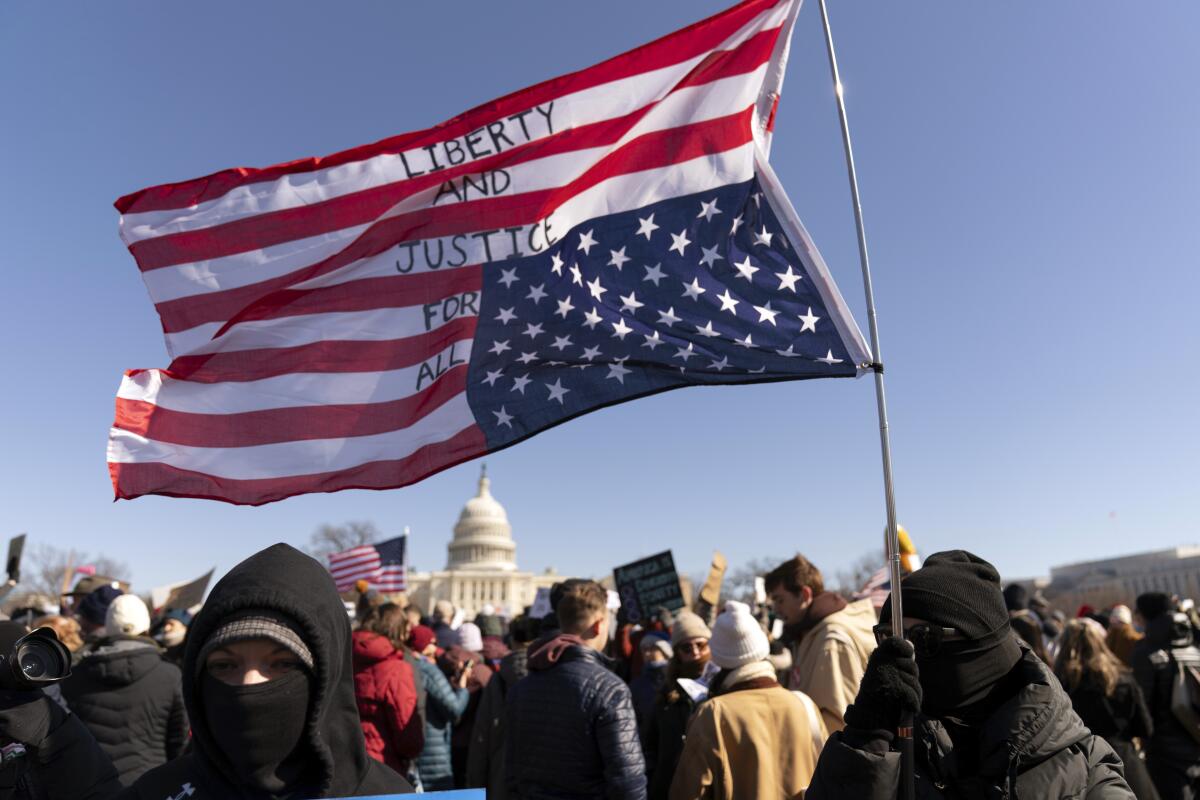
A crowd of demonstrators on the Capitol Mall flying an upside down American flag

Demonstrators at a No Kings rally in Washington, protesting actions by President Trump and Elon Musk.

(Jose Luis Magana / Associated Press)

By spring, the administration was attacking Harvard as a test case for strong-arming higher education. By June, Trump’s grotesquely misnamed Big Beautiful Bill had become law, giving $1 trillion in tax cuts to billionaires and funding a deportation effort (and armed force) that has fundamentally reshaped American immigration law and ended any pretense about targeting “the worst of the worst.”

Fall and winter have brought questionable bombings of boats in the Caribbean, a further backing away from Ukraine, a crackdown on opposition to Trump by classifying it as leftist terrorism and congressional inaction on healthcare that will leave many struggling to stay insured.

That’s the short list.

It was a year when America tried something new, and while adherents of the MAGA movement may celebrate much of it, our columnists Anita Chabria and Mark Z. Barabak have a different perspective.

Here, they renew their annual tradition of looking at the year past and offering some thoughts on what the new year may bring.

Chabria: Welp, that was something. I can’t say 2025 was a stellar year for the American experiment, but it certainly will make the history books.

Before we dive into pure politics, I’ll start with something positive. I met a married couple at a No Kings rally in Sacramento who were dressed up as dinosaurs, inspired by the Portland Frog, an activist who wears an inflatable amphibian suit.

When I asked why, the husband told me, “If you don’t do something soon, you will have democracy be extinct.”

A woman standing before an American flag during an anti-Trump protest in downtown Los Angeles.

Crowds participate in No Kings Day in downtown Los Angeles in October.

(Genaro Molina / Los Angeles Times)

I loved that so many Americans were doing something by turning out to not just protest policies that hit personally, but to rally in support of democracy writ large. For many, it was their first time taking this kind of action, and they were doing it in a way that expressed optimism and possibility rather than giving in to anger or despair. Where there is humor, there is hope.

Barabak: As in, it only hurts when I laugh?

In 2024, a plurality of Americans voted to reinstall Trump in the White House — warts, felony conviction and all — mainly in the hope he would bring down the cost of living and make eggs and gasoline affordable again.

While eggs and gas are no longer exorbitant, the cost of just about everything else continues to climb. Or, in the case of beef, utility bills and insurance, skyrocket.

Workers adding Donald Trump's name to the John F. Kennedy Memorial Center for the Performing Arts

The John F. Kennedy Memorial Center for the Performing Arts is another of the long-standing institutions Trump has smeared his name across.

(Jacquelyn Martin / Associated Press)

Meantime, the president seems less concerned with improving voters’ lives than smearing his name on every object he lays his eyes on, one of the latest examples being the John F. Kennedy Center for the Performing Arts.

(The only place Trump doesn’t want to see his name is in those voluminous Epstein files.)

I wonder: Why stop there? Why not brand these the United States of Trump-erica, then boast we live in the “hottest” country on Planet Trump?

Chabria: Stop giving him ideas!

You and I agree that it’s been a difficult year full of absurdity, but we’ve disagreed on how seriously to take Trump as a threat to democracy. As the year closes, I am more concerned than ever.

It’s not the ugly antics of ego that alarm me, but the devastating policies that will be hard to undo — if we get the chance to undo them.

The race-based witch hunt of deportations is obviously at the top of that list, but the demolition of both K-12 and higher education; the dismantling of federal agencies, thereby cutting our scientific power as a nation; the increasing oligarchy of tech industrialists; the quiet placement of election deniers in key election posts — these are all hammers bashing away at our democracy.

Now, we are seeing overt antisemitism and racism on the MAGA right, with alarming acceptance from many. The far right has championed a debate as dumb as it is frightening, about “heritage” Americans being somehow a higher class of citizens than nonwhites.

Vice President JD Vance speaks at a college campus event in front of a poster reading "This Is the Turning Point."

Vice President JD Vance speaks at the University of Mississippi in Oxford.

(Gerald Herbert / Associated Press)

Recently, Vice President JD Vance gave a speech in which he announced, “In the United States of America, you don’t have to apologize for being white anymore,” and Trump has said he wants to start taking away citizenship from legal immigrants. Both men claim America is a Christian nation, and eschew diversity as a value.

Do you still think American democracy is secure, and this political moment will pass without lasting damage to our democratic norms?

Barabak: I’ll start with some differentiation.

I agree that Trump is sowing seeds or, more specifically, enacting policies and programs, that will germinate and do damage for many years to come.

Alienating our allies, terrorizing communities with his prejudicial anti-immigrant policies — which go far beyond a reasonable tightening of border security — starving science and other research programs. The list is a long and depressing one, as you suggest.

But I do believe — cue the trumpets and cherubs — there is nothing beyond the power of voters to fix.

To quote, well, me, there is no organism on the planet more sensitive to heat and light than a politician. We’ve already seen an anti-Trump backlash in a series of elections held this year, in red and blue state alike. A strong repudiation in the 2026 midterm election will do more than all the editorial tut-tutting and protest marches combined. (Not that either are bad things.)

A poll worker at Los Angeles' Union Station.

A stressed-out seeming poll worker in a polling station at Los Angeles’ Union Station.

(Eric Thayer / Los Angeles Times)

The best way to preserve our democracy and uphold America’s values is for unhappy citizens to register their dissent via the ballot box. And to address at least one of your concerns, I’m not too worried about Trump somehow nullifying the results, given legal checks and the decentralization of our election system.

Installing lawmakers in Congress with a mandate to hold Trump to account would be a good start toward repairing at least some of the damage he’s wrought. And if it turns into a Republican rout, it’ll be quite something to watch the president’s onetime allies run for the hills as fast as their weak knees allow.

Chabria: OMG! It’s a holiday miracle. We agree!

I think the midterms will be messy, but I don’t think this will be an election where Trump, or anyone, outright tries to undo overall results.

Although I do think the groundwork will be laid to sow further doubt in our election integrity ahead of 2028, and we will see bogus claims of fraud and lawsuits.

So the midterms very well could be a reset if Democrats take control of something, anything. We would likely not see past damage repaired, but may see enough opposition to slow the pace of whatever is happening now, and offer transparency and oversight.

But the 2026 election only matters if people vote, which historically is not something a great number of people do in midterms. At this point, there are few people out there who haven’t heard about the stakes in November, but that still doesn’t translate to folks — lazy, busy, distracted — weighing in.

If proposed restrictions on mail-in ballots or voter identification take effect, even just in some states, that will also change the outcomes.

But there is hope, always hope.

Barabak: On that note, let’s recognize a few of the many good things that happened in 2025.

MacKenzie Scott donated $700 million to more than a dozen historically Black colleges and universities, showing that not all tech billionaires are selfish and venal.

The Dodgers won their second championship and, while this San Francisco Giants fan was not pleased, their seven-game thriller against the Toronto Blue Jays was a World Series for the ages.

And the strength and resilience shown by survivors of January’s SoCal firestorm has been something to behold.

Any others, beside your demonstrating dinos, who deserve commendation?

Pope Leo XIV waves after delivering the annual Christmas blessing.

Pope Leo XIV waves after delivering the Christmas Day blessing from the main balcony of St. Peter’s Basilica at the Vatican.

(Gregorio Borgia / Associated Press)

Chabria: Though I’m not Catholic, I have been surprisingly inspired by Pope Leo XIV.

So I’ll leave us with a bit of his advice for the future: “Be agents of communion, capable of breaking down the logic of division and polarization, of individualism and egocentrism.”

Many of us are tired, and suffering from Trump fatigue. Regardless, to put it in nonpapal terms, it may be a dumpster — but we’re all in it together.

Barabak: I’d like to end, as we do each year, with a thank you to our readers.

Anita and I wouldn’t be here — which would greatly please some folks — but for you. (And a special nod to the paid subscribers out there. You help keep the lights on.)

Here’s wishing each and all a happy, healthy and prosperous new year.

We’ll see you again in 2026.

Source link