elected

Hilton proposes eliminating DMV, slashing vehicle registration fee if elected governor

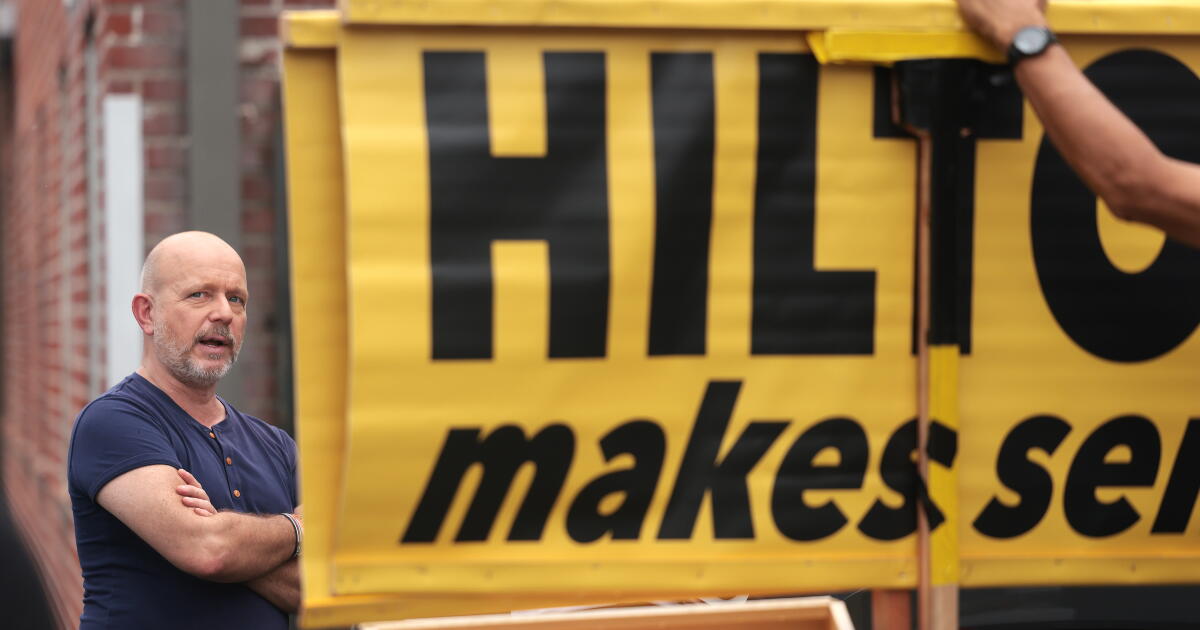
If elected governor in November, Republican Steve Hilton said Tuesday he would eliminate the state Department of Motor Vehicles and slash registration fees for car owners — expressing confidence that the Democratic-controlled Legislature would embrace the plan.

“My starting expectation would be, they would be with me on things to reduce the cost of living, so let’s work together,” he told The Times on Tuesday.

Hilton said that once state lawmakers met with him and realized he was not the “caricature” his critics portray, they would realize that he is “not a particularly tribal person. I’m just looking to solve problems, and we all agree about the cost of living.”

Eliminating a state agency would require approval from the state Legislature, where Democrats hold super majorities in both chambers. Assembly Speaker Robert Rivas (D-Hollister) and Senate President Pro Tem Monique Limón (D-Santa Barbara) have both endorsed Hilton’s Democratic rival in the governor’s race, former Biden cabinet member Xavier Becerra.

The Becerra campaign scoffed at Hilton’s confidence.

“You can’t spend a year calling Democrats a failure and then expect two-thirds of both chambers to take your calls,” said Becerra spokesperson Jonathan Underland. “Steve is in for a very rude awakening, and the fact that he can’t see it coming just shows how little he understands the job he’s asking for.“

Hilton announced his plan at a news conference outside of a DMV office in West Hollywood, where he touted proposals to eliminate the state agency, which has a $1.6-billion budget, and reduce the annual vehicle registration fee to $73 per year.

“We are going to shut down this bloated, nanny-state bureaucratic agency that treats Californians with complete contempt,” he said to cheers at the event. “We are done with it. Enough is enough with the DMV. Enough is enough with sky-high registration rates. We are done.”

Hilton said he could issue an executive order to reduce the vehicle licensing fees, as Gov. Arnold Schwarzenegger did less than an hour after being sworn into office upon winning the 2003 recall election. While the fee is set by state tax code, governors can waive it in specific circumstances, as Schwarzenegger did.

Californians currently register more than 36 million vehicles with the DMV each year, and the average annual fee paid for each is $329, according to the state Legislative Analyst’s Office. The registration fees, along with driver’s license costs and other fees related to the California Highway Patrol and identification cards collected by the DMV, are the primary funding sources of the CHP and DMV.

Hilton said the state currently reaps $11 billion to $12 billion per year from vehicle registration fees, and that his proposal would reduce the revenue to roughly $2.7 billion. He said he would make up for the revenue shortfall created by the proposal — and other plans, including eliminating state taxes on the first $150,000 of income — by reducing the state’s workforce by 10% and agency budgets by 5%.

To eliminate a state agency, Hilton would need legislative approval, although he says that if Sacramento lawmakers were to rebuff his efforts, he could use the budget to slash the DMV’s operations.

Hilton cited a discussion he had with Schwarzenegger at an August dinner at the movie star’s Brentwood estate.

“Arnold said the Democrats who led the Legislature when he was there much preferred” having a Republican governor to a Democratic one, Hilton said.

Hilton lacks Schwarzenegger’s worldwide fame, and the nation and Sacramento are far more polarized than when the Austrian bodybuilder turned action movie star took office. Still, Hilton’s vehicle registration proposal is reminiscent of a major plank of Schwarzenegger’s successful 2003 campaign to recall and replace Democratic Gov. Gray Davis.

Davis had tripled the state’s annual vehicle license fee shortly after being reelected in 2002 to help address a state budget shortfall. Schwarzenegger seized upon the issue during the recall campaign, at one point dropping a wrecking ball from a five-story crane onto a car spray-painted with the words “Davis Car Tax” in front of a cheering crowd in Costa Mesa.

“We had the biggest action star in the world. He’s going to show action,” said Rob Stutzman, who worked as one of Schwarzenegger’s top advisors. “Arnold demanded it. It was always a production to tell a story. He was genius at it.”

“Californians got a huge increase in their vehicle license fee and it was being done to backfill a deficit arguably revealed to them by surprise after the [2002] election,” Stutzman said.

Stutzman said the fee created a backlash that fueled the recall campaign against Davis, along with rolling blackouts during the energy crisis of 2000 to 2001.

Schwarzenegger’s executive order reducing the license fee to its former rate resulted in billions of dollars of losses to the state’s general fund. The Republican had to respond with spending cuts as well as issuing bonds to make up for the shortfall.

Source link

Becerra would extend moratorium on death penalty if elected governor

Democrat Xavier Becerra defended the death penalty while serving as California’s attorney general, a punishment his office actively sought in the case of a gunman convicted of an Orange County mass shooting, but as the front-running candidate for governor he has vowed to block executions if elected in November.

Becerra said he will extend the blanket reprieve for all death row inmates that Gov. Gavin Newsom enacted by executive order in 2019, saying he supported “moving our state away from a costly, flawed system that disproportionately impacts Black and brown communities and too often gets it wrong.”

Those comments have reassured anti-death penalty advocates wary of Becerra, who has stated throughout his career that capital punishment should be an option for victims seeking justice. He reiterated that stance just a decade ago during his confirmation hearing for attorney general, though he also expressed concerns about the unjust application of the punishment.

“I support the death penalty, but I hate the way it’s being executed,” Becerra told state lawmakers in 2017.

“If you commit some heinous crime where you have taken the life of someone else, and you knew that there was a death penalty in place in that place where you committed that crime, then you should face the punishment for what you’ve done,” he explained. “It doesn’t give me pleasure to say that, but I simply do believe there’s a simple justice in that.”

Becerra’s challenger in the Nov. 3 election, former Fox News commentator Steve Hilton, opposes the death penalty but said he would rescind Newsom’s moratorium because it defies the will of voters.

Becerra has said he is concerned by how death sentences historically have been applied, including a highly disproportionate number of condemned inmates who are Black or Latino men and cases in which they later have been exonerated of crimes.

He repeated similar positions last year during a gubernatorial forum in Los Angeles.

“I do not believe every Californian has gotten a fair verdict in these fights,” he said in response to a question about extending Newsom’s moratorium. “But here is what I will tell you: We have to be aggressive in going after crime, especially the most heinous crime. … I will make sure that we have a judiciary system and a prosecution system that takes into account that we must show fairness.”

Though California has not performed an execution since 2006, prosecutors in some areas of the state continue to seek and win death sentences. As of early August, there were 565 condemned inmates in California prisons, according to the state Department of Corrections and Rehabilitation.

Newsom’s moratorium stops the state from carrying out those sentences.

In California, county district attorneys are responsible for prosecuting the vast majority of accused murderers when they go to trial and also deciding whether to seek the death penalty. The office of the state attorney general is responsible for defending death penalty convictions on appeal.

Becerra sought the death penalty in a murder case his office prosecuted early in his tenure, though unsuccessfully. Scott Dekraai, who was convicted of killing his ex-wife and seven others in a shooting at a Seal Beach beauty salon, was sentenced to life in prison without the possibility of parole after a prosecution scandal involving his case.

Some death penalty opponents criticized Becerra for fighting to uphold the death sentence of Robert Lewis Jr., who was deemed by the California Supreme Court in 2018 to have an intellectual disability that made him ineligible for execution.

“I find that reprehensible,” said Mike Farrell, president of Death Penalty Focus, an advocacy group. A longtime anti-death penalty activist, Farrell is better-known for starring as B.J. Hunnicutt in the TV show “M*A*S*H.”

“It may not have been his idea, but he was part of that process,” he said of Becerra.

Others said Becerra cannot be blamed for doing his job. Former Vice President Kamala Harris faced the same dilemma when she served as state attorney general, as does Rob Bonta, who currently holds the office.

“The AG is in a different position because it’s just inherent in their role to defend convictions and sentences,” said Natasha Minsker of the California Anti-Death Penalty Coalition. “For example, Kamala Harris is very strongly personally opposed to the death penalty and still, while she was AG, the office defended hundreds of death sentences. Same with Rob Bonta. He’s very clearly personally against the death penalty, and his office continues to defend death sentences.”

Becerra’s campaign declined an interview on the subject and referred to his statement in support of extending Newsom’s freeze on executions.

Hilton, his Republican opponent in the race, holds starkly different views.

“If you’re arguing that taking a life is such a serious crime, then I don’t think responding by taking a life actually makes that argument,” he said in an interview last month.

But he said California voters spoke clearly by voting twice — in 2012 and 2016 — against ballot measures that would have repealed the death penalty. “I don’t think it’s OK for a governor to just substitute their personal opinion on an issue where the voters had an explicit and direct say,” he said.

“I strongly believe in holding people accountable for what they do,” Hilton said. “But my sort of fundamental belief is that if we’re saying it’s wrong to kill someone, then the state shouldn’t be doing it, either.”

Hilton also would roll back Democratic-led reforms that have shortened many inmates’ prison sentences by allowing them to seek parole sooner.

End or extend? It’s not that simple

Even if a governor rescinds the moratorium, resuming executions would be a long and complicated process because the state has no approved protocol or facilities to carry out death sentences.

Newsom ordered the dismantling of San Quentin’s death row and execution chamber. Even before he took office, the state’s use of lethal injection drugs was part of a long-running and now-dormant legal battle. And a dwindling number of attorneys who specialize in death penalty cases meant 70% of condemned inmates did not have a lawyer at the end of last year, according to a state report.

California’s death penalty also faces a new legal challenge from groups arguing that capital punishment cases have been administered in a way that is racially discriminatory. In May, the California Supreme Court ordered the attorney general’s office to respond to the arguments and assigned the case to a superior court.

The shifts in California’s criminal justice system are reflected in legal battles waged by the pro-death penalty Criminal Justice Legal Foundation, a nonprofit that supports victims of crime and their families in court.

“We used to do a lot of work in the capital punishment area because that was the area where justice and the sentences were under the greatest attack,” said Kent Scheidegger, the group’s legal director.

But as California’s Democratic-controlled Legislature, governor and, at times, voters adopted measures aimed at reducing the prison population, Scheidegger said the foundation’s efforts increasingly are focused on preserving “the finality of sentences.”

Many capital cases were negotiated as “plea bargains to life without parole on the express promise that this will provide the finality that the victims need most,” he said. “Life without possibility of parole, until recently, meant life without possibility of parole. And now we’ve got one action after another coming out of the government to break down that finality and give people sentenced to life without parole opportunities to get out.”

The group has challenged attempts to expand early release for violent offenders under 2016’s Proposition 57 and new regulations that would allow people sentenced to life without the possibility of parole to seek release.

Twenty-seven states allow the death penalty, but governors in four of them — California, Ohio, Oregon and Pennsylvania — have paused executions.

Slow shifts in public opinion

Attitudes about capital punishment have shifted over time. A 2025 Gallup poll showed 52% of Americans favor the death penalty for people convicted of murder, down from its peak of 80% in 1994.

In a 2023 survey by the Public Policy Institute of California, 62% of adults in the state said they “strongly favor” or “somewhat favor” the death penalty in murder cases. When asked which punishment they prefer for a first-degree murder case, 55% said life without parole and 43% chose the death penalty. More than three-quarters believe there “is some risk that an innocent person will be put to death.”

Despite the changing opinions, Minsker, of the California Anti-Death Penalty Coalition, said there’s little appetite for another repeal attempt because of how expensive ballot measure campaigns have become.

“I am personally one of the strongest proponents of ending the death penalty, and I am not sure I would spend $30 million on that right now, given all the other needs that California has,” said Minsker, a former attorney for the American Civil Liberties Union who ran the unsuccessful 2012 death penalty repeal measure.

Putting an anti-death penalty measure on the statewide ballot also could have put Newsom in an precarious political position. If it failed, Californians would be sending a stinging rebuke to the Democratic governor’s executive decision to grant a blanket reprieve to all condemned inmates.

Minsker is leading a group of criminal justice advocates, faith organizations, prosecutors, murder victim family members and others urging Newsom to commute every death sentence in California before he leaves office.

But advocates are unsure whether Newsom, who is considering a run for president in 2028, would risk the backlash a mass commutation would probably bring. The California Supreme Court also must review executive clemency actions for inmates with more than one felony charge.

Commuting all death sentences to life in prison “would be the coup de grâce,” Farrell said. “However, politically, I’m sure those who are advising him are urging him to have caution in that regard.”

Source link

Americans have only elected 3 Black governors. This year, 8 major party candidates are on the ballot

Across 250 years, only three elected governors out of thousands have been Black — all Democrats and all men, including current Maryland Gov. Wes Moore.

But Moore could soon have company.

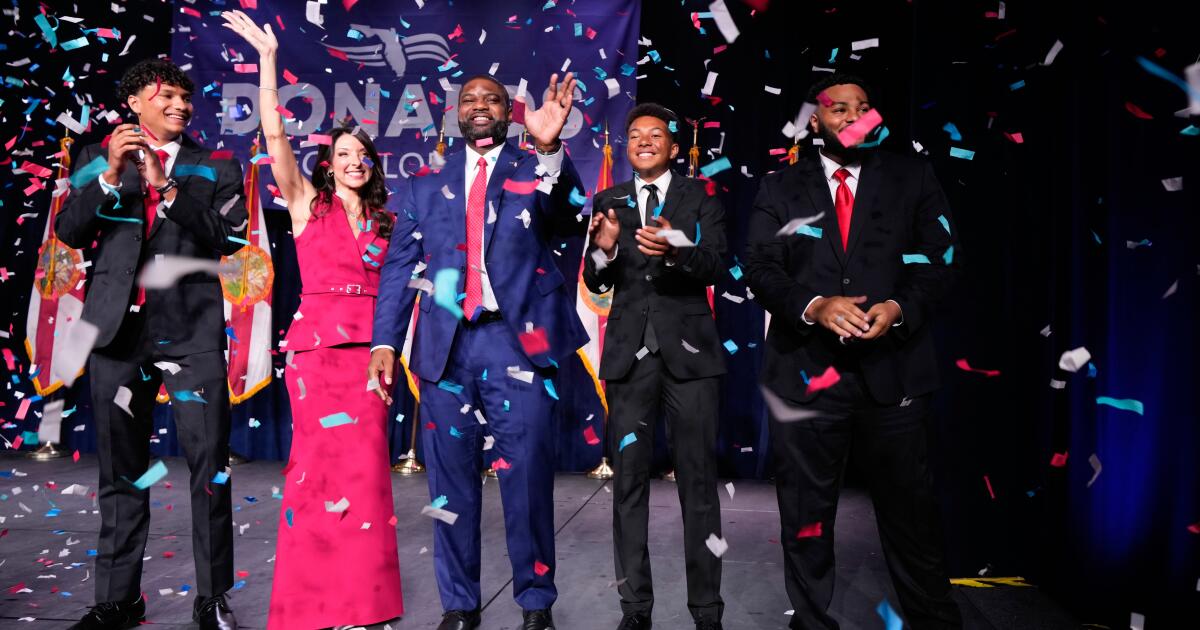
With Florida Republicans nominating U.S. Rep. Byron Donalds on Tuesday, there are seven Black major party gubernatorial nominees in addition to Moore — men and women, Democrats and Republicans — on November ballots.

“We do have a unique moment here,” said Moore, who recently became chair of the National Governors Association. He often says that his historic status is “not an applause line” but instead represents a bigger challenge that this country is still looking to overcome.

The Black nominees typically do not focus on the history at stake, instead emphasizing their experience and policy proposals.

“Florida is a great meritocracy in America,” Donalds told reporters Tuesday night after not mentioning his race at all in his victory speech. “I’ll let you guys write about that,” he added.

But many said that more reflective representation matters given the nation’s history, from slavery to Jim Crow and the lingering effects.

“It’s not a secret that some issues in the African American community get ignored and don’t have a voice,” said Aaron Ford, Nevada’s first Black attorney general and now the Democratic nominee for governor. Ford said he brings a focus to issues ranging from voting rights and civil rights to the economy.

Republican Lisa Demuth said she “has never led with any type of identity politics” as Minnesota’s first Black House speaker and now her party’s nominee for governor. “But I recognize the historic state we are in right now,” she said. Michigan Republicans also chose U.S. Rep. John James, who is Black, as their gubernatorial nominee.

Former New York Gov. David Paterson, a Democrat who was not elected but ascended when Eliot Spitzer resigned in 2008, celebrated that the slate crosses party lines. “This is one day when maybe the Democrats and Republicans could stand in front of a statue of George Washington and let him know that we’re finally getting it right,” he said.

Democrats, meanwhile, emphasized that their Black candidates – who also include Keisha Lance Bottoms in Georgia, Jermaine Johnson in South Carolina and David Crowley in Wisconsin – are especially important after the U.S. Supreme Cour t cleared the way for states to redraw legislative districts that are majority or plurality nonwhite. That was compounded by President Trump’s attacks on diversity initiatives and push to rewrite how the U.S. tells its history of the slave trade and Jim Crow segregation.

“Governors, in many ways, are becoming the last lines of defense against what we’re seeing in Washington,” Moore said.

A challenge for Black politicians, even more so than reaching the U.S. Senate

Karen Finney, who helped push Democrat Joe Biden to select a Black woman as his vice presidential running mate, said Black politicians often are the first and loudest advocates on issues that acutely affect Black constituents. She and others cited health disparities such as maternal and infant mortality and sickle cell disease, and Finney noted that an inflationary economy hits harder in Black communities that, on average, have lower income and net worth than the wider population.

She said it is important for legislators to raise those matters and even more impactful when it is an executive.

“These are people who have the power to shape our lives, and they shape the agenda,” Finney said.

But the governor’s seat has been notoriously hard for Black politicians to reach, even more difficult than the U.S. Senate. Democrat Douglas Wilder of Virginia took office in 1990 as the nation’s first elected Black governor.

“I didn’t become Maryland’s first Black governor because the Democratic Party said, ‘I think it’s time for us to put Wes Moore up in the seat’,” Moore said. “I had to run against the party.”

“I don’t think that the party is doing enough,” Moore added, specifically bemoaning a “negligence” in Southern states where Black voters anchor Democrats’ base.

Stacey Abrams, who lost two Georgia governor’s races, recalled white Democratic power players raising money for her primary opponent in 2018, although she disputed that explicit racism was the issue.

“We do what we’ve done because it’s what we did,” she said. “Black women have not been executives, and the absence of that proof point becomes a self-reinforcing philosophy.”

This time, she noted, Bottoms already has been an executive as mayor of Atlanta.

Democrats and Republicans talk about ‘identity politics’ differently

In Minnesota, history will be made in November when the state elects its first female governor as Demuth competes against Democrat Amy Klobuchar, a U.S. senator. Demuth said she looks forward to a day when such distinctions seem less notable.

“One of the things that I really do look forward to is where it’s already done, where it no longer makes history,” she said. “So I think of young women, little girls that are looking at you, could I ever be governor of Minnesota? I hope when I win, they’re able to look at point to that and say she’s already done it.”

In Georgia, Bottoms told the National Association of Black Journalists last week that she does not “give a lot of talk … about the historical nature” of her campaign. Yet she notes her family’s Georgia ties go “back at least five generations through a plantation in Crawfordville” and that her grandfather had to “walk through these back doors” when he moved to Atlanta. She never mentioned slavery or segregation but said her ancestry “is always present with me.”

Abrams, who has campaigned for Bottoms and other Democrats this year, was more direct, arguing that all politics is identity politics of some kind — and that Republicans’ version is simply more coded.

“When your Constitution specifically strips a race of its humanity, you cannot then later on say identity doesn’t matter and has no effect, and we’ve spent 250 years trying to reckon with that identity” with social, political and legal fights, she continued. “So, it’s deeply disingenuous, if not woefully naive, to say that identity does not matter.”

Race shapes many decisions, but not all of them

Deval Patrick, whose tenure in Massachusetts overlapped with Paterson’s in New York, said his race mattered especially to his Black constituents and what they wanted from him. It was “just different than the expectations of my predecessors,” he said, recalling criticism after he did not visit a Boston neighborhood where a teenager had been killed by gun violence.

“His mother was on the news grieving, and at some point she said while the cameras were rolling, where is Gov. Patrick?” he said. “Nobody had ever asked one of my predecessors to come to a crime scene in a neighborhood. Never.”

In Nevada, Ford said being governor still means recognizing how many core issues – jobs, housing and healthcare – cross demographic lines.

“It could be a white man, a Latino woman. It could be a person urban, suburban or rural Nevada. It could be someone from northern Nevada, southern Nevada. These are the issues that are important to them,” he said.

Patrick, who talks regularly with Ford and Moore, agreed, saying that is not just how a governor does the job, but how a candidate wins it in the first place.

“The successful candidates are the ones who present themselves as candidates for everyone,” he said, “and not candidates for just some.”

Barrow and Sloan write for the Associated Press. Sloan reported from Washington.

Source link