Republicans want voters to elect Kansas Supreme Court justices
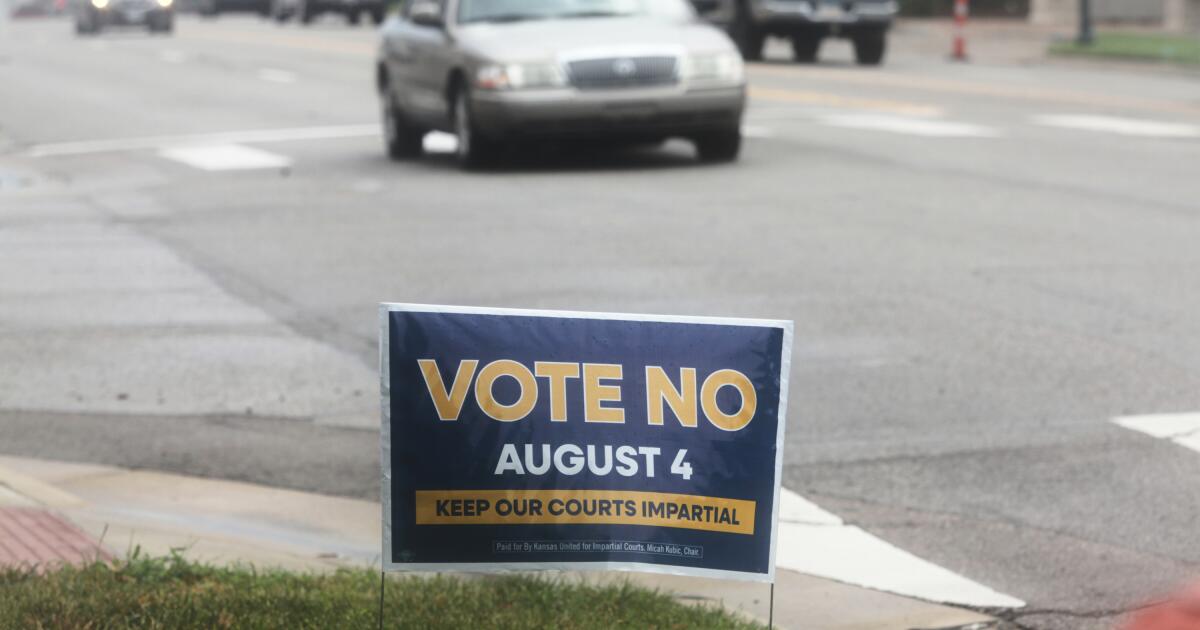
TOPEKA, Kan. — Kansas voters will decide Tuesday whether to elect state Supreme Court justices rather than have the governor appoint them, a push from conservatives who have chafed for years over court decisions they disagreed with on issues such as abortion, school funding and the death penalty.
If the constitutional amendment passes, supporters hope to elect at least four conservative, antiabortion justices to the seven-member court by 2033.
Kansas is considering the change amid concerns that increasingly contentious and expensive judicial elections in other states are making their courts more partisan and less independent. Spending in a single state Supreme Court race in Wisconsin last year topped $100 million.
Kansas Gov. Laura Kelly, a term-limited Democrat who opposes the measure, said gerrymandering and dark money have put the Legislature out of step with the state’s voters, and “to think you can make the judicial branch a part of that dysfunctional system is frightening.”
Rulings the GOP dislikes
GOP lawmakers cite rulings by Kansas courts over the last two decades as reasons a change is needed.
Most recently, a district court judge in July reinstated a three-day grace period for voters to return mail ballots after election day, which GOP lawmakers had eliminated. Kansas Senate President Ty Masterson, who is seeking the Republican nomination for governor, called the decision “outrageous” and urged people to vote yes on the ballot question.
The same judge — a finalist to fill the most recent Supreme Court vacancy — blocked enforcement of a 2025 law banning gender-affirming care for transgender minors. Masterson described him as “radical.”
The list of rulings Republicans criticize also includes rulings on education funding back to 2004. Supreme Court decisions forced lawmakers to increase funding to comply with the state constitution.
“If we elect our Supreme Court, they won’t force you to spend money on schools,” Masterson said in remarks in November to a conservative group, the Marion County Patriots for Liberty, the Marion County Record reported.
Abortion remains a key issue
Electing state Supreme Court justices gained currency among Republicans after a 2022 public vote affirming the high court’s landmark 2019 decision that Kansas’ Bill of Rights guarantees bodily autonomy and access to abortion. Total spending by both sides has exceeded $12 million.
Legislators who worked to overturn the Supreme Court’s protections, including Masterson, helped write this proposal.
Seven weeks after that 2022 vote, state Atty. Gen. Kris Kobach, then a GOP candidate for the office, told a Republican club in Wichita that electing justices would “slowly and quietly” put antiabortion justices on the high court.
The vote-yes campaign’s biggest donor — providing $1.7 million toward the campaign’s $3.7 million in spending — is a Nashville-based nonprofit that supports Republican candidates, groups and causes. Kansans for Life, the state’s most influential antiabortion group, has spent at least $87,000 in a recent 11-day span on mailers and texts.
“Kansans can bring an end to this reign of abortion by voting ‘yes,’” Troy Newman, president of Operation Rescue, said in an editorial written by a staffer on the antiabortion group’s website.
Meanwhile, the national and state affiliates for abortion provider Planned Parenthood contributed $1.6 million toward the vote-no campaign’s $8 million-plus in spending.
Jamie Swan, an engineer and college teaching assistant who knocked on doors for abortion rights in 2022, is doing the same to try to halt the proposal.
“I really believe that this is just a power grab,” she said.
Legislators have no say in appointments
Backers of the Kansas proposal brush aside arguments that electing the justices will give wealthy donors control over the Supreme Court.
“Globally and over history, even in its imperfection, the best system is democracy,” said Elizabeth Patton, state director of the low-tax, small-government group Americans for Prosperity, which has spent $935,000 to promote the vote-yes campaign.
Twenty-two states elect their top court’s judges, eight in partisan races. Governors in 26 states appoint them. In South Carolina and Virginia, legislators pick the justices.
Kansas elected justices for nearly 100 years before voters amended the state constitution in 1958. The governor now picks one of three finalists named by a nominating commission controlled by attorneys. Legislators have no role.
A review of every state’s current and past constitutions shows that the last state to add an amendment like the one Kansas is contemplating was Mississippi in 1914. Since then, 18 states’ amendments went the opposite way.
Voters weigh in every six years on whether a justice remains on the bench through a yes-or-no ballot question, but they’ve never booted a sitting justice. Conservatives say that means justices face no consequences for errant decisions.
Retirements and deaths on the bench allowed Kelly to appoint four of the current justices. Recently, the governor picked a district court judge who blocked enforcement of long-standing abortion restrictions in 2023.
“We don’t have a good way to fight back,” said state Sen. Mike Thompson, a conservative Kansas City-area Republican, who backs the measure.
Hanna writes for the Associated Press.