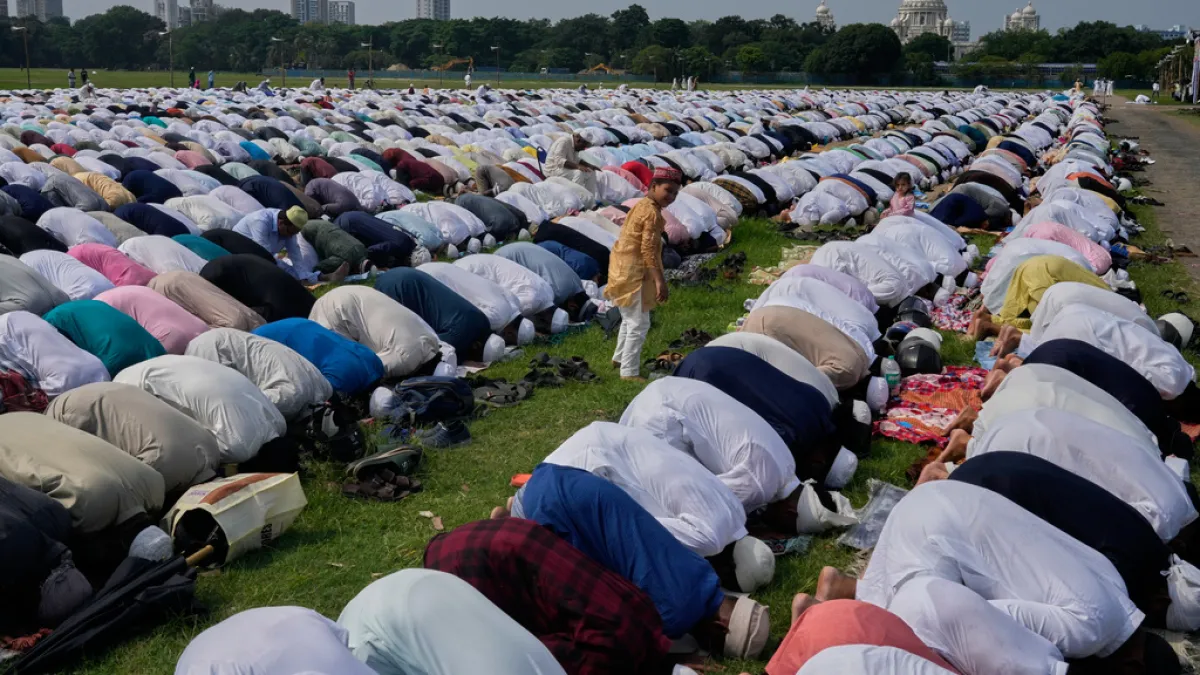
India’s Muslims celebrated Eid al-Adha with mass prayers and gatherings nationwide. Celebrations remained largely peaceful under tight security amid growing anti-Muslim tensions over restrictions on public Eid prayers.
Eid al-Adha, one of the most important dates in the Islamic calendar, comes at a critical time for Iranians this year.
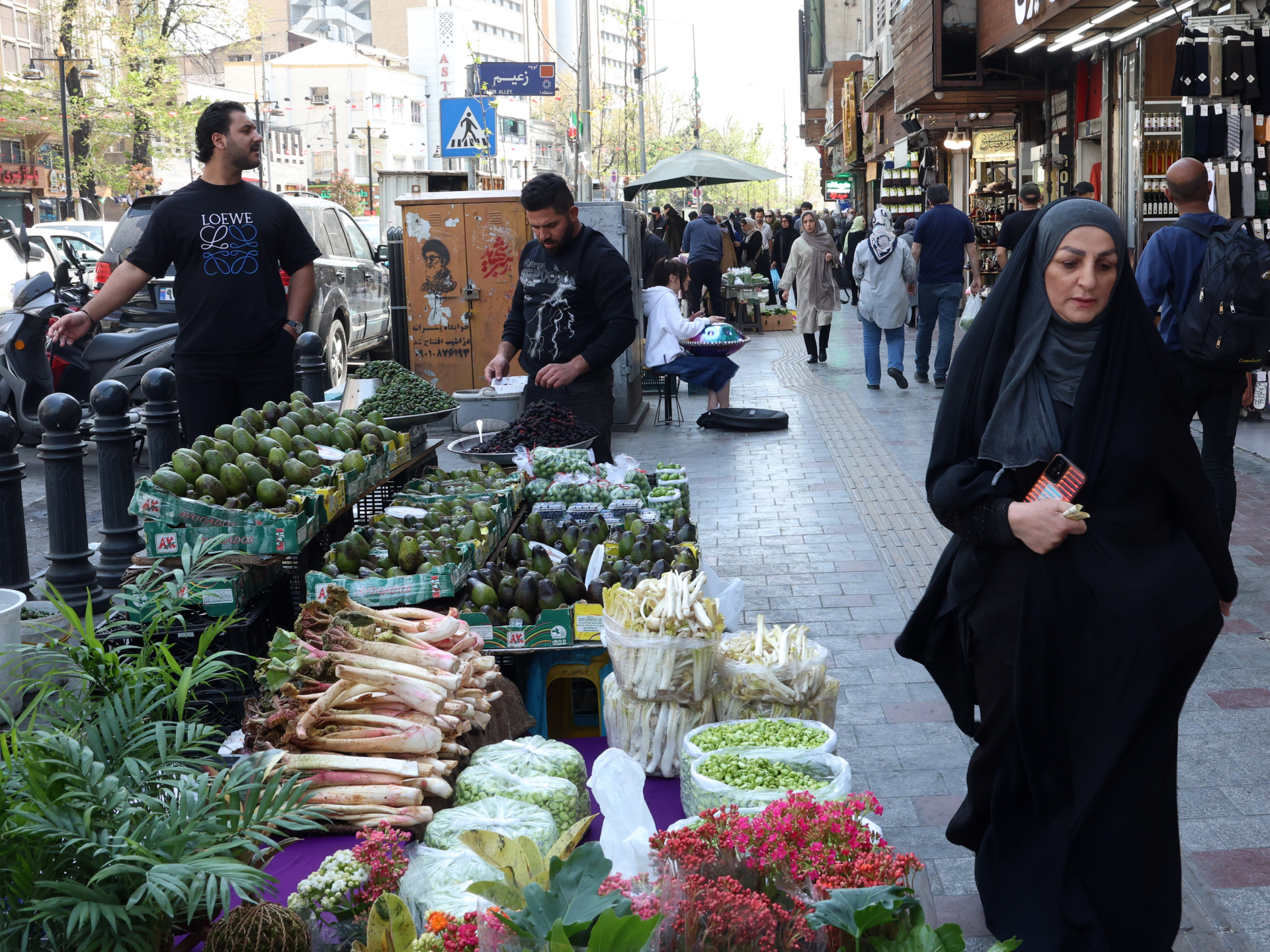
Meat from sacrificed animals is often eaten at Iranian tables, but a blockade on Iranian ports and sanctions by the US has led to escalating costs across the country.
Unlike Nowruz, the Persian New Year, Eid al-Adha is not as widely celebrated in Iran, but mosques and other institutions still observe the ritual of animal sacrifice, known as qurbani, through authorised livestock and slaughter centres.
Here, animals are sacrificed according to Islamic law in a hygienic environment. But another goal of the network is to control runaway inflation by offering meat at lower prices than market rates.
Meat substitutes
A Tehran municipality body announced on Tuesday that each kilogramme of sacrificial meat would be sold at 7.4 million rials ($4.30) at designated shops.
The price for a similar cut on the market can be more than three times that, depending on its quality and the location of the butchers. The minimum wage is currently less than $100 per month in Iran.
“I usually buy meat for a stew or a few dishes around every three weeks; for some families in the neighbourhood, it has become a sort of luxury,” said a middle-aged woman, who lives with her husband and son in Tehran.
She told Al Jazeera that chicken, eggs and legumes have become replacements for red meat, but the costs of these staples have significantly increased, too.
Masoud Rasouli, a meat-packing industry representative, told the state-linked Mehr news agency earlier this week that demand for red meat has decreased by 50 percent compared with last year.
He said some meat was imported to counter any effects of the US blockade, but local demand is currently so low that “existing livestock population is enough for all the needs of the market”.
Data released by the state-linked Iranian Labour News Agency this week showed that the current cheapest government-announced price for one kilogramme of meat during Eid is equal to the price of a 50kg live sheep 10 years ago.
According to the Statistical Center of Iran, year-on-year inflation stood at more than 73 percent in the first month of the Persian calendar year that ended in late April.
Iranian rice was up by 173 percent and chicken by 191 percent in that month compared with a year before, while liquid cooking oil more than quadrupled. Figures for the next month are expected to be worse.
Controlling inflation
Price-control measures – which have been implemented by authorities to fight a decade of rampant inflation – have been unable to adequately compensate for the ever-decreasing purchasing power of Iranian households living under local mismanagement and US sanctions – and now war and a blockade.
A young man working at a butcher shop in southwestern Tehran said they have had to increase prices several times over recent months after suppliers announced hikes.
“Our sales were a bit higher today because of the Eid, but we see even our most frequent customers far less these days. Most of the conversations with the customers are about the prices,” he told Al Jazeera.
Iran and the US have been holding negotiations through regional mediators to potentially end the war. But amid exchanges of fire and inflexibility over demands, no breakthrough has emerged even as both sides say a memorandum of understanding has mostly been negotiated.
Religious messaging
Beyond greetings and congratulatory phone calls with regional peers, Iranian authorities also used the Muslim festival this year to issue political messages.
On Wednesday morning in the capital, the authorities organised a large prayer to mark Eid at the University of Tehran, which was led by ultraconservative Ayatollah Ahmad Khatami.
He said that “submitting to humiliation” is an example of “evil” and the height of vice, at a time when he believes the other side, the US, seeks a surrender from Iran.
“Your enemies, the Iranian nation’s enemies, and this mad enemy sitting in the Black House – which is wrongly referred to as the White House – want your humiliation. But this madman will take that wish to his grave,” he said about US President Donald Trump.
Khatami, a member of the powerful Guardian Council and the clerical Assembly of Experts, also praised the supporters of the government who have taken to the streets every night for almost three months and said this “unprecedented” phenomenon would be repeated on the nights of Eid al-Adha.
President Masoud Pezeshkian had a relatively softer approach, but his comments were still laden with religious symbolism.
“In today’s turbulent world, where the fire of tyranny, occupation, and the arrogance of the hegemonic powers burns bright, Eid al-Adha conveys the message of dignity, liberty, and fearlessness in the face of the pharaohs of our time,” he said.
Foreign Minister Abbas Araghchi said in a message on Wednesday that he hoped for harmony in the Muslim world, amid this difficult time for the region.
“We pray that, by the auspiciousness and blessing of this great Eid, we will witness the deepening and strengthening of Islamic solidarity for cooperation and mutual assistance in confronting war, discrimination and occupation, especially in the West Asia region, and that our world will return to the path of reviving peace and justice,” he said.
Muslims around the world have begun celebrating Eid al-Adha, the “Festival of Sacrifice”, which falls on the 10th day of Dhul Hijjah, the 12th and final month of the Muslim lunar calendar.
One of the biggest holidays in the Muslim calendar, it coincides with the last day of the annual Hajj pilgrimage in Saudi Arabia.
In Gaza, where Israel’s months-long offensive has devastated neighbourhoods and displaced most of the population, many families are marking Eid in tents and crowded shelters, with little meat or festive clothing.
More than 1.7 million people are taking part in the Hajj this year, slightly up from 2025, even as a war pitting the United States and Israel against Iran casts a long shadow across the Middle East.
On Tuesday, pilgrims prayed on Mount Arafat, where Prophet Muhammad is believed to have delivered his final sermon. They then spent the night out in the open at Muzdalifah, halfway between Arafat and Mina, where they collected pebbles for the symbolic stoning of the devil.
After the stoning ceremony in Mina, pilgrims return to Mecca for a final circumambulation of the Kaaba, the cube-shaped building at the heart of the Grand Mosque towards which Muslims around the world face when they pray.
Eid al-Adha commemorates the Quranic story of Prophet Ibrahim’s willingness to sacrifice his son Ismail as an act of obedience to God. Islamic tradition holds that God spared the boy, replacing him with a ram.
The day is marked with the sacrifice of an animal – usually a sheep, goat or cow – and the distribution of its meat among family, neighbours and those in need, underlining the festival’s themes of faith, charity and community.
Mogadishu, Somalia- Muslims around the world celebrated Eid al-Adha, the Festival of Sacrifice, which marks the end of the Hajj pilgrimage period.
It is the second major holiday in the Islamic calendar after Eid al-Fitr, which follows the holy month of Ramadan.
In Somalia’s capital, Mogadishu, families and communities gathered across the city on Wednesday to celebrate the occasion.
The holiday is typically marked by communal prayers in the morning, family visits, festive meals and outings for children.
Popular locations for the city’s residents include Lido Beach, the Darus Salam Zoo, and Maka al-Mukarama Road, the central business district.
More broadly, Mogadishu has been tentatively emerging from the waves of violence that have rocked the city over recent decades.
Since 2006, the government has been battling al-Shabab, a local affiliate of al-Qaeda, for control of the country – a conflict that has made Mogadishu one of the world’s most dangerous capitals.
But improving security has led to a surge of investment in the city, alongside the emergence of new cafes, restaurants and other recreational spaces.
At an Eid speech at the Islamic Solidarity Mosque, Somalia’s President Hassan Sheikh Mohamud said, “We see the change that has happened in Mogadishu’s security,” and called on the public to protect the city’s peace. Ali Jimale Mosque, the country’s largest, usually draws the biggest crowds and serves as a gathering place for the city’s residents.
Central to Eid al-Adha is the ritual sacrifice of livestock, commemorating the Prophet Ibrahim’s willingness to sacrifice his son before God provided a ram in his place.
The meat is traditionally shared among relatives, neighbours and people in need, reflecting the festival’s emphasis on charity, community and devotion.
Costs for livestock have soared in recent months in Somalia due to failed rains and drought, with a United Nations hunger monitor warning of famine risk in parts of the country.
The Integrated Food Security Phase Classification has said 6.5 million people in Somalia are facing “high levels of acute food insecurity”, a crisis worsened by the country’s ongoing armed fighting and a political standoff that has persisted since the president’s term expired on May 15.
Nearly 2 million Muslims are preparing to embark on the annual Hajj pilgrimage to Mecca, which begins on May 25, following the sighting of the crescent moon in Saudi Arabia.
The Hajj is the largest annual gathering of Muslims from all over the world and a once-in-a-lifetime journey for many. It is also the fifth pillar of Islam.
Recommended Stories
list of 4 itemsend of list
In this visual explainer, we look at how Muslims perform the Hajj, including the key steps, rituals and preparations.
What is Hajj?
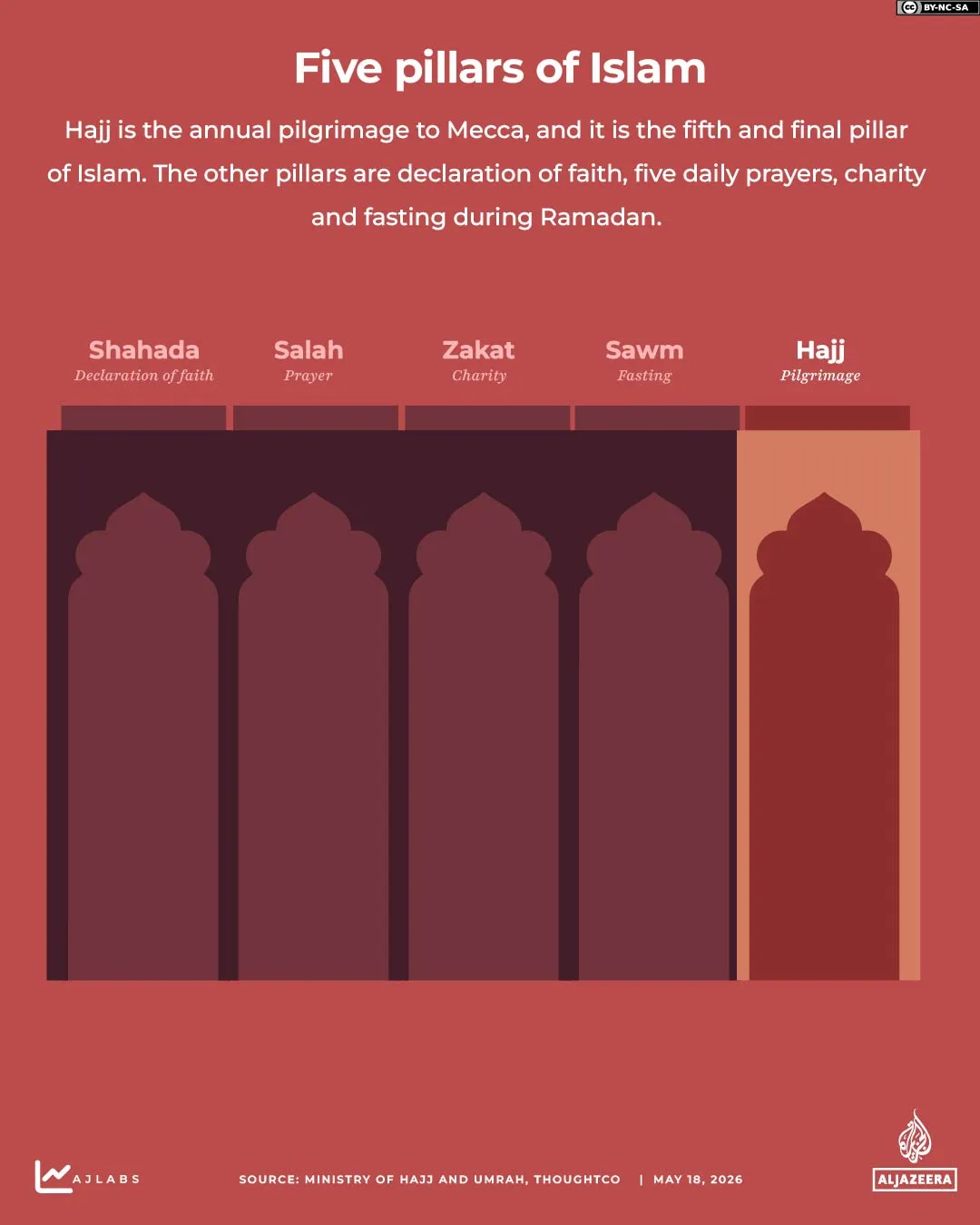
The Hajj is the annual pilgrimage to Mecca, Saudi Arabia. It is the fifth and final pillar of Islam, along with the declaration of faith (shahada), five daily prayers, obligatory charity (zakat), and fasting during the month of Ramadan.
The word comes from the Arabic root “h-j-j”, which means “intending a journey” or “to set out for a definitive purpose”.
It is obligatory once in a lifetime for all adult Muslims who are physically and financially able to undertake the journey.
When is the Hajj performed?
The Hajj is performed between the 8th and 12th (or 13th) of Dhul-Hijjah, the 12th and final month of the Islamic calendar.
The timing falls roughly 70 days after the end of Ramadan, though this can vary slightly depending on the lunar cycle.
In 2026, the Hajj will take place from May 25 to May 27, but many pilgrims arrive in Saudi Arabia weeks before to prepare for the journey.
Because the Islamic calendar follows a lunar cycle, with months lasting 29 or 30 days, the Hajj shifts 10 to 12 days earlier each year in the Gregorian calendar.
Why do Muslims perform the Hajj?
Muslims believe that the Hajj is a direct commandment from God, as outlined in the Quran.
Prophet Muhammad’s “farewell pilgrimage” in 632 AD affirmed the steps in the 10th year of the Islamic calendar, and it is mentioned in the Quran nearly a dozen times.
The Hajj begins before pilgrims even enter Mecca.
The journey is a spiritual one, and it is considered to allow Muslims to seek forgiveness, purify their souls and demonstrate their submission to God.
How is the Hajj performed?
Muslims perform many rites and rituals during the five days of Hajj, which can be explained in the following steps.
Day 1
Ihram: Entering the pilgrimage
Before entering Mecca, pilgrims enter a sacred state known as ihram. After making the intention to perform the Hajj, men change into two white garments and women wear modest attire. The basic clothing symbolises equality, humility, and unity before God, where differences of nationality, wealth, and status disappear.
Husin bin Nisan, centre, with other worshippers, prepares to wear a special garb called ihram, typically worn during the Hajj pilgrimage, prior to a Hajj rehearsal in Tangerang, Indonesia [File: Achmad Ibrahim/AP Photo]
2. Tawaf: Circling the Kaaba
After entering Mecca, pilgrims circle the Kaaba – a cubic building at the Masjid al-Haram (Grand Mosque) that serves as the qibla, the direction Muslims face during prayer – seven times in a counterclockwise direction. This shared rhythm symbolises unity in the worship of the One God.
Muslim pilgrims circle the Kaaba, the cubic building at the Grand Mosque, during the annual Hajj pilgrimage in Mecca, Saudi Arabia, on June 11, 2024 [Rafiq Maqbool/AP Photo]
3. Sa’i: Walking between Safa and Marwah
Pilgrims can then perform the sa’i, a ritual of walking seven times between the hills of Safa and Marwa.
The ritual retraces the search for water in the desert valley of Mecca by Prophet Abraham’s (Ibrahim) wife, Hagar (Hajar), for their son, Ishmael (Ismail), before the Zamzam well emerged.
In Islamic tradition, this well has supplied pristine water in the arid desert for more than 4,000 years and continues to nourish pilgrims to this day.
Muslim worshippers walk between the Marwa and Safa hills at the Grand Mosque in Saudi Arabia’s holy city of Mecca [File: Abdel Ghani Bashir/AFP]
4. Mina: The tent city
Pilgrims then proceed to Mina, about 8km (5 miles) east of the Kaaba, where they will spend the night in prayer and reflection.
Mina is famously known as the “city of tents” due to the vast expanse of 100,000 white tents to house the millions of pilgrims.
Tents for Muslim pilgrims fill the Mina tent camp during the Hajj, in Mecca, Saudi Arabia, on July 10, 2022 [Amr Nabil/AP Photo]
Day 2
5. Arafat: The central day of Hajj
On the second day of the Hajj, pilgrims arrive early at the plains of Mount Arafat, about 15km (9 miles) from Mina. They spend the afternoon in wuquf (standing) from midday to sunset, praying, and repenting.
Arafah is the most important ritual of the Hajj and symbolises a preview of the Day of Judgement. Muslims worldwide are encouraged to fast on this day and engage in prayer and reflection.
Muslim pilgrims gather on top of the rocky hill known as the Mountain of Mercy, on the Plain of Arafat, during the annual Hajj pilgrimage near the holy city of Mecca, Saudi Arabia, on June 5, 2025 [Amr Nabil/AP Photo]
6. Muzdalifah: Sleeping under the open sky
After sunset, pilgrims travel to Muzdalifah, 9km (5.5 miles) away. There, they perform maghrib and isha prayers before collecting pebbles for the next day’s ritual.
Muslim pilgrims rest after arriving at Muzdalifah, before heading to Mina during the annual Hajj pilgrimage, on June 27, 2023 [Sajjad Hussain/AFP]
Day 3
On this day, Muslims from around the world celebrate the first day of Eid al-Adha, or the celebration of the sacrifice.
From the early hours of the morning, pilgrims perform a series of rituals, starting with walking back to Mina.
Muslim pilgrims walk on their way to cast stones at pillars in the symbolic stoning of the devil, the last rite of the annual Hajj, in Mina, near the holy city of Mecca, Saudi Arabia, on June 6, 2025 [Amr Nabil/AP Photo]
7. Stoning of the pillars
Pilgrims enter Mina, where they throw seven pebbles at the largest of three stone pillars. This ritual represents the stoning of the devil, which symbolises the rejection of Satan’s temptations.
Muslim pilgrims cast stones at pillars in the symbolic stoning of the devil, the last rite of the annual Hajj, in Mina near the holy city of Mecca, Saudi Arabia, on June 6, 2025 [Amr Nabil/AP Photo]
8. Sacrifice during Eid al-Adha
Pilgrims, or agents on their behalf, offer an animal sacrifice in remembrance of Abraham’s willingness to sacrifice his son in obedience to God.
9. Cutting or shaving hair
Men shave or trim their heads, and women cut a small portion of their hair. This symbolises spiritual renewal.
Muslim pilgrims have their heads shaved by barbers upon leaving Muzdalifah, after throwing pebbles as part of the symbolic al-Aqabah (stoning of the devil ritual) at the Jamarat Bridge during the Hajj pilgrimage in Mina, near Saudi Arabia’s holy city of Mecca on August 11, 2019 [Fethi Belaid/AFP]
10. Main tawaf
Pilgrims return to Mecca to perform tawaf, circling the Kaaba, followed by sa’i, walking seven times between the hills of Safa and Marwa.
Muslim pilgrims walk around the Kaaba, the cubic building at the Grand Mosque, during the annual Hajj pilgrimage, in the Muslim holy city of Mecca, Saudi Arabia, on June 4, 2025 [Amr Nabil/AP Photo]
Days 4 and 5
Pilgrims return to Mina and perform rami (stoning) of all three stone pillars on each day. Pilgrims who remain for an extra day repeat the stoning ritual at all three pillars once more.
Before leaving Mecca, pilgrims perform a final tawaf around the Kaaba, known as the tawaf al-wada or a “farewell tawaf”, signifying a spiritual farewell to the holy sanctuary.
How do Muslims mark the end of Hajj?
Muslims mark the end of the Hajj with Eid al-Adha, celebrated on the 10th of Dhul-Hijjah and lasting up to three days in many countries.
The day begins with a special prayer shortly after sunrise, as Muslims gather in mosques or open areas, wearing their finest clothes. The rest of the day is spent sharing meals, exchanging gifts, and visiting family and friends. The greeting “Eid Mubarak”, meaning “Blessed Eid,” is commonly exchanged.
Eid al-Adha also involves the ritual of animal sacrifice, known as Qurbani. Muslims who are able to do so sacrifice a sheep, goat, cow or camel, and the meat is divided into three parts: one for the family, one for relatives and friends, and one for those in need.