Spain sanctioned by FIFA after incidents at Espanyol’s stadium in Barcelona, which staged the friendly with Egypt.
Published On 16 Oct 202616 Oct 2026
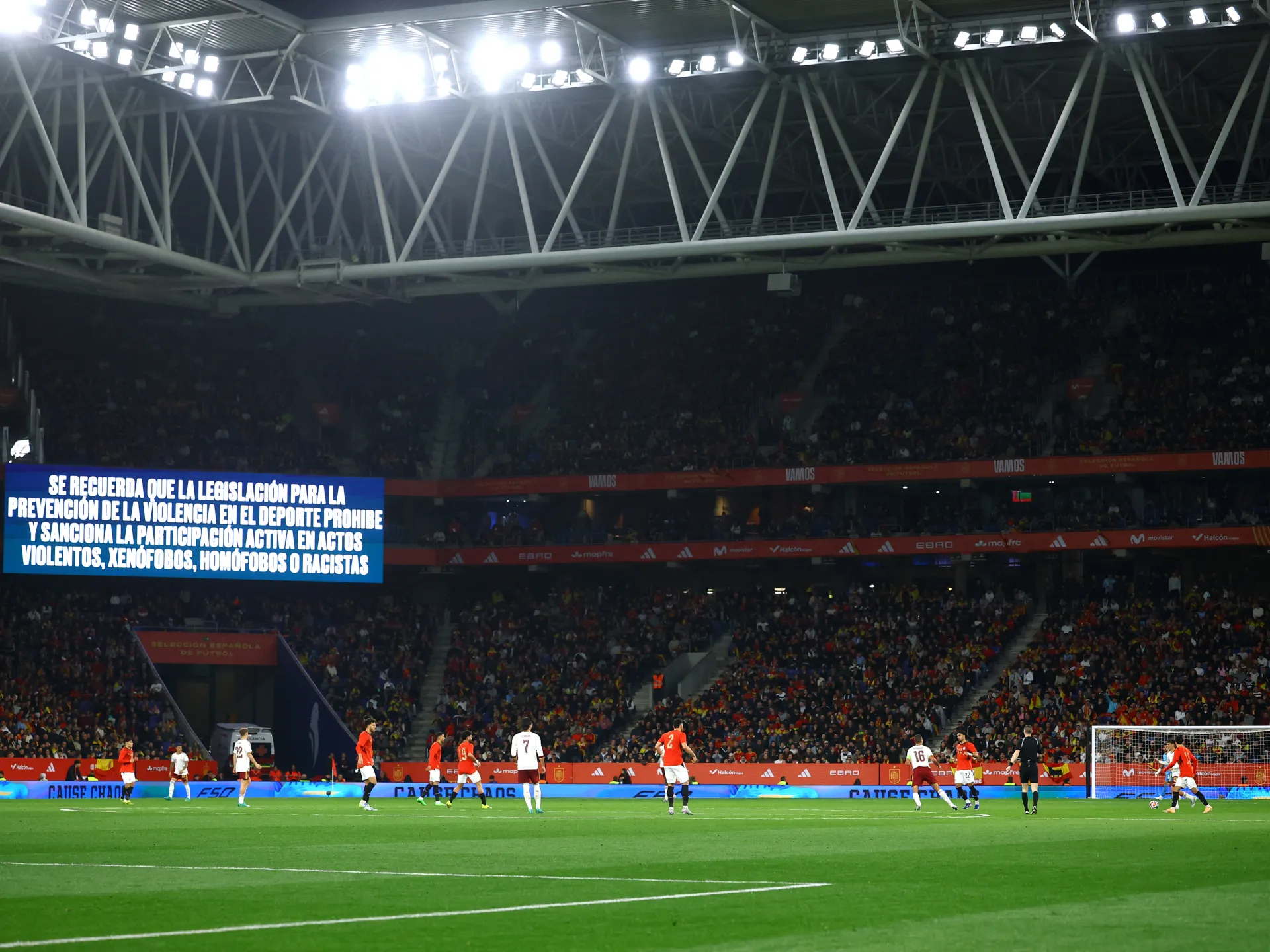
Spain have been fined $20,000 and ordered to partially close their stadium for their next friendly after supporters twice chanted Islamophobic slogans during the game against Egypt in March, FIFA said in a statement.
The sanctions relate to incidents at the RCDE Stadium near Barcelona, home of LaLiga club Espanyol, where some Spain fans chanted, “Who doesn’t jump is a Muslim” during a World Cup warm-up match which ended in a 0-0 draw.
Recommended Stories
list of 3 itemsend of list
After the second occurrence of the chant, the stadium announcer issued a warning and the scoreboard displayed a message against discriminatory behaviour.
Spain winger Lamine Yamal, who is Muslim, condemned the chants at the time, describing them as disrespectful and intolerable and calling those responsible “ignorant and racist”.
Spanish police launched an investigation the following day, while world governing body FIFA later started disciplinary proceedings against the Spanish football federation (RFEF).
It argued that the word ‘Muslim’ was “neither insulting nor pejorative”, adding that the fans’ conduct should be assessed under FIFA’s Article 17, which covers political, ideological, religious or offensive messages, rather than Article 15, which deals with discrimination and racist abuse.
However, FIFA’s disciplinary committee rejected that argument, saying Article 15 does not require the explicit use of a slur and that a term can be discriminatory when used in context as “an insult, taunt, or marker of inferiority”.
FIFA fined the RFEF and ordered the closure of at least 15% of available seats for Spain’s next friendly.
Scott, from Cheshire, had visited Hurghada in Egypt twice before, but a taxi ride back from a nightclub on his last trip has put him off returning to the Red Sea destination for good
Scott had enjoyed a night in Hurghada when the scam took place
A Brit has vowed never to return to an Egyptian holiday hotspot after he was scammed.
Scott, from Cheshire, had visited Hurghada in Egypt twice before, but a taxi ride back from a nightclub on his last trip has put him off returning for good. Despite being warned by holiday reps to agree to a total fare before getting in, Scott and his friends ended up paying well over the odds by the end of the ride.
“The worst part is how it’s stuck with me. I’d been to Hurghada twice before and enjoyed it, but that one journey ruined the whole holiday. You forget all the good bits, and that’s the part that stays with you. It’s put me off going back for good,” Scott told the Mirror.
The incident unfolded after an evening out in the beach resort city, which sits on Egypt’s Red Sea coast.
“It was the strangest taxi journey I’ve ever experienced. We’d been told to always agree on a total price before getting in, so that’s what we did. But partway back, the driver pulled over and went off to get himself some food,” Scott explained.
When they got back to the hotel, the taxi driver announced a different, much higher price than they’d expected.
“When we finally got back to the hotel, he suddenly wanted us to pay per person. It felt like, these are tourists, we’re going to rinse them,” Scott said. The situation quickly escalated when the driver mentioned that they would call the police. Unable to speak the local language and unsure whose side the police would take, Scott focused on keeping things calm, and the group ended up paying more than they had agreed just to bring it to an end. “My friend was getting really anxious, and all I could think was, if the police turn up, who are they going to believe?” he explained .
“Honestly, it left me feeling really uneasy and quite vulnerable. We’d done everything we were told to do and agreed a total price before getting in, so when the driver suddenly demanded we pay per person, it felt like we were being taken advantage of just because we were tourists. Once he started talking about calling the police, that unease turned into real anxiety. My friend was getting really worked up, I couldn’t speak the language, and all I could think was, if the police turn up, who are they going to believe? In the end I just wanted it over, so we paid more than we’d agreed to keep things calm.
“It ruined the whole holiday. You forget all the good bits, and that’s the part that stays with you. Now I’d use Uber or a local app wherever I can, because you know the price before you get in. Having one guide or site that shows you which apps work in each destination and what an average fare looks like would give people that confidence before they even arrive.”
It’s experiences like Scott’s that led Confused.com to create its interactive global taxi guide. Travellers can search any destination to see which apps to use, what a typical fare looks like and the local tips worth knowing before they set off.
Do you have travel story to share? Email webtravel@reachplc.com
During the Six-day War with Israel in June 1967, Egypt had lost control of the Sinai Peninsula.
In an attempt to regain the territory, Egyptian President Anwar Sadat carried out a surprise attack on 6 October 1973. The attack was supported by the Syrians and met with initial success when more than 80,000 Egyptian troops breached the fortifications set up by the Israelis and took control of the Sinai territory. After two days, the Egyptians were forced to retreat when the Israeli army counterattacked and surrounded the Egyptian forces.
The war ended in a cease-fire brokered by the United States. The assault proved unsuccessful in liberating the Sinai Peninsula, but the conflict directly led to talks at Camp David organised by US President Jimmy Carter. These talks resulted in the Israeli-Egyptian peace treaty of 1979 which eventually saw the return of the Sinai Peninsula to Egypt.
The holiday is marked by large military parades and fireworks. It was during one of the parades on Armed Forces Day in 1981, when President Anwar Sadat was assassinated by opponents of the peace with Israel.
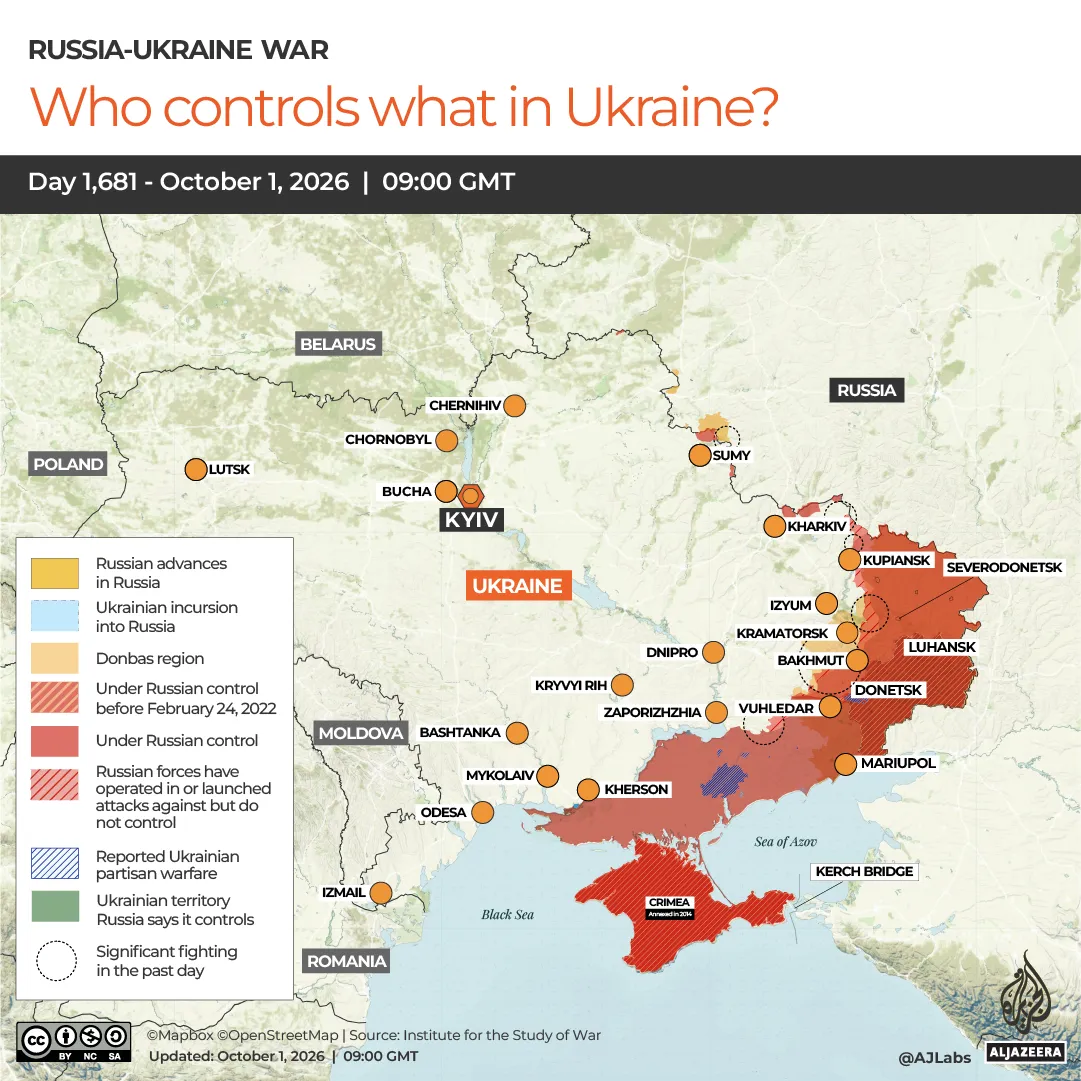
Ukraine says it has received proposals from India, Turkiye, Egypt and the United States to broker talks with Russia. The offers come as the two adversaries escalate attacks on each other’s energy and port infrastructure with their war now in its fifth year.
Ukrainian Foreign Minister Andrii Sybiha revealed the four proposals at a briefing in Kyiv on Friday and singled out New Delhi’s. “The most comprehensive is India’s proposal,” he said, adding that India had signalled a willingness to play a role for the first time.
Recommended Stories
list of 3 itemsend of list
None of the proposals aims to end the war. Each seeks a narrower truce, covering energy facilities, ports or commercial shipping in the Black Sea.
Here’s what we know:
What is India proposing?
India has not made its plan public. Quoting unnamed sources, however, Indian media have reported it has three parts. According to the Hindustan Times, it would aim to protect infrastructure, keep grain and energy supplies moving through Black Sea ports, and ensure the safety of commercial shipping.
The first part – mutually halting strikes on energy facilities and ports – matches what Kyiv has been demanding. Sybiha said any deal must be a complete energy truce that covers port infrastructure as well.
The second part builds on the Black Sea Grain Initiative, which Turkiye and the United Nations mediated in 2022 but Russia abandoned in 2023.
The third part, protecting merchant ships and their crews, is particularly important to India because Indian sailors have been killed or harmed on Black Sea routes.
The sources were quoted as saying India’s plan goes further than the other three proposals because it covers infrastructure and shipping together. A Ukrainian official told the Kyiv Independent that it incorporates elements of the Turkish, Egyptian and US initiatives. The Kyiv Post reported that Sybiha also described the plan as addressing a possible ceasefire along the front lines, although other accounts said he gave no specifics.
The proposal likely took shape during Indian External Affairs Minister Subrahmanyam Jaishankar’s first visit to Ukraine last month and in a later meeting with Sybiha at the UN General Assembly in New York, also in September. Jaishankar said New Delhi was “trying to be helpful, starting with the Black Sea safety of shipping issue”.
What do we know about the Turkish and Egyptian proposals?
Very little. Neither Ankara nor Cairo has published details. Both reportedly focus on keeping Black Sea grain supplies moving by suspending attacks on commercial shipping. Some reports said the two countries proposed a grain truce jointly while others described two separate plans.
Turkiye has done this before. With the UN, it steered the 2022 grain deal, one of the few narrow truces of the war to hold for any length of time. Ankara and the UN are now organising new Black Sea talks with a round planned for October.
Beyond its Black Sea focus, almost nothing is known about Egypt’s proposal. Its interest, however, is clear: Egypt relies on Ukraine for nearly one-third of its grain supplies.
What is the US pitching?
According to Ukrainian President Volodymyr Zelenskyy, Washington has proposed three steps: a mutual halt to energy strikes, a reopening of the grain corridor and a trilateral meeting with Ukraine and Russia, possibly in Abu Dhabi.
The latest effort began in early September when US President Donald Trump’s envoys visited Kyiv and Moscow and secured an agreement in principle for a trilateral meeting. Steve Witkoff and Jared Kushner met Russian President Vladimir Putin in Moscow on September 5 while Kremlin envoy Kirill Dmitriev visited the US twice in September.
The trilateral meeting has since been pushed back. It had been expected to take place in the United Arab Emirates in early October. Washington now wants it in late October, and people close to the talks blamed the delay on Russia.
Washington has also invited Putin to the Group of 20 summit in Miami, Florida, in December. “We hope that’s an invitation he’ll accept,” US Secretary of State Marco Rubio said. The Kremlin said no decision has been made.
At the same time, the US is applying pressure to try to end the war. Trump recently signed a law giving him sweeping powers to sanction buyers of Russian energy.
He has also called on Ukraine to stop targeting Russian diesel facilities amid a diesel prices crisis in the US, where Trump faces tricky midterm elections next month. “Mr Zelenskyy has to do one thing,” he said on September 13. “He has to stop knocking out diesel fuel in Russia.” This drew much criticism that Trump instead should focus his comments on Russia, which began the war with its invasion of Ukraine in February 2022.
He is reportedly sceptical about his own government’s latest diplomatic initiative. People familiar with his thinking have told US media that he doubted Putin would agree to an energy truce before winter.
(Al Jazeera)
How have Russia and Ukraine responded?
Sybiha said Ukraine would agree to a truce but with conditions. It would accept an energy and Black Sea shipping ceasefire, but only as a combined package, he said.
He added that Kyiv is also open to an unconditional ceasefire along the current front lines. Zelenskyy backs the US-proposed meeting but stressed it needs “not only Ukraine but also the Russian side” to support it.
Moscow has been warm in tone but has committed to nothing. Kremlin spokesperson Dmitry Peskov said Russia would welcome India’s peace efforts while Putin said Modi has “very good ideas aimed at finding mutually acceptable solutions”, but he did not elaborate.
In private, Moscow appears to have said no. A Ukrainian official told the Kyiv Independent that Russia has rejected India’s proposal although this has not been confirmed publicly. Ukraine’s agriculture minister said Russia had rejected every Black Sea ceasefire option the mediators have presented.
Why are Global South countries becoming more involved?
Food supplies, the lives of their citizens and fuel prices are all at stake.
“I think it’s clear to many countries that this war is not a localised war, but it’s a war that has these global consequences,” Fredrik Wesslau, a senior policy fellow at the European Council on Foreign Relations, told Al Jazeera.
Russia and Ukraine account for more than a quarter of global wheat shipments, and their attacks on each other’s ports helped push wheat futures to a three-year high in August.
Sailors from countries with no links to the war are being killed. At least five Indian seafarers have died in strikes on Black Sea shipping in recent months along with seven Azerbaijani crew members since June. On Saturday, a Russian strike on a Liberian-flagged ship in a port in the Odesa region killed a crew member. Ukraine, for its part, has targeted tankers it links to Russia’s shadow fleet since July.
The energy war is also being felt in global markets. Ukraine reported more than 194 drone attacks on Russian refineries this year, hitting all 11 of the largest. Bloomberg News estimated that Russia’s fuel output has fallen by more than 30 percent. With Middle East supply already down as a result of the US-Israel war on Iran, global diesel markets are more exposed to the loss of Russian supplies.
Maximilian Hess, a nonresident senior fellow in the Eurasia Program at the Foreign Policy Research Institute, said energy is at least as important as grain in driving the diplomatic efforts. He pointed to a “clear frustration” among many countries over high oil prices, which reflect both the Russia-Ukraine war and the crisis in the Middle East.
“Of course, Ukrainian grain is important for them, but the oil-price factor is important there as well,” he told Al Jazeera. “I think it is those commodity-shock concerns that are pushing them to re-embrace this rhetoric, rather than anything else.”
What are the challenges ahead?
Every previous attempt at diplomacy has failed to end the Russia-Ukraine war. A US-brokered, 30-day energy truce in early 2025 collapsed amid accusations of violations on both sides. At talks in Istanbul in May 2025, Zelenskyy complained that Russia had sent a junior delegation with no authority to sign a ceasefire.
In August 2025, a meeting between Trump and Putin in Alaska yielded no results despite Trump claiming to be close to a deal ahead of it.
Wesslau said Washington’s efforts have faltered partly because Trump – who had boasted he would end the war within 24 hours of taking office in January 2025 – has appeared unwilling to put real pressure on Moscow. “The Russians see this, and they conclude that they can continue this war,” he said.
Deep distrust remains. Oleksandr Merezhko, head of the Ukrainian parliament’s foreign affairs committee, said: “Putin never keeps agreements.”
Moscow’s actions on the ground suggest it is in no hurry, Wesslau said “They’re trying to strangle Ukraine, strangle the economy, and make it unliveable ahead of the winter,” he said. He added that Moscow’s occasionally softer rhetoric was aimed mainly at the Trump administration and “has always proved to be a bluff”.
Russia’s terms are another obstacle. Hess said Moscow’s demands have not softened at any point since it launched the war and at times have grown. Putin has demanded all of Ukraine’s Donetsk, Luhansk, Kherson and Zaporizhia regions, including territory Russian forces have never controlled, as well as a buffer zone in northern Ukraine. Moscow is also seeking sanctions relief and military concessions for any Black Sea deal.
“I don’t think it’s a question of who actually mediates. I think it’s really a question of the calculation in Moscow,” Wesslau said. “Fundamentally, the problem is that Putin doesn’t want a ceasefire or a peace agreement. He wants to continue the war. He believes that he can win.”
Analysts said only greater economic pressure is likely to change that calculation.
Wesslau said if Europe can close down Russia’s shadow fleet of oil tankers, “this would be a massive blow to Russia’s war economy.” Hess said the country best placed to shift things quickly is China, rather than the US, by cutting its purchases of Russian oil. However, he added: “I don’t think Beijing is interested in doing so.”
Hess said that unless there is an outside shock, the war “is much more likely to last another four years than another four months”.
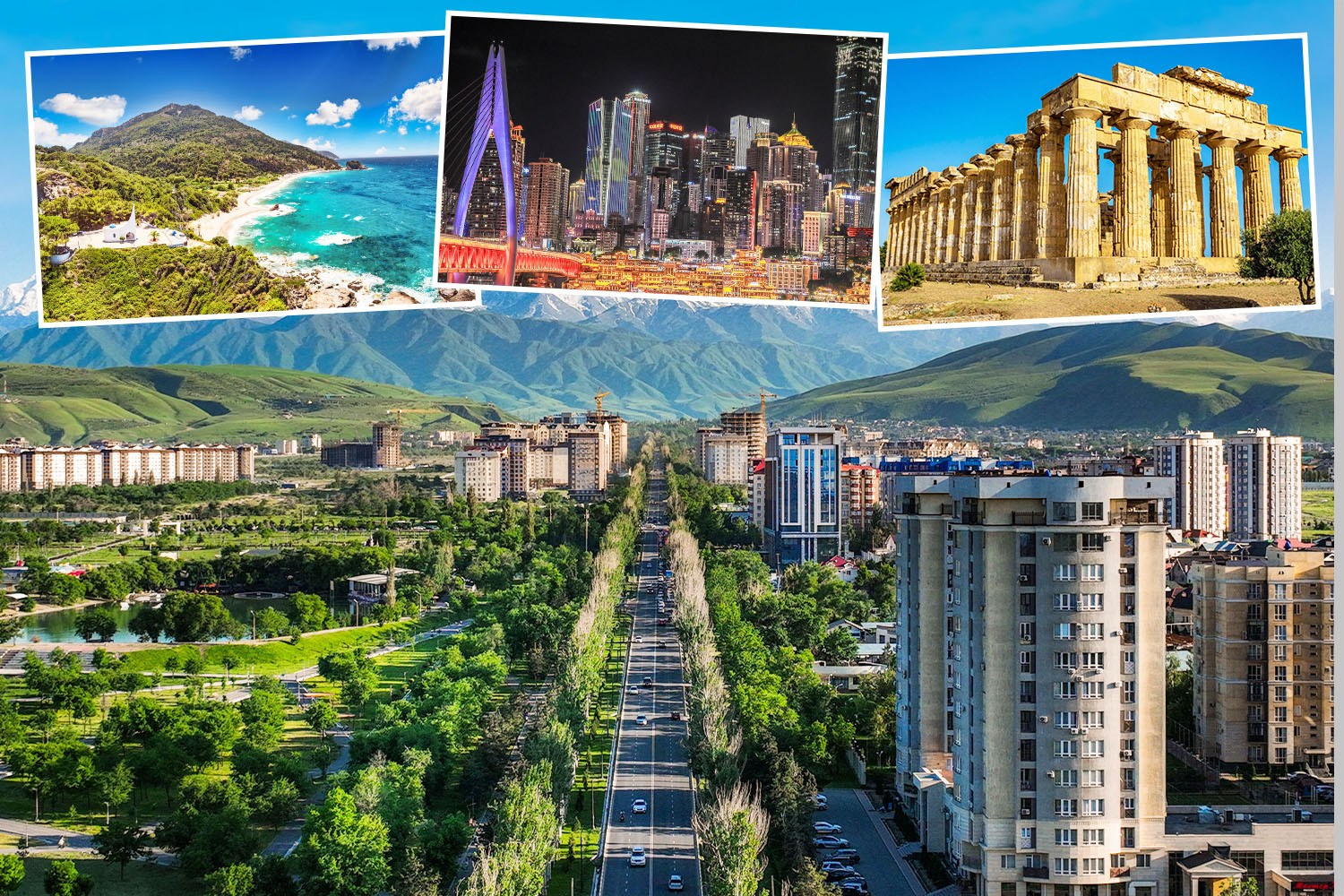
TORN on where to go on holiday next year? You’re in luck – the cool new places have been revealed.
Skyscanner’s Travel Trends 2027 report has looked at which destinations are seeing the biggest year-on-year searches.
This means these are the destinations which are seeing a boom in interest in demand, and much higher than the year before.
Skyscanner boss Bryan Batista said: “Travel is entering a new era.
Sign up for the Travel newsletter
Thank you!
“As people become more intentional about how they spend their time and money, they’re making different choices about where they go, how they book and what creates lasting value.”
So here are the top 10 destinations set to be the next big thing for Brits next year.
Yet the beach city of Da Nang has seen searches increase by 68 per cent according to Skyscanner (just after it was named a top 2027 holiday destination by Lonely Planet too).
There’s white sand beaches, but it is also, bizarrely, famous for its two beaches – Golden Beach, which is held between two huge stone hands, or Dragon Bridge which is shaped like the creature itself.
To get there, it is best to fly via places like Singapore or Bangkok, or a short domestic flight from other cities in Vietnam.
8. Sal, Cape Verde
Cape Verde’s Sal is great for no jet lag but hot wintersCredit: Alamy
Cape Verde remains a popular winter sun destination for Brits.
And a 67 per cent increase in searches to Sal means it is getting even more popular.
Hot weather all year round, no jet lag and short direct flights – all you’d need from a warm break from the UK
Flights to the African island are direct, with tour operators like TUI offering affordable package holidays.
9. Kittilä, Finland
Lapland is the best in Christmas, so try KittilaCredit: Alamy
If you want the ideal Christmas break, where better than Lapaland?
With searches up 65 per cent, Kittilä in Finland has it all husky sledding, reindeer safaris and and Northern Lights.
You an even head over to Levi for some fantastic skiing too.
EasyJet fly direct, and they start from £28.99.
10. Guatemala City, Guatemala
Volcanoes and fantastic food is all you need in Guatemala CityCredit: Alamy
The last trending destination on the list is Guatemala City which has seen searches increase 63 per cent.
It is actually the biggest capital in Central America, with everything you could want – fantastic coffee scene and historic museums.
The scenery is pretty stunning two, with a number of volcanoes being the backdrop.
Guatemala’s tourism minister suggested earlier this year that more flights from Europe could connect to the city – but until then, you’ll have to fly via Madrid with Iberia.
Eritrea has cut off diplomatic relations with neighbouring Ethiopia, escalating a long-simmering conflict between the two states rooted in territorial disputes and mutual accusations of interference.
The move comes as fighting flares in northern Ethiopia between Ethiopian federal troops and an opposition alliance that Addis Ababa accuses Eritrea of backing.
Recommended Stories
list of 3 itemsend of list
The clashes are the most severe in Ethiopia since its 2020-2022 civil war that killed hundreds of thousands of people.
But this time, the ripple effects could go further, potentially fuelling broader unrest in a region already plagued by numerous interrelated conflicts, analysts warn.
Here’s what we know about the Ethiopia-Eritrea conflict, the latest fighting in northern Ethiopia and what it could mean for the region at large:
Why did Eritrea break off ties with Ethiopia?
Eritrea announced it was severing ties with Ethiopia on Thursday, after Addis Ababa announced it would close its embassy in Asmara and expel 10 Eritrean diplomats.
In a statement, Eritrea’s Ministry of Foreign Affairs said Ethiopia’s actions had left it with “no option but to reciprocate in kind and sever all diplomatic ties with Ethiopia”.
The Eritrean ministry accused Ethiopia of pursuing a years-long “agenda of incessant hostility”, including by infringing on its coastal areas and arming fighters opposed to Ethiopia’s government.
Ethiopia has likewise accused Eritrea of backing armed groups opposed to its government. Both sides have rejected the other’s accusations.
The diplomatic breakdown follows months of worsening relations, driven largely by disputes over landlocked Ethiopia’s push for access to the Red Sea and allegations that Eritrea is backing the rebel Tigray People’s Liberation Front (TPLF), which leads the Ethiopian Peoples’ Forces Alliance for Survival, a rebel alliance fighting for control of parts of northern Ethiopia.
Have Ethiopia’s ties with Egypt and Sudan been hit, too?
Yes. Ethiopia accuses Egypt and Sudan of joining Eritrea in backing Tigrayan rebel forces, worsening already strained ties with both countries.
Ethiopia has long been at odds with Egypt over the status of Ethiopia’s Grand Ethiopian Renaissance Dam (GERD) project, which Cairo views as a risk to its water security and share of the Nile.
Ethiopia and Egypt have also expelled diplomats. Cairo ordered an Ethiopian diplomat to leave the country on Thursday, after Addis Ababa earlier kicked out an Egyptian diplomat, Egyptian state-linked media reported.
Egyptian state-linked broadcaster Al-Qahera News quoted an Egyptian official as calling Ethiopia’s move to expel the Egyptian diplomat as “regrettable and unjustified” and saying that Cairo responded in line with “the principle of reciprocity”.
The latest conflict also has implications for Sudan, whose military-backed government accuses Ethiopia of backing rebel forces it is fighting in its own civil conflict. Ethiopia rejects those allegations.
“The conflicts in Ethiopia and Sudan have become more interconnected, with the Ethiopian government and Sudanese Armed Forces accusing each other of harbouring and equipping respective opposition forces from inside their own borders,” Ahmed Soliman, senior research fellow at the Chatham House think tank’s Africa programme, told Al Jazeera. “Egypt has also been drawn into the escalation with its long-running enmity with Ethiopia over the Nile.”
What is happening in northern Ethiopia?
Tigrayan-led rebel forces have engaged in clashes with Ethiopian government-backed forces in the country’s north since last week. Fighting is concentrated in three regions: Tigray, Amhara and Afar.
Al Jazeera’s bureau chief in Ethiopia, Mohammed Taha Tawakel, reported that forces loyal to the federal government have made significant gains in the Tigray region, taking control of several towns and closing in on the regional capital, Mekelle.
Further east in Afar, a pro-government armed group claimed on Thursday to have recaptured the town of Erebti, which rebel forces had taken control of earlier in the week. The pro-government group thanked the Ethiopian military for its “magnificent air support” and said it would pursue further advances.
Despite the pro-government advances, Tawakel reported that rebel forces still maintain what he described as a “strong rear link with Eritrea” along the countries’ border.
He also reported growing fears that fighting could move into major urban centres of Tigray, such as Adwa, Axum, Shire and Mekelle. Some people have already begun fleeing to Amhara and Afar, he added.
Outside northern Ethiopia, the conflict appeared to spill into the capital, Addis Ababa, for the first time early on Thursday, as an explosion was reported at the Ministry of Defence.
AFP quoted a diplomatic source as saying small drones were the most probable cause of the blast.
While Ethiopia’s army has a much larger arsenal of drones, rebel forces have previously used them to target airbases and airports in various parts of the country, reported conflict monitor ACLED.
What are the roots of the Ethiopia-Eritrea dispute?
Ties between the neighbours have been historically fragile. In 1962, Ethiopia annexed Eritrea. An armed independence struggle, led by Eritrea’s current President Isaias Afwerki, secured independence in 1993. The countries fought another border war from 1998 to 2000.
When Ethiopian Prime Minister Abiy Ahmed came to power in 2018, he moved to end the tensions and normalise diplomatic relations with Eritrea. During Ethiopia’s last civil war in 2020-2022, Eritrea even backed Ethiopia’s government against the TPLF.
But Abiy’s ambitions to seek direct sea access for landlocked Ethiopia have contributed to recent tensions, say analysts. Abiy has repeated that Ethiopia has a right to sea access, words that officials in Asmara take as a declaration of territorial conflict with Eritrea.
Could the current conflict spread in the region?
Many analysts fear it could.
Laura Hammond, professor in development studies at SOAS University of London, told Al Jazeera this scenario is already under way.
“The risks that conflict will spread to other countries, or that neighbours in the region will be brought into the present conflict are already playing out in terms of Eritrea’s support for the TPLF and the Alliance for Survival,” said Hammond.
“There is a strong possibility that Eritrea will become more involved in the conflict on the ground inside Tigray if it continues much longer,” she continued. “There is also a risk that the conflict could inflame relations with and inside Sudan.”
Martin Plaut, an analyst specialising in the Horn of Africa, also said there was a “real danger” of the conflict spreading.
“The situation is extremely tense and it would only require a spark to ignite a conflagration that could engulf [Ethiopia and Eritrea], as well as neighbouring Sudan,” he told Al Jazeera.
A EUROPEAN theme park that is a great Disney alternative has revealed it is opening a grand new hotel in just months.
Park Asterix in France, which is cheaper than Disneyland Paris and is under 19miles from the centre of Paris, is opening a themed hotel for up to 750 guests in March.
Parc Asterix has unveiled a new hotel it is opening next yearCredit: PARC ASTERIX
Opening on March 26, The Odyssey will be the park’s fourth hotel and boast 301 rooms across four themed sections.
The hotel will have a more “mineral theme”, designed around Asterix’s travels to the Orient.
Sign up for the Travel newsletter
Thank you!
The hotel will be inspired by caravanserais – typical fortified buildings used as a lodging by merchants and their animals in the likes of Egypt.
The hotel will have four facades surrounding a central courtyard with a number of common areas on the ground floor and bedrooms then on the upper floors.
In the courtyard, there will be four areas around a central oasis.
Each will be a garden with a different theme including Persian, Phoenician, Egyptian, and Mesopotamian.
And then the interior of each facade will correspond with one of the four themes.
In the Mesopotamia area, for example, there will be different artisans.
The hotel will have four themed areasCredit: PARC ASTERIX
Then in the Phoenicia area, the theme will centre around welcoming merchants.
And finally the Egyptian section will transport guests to the banks of the River Nile.
The entire roof of the hotel will then also feature lots of plants.
When it comes to the bedrooms, each will have a double bed that can be separated into two single beds if needed and an alcove with a bunk bed in.
Rooms will be able to host between three and six people.
And if you fancy something a little more lavish, there will be four suites and large terrace on the second floor as well.
The four-star hotel will be twice the size of the other three hotels at the park.
When it comes to dining options, there will be two all-you-can-eat restaurants – La Table des Rois (The Kings’ Table) and La Table Gourmande (The Gourmet Table).
A bar is also in the plans, at the centre of the gardens.
It comes as the park is also set to open a Greek land next year and a London-themed area in 2028Credit: PARC ASTERIXIt will be the fourth hotel at the park and the largestCredit: Parc Asterix
The new hotel was first announced in October last year when the park was also revealed to be the second most visited theme park in France.
And the hotel is part of a wider €250million (£212.6million) investment project to expand the park by 2030.
This year, the park transformed its Egypt area including the re-theming of the Oxygénarium attraction to become The Descent of the Nile.
Les Chaises Volantes then also became The Flight of Ibis and the Le Cirque restaurant became Le Comptoir d’Epidemaïs.
In 2027, the park will also open a new Greek zone with two family attractions, a playground and a restaurant.
And in 2028, there will be a Londinium Zone which will be an indoor area inspired by Asterix in Britain comic books.
Veronica Lorraine, Gardening Editor and Associate Head of Features, who recently visited the park, said: “With more than 50 attractions, there really is a ride for everyone, regardless of age, or fear factor — you definitely need more than one day if you want to get round all of them.
“Disney certainly has the monopoly on world-renowned characters and a blow-out budget to create that real wow factor, all of which seems impossible to compete with — yet somehow Parc Asterix does.
“The tickets are cheaper, the food is better, the shows are spectacular and the rides are a total revelation.
“Add in a sprawling protected countryside backdrop just 30km outside Paris, with three separate hotels within the grounds at very reasonable prices, and you’ve got yourself a winner.
“It’s pure escapism, based all around the cherished world of Asterix — the man who, in famous French comics, protected France from the Romans.”
Coffins containing the remains of those killed will be carried in a funeral procession involving family members.
Published On 1 Oct 20261 Oct 2026
Palestinians are preparing to bury the remains of 105 people killed in a devastating Israeli attack on Gaza City in October 2023.
The victims were killed in a series of Israeli air strikes involving at least 20 bombs that levelled the seven-storey Al Taj 3 building and destroyed several other residential buildings in the Yarmouk Square neighbourhood on the afternoon of October 25, 2023.
Recommended Stories
list of 3 itemsend of list
Coffins containing the remains of those killed will be carried in a funeral procession involving family members on Thursday, the General Directorate of Civil Defence said.
The remains will be buried in the Sheikh Radwan cemetery, northwest of Gaza City.
Gaza’s civil defence said the recovery operation was carried out in coordination with an Egyptian committee.
Al Jazeera correspondent Ibrahim Khalili, reporting from Gaza City, said the recovery operation was the fifth largest of its kind since Israel launched its genocidal war against Palestinians in Gaza in October 2023, in terms of the number of bodies recovered.
Civil defence operations director Abdul al-Majdalawi said it had been “impossible” to reach the bodies at the time of the attack.
“Bulldozers, excavators and other heavy machinery used by civil defence teams in Gaza were directly and deliberately targeted,” he said.
Osama Sharaf said 37 members of his family were killed in the attack.
“We recovered some of them at the beginning of the war, and today [Wednesday] 16 more were recovered, including my father, my mother, and all of my siblings. My sister’s son was also there with them,” he said.
As renewed fighting spreads across northern Ethiopia, the government has accused Eritrea, Sudan and Egypt of backing armed opposition groups, raising fears that the conflict could draw in regional powers.
Over the weekend, Ethiopian army chief Birhanu Jula attributed his country’s unrest to those he called Ethiopia’s “historical and contemporary adversaries”.
Recommended Stories
list of 3 itemsend of list
Birhanu accused Eritrea of being the go-between linking these external powers – including Sudan and Egypt, which he explicitly named – with armed groups inside Ethiopia.
Eritrea, Sudan and Egypt have all rejected the accusations. Speaking to Al Jazeera, Egyptian Foreign Ministry spokesperson Nader Zaki said that Egypt’s foreign policy was founded on “full respect for the sovereignty, unity and territorial integrity of states, and noninterference in the internal affairs of other countries”.
Zaki added that Egypt “is fully committed to the rules of international law and the Charter of the United Nations, and rejects any practices that would undermine regional security and stability”.
Major-General Samir Farag, the former head of the Egyptian Armed Forces’ Morale Affairs Department, also told Al Jazeera that the accusations against Egypt were false. “It has not been Egypt’s policy to interfere in the internal affairs of any state in the region,” he said.
Sudan’s military also dismissed the accusations as “baseless” and levelled its own charge of destabilising behaviour at Ethiopia, accusing it of supporting the paramilitary Rapid Support Forces (RSF), which has been fighting the Sudanese Armed Forces since 2023. Ethiopia has denied those allegations.
Troubled relations
Ethiopia’s relations with the countries it has accused have already been strained by other disputes that predate the latest fighting.
Relations between Cairo and Addis Ababa have remained tense as a longstanding dispute over the Grand Ethiopian Renaissance Dam (GERD) remains unresolved. Competition between the two has increasingly extended to regional security, the Red Sea and the Horn of Africa.
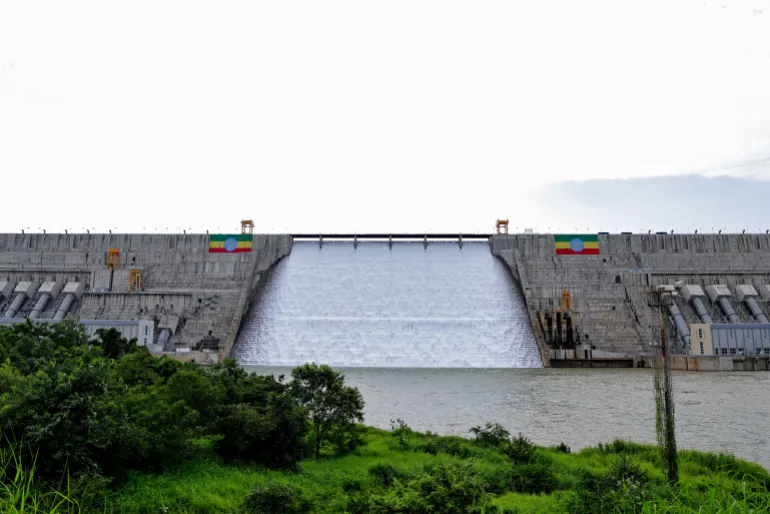
The Grand Ethiopian Renaissance Dam, the construction of which stoked fears in Cairo that Ethiopia could choke off the Nile River, September 9, 2025 [File:Tiksa Negeri/Reuters]
Sudan’s relations with Ethiopia are similarly troubled. Since the outbreak of the Sudanese civil war, Khartoum has accused Addis Ababa of providing training, supplies and the use of Ethiopian territory to the RSF.
Eritrea had fought alongside Ethiopia against rebel groups in the latter’s Tigray region during a war between 2020 and 2022, but relations between the two neighbours have since soured, with Eritrea alarmed by Ethiopia’s attempts to gain access to the Red Sea.
Against that background, some analysts and Ethiopian opposition figures say that Addis Ababa is pointing the finger at foreign conspiracies in a bid to rally support behind its national army.
Mohamed Selim, deputy chair of the Egyptian parliament’s African Affairs Committee, told Al Jazeera that he believes the accusations were an attempt to shift attention from Ethiopia’s domestic problems by creating an external enemy and seeking to unify the internal front.
Amani al-Tawil, director of the Africa Programme at the Al-Ahram Centre for Political and Strategic Studies, similarly described the accusations as “an understandable attempt to escape from internal crises”.
She questioned why Egypt would choose this moment to intervene militarily in Ethiopia, given the two have been in dispute over GERD since 2011.
Al-Tawil said the breadth of the new opposition alliance in Ethiopia – seven groups representing disparate ethnic groups and regions announced the coalition last week – presented a challenge to Addis Ababa.
(Al Jazeera)
Spillover concerns
The renewed fighting in Ethiopia has spread across Tigray and into neighbouring Amhara and Afar.
Mohammed Hussein, the chairman of the Prosperity Party Afar Region Branch Office – the ruling party in Ethiopia’s Afar region – told Al Jazeera that the three regions together have a population of more than 38 million, according to his estimate, and include areas near the borders with Djibouti and Eritrea, raising fears of a regional war.
Ammar Arki, a writer focusing on Horn of Africa affairs, told Al Jazeera that Ethiopia had, at various stages, blamed Sudan, Egypt and Eritrea for contributing to instability inside Ethiopia.
He said the latest accusations could be interpreted as an attempt to redirect some domestic attention towards an external threat and build support around the federal government.
But Arki warned that the longer Addis Ababa continued to explain its internal crisis in terms of an “external conspiracy”, particularly if neighbouring states responded in the same way, the greater the risk that Ethiopia’s conflict could move beyond Ethiopia’s borders and become regional.
Egyptian FA has decided to rest Salah to protect him from playing on artificial turf, which has a higher risk of injuries.
Published On 26 Sep 202626 Sep 2026
Mohamed Salah will not travel with Egypt’s squad to South Sudan for their second Africa Cup of Nations qualifier because the match will be played on artificial turf, the Egyptian Football Association said on Saturday.
Record seven-time AFCON champions Egypt were held to a goalless draw by Angola at Cairo International Stadium on Friday in their opening qualifier.
Recommended Stories
list of 3 itemsend of list
Two-time African Footballer of the Year, Salah, who joined Turkiye’s Trabzonspor from Liverpool last month, started against Angola but did not complete the match after coach Hossam Hassan substituted him midway through the second half.
“The Egypt national team’s technical staff, led by Hossam Hassan, has decided to rest Mohamed Salah for the match against South Sudan scheduled for September 29 because of the playing surface,” the EFA said on social media.
“It was agreed between the national team’s technical staff and Mohamed Salah before the Angola match that he would not play against South Sudan, and the technical staff preferred this approach in order to protect the player,” the EFA added.
Salah has scored 68 goals for Egypt and is just one short of matching coach and ex-player Hassan’s all-time record of 69 for The Pharaohs.
Tuesday’s match between South Sudan and Egypt will be played at Juba Stadium, which has an artificial turf pitch. Such surfaces pose a higher risk of injuries than those with natural grass.
Egypt are in Group B of the AFCON 2027 qualifiers, alongside Angola, South Sudan and Malawi. The 2027 AFCON will be co-hosted by Kenya, Uganda and Tanzania, featuring 24 teams.
Though Egypt are the most successful African side, they haven’t won the championship since 2010.
With Wowcher you can buy a 4* holiday to Marrakesh including a hotel stay and return flights from £59pp from October 5-9.
Seville, Spain
One of the best things about Seville is that it’s less than three hours away from the UKCredit: Alamy Stock Photo
Under three hours away from the UK, Seville is Spain’s fourth-largest city with lots to offer from its tasty tapas and fabulous flamenco.
Not to mention in early October temperatures tend to sit around 26C on sunny days.
Top spots to see include Plaza de Espana – and pop by El Rinconcillo, the city’s oldest tapas bar where a huge glass of wine barely costs £3.
With loveholidays, book a stay at the Ilunion Alcora Sevilla which has sweeping views of the city, and a luxury swimmingpool.
A four-night stay between October 19-23 starts from £279pp with return flights to London Gatwick.
Sharm El Sheikh, Egypt
Dubbed to be super popular next year (so get ahead of the game), Sharm El Sheikh is in Egypt.
The resort city on the Red sea has world-class reefs, incredible beaches and average highs of 31C in October.
Sharm El Sheikh has world-class reefs and incredible beachesCredit: Getty
For Brits, it has lots to offer alongside its sunshine like all-inclusive hotels and waterparks.
With Wowcher, there’s an offer for a seven-night 4* all inclusive Sharm El Sheikh getaway with return flights – the hotel has a spa, sauna, gym, tennis courts and watersports.
Book a stay at the Sharm Club Beach Resort from £299pp
Antalya, Turkey
Antalya has bright blue seas and can be as high as 26C in OctoberCredit: Getty
If you’re seeking autumn sunshine, why not look in what has been called ‘paradise on earth‘?
To make it even better, the average flight time from the UK is around four and a half hours.
There’s a current offer with Wowcher for a 4* Antalya getaway in a sea view hotel stay with breakfast and return flights included.
Book a stay from 5-8 October from £159pp.
Limassol, Cyprus
In Limassol, the largest waterpark is Fasouri Watermania WaterparkCredit: Alamy
Five hours away from the UK is the city of Limassol in Cyprus which has daytime highs of 27C next month.
Some favourite sunbathing spots include Kourion Beach and Pissouri Beach which has been described as a “beautiful rustic pebble beach with pristine water.”
With loveholidays, you can book into the Troodos Hotel which is minutes from Mount Olympus and is surrounded by natural beauty.
A seven-night holiday between October 5-12 starts from £369pp.
Reggio Calabria, Italy
Head to southern Italy for warm weather and vineyard toursCredit: Getty
In just three hours, you could be basking in the Italian sunshine in Reggio Calabria with city with sun, beaches, mountains, waterparks and lots ofhistory.
Not to mention there are highs of 26C in October and Brits can fly directly to Reggio Calabria from London Stansted and return fares start from under £30.
As southern Italy is the perfect place for vineyards, there are even vineyard tours and wine tastings for £20.
You can book a getaway with loveholidays to La Bussola a hotel with huge swimming pools and plenty of space to sunbathe.
A seven-night break between October 4-11 starts from £270pp.
Tenerife, Canary Islands
Tenerife has golden sand beaches and a huge Thai-themed waterparkCredit: Getty
The Canary Islands are a safe option for autumn sunshine, and in October, the island of Tenerife has highs of 26C.
The island also has hundreds of beaches, coastal towns with bustling promenades and head up to Mount Teide National Park on the cable car.
Siam Park, an enormous Thai-themed waterpark is open throughout next month too.
It has high-speed slides, family zones, beaches and plenty of swimming pools.
With Wowcher, book an all-inclusive break to Tenerife from October 5-8 including return flights from £169pp.
Fuerteventura, Canary Islands
Fuerteventura is the sunniest Canary IslandCredit: Getty
Tenerife’s trusty neighbour, Fuerteventura has the same high temperatures – and can actually be cheaper.
On the second largest Canary Island, you can explore a number of beaches like Playa de Matorral, Corralejo and Playa Bajo de la Burra.
It’s easy to take a boat excursion out into the waters and go snorkelling to spot colourful fish and sometimes even stingrays.
Also make sure to check out Acua Water Park and hike on Corralejo Natural Park.
With Wowcher, book an all-inclusive break to Fuerteventura including return flights from £179pp.
Sousse, Tunisia
Sousse is a coastal city in Tunisia and lots of pretty beachesCredit: Corbis via Getty Images
It’s no secret that Tunisia is a top spot when it comes to staying sunny during autumn.
In October, daytime highs can reach 28C – perfect sunbathing weather.
Sousse in particular is known for its sandy beaches and modern marina with boutique shops and boat trips.
Tunisia is relatively cheap too with a pint of beer costing less than £2.
With loveholidays, book a seven-night break between October 9-16 to Riadh Palms which has an enormous swimming complex – prices start from £415pp.
Dubai, UAE
Dubai has highs of around 35C in October making it the ideal autumn getawayCredit: Stefan Tomic
In the UAE, Dubai offers all the delights of an autumn getaway from its many luxury hotels to its thrilling waterparks and exotic beach clubs.
You can do all this next month while enjoying highs of 35C – and Emirates offers direct flights to Dubai which get there in seven hours.
Don’t forget to hit the shops or head to the Grand Souk for tasty treats like stuffed breads.
Or try a Iranian falooda — a sorbet-like dessert made of thin rice noodles and syrup.
With Wowcher, book a break to Dubai (a four or seven night stay) including breakfast and return flights from £449pp.
In terms of the ongoing conflict in the Middle East, the FCDO no longer advises against travel to the UAE, but warns that “the situation in the Middle East remains unpredictable”.
Italy’s defence minister warns of severe economic fallout if Bab al-Mandeb becomes impassable, bypassing EU delays.
Published On 18 Sep 202618 Sep 2026
Italy will deploy warships to ensure safe passage for its commercial vessels through the Bab al-Mandeb strait, Defence Minister Guido Crosetto said, adding that Rome would not wait for a joint decision from the European Union.
“We have the capabilities to protect the passage,” Crosetto said, warning that if the waterway became impassable, the economic consequences would be severe.
Recommended Stories
list of 3 itemsend of list
The Italian defence minister said that Rome “must not allow bureaucratic delays in decision-making to exacerbate an already complex situation”.
Bab al-Mandeb links the Red Sea to the Gulf of Aden, forming one of the world’s busiest shipping corridors between Europe and Asia and a critical route for oil, gas and container traffic heading to and from the Suez Canal.
Roughly 12 to 15 percent of global trade has historically passed through the narrow waterway, which separates Yemen from Djibouti and Eritrea on the African side and is only about 30km (19 miles) wide at its narrowest point.
The strait’s importance has grown sharply since Iran effectively seized control of the Strait of Hormuz earlier this year amid its war with the United States and Israel, choking off the world’s most important oil chokepoint and pushing much of the Gulf’s crude exports towards alternative routes.
Saudi Arabia, in particular, has increasingly relied on pipelines and Red Sea shipping to bypass Hormuz altogether, making the Bab al-Mandeb strait one of the last major arteries still open to Gulf oil reaching global markets.
Control of the strait has been contested for years, as Yemen’s government, Houthi rebels and, at times, forces in the region have held stretches of its coastline at different points since the war in Yemen began in 2015.
The significance of the strait has been hit dramatically in the past few weeks, when the Iran-backed Houthi movement launched a rapid offensive that brought the entirety of Yemen’s western Red Sea coast under its control, including several strategically located islands.
The advance has given the Houthis effectively unrestricted access to the waterway, a development seen as a major setback for international shipping, given the group’s history of attacking vessels it associates with the US or its allies in the region.
The US and the European Union have already carried out military operations aimed at better protecting merchant ships from Houthi attacks in the area, though those efforts have struggled to fully secure the route as fighting in Yemen has escalated.