Amid Dodgers’ uncertainty, Padres’ new owners promise to ‘win it all!’
SAN DIEGO — José E. Feliciano, the new controlling owner of the San Diego Padres, lives in Los Angeles. You know, that place at the end of the Padres’ incessant “Beat L.A.” chants.
No worries, Padres fans. Feliciano is — make that was — a longtime New York Yankees fan.
“The good thing is,” he told me after an introductory news conference Monday, “rooting against the Dodgers comes naturally to me.”
It was only 18 months ago that Padres fans wondered whether the good times might come to an end, with the widow of beloved owner Peter Seidler suing his brothers for control of the team. For their part, the brothers said they had “no plans to sell the Padres.”
That sounds a lot like what Dodgers president Stan Kasten said Friday, amid a federal investigation into alleged financial improprieties among insurance companies controlled by Dodgers owner Mark Walter.
“The Dodgers are not being sold,” Kasten said. “They’re not going to be sold.”
What is true today might not be true tomorrow. What is true today, as potential bidders for the Dodgers lurk and coalesce amid L.A.’s turn at uncertainty, is that the Padres have an energetic and effervescent couple as their new principal owners.
Feliciano, a founder of Clearlake Capital in Santa Monica, took the mound at Petco Park on Monday afternoon, working out of a stretch and looking toward an invisible runner at second base before delivering a pitch. In spring training, he said, he stepped into the batting cage to try to hit simulated pitches from Padres All-Star closer Mason Miller.
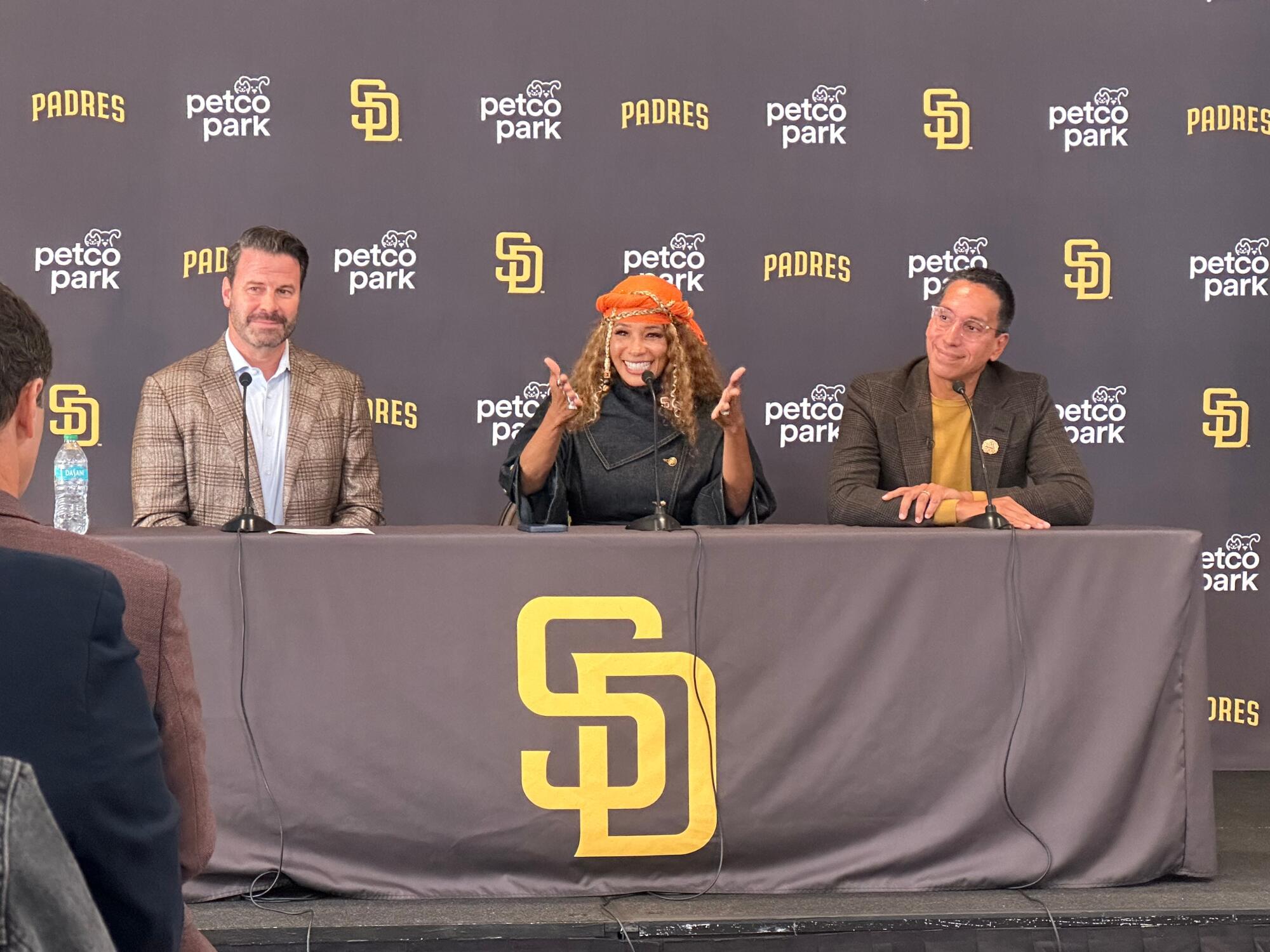
His wife Kwanza Jones, an artist and entrepreneur, led her husband into the news conference amid the sounds of a song she co-wrote, she said, inspired in part by a catch made by Padres outfielder Fernando Tatis Jr.
“My only musical talent is my name,” Feliciano said. “I humbly ask you to please add my middle initial so I never get confused with the singer.”
As the couple looks for a home in San Diego, Jones appealed to fans to share what they love about their neighborhoods. Later, the couple took selfies along the first-base line.

New San Diego owners Kwanza Jones, center, and José E. Feliciano, right, speak at a news conference with Padres Chief Executive Erik Greupner at Petco Park on Monday.
(Greg Beacham / Associated Press)
Their enthusiasm bubbled forth as the news conference proceeded, as their sense of whether the Padres might finally win a World Series got more and more optimistic.
Feliciano, three minutes into the news conference: “We cannot promise we are going to win.”
Jones, two minutes later, riffing off her lyrics, her voice rising: “We gonna win! We gonna win! We gonna win — win it all!” And then a pause, to lower her voice: “We hope it’s sooner rather than later.”
Feliciano, two minutes later: “We need to win a World Series. It’s that simple. That’s what we’re going to do.”
Jones, one minute later: “Multiples.”
Feliciano, one minute later: “The impossible becomes possible when somebody does it. So let’s do it.”
This is not Feliciano’s first foray into professional sports. Clearlake Capital is the majority owner of Chelsea, the storied soccer club.
“I’m missing the first game of the Premier League right now,” Feliciano said.
He said he could not comment on reports Walter is looking to sell his stake in Chelsea. Two weeks ago, Walter announced an agreement to sell controlling interest in the Lakers at a $12.5-billion valuation, the cash from which could help repay loans under scrutiny. The Dodgers could command a similar valuation, industry sources not authorized to discuss the issue publicly told The Times, should Walter decide to sell.
As part of a search for cash, Puck reported last week, Walter had talked with Charter Communications about whether the company would be interested in paying a lump sum now to get out of its SportsNet LA contract — a money-losing deal for Charter, but the primary source of the Dodgers’ financial advantage over the other 29 teams in the major leagues.
The talks “went nowhere,” Puck reported. Kasten declined to address the matter, as did a Charter spokesman.
In 2011, with the Dodgers headed toward bankruptcy, former owner Frank McCourt found what he believed would be his financial lifeline in a television rights deal with Fox Sports.
In a withering letter to McCourt, then-commissioner Bud Selig rejected the deal, criticizing McCourt for proposing a financial structure that would have foreclosed the Dodgers from pursuing more lucrative options “because of your desperate need for immediate cash.”
That precedent could inform how Rob Manfred, the current commissioner, would evaluate any proposed restructuring of the Dodgers’ television deal. Under the owners’ current collective bargaining proposal, to which Walter agreed, the Dodgers’ annual television riches — more than $500 million per year by the end of the deal in 2038 — would be fully contributed toward revenue sharing among all 30 teams.
I asked Feliciano whether the Dodgers’ uncertainty might make this a particularly opportune time to buy the Padres.
“You’ve got to look at these things on a generational, multi-decade basis, honestly,” he told me. “It’s like trying to time a great investment in the market. You can’t.
“What I can tell you is that this is the good time — the best time — for us. I think it also coincides with Peter’s legacy: The team is in a great place, the city is in a great place.”
The Dodgers’ revenue advantage remains significant, not just because of their SportsNet LA deal but because they fill the largest stadium in the majors almost every night and employ Shohei Ohtani.
In San Diego, however, where ticket sales represent the largest source of team revenue, the Padres sell more tickets than any major league team besides the Dodgers. Petco Park already is a year-round concert venue and event center, and the Padres could rekindle plans to develop a large parking lot near the ballpark.
And, if owners emerge from collective bargaining with a salary cap or other restraint on the Dodgers’ spending, that would be a win for San Diego.
On the field, the Padres entered play Monday with 21 victories in their past 28 games. The Padres acquired Robbie Ray and Casey Mize at the trade deadline to bolster a patchwork rotation, and they retained Miller and Adrian Morejon rather than break up a mighty bullpen. Tatis leads the National League with 12 home runs since the All-Star break; outfielder Jackson Merrill has 11.
“As we have seen the last few weeks, we are very competitive. I feel we are one of those teams — us and the Phillies, probably — that nobody wants to play,” Feliciano said.
“We want to keep it that way.”
The Phillies entered play Monday on a nine-game winning streak, in position for one of the National League wild cards. The Padres also are in position for an NL wild card, keeping alive the possibility that the Dodgers and Padres could meet in the NL Championship Series.
If that happens, it won’t matter how many games the Dodgers finished ahead of the Padres during the regular season.
“We’d just need to win four,” Feliciano said.
Beat L.A., indeed.