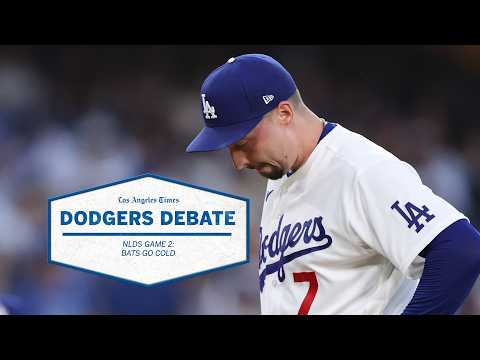
Dodgers’ bullpen went from question mark to exclamation point in NLDS
ATLANTA — And you thought the bullpen was going to be the weakest branch.
In the four aces, you trusted. The Dodgers’ stellar starting rotation of Yoshinobu Yamamoto, Tarik Skubal, Blake Snell and Tyler Glasnow? A quartet who can strong-arm anyone.
And you probably figured Freddie Freeman would get it going. You had faith in playoff risers Max Muncy, Kiké Hernández and Teoscar Hernández — and in the Dodgers’ playoff-proven offense overall.
You were not, however, so bullish on the bullpen.
That was the proverbial, annual question mark entering the best-of-five National League Division Series against the Atlanta Braves, whom the Dodgers vanquished with a 4-1 victory Wednesday at Truist Park to set up an NL Championship Series rematch with the Milwaukee Brewers.
Edwin Díaz, the Dodgers’ purported closer, had a disastrous, injury-marred first season with the team — or he was having one.
That left Tanner Scott — last season’s purported closer — handling the bulk of the ninth-inning duties this season, and he finished with a career-high 25 saves. But you were going to have to see him sustain that in the postseason to believe in Scott, whose first season with the Dodgers also was so disastrous that he wasn’t even included on the playoff roster.
The Dodgers are paying Díaz $69 million and Scott $72 million. A steep price and a sign of how badly the team wants to avoid having to turn to starting pitchers to finish off important postseason games, as they have in the past with Julio Urías, Walker Buehler and, last season, Yamamoto.

But until now, the Dodgers haven’t had much but frustration to show for their investment in Scott or Díaz — who were two names among four, including Roki Sasaki and Evan Phillips, that manager Dave Roberts suggested could close games in the playoffs.
It was a tangled trust tree that needed lots of water.
Or how about champagne? Maybe ice-cold beer?
Because after Alex Vesia, Edgardo Henriquez, Scott and Díaz combined to get the final 13 outs of Game 4 without giving up a run, they helped lead the charge in the clubhouse afterward, dousing one another to celebrate.
In the series, the Braves went one for 23 (.043) with runners in scoring position. That, according to OptaStats, is the second-lowest such batting average in a postseason series in history — and it doesn’t happen without a bullpen being locked in; the Braves went 0 for 13 with runners in scoring position against the Dodgers’ relief pitchers.
In the deciding Game 4, Vesia took the baton from Glasnow with two outs and two runners on in the fifth, got the inning’s final out on one pitch and came back out in the sixth. He gave up a double but got Drake Baldwin to line out before handing the ball to the hard-throwing Henriquez, who hit 100 mph or higher on 11 of his 15 pitches, retired five of six batters and earned his first postseason win.
Then Scott had the inning of his Dodgers career in the eighth — sitting down the Braves’ 3-4-5 hitters with a nasty array of sliders and fastballs. He punctuated his performance with a fastball on the corner that ended the inning and wound up costing Atlanta its final ABS challenge.
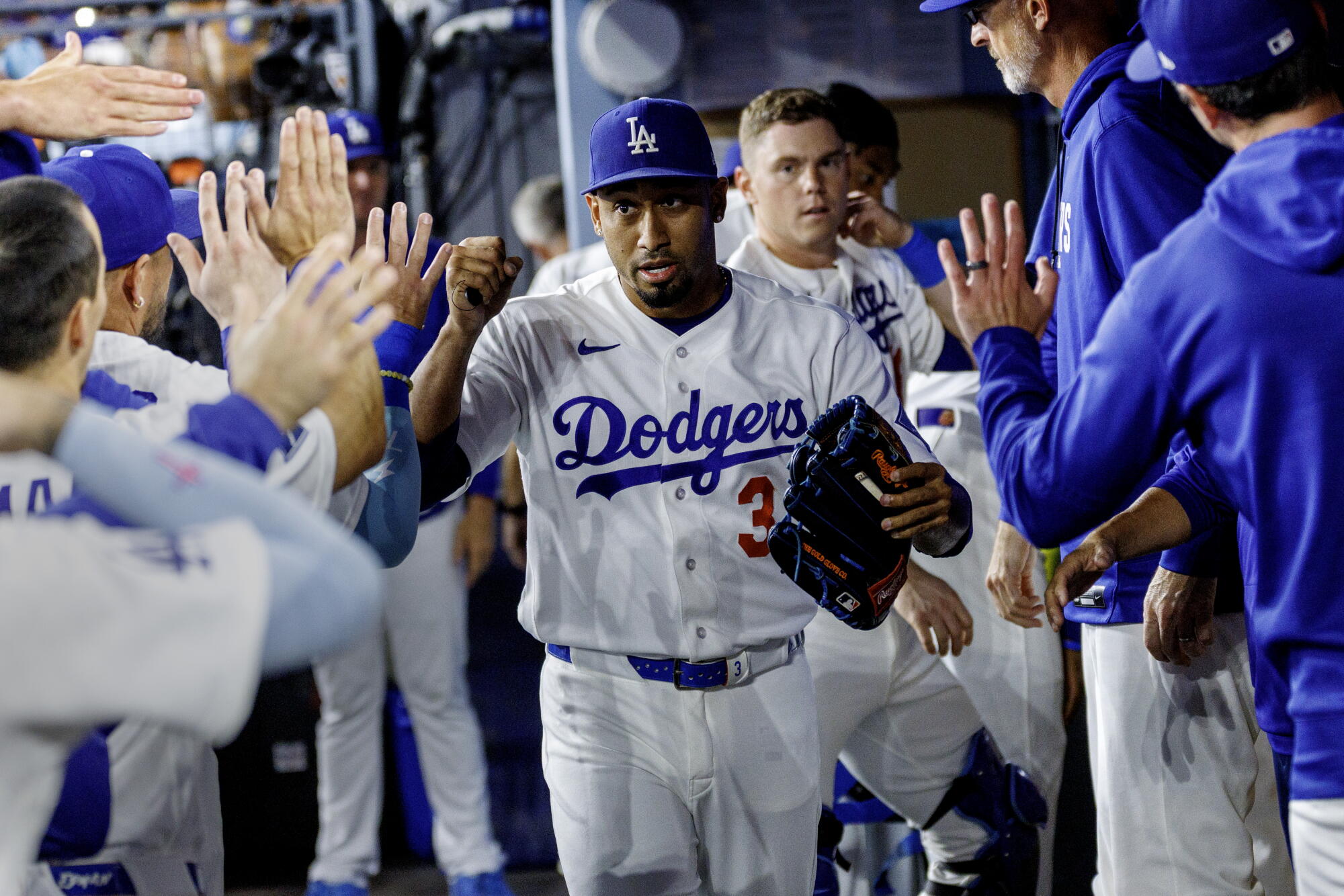
And, finally, in closing, Díaz.

-
Share via
He earned his second consecutive save with an efficient, eight-pitch, 1-2-3 inning. He isn’t the closer, not officially. But, darn, is he important: “For us to win the World Series,” Roberts said, “he’s got to be a relevant part of this equation … I’ve got to trust him.”
The way Díaz is dealing, why wouldn’t he? Díaz has given up just one hit in three postseason innings. And he’s feeling good.
“The last two nights it’s been amazing,” Díaz said. “That’s why I came here, to win games and close games like this one. So I’m really happy.”
Andrew Friedman, the Dodgers’ president of baseball operations, raved about Díaz’s resilience, referencing the roller coaster of a season that included an 8.68 earned-run average, neck and elbow injuries, a stint on the injured list and in triple A.
“He would say, ‘Hey, I’m ready to come back,’” Friedman said. “And it was like, ‘Hey, we need to see more, we need to see this really lock in.’ And at every turn, he said, ‘Whatever you guys need … anytime you want me to pitch, I’ll be ready.’
“It was never a question of the heartbeat and his ability to handle these moments. It was about just getting him right mechanically and getting back to the stuff that we’ve all seen over the years.”
Vesia is similarly impressed with his friend Scott’s resurgence.
“Going back to last year with ups and downs and adversity and all that stuff, we definitely leaned on each other,” said Vesia, who missed the World Series after the October death of his newborn daughter, Sterling Sol.
“And, you know, for this year to watch [Scott] really take off and have a great year, it’s been awesome, you know? It’s really awesome. With the closing role being undefined and all that stuff, he stepped up. Every year, there’s always guys that step up.
“Now, we got eight more.”
Eight more wins to three-peat, and no weak links anywhere.