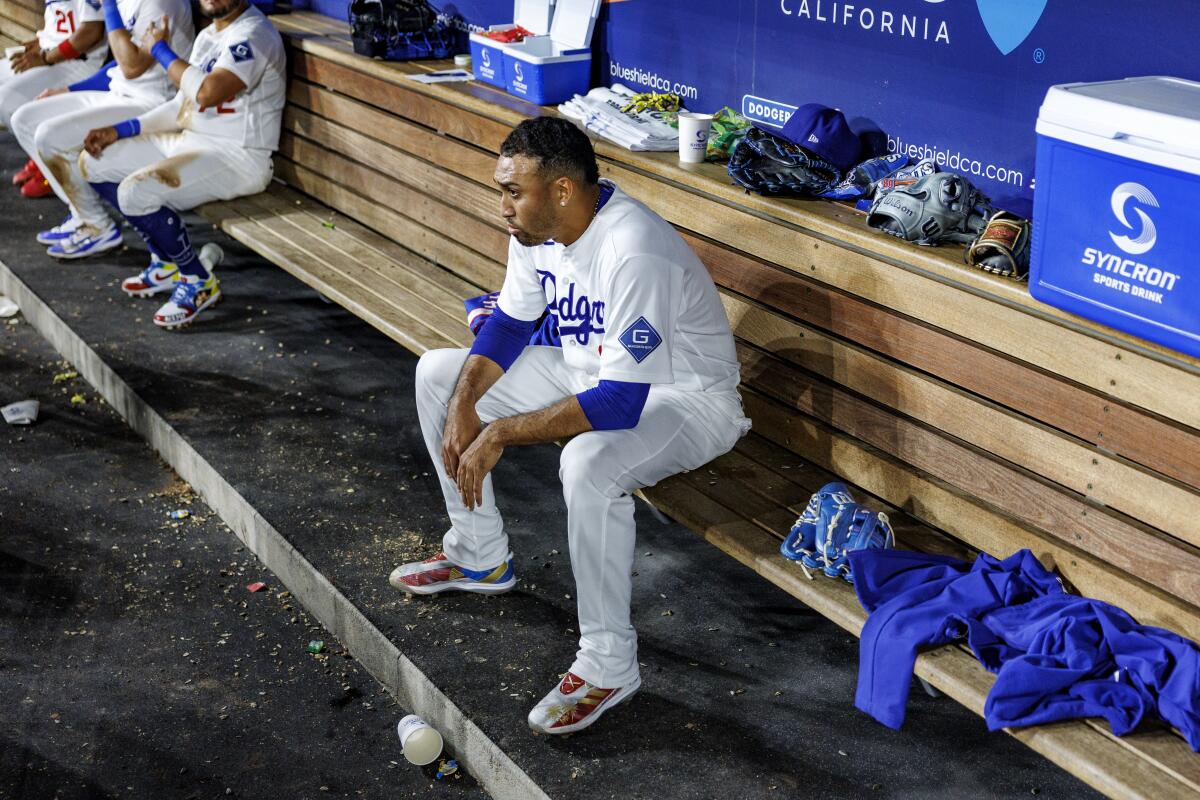
Edwin

How Dodgers landed Edwin Díaz — and finally found a bona fide closer

At the start of the winter, the assumption was that top free-agent closer Edwin Díaz would fall out of the Dodgers’ preferred price range.

Knowing they needed bullpen help, however, the Dodgers decided to reach out with interest anyway.

What followed will go down as one of the most surprising outcomes of this MLB offseason. And, for the Dodgers, their latest in a string of big-name, star-player acquisitions.

Even though the Dodgers initially had doubts about their chances of landing Díaz — especially on the kind of relatively shorter-term deal they were seeking in their hunt for relief help — circumstances changed, Díaz’s market evolved, and they went from dark horse to front-runner.

On Friday, it all culminated in a Dodger Stadium news conference, the once-unexpected union between the two-time defending champions and three-time All-Star right-hander being made official as Díaz’s three-year, $69-million contract was finalized.

“It wasn’t easy,” Díaz said of his free agent process, which ended with him leaving the New York Mets after a decorated seven-year stint. “I spent seven years in New York. They treated me really good. They treated me great. But I chose the Dodgers because they are a winning organization. I’m looking to win, and I think they have everything to win. So picking the Dodgers was pretty easy.”

That didn’t mean it came as any less of a surprise.

Early on this winter, the Dodgers signaled a hesitancy to hand out another long-term contract to a reliever, after watching Tanner Scott struggle in the first season of the four-year, $72-million deal he signed last winter.

And though they gradually grew more open to the idea, giving serious consideration to Devin Williams before he signed a three-year, $51-million deal with the Mets two weeks ago, the thought of landing Díaz seemed far-fetched.

After all, the 31-year-old was widely expected to receive a four- or five-year deal, having already opted out of the remaining two seasons on his record-breaking five-year, $102-million contract with the Mets to become a free agent this winter. Also, since he had turned down a qualifying offer from the Mets at the start of the offseason, the Dodgers knew they’d lose two draft picks (their second- and fifth-highest selections) to sign him.

“We checked in from the get-go,” general manager Brandon Gomes said. But, he acknowledged, “the opportunity to add somebody of this caliber to what’s already a really talented bullpen was something that we weren’t sure was going to be able to actually come to fruition.”

Turned out, a few factors were working in the Dodgers’ favor.

First, the Mets weren’t willing to give Díaz a longer-term deal, either. Instead, in the wake of the Williams signing, they were reportedly offering only three years for a similar salary as the Dodgers. Not coincidentally, it was only entering last week’s winter meetings — mere days after Williams’ Dec. 3 agreement with the Mets — that Gomes said talks started to intensify.

“Having those conversations and making sure you’re in there and [letting him know], ‘Hey, we’re really valuing you, and if things make sense on your end, great, we’re here’ — that was the biggest thing,” Gomes said. “Making sure you’re exploring all avenues, because you don’t know how things are gonna play out.”

Another benefit for the Dodgers: They had advocates close to Díaz vouching for the organization.

Dodgers new star closer Edwin Díaz speaks wearing his new uniform during a news conference at Dodger Stadium Friday.

The Dodgers’ new star closer, Edwin Díaz, speaks at his introductory news conference on Friday at Dodger Stadium.

(Allen J. Schaben / Los Angeles Times)

Díaz said he received rave reviews about the club from both his brother Alexis (who spent most of last year with the Dodgers, after they acquired him from Cincinnati following an early-season demotion to the minors) and his Team Puerto Rico teammate Kiké Hernández (a longtime Dodgers fan favorite who is currently a free agent).

“They treat every single player the same,” Díaz said of the message he received. “That’s really nice, [especially] knowing they have a lot of great players, future Hall of Fame players. … That’s really good. That’s how a winning clubhouse is.”

Ultimately, it all led up to a rather swift signing process on Tuesday morning, one in which the Dodgers gave Díaz the highest average annual salary for a reliever in MLB history ($23 million per year) but kept the terms to three years and were able to defer more than $13 million of the total guarantee.

“I think once Devin came off the board, it was like, ‘OK, let’s continue to explore the different options,’” Gomes said. “Obviously having no idea what conversations had gone on up to that point between Edwin and other clubs, it was more about: ‘Hey, we’re here if there’s something that makes sense. And we would love to have you join our group.’ And fortunately enough, everybody’s interests were aligned on that.

“That’s why you shouldn’t play the game of assumptions, and just do the due diligence on the front end,” Gomes added. “Sometimes things work out, sometimes they don’t. But having those conversations and making sure you’re doing the work that’s needed to really understand the situation is important, especially when you see situations like this play out.”

Now, the Dodgers will put their faith in Díaz to play a leading role in their quest for a World Series three-peat.

He will be the club’s designated closer — a role they have been hesitant to bestow upon any one reliever since the departure of Kenley Jansen (the only MLB reliever with more saves than Díaz since his debut in 2016).

“For us, we have a high bar. To name someone the closer, you have to be one of the best. You have to be elite and dominant at what you do,” president of baseball operations Andrew Friedman said.

The team’s expectation is that Díaz’s presence will elevate the rest of the bullpen, too, giving a more defined late-game structure to a relief corps that ranks just 21st in the majors in ERA last season.

“It allows Doc and our coaching staff to kind of put guys into spots leading up to that,” Gomes said, “knowing that it doesn’t really matter who’s in the ninth, that we’re gonna like the matchup.”

Perhaps the biggest news from Friday’s introduction: Díaz still plans to enter games to his iconic walk-out song, “Narco” by Timmy Trumpet — which Gomes described as “probably the most electric walkout song in the game.”

“I can’t wait, the first game of the season, coming in the ninth with Timmy Trumpet and getting the W for the Dodgers,” Díaz said.

A few weeks ago, that scene felt like an unlikely vision.

But now, anytime the sounds of trumpets echo around Chavez Ravine in the summers to come, they will serve as a reminder of the team’s latest free-agent coup — one more unexpected than almost all the rest.

Source link

Could Dodgers’ Edwin Díaz signing portend more big offseason moves?

As the hotel lobby at the Signia by Hilton Orlando filled at MLB’s winter meetings on Tuesday morning, an unexpected prize was falling into the Dodgers’ lap.

Edwin Díaz, the top reliever on this year’s free-agent market, was suddenly slipping away from the incumbent New York Mets, who reportedly made the fan favorite closer only a three-year offer that did little to entice him to re-sign with the team.

The Dodgers, meanwhile, were swooping in late to snatch away the hard-throwing right-hander, submitting a more lucrative three-year bid that would pay Díaz a relief-pitcher-record $23 million per season.

Just like that, the Dodgers had gone from a perfectly content, but unremarkably quiet winter, to one in which they’d once again flexed their financial muscles and stunned the baseball industry.

“There were a lot of scenarios [that could have potentially played out this winter] where we didn’t necessarily end up with a top-end reliever,” president of baseball operations Andrew Friedman said Tuesday night, while declining to comment on Díaz directly since the transaction wasn’t finalized. “But we just kind of prepared on a bunch of different fronts. And being aggressive, if something lined up, we’ve known all along [it is something we would do].”

The Díaz signing was an affirmation of the team’s operating procedure on the free-agent market. They always at least target top talent. They always at least stay around the proverbial blackboard, as Friedman calls it, in case a player’s market doesn’t develop as expected. And now, they are armed with the kind of endless resources that can make them a threat to scoop up any rebound.

As they leave Orlando this week and embark on the rest of this offseason, it serves as a reminder:

The Dodgers might not need to make another big move, in the same way they downplayed the need for any big acquisition coming into the winter.

But they’ll certainly be ready to pounce if another opportunity materializes.

  • Share via

“I would say we definitely can,” Friedman hinted when asked if another big move this offseason could be possible. “Whether that makes the most sense within the timing of our roster — there’s so many factors that go into it, and any decision you make has a future cost. It’s just weighing that. So, yes, we can. How likely it is, is probably another question.”

Start with the top overall available free agent, Kyle Tucker.

The Dodgers are not expected to entertain a long-term contract for the soon-to-be 29-year-old and four-time All-Star. If his bidding war, as projected, results in offers upwards of 8-10 years and $400 million, the club is unlikely to engage; given the glut of long-term contracts already on their books, and the crop of young outfield prospects expected to reach the majors in the next several seasons.

But what if Tucker’s market cools? What if, like Díaz, he is left to consider relatively shorter-term deals with higher annual salaries? Granted, that’s unlikely to happen, considering the wide interest Tucker is reportedly attracting, including from the Toronto Blue Jays and their suddenly big-spending front office. If it does, however, the Dodgers could once again become candidates for a blockbuster, still needing to fill out their outfield as they embark on a quest for a World Series three-peat.

The same dynamic could be in play with other top free agents. The Dodgers have already shown interest in familiar face Cody Bellinger, who could bring both positional versatility and a more refined hitting approach than he had during his first stint with the club. Bo Bichette also presents the kind of balanced offensive profile the Dodgers are believed to seeking, as they try to shore up a lineup that too often was boom-or-bust last year.

Like Tucker, both players are unlikely to fit the Dodgers’ bigger-picture plans if their free agencies develop as expected (with Bellinger pegged for roughly five years and $150 million, and Bichette perhaps eight years and more than $200 million).

But thanks to the team’s flush financial outlook — and the fact that a salary cap could be coming next year, potentially incentivizing extra spending right now — all it could take is a slight cooling in either player’s market to make them more realistic targets for the two-time defending champions.

As long as there isn’t an overburdensome long-term risk, the Dodgers don’t seem afraid of lucrative shorter-term commitments to sustain their newly cemented dynasty.

“We have not only a really talented group of players, but an extremely driven group of players, who want to take care of their legacy and create a dynasty and be part of something really special,” Friedman said. “Because of that mindset, it makes it easier to invest. And do everything we can to help support that and be a part of helping bring that to fruition.”

The Dodgers could alternatively get aggressive on the trade market. Brandon Donovan and Lars Nootbaar of the St. Louis Cardinals are seen internally as fits. Steven Kwan of the Cleveland Guardians would be an even bigger-name addition, albeit is less likely to be dealt this winter.

Then there is the real white whale: Two-time Cy Young Award-winning pitcher Tarik Skubal of the Detroit Tigers.

For now, it’s uncertain at best that Skubal, who will be a free agent after next season and is unlikely to sign a contract extension with the Tigers (or any other team that trades for him) before then, gets moved this winter.

If he does, it figures to come at an extremely steep cost for a starting pitcher with one year remaining of team control.

If there’s any team that has the ammunition to pull it off, however, it’s the Dodgers, with their ample pitching depth and top-ranked farm system. Like with their free-agent pursuits, there is likely to be a limit for how much they’d part with. But if the Tigers seriously consider a trade, it would be no surprise to see the Dodgers be seriously involved.

There are less splashy routes for this offseason to go down, of course. If the Dodgers don’t make another marquee addition, they still feel confident with the roster core they have in place.

Then again, that’s the tone they were striking coming into these Winter Meetings, before swiping away Díaz in the surprise move of the week.

Thus, the baseball world has been put on alert again: The Dodgers won’t be reckless. They want to maintain longer-term flexibility. But if they see value in a top-talent target in the short-term, they won’t be afraid to once again spend big.

Source link

Surprise! The Dodgers make blockbuster move, sign Edwin Díaz

From Jack Harris: Coming into the offseason, the Dodgers signaled that they would be conservative when it came to pursuing help in the bullpen.

Turned out, they were quietly plotting one of the most surprising — and influential — signings of the winter.

In a blockbuster move on Tuesday, the team agreed to a three-year, $69-million deal with top free-agent closer Edwin Díaz, according to multiple people with knowledge of the situation not authorized to speak publicly, snatching the three-time All-Star and three-time reliever of the year award winner in a move that will transform their previously shaky bullpen.

Díaz, 31, was the consensus best relief pitcher in this year’s free-agent class. Over his nine-year career, he has a 2.82 ERA and 253 saves. In that time, no other MLB reliever tops him in strikeouts (839), while only Kenley Jansen has recorded more saves (334). With the New York Mets this past season — his second since returning from a knee surgery that sidelined him for all of 2023 — Díaz also had one of his best career campaigns, posting a 1.63 ERA with 28 saves in 31 opportunities and 98 strikeouts in 66 ⅓ innings.

He was so good, he elected to opt out of the final two years of the record-setting five-year, $102-million deal he signed with the Mets in 2022.

Thanks to that track record, the hard-throwing right-hander was positioned to be the highest-paid reliever on this year’s market. Most projections pegged him for another four- or five-year deal, making upward of $20 million per season again.

Continue reading here

MORE BASEBALL:

Shaikin: Edwin Díaz signing shows Dodgers aren’t going to worry about potential salary cap

Take a swing? Two Buss brothers consider investing in baseball’s Athletics

NEW UCLA COACH TAKES AIM AT USC

From Ben Bolch: Nine months before his debut in his first big-time college football coaching job, Bob Chesney sounded as confident as a running back with four downs to gain one yard.

Nothing could stop him, no matter the weight of the unique challenges ahead.

For instance…

How did he feel about UCLA’s lack of recent football success?

“To me,” Chesney said, “there is zero doubt in my mind that we can win here.”

A perceived lack of institutional support?

“Alignment,” Chesney said, referencing his shared vision with university officials, “was a word that continued to show up over and over and over again.”

That annoying crosstown rival?

“We don’t need to be the other school in this town,” Chesney said, “we need to be the school in this town and I promise that will happen here in the very, very near future.”

Continue reading here

USC BASKETBALL TAKES NOSTALGIC TRIP

From Ryan Kartje: When they first met more than four decades ago now, the four freshmen on the University of San Diego’s men’s basketball team in 1983 didn’t need long to figure out who would lead them. Eric Musselman had all but elected himself within moments of moving into their dorm room.

“Before I could even drop my bag on the bed, Eric goes, ‘OK, we’re going to the gym,’” recalled Scott Thompson, San Diego’s 7-foot center. “He’d barely said hello.”

It didn’t matter that, at 5-foot-7, Musselman — the future USC men’s basketball coach — was more than a foot shorter than his freshman counterparts, with the other two checking in at 6-foot-11 and 6-foot-9. Or that Musselman carried himself with a swagger and confidence more befitting, even then, of a coach than a college freshman. He was so sure of himself, he actually pitched himself for the head coaching job as a sophomore.

“Father [Pat] Cahill was our athletic director,” Musselman said. “So before they named our new coach [in 1984], I went in there and told him, ‘Hey I think I can coach these guys and be a student athlete and a coach, and it’d be great publicity, the first time ever and all that.”

“And Father Cahill told me to get back to class.”

Continue reading here

MORE USC:

Chad Baker-Mazara and Ezra Ausar lead USC to win at San Diego

USC vs. San Diego summary

RIVERS RETURNS TO NFL

From Sam Farmer: These are not your grandfather’s Indianapolis Colts.

Or perhaps they are.

The Colts are planning to sign Chargers legend Philip Rivers, who recently became a grandfather, bringing back the 44-year-old quarterback after five years of retirement.

Continue reading here

HIGH SCHOOLS

From Eric Sondheimer: It was paparazzi time on Tuesday night at the old Morningside High gymnasium, where more than 20 photographers stationed themselves on the baseline trying to capture the moment Jason Crowe Jr. of Inglewood set the state record for career scoring by a high school basketball player.

Think Chino Hills days with the Ball brothers and Sierra Canyon days with Bronny James to bring out the cameras en masse.

The 6-foot-4 senior and son of Inglewood coach Jason Crowe Sr. needed 29 points to pass the 3,659 career points accumulated by Tounde Yessoufou of Santa Maria St. Joseph.

Continue reading here

MORE HIGH SCHOOLS:

Josh Gallagher helps Loyola turn back Cathedral in boys’ soccer rivalry game

Prep basketball roundup: Freshman Major Williams makes 11 threes for Edison

DUCKS

Beckett Sennecke scored a shorthanded goal with one second remaining to force overtime, Leo Carlsson scored in the shootout and the Ducks beat the Pittsburgh Penguins 4-3 on Tuesday night for their fifth win in seven games.

The 19-year-old Sennecke eluded three defenders and his shot deflected off the glove of Pittsburgh’s Erik Karlsson and into the net. A replay review confirmed the shot beat the buzzer.

Ville Husso made 45 saves, including seven in overtime, and stopped all three shots in the shootout.

Continue reading here

Ducks-Penguins summary

NHL standings

THIS DAY IN SPORTS HISTORY

1939 — The Green Bay Packers register the first shutout in an NFL championship game by beating the New York Giants 27-0.

1961 — Billy Cannon of the Houston Oilers rushes for 216 yards, catches five passes for 114 yards and scores five touchdowns in a 48-21 victory over the New York Titans. Cannon finishes with 373 combined yards.

1971 — Kareem Abdul-Jabbar scores a career-high 55 points in Milwaukee’s 120-104 victory over the Boston Celtics.

1982 — Michael Dokes knocks out Mike Weaver in the first round to capture the WBA heavyweight title in Las Vegas.

1985 — The Indiana Pacers hits only 19 field goals in an 82-64 loss to the New York Knicks, setting an NBA record for the fewest field goals made by one team since the inception of the shot clock.

1986 — Atlanta’s Dominique Wilkins scores 57 points to lead the Hawks to a 123-95 rout of the Chicago Bulls.

1992 — The NHL awards expansion franchises to Anaheim and Miami. The newcomers, scheduled to begin play in the 1993-94 season, bring the NHL to 26 teams.

1994 — Art Monk sets an NFL record for consecutive games with a reception on New York’s first play in the Jets’ 18-7 loss to the Detroit Lions. Monk’s 5-yard catch gives him 178 consecutive games with a reception, breaking Steve Largent’s NFL mark.

1999 — Laffit Pincay Jr. guides Irish Nip to a two-length victory in the sixth race at Hollywood Park for his 8,834th victory, breaking Bill Shoemaker’s 29-year-old record and making him the world’s winningest jockey.

2006 — LaDainian Tomlinson breaks Shaun Alexander’s NFL single-season touchdown record of 28 when he scores three times in the San Diego Chargers’ 48-20 victory over the Denver Broncos. Tomlinson has 26 TDs rushing and three receiving.

2006 — Marvin Harrison of Indianapolis is the fourth player in NFL history with 1,000 receptions, joining Jerry Rice, Tim Brown and Cris Carter.

2008 — Carmelo Anthony matches George Gervin’s NBA record for points in a quarter with 33 in the third and finishes with a season-high 45 points in Denver’s 116-105 victory over Minnesota.

2010 — George Karl earns his 1,000th coaching victory, the seventh coach in NBA history, as Al Harrington scores a season-high 31 points and Nene adds 26 to help the Denver Nuggets hold off the Toronto Raptors 123-116.

2016 — 82nd Heisman Trophy Award: Lamar Jackson, Louisville Cardinals (QB), youngest player to win at 19.

2016 — Army ends a 14-year run of frustration against Navy, using an overpowering running game and opportunistic defense to carve out a long overdue 21-17 victory.

2016 — Roman Torres scores in the sixth round of penalty kicks to give the Seattle Sounders their first MLS Cup title, 5-4 over Toronto FC after 120 scoreless minutes. It’s the first MLS Cup final to fail to produce a goal in regulation, setting the stage for a dramatic tiebreaker.

2017 — Ben Roethlisberger completes 44 of a franchise-record 66 passes for 506 yards and two touchdowns, becoming the first quarterback in NFL history to top 500 yards passing three times and leading Pittsburgh past Baltimore 39-38. Antonio Brown caught 11 passes for 213 yards for Pittsburgh.

Compiled by the Associated Press

Until next time…

That concludes today’s newsletter. If you have any feedback, ideas for improvement or things you’d like to see, email Houston Mitchell at houston.mitchell@latimes.com. To get this newsletter in your inbox, click here.

Source link

Dodgers signing of Edwin Díaz shows they aren’t worried about a potential salary cap

What kind of team would commit $141 million to two closers?

The one that won last year. The one that won this year. The one that plans to win again next year.

“All I have to say to you,” Dodgers owner Mark Walter told fans at the team’s World Series championship celebration last month, “is we’ll be back next year.”

The Dodgers handed Tanner Scott $72 million last winter. It hasn’t worked out. So, on Tuesday, the Dodgers handed Edwin Díaz $69 million.

If the Dodgers are going to be Exhibit A for Walter’s rival owners to cry about how desperately they need a salary cap, bring it on. If Walter’s rival owners demand that players be locked out next winter and not be allowed back until they relent and accept a salary cap, well, bring that on too.

There is a sentence players are taught to utter: “I can’t worry about what I can’t control.” The Díaz signing is basically the Dodgers’ ownership saying the same thing: “We can’t worry about other owners pointing their fingers at us. We’re here to win. If the rules change, then we’ll worry about that.”

Or maybe not.

“Honestly, I think that we have an organization that, whatever rules or regulations or constructs are put in front of us,’’ Dodgers manager Dave Roberts told reporters Monday, “we’re going to dominate.”

In what they call their golden age, the Dodgers are chasing history. No team had won back-to-back championships in 25 years. Next up: tying the major league record of 14 consecutive postseason appearances, and becoming the first National League team ever to win the World Series in three consecutive years.

“What’s better than two?” Roberts hollered at the World Series celebration. “Three! Three-peat! Three-peat! Let’s go!”

It ain’t bragging if you can back it up. For the first time in what will be his third season with the Dodgers — and after winning consecutive most valuable player awards — Shohei Ohtani should be available to pitch and hit for the entire season.

“I’m ready to get another ring next year,” Ohtani said at the celebration.

Mookie Betts, the only active player to win four championships, will come off a Gold Glove-nominated year in his first full season at shortstop and, presumably, will not have to fight off an illness like the one that derailed his strength and hampered his offense at the start of last season.

“I got four,” Betts told the celebration crowd. “Now it’s time to fill the hand all the way up, baby. ‘Three-peat’ ain’t never sounded so sweet. Somebody make that a T-shirt.”

Roberts stirred some conversation last week when he told the Amazon Prime show “Good Sports” that he would support a salary cap.

“You know what? I’m all right with that,” Roberts said. “I think the NBA has done a nice job of revenue sharing with the players and the owners. But if you’re going to suppress spending at the top, I think that you’ve got to raise the floor, to make those bottom-feeders spend money, too.”

The owners of those bottom-feeders ought to be aware of that, because they would have to spend, and they would not be able to point their finger at the Dodgers. The owners, after all, are pitching a salary cap to the public as a cure for competitive balance.

The Dodgers would welcome that challenge. A salary cap would limit salaries, but it would not limit spending on coaching, analytics, biometrics, facilities, nutrition, team planes, and other areas in which the Dodgers’ owners have earned championship rewards for their significant investments.

For now, though, the Dodgers needed a closer. The Dodgers got the best one available in free agency, a guy who has struck out at least one-third of opposing batters in each of his past seven seasons and has limited opponents to a batting average under .200 in each of his past five seasons.

Would the Dodgers like to get younger? Yes. Did they field the oldest group of position players in the majors last year? Yes. Do the Dodgers now have Díaz and Scott for the next three years, and do both turn 32 next year? Also yes.

But, given where both the Dodgers and Major League Baseball are right now, this might be the more pertinent question for the Dodgers: Can Díaz become the first Dodgers reliever to close out a World Series clincher since Steve Howe in 1981? (Orel Hershiser did the honors in 1988, followed by Julio Urias in 2020, Walker Buehler in 2024 and Yoshinobu Yamamoto in 2025.)

If you believed the Dodgers were ruining baseball, then the signing of Díaz will only intensify that. After all, 11 teams did not open last season with a payroll of $141 million — the combined value of the Díaz and Scott contracts.

And, if enough owners believe the Dodgers are ruining baseball, then those owners can find a solution short of a salary cap — or they can set fire to the game, and to the momentum generated by a global superstar leading an internationally popular team, and an internationally popular World Series.

The Dodgers cannot resolve that by themselves. They can act in their best interest, and on Tuesday they did.

Source link

Dodgers and closer Edwin Díaz agree to terms in blockbuster move

Coming into the offseason, the Dodgers signaled that they would be conservative when it came to pursuing help in the bullpen.

Turned out, they were quietly plotting one of the most surprising — and impactful — signings of the winter.

In a blockbuster move on Tuesday, the team agreed to a three-year, $69 million deal with top free-agent closer Edwin Diaz, according to a person with knowledge of the situation not authorized to speak publicly, snatching the three-time All-Star and three-time Reliever of the Year award winner in a move that will transform their previously shaky bullpen.

Diaz, 31, was the consensus best relief pitcher in this year’s free-agent class. Over his nine-year career, he has a 2.82 ERA and 253 saves. This past season with the New York Mets, he had one of his best campaigns, posting a 1.63 ERA with 28 saves in 31 opportunities, while striking out 98 batters in 66 1/3 innings.

That track record positioned Diaz to be the highest-paid reliever on this year’s market, with most projections pegging him for a five-year deal. Because of that, the Dodgers appeared to be long-shots to sign him, with the club believed to prefer a shorter-term contract after watching their big relief signings last offseason (namely Tanner Scott) struggle in a bullpen that ranked just 21st in ERA.

However, in recent weeks, the Dodgers’ approach had begun to subtly shift.

The team had strong interest in Devin Williams before he signed with the New York Mets, staying in the running even as his bidding reached the level of multi-year offers.

They were showing interest this week in Robert Suarez, another high-powered arm likely to sign a multi-year contract.

Then, on Tuesday morning, they stunned the Winter Meetings by making their surprise signing of Diaz — giving the right-hander the biggest contract, by annual average value, for a relief pitcher in MLB history.

This is a developing story and will be updated.

Source link