Melvin Edwards, a sculptor best known for abstract steel works that illustrated the history and resistance of African Americans, died March 30 at his Baltimore home. He was 88.
His death was confirmed by Alexander Gray Associates, the gallery that represents him.
Edwards rose to prominence in 1963 with the first works of what would become his most notable series, “Lynch Fragments.” A collection of small, wall-mounted sculptures, he combined fragments of found and recycled steel and welded them into forms of chains, sharp tools, barbed wire and other metal objects.
The series spans several decades, drawing inspiration from racial violence during the civil rights movement, the Vietnam War, his personal relationship to Africa, people in his own community and across the African diaspora.
Over the years, Edwards made more than 300 “Lynch Fragments.”
Recurring materials in his works held layered meanings. Barbed wire served as a symbol of violence and oppression, but also of agriculture, cultivation and survival.
“Melvin was somebody who looked at multiple dimensions of any situation or person,” said Alexander Gray, a gallery owner and close personal friend of Edwards. “He really looked at the world, not through any kind of binary lens, but through a personal lens that was respectful of other people’s perspective.”
Born May 4, 1937, in Houston, the eldest of four children, Edwards grew up surrounded by racial segregation. As a child, he took drawing classes and visited museums, and he also played football.
“The world that I came from was American racism, segregation. I may have been young, but I paid attention,” Edwards said in an introduction to “Lynch Fragments” at the Museum of Modern Art in New York.
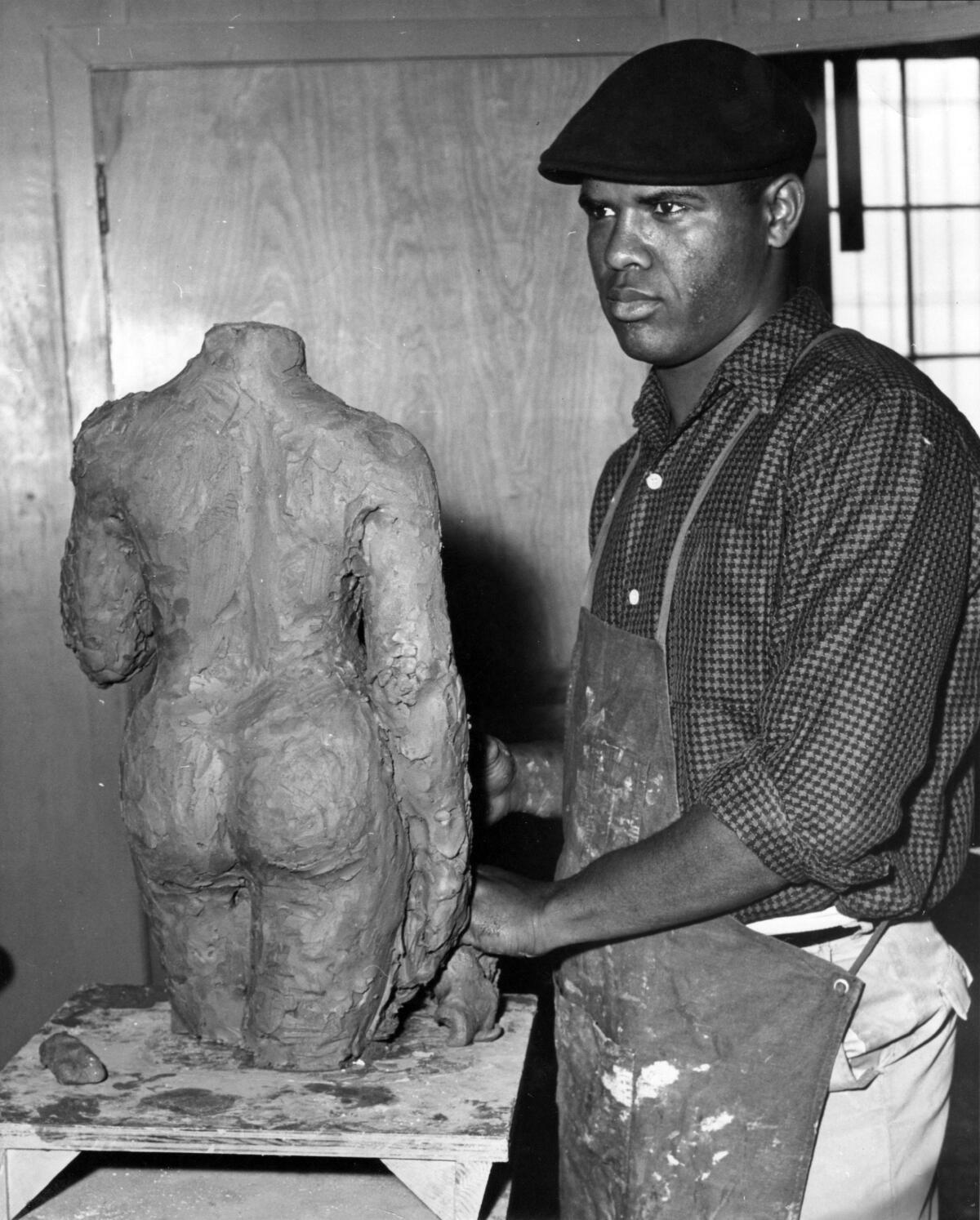
Melvin Edwards, seen here in fellow sculptor Hal Gebhardt’s class at USC sometime between 1959 and 1960, died March 30 at his home in Baltimore.
His artistic career began while studying art on a football scholarship at USC, where he met and was mentored by Hungarian painter Francis de Erdely. Edwards’ L.A. roots were critical to his identity as an artist. Here, he began experimenting with welded steel, which became his primary medium.
After moving to New York City in 1967, he became, in 1970, the first African American sculptor to have a solo exhibition at the Whitney Museum of American Art.
Throughout his career, Edwards remained committed to public art, creating sculptures for universities, public housing projects and museums around the world.
Those who knew him described him as overwhelmingly positive, which shaped both his work and his relationships.
“Melvin’s community of artists was remarkable because it spanned the globe. You could spin a globe, land anywhere, say the name of the country or the city, and he would know three people there, minimum,” said Gray. “He could recall a conversation he had with a person 35 years ago without any hesitation. He had an incredible constellation of people that he was surrounded by.”
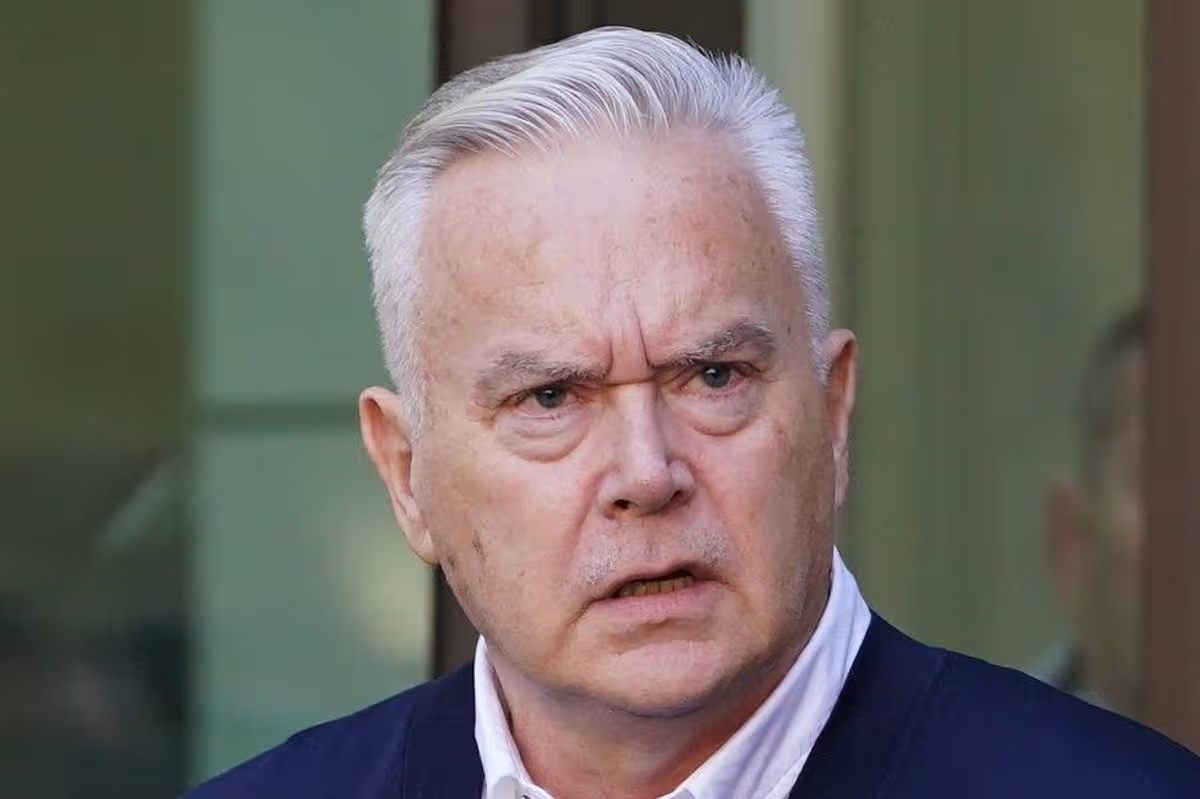
Huw Edwards has said he will ‘challenge the misleading or fabricated’ claims surrounding him after he pleaded guilty to making indecent images of children
Daniel Bird Assistant Celebrity and Entertainment Editor
12:22, 02 Apr 2026Updated 12:33, 02 Apr 2026
Huw is plotting his next move(Image: PA)
Huw Edwards vows to “challenge” claims about himself. The disgraced BBC News anchor will “challenge the misleading or fabricated claims” made in recent coverage, and will “produce my own account”.
Edwards was one of the BBC’s highest-paid newsreaders, known for presenting the BBC’s News At Ten for decades, before pleading guilty to making indecent images of children in July 2024.
He was handed a six-month prison sentence, suspended for two years. Edwards was placed on the sex offenders’ register for seven years after his sentence.
The disgraced broadcaster was offered “naughty” images of somebody described as “ying [sic]”, to which he replied “go on”. Edwards was also the subject of a recent Channel 5 drama about his downfall, starring Doc Martin actor Martin Clunes.
He said in a statement: “Much has been written and reported in the past week following Channel 5’s one-sided account. Other opportunities will arise later this year for me to state my case and to challenge the misleading or fabricated claims made in recent coverage.
“A number of serious questions still remain to be answered, and not just by me. It will now take some time for me to produce my own account, and until then, I do not intend to comment any further.” It is understood that Edwards intends to make his own documentary or podcast series about the events.
Edwards previously claimed the production company behind the 5 drama, Wonderhood Studios, failed to check the “truth” of the narratives shown in the series, relating to allegations made by The Sun in July 2023, which claimed that a “top BBC star” paid a teenager more than £35,000 for sexual pictures.
Days later, Edwards’ wife named him as the presenter at the centre of the scandal. He resigned from the BBC in April and was charged in June 2024 following a Metropolitan Police investigation.
In a previous statement, he said: “[They] made no attempt to check with me the truth of any aspect of their narrative before going ahead with the production. They belatedly asked for a response after the drama had been made, while reserving the right to edit any such response. They also refused to disclose whether any of those making allegations had been paid for their contributions. Channel 5’s ‘factual drama’ is hardly likely to convey the reality of what happened.
“My deep regret and remorse for the crimes I committed were expressed in court. In pleading guilty at the earliest opportunity, I took full responsibility for my reprehensible actions. I am repelled by the idea that some people enjoy viewing indecent images of children. Every image represents an innocent victim. I offer my sincere and profound apologies for what I did.
“I am making an effort to produce my own account of these terrible events. This is a slow process, given the fragile state of my health. have been open about my struggle with persistent mental illness over a period of 25 years. What is less well known is the severity of that condition, which was managed successfully until the downward spiral which led to an appalling outcome.
“Mental illness is misunderstood by many, but can never be an excuse for criminality. It can, however, at least help explain why people sometimes behave in shocking and reprehensible ways, and why things fell apart for me in the way they did.”
A previous statement from Channel 5 said: “Power: The Downfall Of Huw Edwards is based on extensive interviews with the victim, his family, the journalists who revealed his story, text exchanges between the victim and Edwards, and court reporting.
“It has been produced in accordance with Ofcom’s Broadcasting Code. All allegations made in the film were put to Huw Edwards via his solicitors six weeks before transmission.”
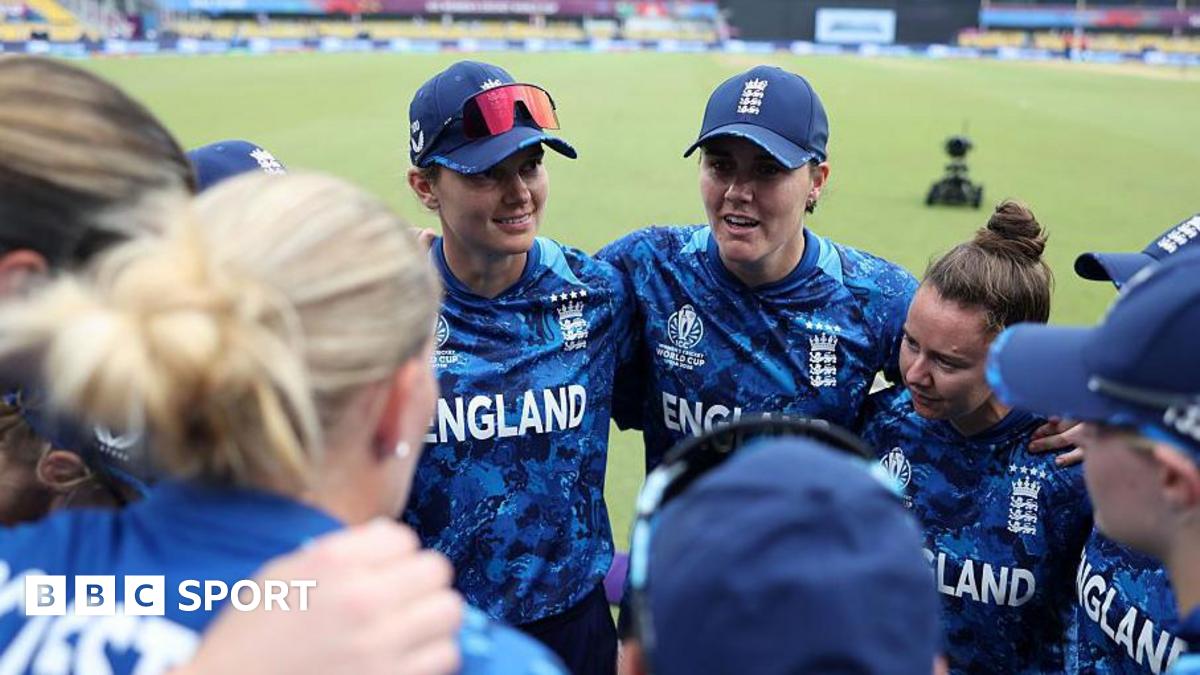
England head coach Charlotte Edwards says her players have categorically addressed the issues surrounding their fitness.
The physical condition of England’s players was a hot topic of debate before Edwards’ appointment.
England’s early exit from the Women’s T20 World Cup just under 18 months ago prompted former spinner Alex Hartley to say some players were “letting the team down” in terms of fitness.
Athleticism again came into focus during the Ashes in January 2025, and former coach Jon Lewis attributed it to a cultural difference between the UK and Australia.
When asked on a BBC Test Match Special debate show if the fitness issue had been put to bed, Edwards responded that it “100%” had.
“We’re in a really good place. The results are all so high. I couldn’t be more chuffed – we’ve made real progress,” Edwards said.
“It’s not just all about whether you can run round a track. It’s all the other elements to it that we’ve tried to make just as important.”
Edwards will celebrate a year in charge of England, who host the T20 World Cup this summer, on Wednesday.
The 46-year-old said the introduction of specific benchmarks relating to fitness have had the desired impact.
“I think once you set out the expectation, the players know what they need to do. And we’ve added in sort of benchmarks over the winter,” Edwards added.
“We’ve got to keep raising the standard. The players have fully bought into that, which, that was, I guess what I set out to do and am really pleased with the buy-in.
“I don’t know if anyone watched the fielding from the recent [intra-squad] series, but it’s some of the best fielding I’ve seen, certainly from our group, the improvements we’ve made.”
Watch the full debate about England’s women’s team on BBC iPlayer or listen to it as a podcast on BBC Sounds.
Huw Edwards, the lead presenter of BBC News at Ten for 20 years, was spared jail at Westminster Magistrates’ Court after pleading guilty to three charges of making indecent images of children
01:54, 26 Mar 2026Updated 02:05, 26 Mar 2026
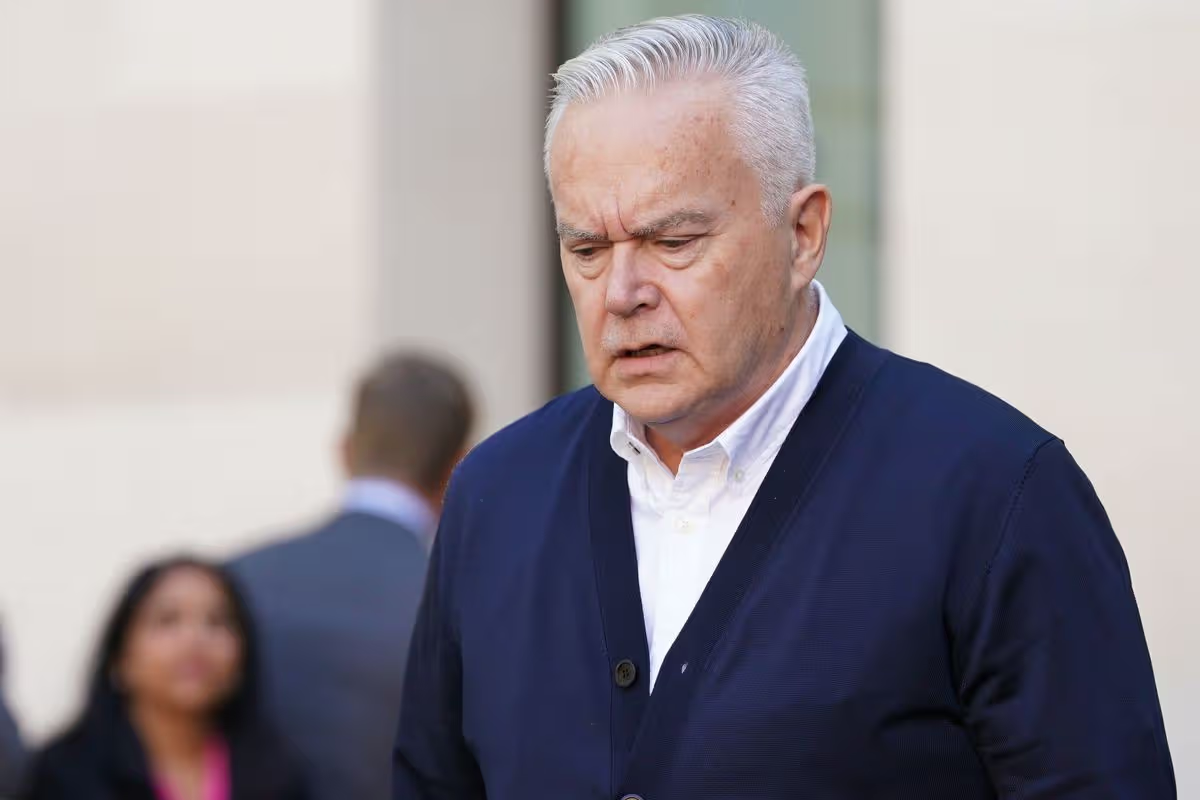
Huw Edwards is pictured leaving Westminster Magistrates’ Court after he was spared jail(Image: PA)
Furious viewers have blasted Huw Edwards’ “disgraceful” sentence after a shocking TV drama detailed his crimes.
The shamed broadcaster, 64, was spared jail despite admitting three charges of making indecent images of children. His case was explored in Channel 5’s Power: The Downfall of Huw Edwards on Tuesday night, in which Martin Clunes played the presenter.
The 90-minute programme showed how Edwards groomed a teenager, paying him for sexual photos and videos. After it was broadcast, one viewer said: “First time in ages I flicked on terrestrial telly — and wow, it laid bare exactly what a monster he was.” Another summed up public anger by adding: “He should be watching this behind bars.” A third viewer said: “His sentence was disgraceful, considering what a sick creep he was.”
Nearly two million people tuned in to see Clunes, 64, portray the broadcaster, who had a vile double life. He was praised for his “compelling” and “career-defining” performance.
“I don’t get why Huw isn’t in prison. He needs to pay for what he’s done. It’s fact,” one viewer posted on X, which was known as Twitter. Another on the platform said: “Watching Power. Martin Clunes is excellent but it’s very uncomfortable viewing. How did Huw Edwards escape prison?”
Katie Jones, a mum who watched the show, wrote online: “I watched simply because I wanted to understand why NO jail time for EDWARDS. Was it cos he claimed to be suffering from a mental breakdown? It’s a must watch — difficult subject told well.” A shocked viewer agreed: “He should have been jailed. He’s a paedophile. He’s not sorry.”
Edwards paid a troubled teenager thousands of pounds, which the lad spent on drugs. The youngster was played by Emmerdale actor Osian Morgan. Osian, who was also in Waterloo Road in 2023, was praised for his acting in the harrowing drama.
Father-of-five Edwards was charged after the arrest of another paedophile, Alex Williams, who had sent him 377 images via WhatsApp. Westminster Magistrates’ Court the star, who was the lead presenter of BBC News at Ten for 20 years, sent 41 indecent images of children, some showing a victim aged between seven and nine.
Child protection charities have slammed the sentencing. Emma Hardy, of the Internet Watch Foundation, said: “We must never forget children are at the heart of this story — children who have suffered, and who suffer again each time imagery of them at their most vulnerable is reshared.
“Perhaps most worryingly, there is nothing to stop this happening again. WhatsApp, and other apps which use the extreme end-to-end form of encryption, are still failing to prevent the upload of known child sexual abuse imagery.
“While some platforms are now choosing not to use this kind of encryption because of safety fears, there remain whole swathes of the internet where this dangerous and illegal content can still be shared undetected and unopposed. The tools to help stop the next Huw Edwards are here, they work, and they do not impact on individuals’ privacy. It’s time to use them.”
Power: The Downfall Of Huw Edwards tells the story of the presenter’s fall from grace
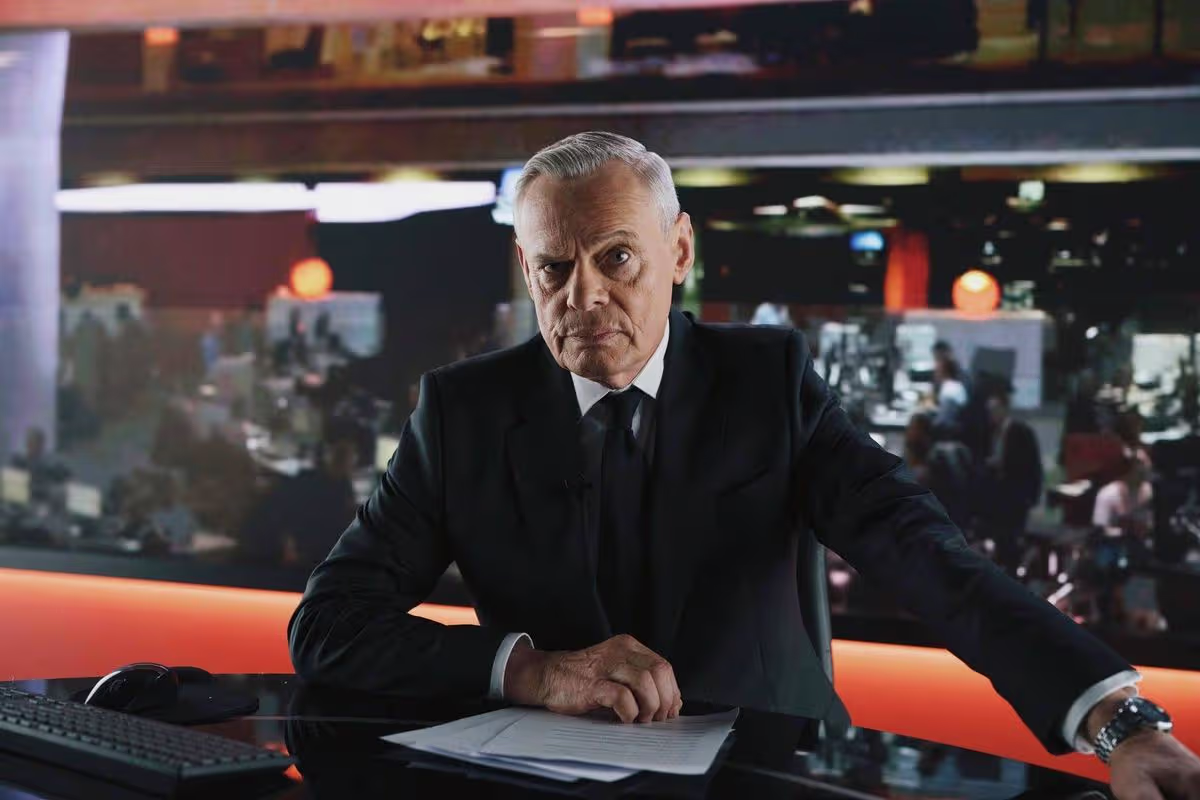
Martin Clunes plays Huw Edwards in the drama(Image: PA)
Channel 5 viewers have called a new programme about former BBC newsreader Huw Edwards a “hard watch”.
Power: The Downfall Of Huw Edwards – starring Martin Clunes in the main role – chronicles the events leading to the presenter’s conviction for making indecent images of children. He was found guilty in 2024, and received a six-month prison sentence, which was suspended for two years.
The drama aired on Channel 5 on Tuesday (March 24), centring on Edwards’ alleged interaction with a 17-year-old. The teen, given the fictional name ‘Ryan’, is portrayed by Welsh actor Osian Morgan.
Moments after it began, viewers started posting comments on social media stating that it made for “uncomfortable” viewing, reports Wales Online.
“5 minutes in and can already tell this will be a thoroughly uncomfortable watch,” one viewer posted on X. Another individual admitted they were “already creeped out”.
“Not even halfway and I feel nauseous,” another person shared on the platform, formerly known as Twitter.
“Already creeped out when he calls him ‘baby’,” commented another viewer, whilst someone else confessed they were “speechless” watching the story unfold.
“I’m normally quite hardened to these sorts of dramas but honestly this Huw Edwards programme on 5 is a heck of an uncomfortable watch,” another viewer expressed.
“It’s a hard watch,” concurred another, as one viewer admitted they were turning off.
“I tried watching Power but it’s so grim that I’ve switched over to a repeat of Simon Schama’s History of Britain,” they shared.
“That’s it I have had to turn off this Huw Edwards programme,” said someone else.
Another viewer described the programme as feeling “dark and ominous”.
Numerous viewers also commented on Martin’s depiction of the former newsreader, saying he “nailed it”.
“Clunes is playing a blinder as Huw Edwards,” one individual remarked, whilst another added: “Martin Clunes is giving a career-defining performance. A disturbing, but compelling, portrayal of Huw Edwards.”
“Clunes is really pulling this off,” observed another, with someone else stating that the Doc Martin star’s performance was an “absolute tour de force”.
“Martin Clunes is formidable in his portrayal of Huw Edwards,” praised another impressed viewer.
Power: The Downfall Of Huw Edwards airs on Channel 5.
Fabian Edwards’ wait for a world title goes on after he loses against Costello van Steenis, who successfully defends his PFL middleweight title with a third-round knockout in Madrid.
Huw Edwards touted himself as a bastion of righteousness and good but behind closed doors he led a depraved double life that destroyed the lives of those around him
17:41, 19 Mar 2026Updated 18:04, 19 Mar 2026
The alleged texts have been revealed in a new TV drama(Image: Lucy North/PA Wire)
Huw Edwards presented himself as the trusted voice of the nation, but off-screen he lived a secret life of depravity.
Married for 31 years, the Welsh BBC newsreader was welcomed into homes each night and anchored some of the country’s most seismic events – including the death of the late Queen Elizabeth. He reported on downfalls, scandals and abuses of power. But little did viewers know that he, too, was guilty of his own trangressions.
It started with a report in The Sun alleging he had paid a you for sexual pictures. The Met Police investigated but found no evidence of crime. Then came accusations that he inappropriately messaged a freelance journalist, a sixth-form student and other staff at the BBC. Finally, he was arrested after police learned indecent images of children had been sent to his phone by convicted sex offender, Alex Williams. He pleaded guilty to three counts of making indecent images of children and was given just six months imprisonment, suspended for two years, with a requirement to complete a sex offender programme.
Slowly, a picture began to emerge of a middle-aged man who became obsessed with social media and its ability to bring him both adoration and sexual connection with men and women. As his wife Vicky Flind struggled to care for her ailing mother, Edwards – who was described as a ‘volatile’ man with a ‘history of agitation’ – instead looked to his phone for cheap thrills.
In a report, Dr Appleyard, a Forensic Psychosexual therapist, told a September 2024 court hearing: “His social media engagement presented as an easy way to manage his low mood and provided him with a number of men and women who were motivated to be sexual with him which not only boosted his fragile self esteem but allowed him to re-engage with his sexual interest in men which had been managed since 1994.
“The feelings of being desirable and unseen alongside Mr. Edwards’ unresolved sexual orientation created a perfect storm where he engaged in sexual infidelities”
Now, the sordid saga is being retold in Channel 5 drama, Power: The Downfall Of Huw Edwards. Martin Clunes stars as Edwards, and executive producer Sam Anstiss has compared reading the raft of text messages sent by Edwards to “going into the heart of darkness.”
“Because here in these messages was, in the most visceral, disturbing way, a very imbalanced relationship of power. They were so disturbing. It was, ‘I love you, but you kill me’,” she told The Sun.
Here, the Mirror explores the damning texts Edwards allegedly sent…
The young man, now aged 23 and who wishes to remain anonymous, says he feels like Edwards, 64, ‘groomed’ him after they first connected in 2020. At first, Edwards was not named publicly, but within days his identity was revealed by his wife and he was admitted to hospital due to serious mental health concerns.
The man said he was in a very troubled state of mind when he first contacted the television newsreader. Having fallen out with his mother and step-father, he was sleeping on friends’ sofas and had spent a few nights at a homeless shelter, which he described as ‘scary’. He began sending messages to famous people asking for help. He was in a burger bar in Cardiff when he happened to see Edwards on the TV, so decided to message him on social media.
Edwards was the only person to reply to any of the messages. The man said he didn’t ask for money, but Edwards deposited £500 into his PayPal account, which went towards hotel costs for a few days. The man told the Mirror: “Although it was a friendship at the beginning, it did change. He would say things like, ‘Are you going to do something for me then?’ I needed help, so I did. I feel like he sort of fed on my vulnerability… as he knew I needed the money. I felt like I was being groomed.”
Messages seen by The Sun and shared in its documentary, Huw Edwards: Unmasked, are harrowing reading. In one, he allegedly says, “I want a pic of you totally naked head to toe.” After transferring the fan £2,000, he then rages after receiving only a picture of the young man’s naked top half.
“F*** that. F*** that. Really not impressed by you. I believed you were serious. But you’re not. You chase me for cash. But you then ‘forget’ to deliver. F*** that,” he wrote, according to the publication.
After paying for the young man’s train ticket to London, he allegedly teased: “Then you really would owe me.” But the texts take a dark turn. On New Year’s Eve 2022, the documentary states that he sent a string of abuse to the man. “Stop being a kn*b and talk to me tomorrow when you’re sober.”
“Now listen to me. If you want help in future stop this cr*p OK,” he is said to have raged. “You’ve disappointed me… I regret helping you so much… I should have known… You should know better.”
In the February, the film claims that Edwards unleashed another tirade on the young man after worrying that his payments for sexual images could be exposed. “You’re a disaster area,” he is said to have raged. “Why does this happen all the time??!??… Im with family stop being a pain… I’m sick of you getting into a mess all the time… Don’t be stupid… My Monzo is easily traceable. I can do PayPal nothing else.”
“You are really really really trying my patience,” he allegedly continued. “I don’t need this f***ing sh*t… Delete these messages if it’s not your phone OK???… Send me your Monzo details you idiot… You make me so angry… WTF you talking about you f***ing disaster… Go f**k yourself. Get f***ing real. Tell you what. I’ll stop helping you then you can see what no care is. F**k you. You’re an ungrateful t**t.”
Edwards then seemingly softens, apparently adding: “I f***ing love you…but you kill me x” and “I love you seriously x… I will never end you. You idiot. You know that. X… Next time in Cardiff you need to see me x… Good boy… Don’t forget. I love you x”
But there was yet another alleged outburst after the young man called him in the night. “I can’t trust you to respect my situation,” the News at 10 anchor reportedly fumed. “Now leave me alone. Actually calling me at 2am? F**k that. Calling me at 2am even when I told you to stop ?????? You’re so f***ing out of order. Grow up. Just grow up. And when someone helps you – show respect.”
The man told The Mirror how Edwards messaged on an unknown number In October just one month before he was arrested – but was left “staggered” by his reaction. The man said: “I think it was about two weeks before he got arrested. The message said ‘guess who’ or something like that.
“The message said ‘don’t say my name on here… just call me’. So I phoned him and he said download the messaging app Signal. And he said we can catch up on there.” The man said he was staggered by Edwards’ demeanour on the call, adding: “He said, ‘What’s been going on? I really care about you’. He had no remorse for anything at all.”
It was the final time they spoke. A month later Edwards was arrested over the indecent images on his phone in an unrelated case. He stood down from the BBC in April 2024.
‘Strange messages to journalist’
The Express’ assistant politics editor Sam Stevenson has shared his experience of a message exchange with Edwards.
When Sam started his journalism career five years ago, he was keen to make contacts and keep up-to-date with the rolling news cycle. His first port of call was to follow as many “leading industry figures” as he could on Twitter, now X. He said he wanted to follow those he “respected” and “hoped to one day emulate”.
Sam claimed that within minutes of following Edwards, he was followed back “much to his delight”. He stated that he “couldn’t have been more thrilled” to have “perhaps the most famous news anchor in Britain” acknowledge him. Edwards is said to have sent Sam a message just “seconds later”.
It reportedly read: “Latecomers are welcome, Sam” followed by a praying hands and a yellow smirking face emoji. Sam recalled being on holiday at the time and excitedly sharing the news that Edwards had sent him a direct message to his family. He admitted to wondering why “a high-profile celebrity 32 years my senior, with almost 200,000 followers versus my measly 1,000, want to speak to me”.
Sam replied: “Haha, thanks for the follow, Huw! Big fan of your work” alongside a thumbs up emoji. Edwards is said to have reacted to Sam’s message with a thumbs up emoji and added: “Thanks, Sam. Keep in touch. H.”
Writing in the Express, Sam said: “At that moment, I was not sure what to make of it. My immediate thought was what an excellent new contact I had just made. But, knowing what we do now, perhaps the reality was something more sinister. On reflection later that day, it was clear from his playful and casual manner, the coquettish nature of his initial message, the liberal emoji use, the over-familiarity coming seemingly at random, and the plea to ‘keep in touch’, that something was off.”
Sam admitted to feeling “somewhat uneasy” that the “playful tone” had “came from somebody who was so well-respected”. He said: “It did not feel right. Then, the penny dropped. Huw Edwards, the Huw Edwards, was privately flirting with me. Looking back, it makes my blood run cold.” The journalist ended by writing: “For my part, I am relieved I managed to avoid him. Others were not so lucky.”
Sixth-form student ‘exchange’
Welsh TV channel SC4 launched its own investigation into the scandal and interviewed a young man who said he met Edwards while he was performing in a concert. He was an 18-year-old sixth-form pupil and Edwards was the compere.
“I was in my school uniform. He came up to me at the end of the concert and said hello, that the performance was really good. He told me I was very talented. He was interested to have some sort of contact with me,” the student claimed. “He told me if I wanted to come to London to meet him, he could give me a tour of the BBC and maybe meet a couple of musical contacts.”
The pair connected on Instagram and the teen travelled to the London to visit the BBC but began to suspect that Edwards’ intentions were not admirable. In messages shown by the channel, Edwards signed off messages with a kiss or a heart. In one, Edwards wrote: “Yeah, OK big boy, we believe you.”
“I think it’s clear he was trying to groom me, trying to pull me in,” the young man said. After a few months, however, Huw stopped answering his messages and stopped following him. “He just lost interest in me, I wasn’t giving him what he was looking for,” the student added.
Junior BBC employee ‘sickened’
Victoria Derbyshire shared details about how an ex junior staffer – whose story featured on Newsnight – “felt sick” upon hearing Edwards had child sexual abuse images on WhatsApp. According to Derbyshire, the former employee was in their mid 20s when Edwards allegedly messaged then on Instagram.
Posting on her X account, Derbyshire wrote: “Here’s what they told me IN FULL today: Huw Edwards messaged me on social media several times, despite us having never met and not knowing each other. Many of these messages were clearly inappropriate, including telling me unprompted what he was doing in the early hours of the morning, asking that I take him for food, and including several kisses at the end of his messages. I was quite junior in the BBC at the time, so just tried to play them off and not pay too much attention to them.
“At the time I was confused as to why he was sending such messages to me, but I had heard stories of other younger employees in the BBC having similar experiences with him. That is why I first got in touch with Newsnight: when the original Sun story came out, I felt like the extent of this inappropriate behaviour was likely more widespread than I knew. I didn’t contribute to the subsequent internal BBC inquiry, mostly as I felt I had already come forward and told the important parts of my story to Newsnight and was very busy at the time. It was not because of a lack of trust in the BBC.
“I didn’t report the inappropriate messages at the time when I was working at the BBC, mostly because I had other important things going on in my life that year, not because of a lack of confidence over the efficacy of raising such concerns.”
The anonymous employee claims he had initially connected with Edwards on Instagram before switching to WhatsApp, where he says they sent hundreds of messages between April 2021 and August 2022.
The reporter claimed that when told he lived in a house-share, Edwards said: “So I could pop in to have some tea?” and a few days after the funeral, he tried again, suggesting, “‘Or I can come to yours.”
On the eve of the funeral – where the late Queen was forced to mourn her husband alone because of Covid restrictions – Edwards allegedly sent him a picture of his hotel room, featuring just one bed, with the caption: “Missed a good night. You could have stayed here.”
The BBC worker told the Daily Mail: “He sent me a picture of his hotel room. I felt it was very suggestive. There were lockdown restrictions at the time. The Covid rules about households not mixing were still in force, the Queen was all alone on the pews at Philip’s funeral, and then Boris [Johnson] got a hammering for the parties in No.10 – and that was the same night Huw Edwards suggested I stay in his hotel room.