Editorial: Oil, currency surge raises stagflation fears in South Korea

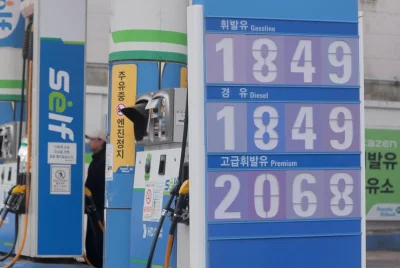
Fuel prices are displayed at a gas station in Seoul, South Korea, 15 March 2026. South Korea implemented a temporary cap system on 13 March to ease soaring fuel prices and reduce the burden on consumers, setting maximum prices for products oil refineries supply to gas stations and distributors. Photo by YONHAP / EPA
March 16 (Asia Today) — This commentary is the Asia Today Editor’s Op-Ed.
International oil prices and South Korea’s currency are rising sharply again as the Middle East conflict intensifies, raising growing concerns that the country could slide into stagflation.
On March 13, global crude prices climbed back above $100 per barrel, while the Korean won weakened beyond 1,500 per U.S. dollar in overnight trading. The simultaneous surge in energy prices and the exchange rate has heightened fears that South Korea could face a worst-case scenario in which economic growth slows while inflation accelerates.
Such developments threaten to derail the government’s economic targets for the year – about 2% growth and inflation in the 2% range – making emergency policy responses increasingly urgent.
Brent crude futures for May delivery closed at $103.14 per barrel, up 2.7% from the previous day. It was the first time Brent crude exceeded $100 since August 2022.
U.S. West Texas Intermediate (WTI) crude futures settled at $98.71 per barrel, approaching the $100 threshold. Meanwhile, Dubai crude, the benchmark most relevant to South Korea’s imports, surged to $123.50 per barrel, up $34.60 from the previous week.
As oil prices surged, investors turned toward the U.S. dollar as a safe-haven asset. The won-dollar exchange rate closed at 1,497.5 won per dollar in overnight trading, up 16.3 won from the regular daytime session. During trading, the rate briefly rose to 1,500.9 won, crossing the psychologically important 1,500 level for the first time in seven trading days.
The twin surge in oil prices and the exchange rate has been driven largely by escalating tensions in the Middle East.
Iran has openly threatened to block the Strait of Hormuz, a critical chokepoint through which about 20% of the world’s crude oil supply passes. Iran’s new supreme leader, Mojtaba Khamenei, declared a prolonged confrontation in his first official statement on March 12, saying Tehran should continue using the possibility of a Hormuz blockade as leverage against the United States and Israel.
Oil prices, which had briefly stabilized after U.S. President Donald Trump suggested the conflict might end soon, surged again following the statement.
Tensions escalated further after the United States launched airstrikes on Kharg Island, Iran’s largest oil export hub, on March 13. Iran retaliated by attacking the Fujairah port in the United Arab Emirates, a key oil-export route that bypasses the Strait of Hormuz, putting global energy supply chains on alert.
Trump has also urged five countries – including South Korea, China and Japan – to dispatch naval vessels to the Strait of Hormuz, pushing regional military tensions to a new peak.
Economic analysts warn the shock could have serious consequences for South Korea’s economy.
The Korea Development Institute (KDI) warned last week that rising oil prices linked to the Middle East conflict would increase inflationary pressure while weakening economic growth.
The Hyundai Research Institute estimated that if oil prices climb to $150 per barrel, South Korea’s economic growth rate could fall by 0.8 percentage points.
The government is considering a supplementary budget of 10 trillion to 20 trillion won ($7.5 billion to $15 billion) and temporary fuel tax cuts. However, these measures would only offer short-term relief.
A more fundamental solution lies in reducing South Korea’s heavy reliance on Middle Eastern crude oil, which accounted for 69% of total imports last year. Diversifying energy sources by expanding imports from countries such as Brazil and Norway should be pursued urgently.
The government must mobilize every available policy tool – including measures to stimulate domestic demand – to prevent what could become the fourth Middle East-driven oil shock from pushing the economy into stagflation.
— Reported by Asia Today; translated by UPI
© Asia Today. Unauthorized reproduction or redistribution prohibited.
Original Korean report: https://www.asiatoday.co.kr/kn/view.php?key=20260315010004332