The Papal presence in Nicaea and the prospective framework of Ecumenical Ecclesiastical Diplomacy
Can a significant and historic presence in Nicaea in commemoration of the 1700th anniversary of the first Ecumenical Council reshape the framework of global Christian dialogue? Pope Leo XIV stands on ground where the first common statement of Christian belief was formed seventeen centuries ago in the context of the first Ecumenical Council. The lake near Nicaea reflects a city marked by long memory. The visit does not seek public spectacle. It seeks depth.
Nicaea holds a rare form of significance. It represents a moment before fragmentation. A point where Christian leaders gathered to agree on the foundations of faith. The Creed shaped in this city became the common reference for churches that later followed separate paths. Modern reporting treats the return to this location as an event that reaches far beyond history.
Catholic analysts describe the entire journey as a platform for structured engagement in regions facing humanitarian risk. Diplomats notice that the visit creates three layers of meaning. The first is theological. The Creed continues to stand as the most stable reference point in the Christian world. It belongs to all. It excludes none. By returning to this shared foundation, the Pope frames dialogue on a level where long-standing differences do not erase the possibility of cooperation. Nicaea becomes neutral ground shaped by memory, not by competition.
The second layer concerns Turkey. The host country receives two ecclesiastical authorities with global reach. This presence allows Ankara to present a profile of stability and controlled engagement. The Turkish state seeks to gain diplomatic value by precisely managing an event of global religious interest. The visit shows that Turkey can provide a calm setting for high-level dialogue. This matters in a region where tensions remain visible and where regional trust is often fragile.
The third layer concerns the Ecumenical Patriarchate. The presence of the Ecumenical Patriarch in Nicaea reflects continuity. The Ecumenical Patriarchate appears as an institution that maintains a steady link to the origins of Christian identity. The visit confirms that this link remains relevant for contemporary diplomacy. The Ecumenical Patriarchate gains space to articulate its role in matters that extend beyond the inner life of the Church. It operates as a voice that connects historical experience with public responsibility.
The papal journey signals a shift in diplomatic rhythm. States often work inside short cycles, shaped by elections, immediate pressures, and shifting alliances. Religious institutions work with longer horizons. Their strength lies in stability and consistent representation. This contrast produces space for initiatives that require patience. Current challenges in Lebanon, instability in the Eastern Mediterranean, and the need to support minority communities demand actors who maintain firm positions without rapid fluctuations. A coordinated presence in Nicaea offers such a foundation.
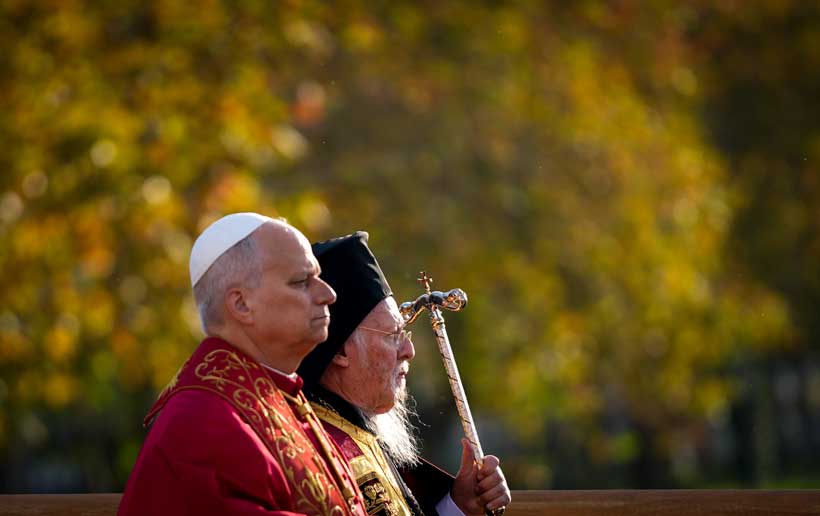
The significance of the visit grows through its simplicity. A prayer beside the lake, a joint statement, and the act of walking together inside the historic city produce a stable message. Cooperation becomes visible without exaggeration. The region gains a moment of calm narrative. Christian communities observe two ancient institutions approaching each other with clarity and restraint. This image contributes to a sense of balance in an environment shaped by uncertainty.
Nicaea becomes a diplomatic space in its own right. It is not an arena of negotiation. It is a site that offers shared memory with no tension. Modern diplomacy often searches for locations that can support conversation without pressure. Nicaea provides this naturally. The city stands outside polarized debates. It holds symbolic value without imposing a political agenda. A papal visit strengthens this character and gives Nicaea renewed relevance in discussions about stability and cooperation.
The effects of this visit may unfold gradually. Joint humanitarian initiatives could gain stronger coordination. Churches may open structured channels for supporting communities under stress in Lebanon, Jordan, and other regions of the Middle East. Dialogue among Christian bodies can develop with greater consistency. States in the Eastern Mediterranean may engage with these institutions in more formal ways. All these possibilities gain substance because the visit gives clear institutional legitimacy to a shared framework.
The return to Nicaea does not promise rapid or dramatic transformation. It shapes a foundation for patient diplomacy. The city provides steady ground in a world where constant crises weaken attention spans. Nicaea speaks through continuity. The visit reminds the international community that institutions with long historical roots can offer stable guidance in periods of instability. This is not nostalgia. It is recognition that durable structures can support fragile societies.
In this sense, Nicaea gains a renewed voice. The city becomes a reference point for future cooperation. The Papal presence demonstrates that sacred geography can still influence public life. The visit marks a shift toward long-range planning where values and institutions act together. It suggests that global dialogue benefits from places where memory and responsibility meet without conflict.
Nicaea does not present solutions. It provides a framework where solutions become possible. For contemporary diplomacy, this may be its greatest contribution. A quiet moment becomes a stable foundation. A historic city becomes a modern point of connection. And a visit shaped by restraint becomes a clear signal that cooperation can grow from shared origins, even in a complex and fragmented world.