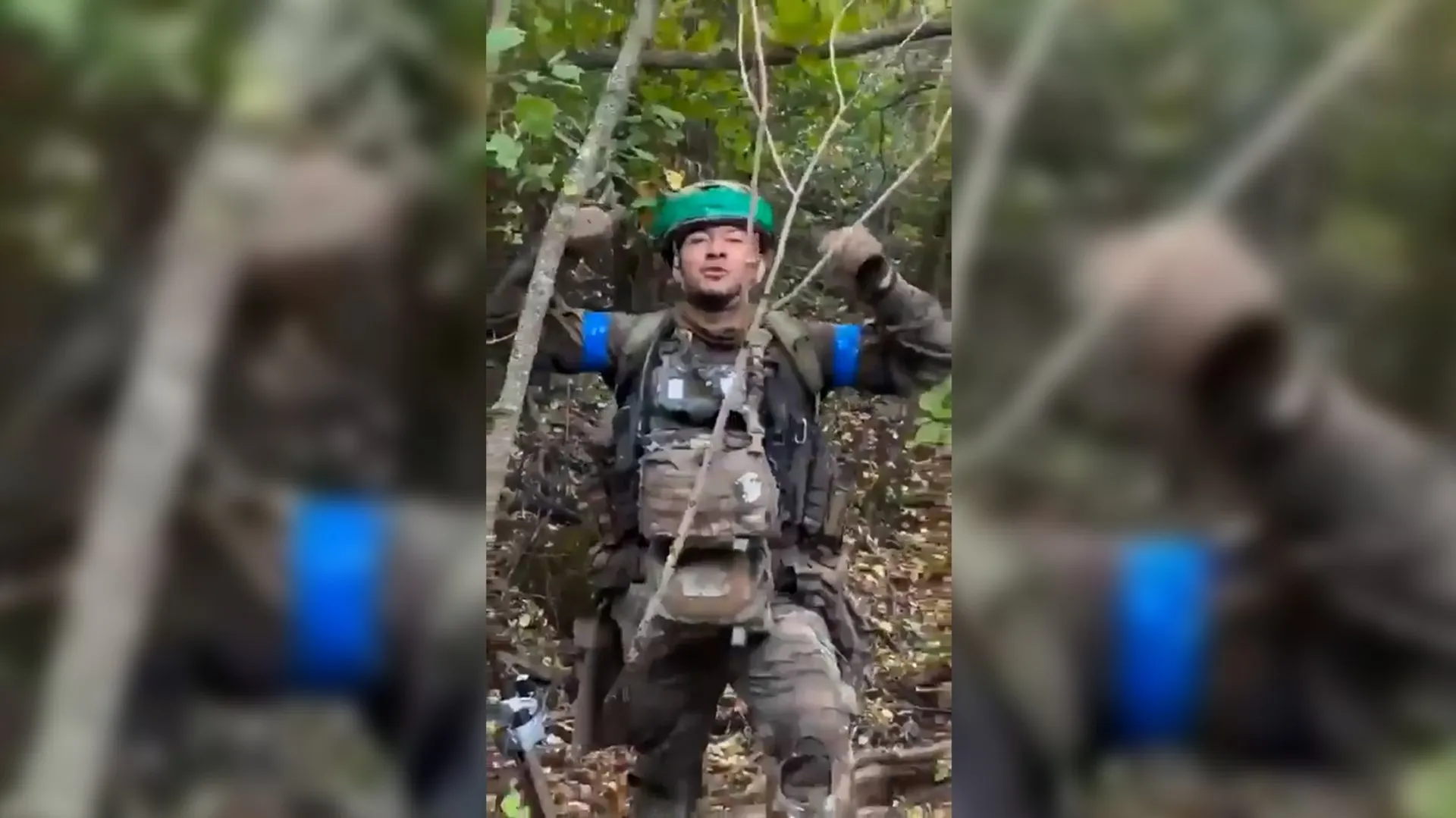
Mexico is investigating a viral video said to show mercenaries chanting drug cartel slogans in Ukraine. President Claudia Sheinbaum announced the inquiry. Mexico previously warned Kyiv cartel members were joining its International Legion to gain drone warfare experience.
Colombian President Abelardo De La Espriella has emerged as close ally the of Trump administration in South America.
Published On 26 Sep 202626 Sep 2026
The Colombian government has extradited an alleged drug trafficking leader to the United States, part of a shift in the country’s security policy into greater alignment with Washington.
President Abelardo de la Espriella announced on Friday the extradition of Geovany Andres Rojas, who is accused of leading an organisation formed by previous members of the FARC rebel group.
Recommended Stories
list of 3 itemsend of list
“You don’t build peace by protecting narco-terrorists like this bandit,” de la Espriella said after he personally oversaw Rojas’s transfer to the US. “I ask US authorities … that he cannot negotiate deals that will leave his crimes unpunished.”
De la Espriella’s left-wing predecessor, Gustavo Petro, shielded Rojas from extradition in order to use him as a mediator in talks between the government and armed and criminal groups, which Petro sought to rein in through negotiations rather than military confrontation.
The far-right president has tossed out that approach, promising to crack down on groups that split off from the former FARC rebel group following a peace deal with the government in 2016. Many of those groups have jostled for control over lucrative drug routes and illicit industries.
Rojas, also known as “the Spider”, was flown to California and placed in the custody of federal agents. He allegedly served as the commander and spokesperson of Comandos de la Frontera, a group associated with cocaine trafficking in the Colombian province of Putumayo that borders Ecuador and Peru.
He will face drug trafficking and terrorism charges in the US, which has sought to expand military operations across Latin America under the pretext of combating crime and drug trafficking during President Donald Trump’s second term in office.
Colombia’s new president has aligned himself closely with those efforts, scrapping peace talks and launching military operations against armed groups since taking office in August.
The New York Times reported that de la Espriella, a former defence lawyer, was previously investigated by US authorities over his ties to powerful drug traffickers, but never charged, and defended politicians linked to right-wing paramilitaries.
Rights groups have warned that a return to militarised confrontation could lead to rights abuses by government forces and an escalation in violence, but many Colombians have expressed support for a harder hand against criminal groups whose operations have often led to violence and mass displacement of civilians.
US-led anti-cartel alliance backs sanctions against crime groups after Trump urges stronger action.
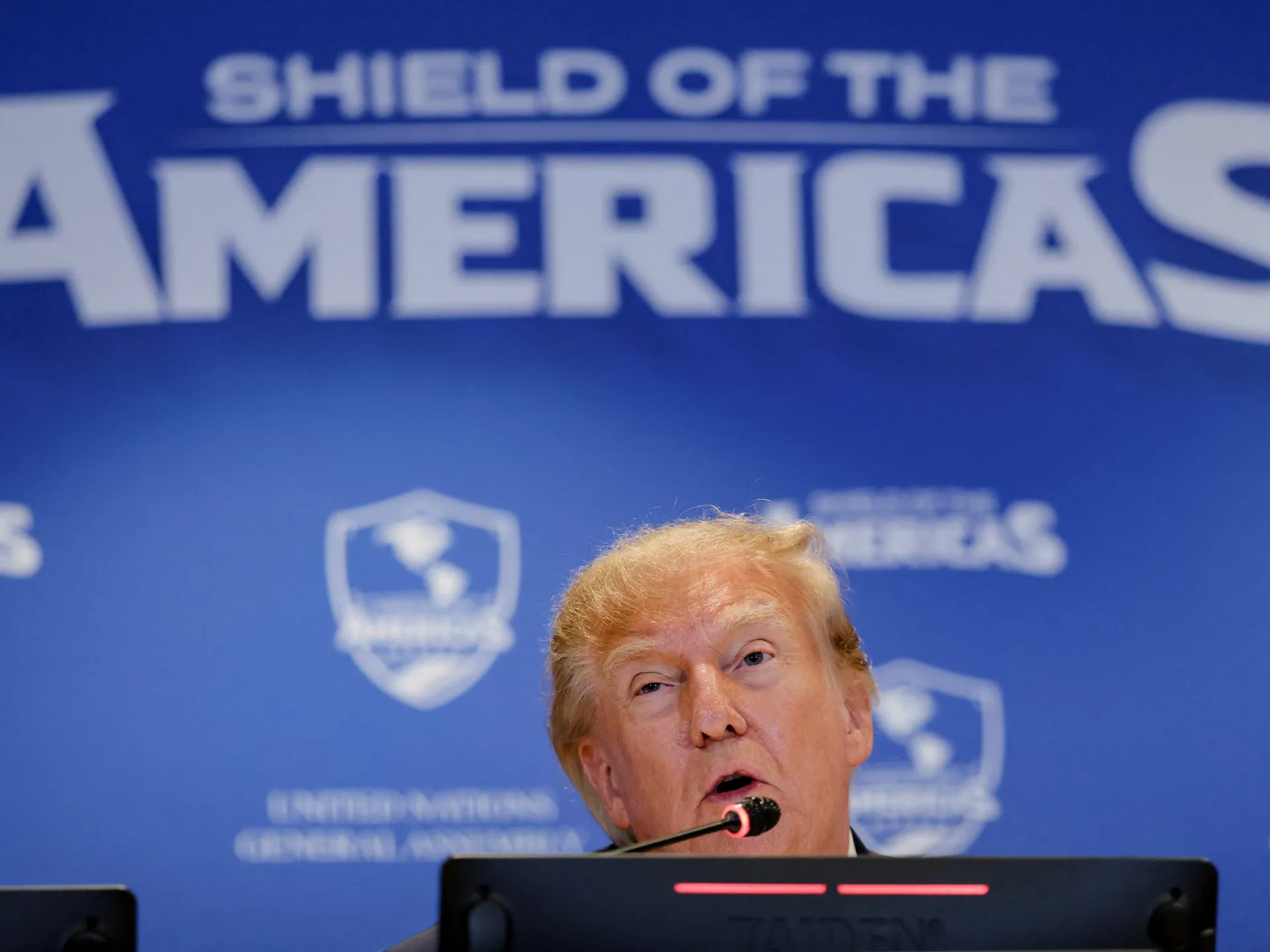
United States President Donald Trump has pledged to use “unmatched military might” against drug cartels in the Western Hemisphere during a meeting of the Washington-led Shield of the Americas coalition in New York City.
In a meeting with leaders and foreign ministers from the anti-cartel alliance, Trump on Tuesday urged member countries to join the US in targeting 24 criminal organisations, which he earlier described as the “ISIS of the Western Hemisphere”.
Recommended Stories
list of 3 itemsend of list
He said he was asking “all nations in the Shield of the Americas to formally designate narco-terrorists as common threats to stability and apply crushing sanctions” against all of the groups. The meeting took place on the sidelines of the annual United Nations General Assembly (UNGA) in New York City.
The coalition’s 15 governments later issued a joint statement saying they intended to impose asset freezes and visa restrictions on members and supporters of the groups and to pursue criminal charges against them.
At the top of the list are two groups that have been declared “terrorist” organisations by Washington: Mara Salvatrucha (MS-13) – one of Central America’s most powerful criminal gangs – and Tren de Aragua, a Venezuelan gang that is also active in Colombia, Peru and Chile.
The list also includes major Mexican cartels, Colombian armed groups such as the National Liberation Army, Brazil’s Primeiro Comando da Capital and Comando Vermelho groups, and Peru’s Shining Path.
Al Jazeera’s Alessandro Rampietti, reporting from Bogota, Colombia, said the statement was largely symbolic for now, because each country must follow its own legal procedures.
“For example, here in Colombia, it will require a law to pass in Congress. We understand that the government here has asked Congress to move forward in drafting such a law. So while the consequences may not be immediate, this is clearly an important step towards building what the US has been trying to do in Latin America [through] this alliance,” he added.
The coalition is made up of governments closely aligned with Trump, including Argentina, Ecuador and El Salvador, whose leaders he has praised or endorsed. Colombia and Peru joined after Trump-aligned presidents took office in recent months.
Brazil and Mexico have not joined.
US Secretary of State Marco Rubio, who also attended, praised “the emergence of strong leaders who are committed to the challenge of taking on transnational terrorism”.
The gathering was the administration’s latest effort to rally the region behind a more aggressive approach to drug trafficking. Since returning to office last year, Trump has designated cartels as foreign terrorist organisations and ordered dozens of strikes on boats in the Caribbean and eastern Pacific that US officials say were carrying narcotics bound for the US.
The strikes have killed more than 223 people, and UN experts say they violate international law and could amount to crimes against humanity.
The Trump administration’s National Security Strategy, released late last year, laid out plans for a revamped Monroe Doctrine, the 19th-century policy asserting US primacy in the hemisphere that critics associate with decades of US intervention.
Trump has also spoken of retaking the Panama Canal and annexing Greenland and Canada. On Tuesday, he signed an agreement on Greenland that stopped short of his demand that the island become US territory.
The focus on the hemisphere has raised concerns across the region.
Brazilian President Luiz Inacio Lula da Silva, in his UN speech, bristled at the approach, warning countries in Latin America and the Caribbean of “renewed hegemonic temptations”.
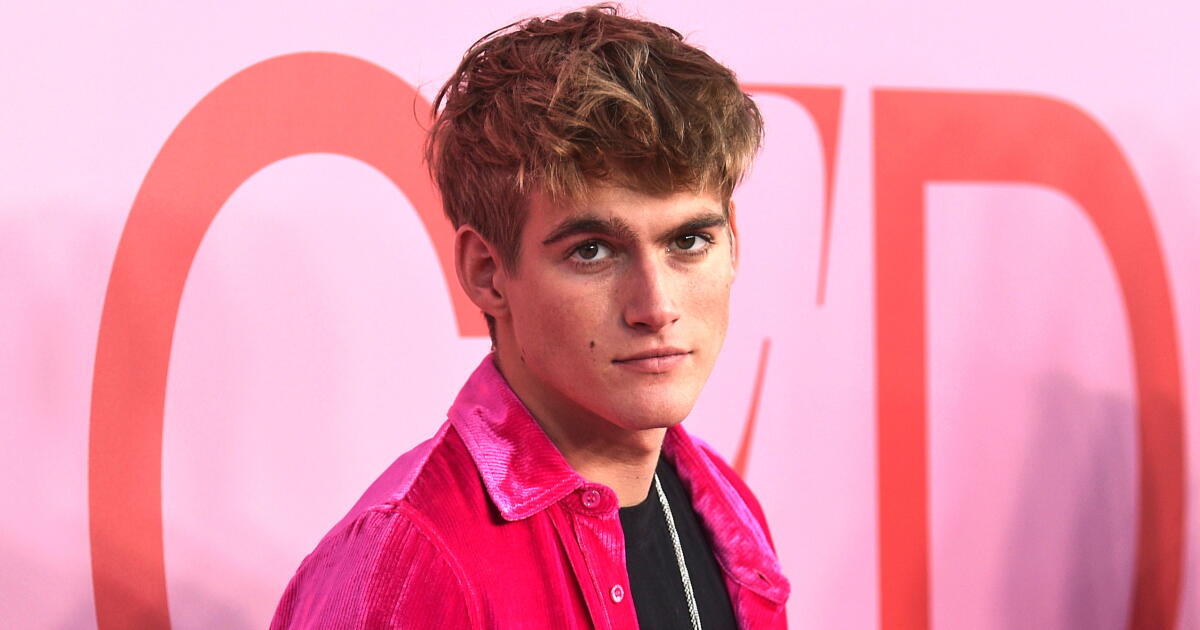
Dispatch calls reveal supermodel Cindy Crawford’s son, Presley Gerber, who died Sunday, suffered an apparent overdose while staying at a luxury outpatient rehab facility.
After Santa Monica police received a call reporting a cardiac arrest and another call for an overdose, officers responded to Resolutions Living, a $7.7-million, seven-bedroom mansion that operates as a rehabilitation home, at about 9:35 a.m., a law enforcement source told The Times.
Paramedics pronounced Gerber dead at 9:45 a.m. Sunday. The onetime Calvin Klein model had checked into the facility just hours before, around 10 p.m. Saturday.
On Monday, the L.A. County medical examiner’s office said that it was in the early stages of investigating the 27-year-old model’s death and that limited information was available.
An autopsy was performed Monday, but the cause and manner of death have been deferred, “which means additional testing and/or studies were requested in order to make a determination.” Due to the ongoing investigation into Gerber’s death, the medical examiner’s office cannot disclose what testing and/or studies were requested.
It could take a few months for a cause of death to be determined, the statement continued.
Police say that, at this time, there is no indication of foul play, but they are also investigating Gerber’s apparent overdose. According to the law enforcement source, police are attempting to track where and whom the drugs came from.
According to Resolution Living’s website, it operates as a partial hospitalization and intensive outpatient program for the treatment of myriad mental health issues, including depression, trauma and addiction, and offers dual diagnosis treatment for co-occurring disorders.
Gerber had been candid about his mental health struggles for years through various podcast appearances and his social media, and revealed that he’d sought treatment through various rehab facilities from the time he was a teenager.
In 2023, he told “Studio 22” podcast that he wanted to use his own experience to help others battling the same issues.
“Having struggled with mental health, depression and some other things that come along with that,” he said, “I think that whether I help one person or 100 people get out of that place that I was in at one point in my life, that’s all I need to do.”
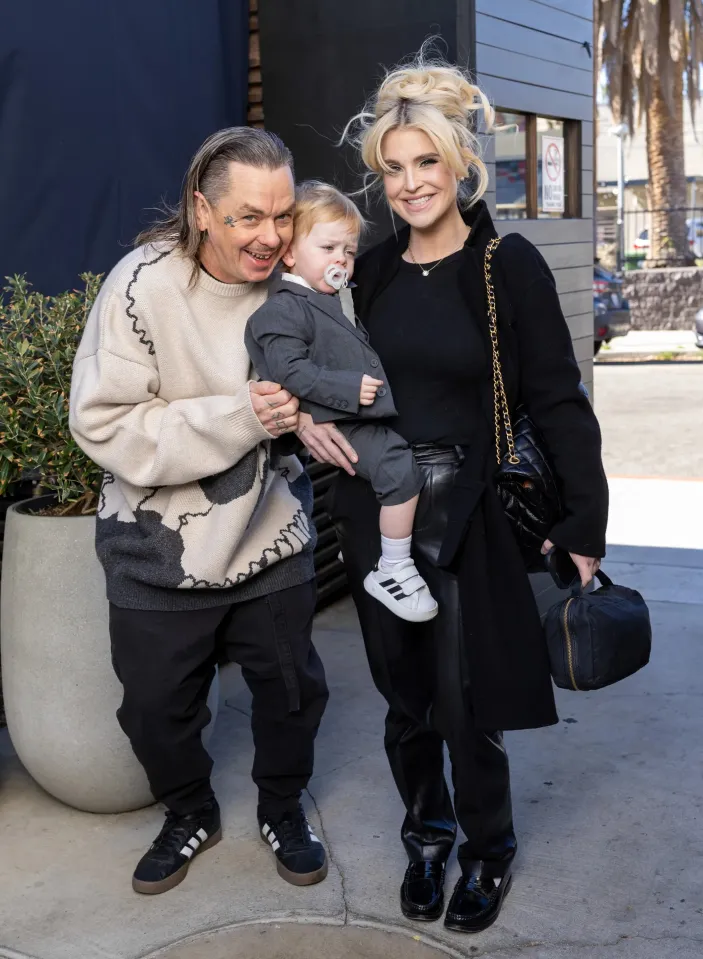
KELLY Osbourne fears her son will become an addict like she and her father Ozzy were.
The TV personality, 41, used alcohol and drugs from 13.
Kelly broke off her engagement to Slipknot rocker Sid Wilson, pictured with their son SidneyCredit: GettyOzzy with daughter Kelly at the Grammys in 2020Credit: Splash
She said it was to “numb that pain” she felt after becoming a child star.
Her rocker dad struggled with addiction for decades.
Sign up for the Showbiz newsletter
Thank you!
And the mum of Sidney, three, said: “I do believe it to be a genetic disorder.
KILLER drug fentanyl has long had a vice-like grip on the US, devastating everyone from high profile celebrities to everyday families across the country.
Just today it was revealed that actress Hayden Panettiere, who died last month age 36, had allegedly taken a pill laced with fentanyl before she passed away.
Hayden Panettiere, who died last month aged 36, allegedly took a pill laced with fentanylCredit: PADemi Lovato suffered three strokes and a heart attack after taking heroin laced with fentanylCredit: Getty
The mum-of-one was found dead of a suspected overdose of oxycodone at a luxury AirBnB in South Carolina on August 17 just days before her 37th birthday.
Cops are said to be “zeroing in” on her alleged long-term dealer from whom she is suspected to have purchased several black-market prescription drugs from.
Sign up for the Showbiz newsletter
Thank you!
Toxicology reports are still pending but, according to the US news outlet, the working theory within law enforcement is that it was the suspected fentanyl-laced oxycodone pill killed Hayden.
But she is far from the first celebrity to have succumbed to the drug.
Prince died of an accidental fentanyl overdose in 2016Credit: AP:Associated PressPrince’s Paisley Park recording studio and home, where he was found deadCredit: Alamy
And the fentanyl crisis is showing no signs of going away as dealers use it to lace other drugs to maximise their profits.
A former NYPD chief of detectives James Essig explained: “Fentanyl is relatively cheap while heroin is expensive.
“You take a kilo of heroin and then add in a tiny bit of fentanyl and stretch it out for more profitability.”
Fentanyl is an opioid 50 times more powerful than heroin and 100 times stronger than morphine.
Opioid addiction became rife in America during the 90s when pharmaceutical companies flooded the market with super-strong painkillers.
But when the government began to crackdown in the 2000s, the Mexican drug cartels spotted a gap in the market and moved in with heroin, and before long they started adding fentanyl to juice up its potency.
Raymond Donovan, former Drug Enforcement Agency (DEA) chief of operations, says: “That really started the wave of the opioid crisis that we are in now.
“Very quickly it went from increasing the strength of heroin to pure fentanyl. You had kilos coming across the south west border.
Tom Petty was found dead with two forms of illicit fentanyl in his systemCredit: Getty – ContributorA makeshift memorial to rapper Mac Miller who died in September 2018Credit: Getty
“The Mexican cartels started buying fentanyl directly from China, pressing it into pills and then selling it as if it was a known opioid, like something that was made by a scientist in a laboratory, but it is not, it is a fake pill.”
It was two years after Prince’s death when investigators finally released their findings.
They had found counterfeit Vicodin pills in his house, laced with fentanyl – but police were unable to establish who had provided the drugs.
Prince’s death put fentanyl in the headlines, but it wasn’t long before another famous name was tragically linked to the drug.
The following year rock n roll legend Tom Petty was found dead – and two forms of illicit fentanyl were found in his system.
He was also using a medically supplied fentanyl patch for pain caused by a fractured hip.
His family released a statement saying they wanted his death to act as a wake-up call in a bid to save others from suffering their heartbreak.
Matt Capelouto lost his college student daughter Alex to the drug in December 2019Credit: GettyMichael K Williams, star of TV series The Wire and Boardwalk Empire, died after taking fentanyl-laced heroin in 2021Credit: AP
But the opioid crisis was only just starting. In 2018 more than 30,000 people died of fentanyl overdoses – up by 10 per cent – and in July that year singer Demi Lovato almost lost her life.
The star had been open about her struggles with drug addiction and had been in and out of rehab.
Entertainment journalist Chris Witherspoon explains: “Despite years of sobriety Demi Lovato went out with some friends in Hollywood, ran into a dealer she knew and she got some heroin that was laced with fentanyl.”
Speaking about her ordeal Demi said: “I had three strokes, I had a heart attack. I suffered brain damage from the strokes. I can’t drive any more.
Her survival was down to being given the drug Narcan in hospital which helps to reverse the effects of an opioid overdose.
It was a huge wake-up call with celebrities including Lady Gaga, Justin Timberlake and Ariana Grande sending her public messages of support.
But another celeb was not going to be as lucky as Demi. Just two months later rapper Mac Miller was found dead at the age of just 26.
Like Demi he had been open about his own struggles with addiction, writing about it in his music.
Comedian and presenter Kate Quigley survived a fentanyl overdose that killed three of her palsCredit: GettyKate Quigley and Fuquan Johnson, (right) who died at a party after taking cocaine that contained fentanylCredit: Getty
Investigators discovered he had been looking to buy oxycodone, but ended up with something laced with fentanyl.
Miller’s drug dealer and the men who supplied him with the drugs were later jailed.
But it isn’t just celebrities that have fallen victim to the fentanyl crisis sweeping America.
Thousands of ordinary families have been left grieving the deaths of their loved ones, too.
Matt Capelouto lost his college student daughter Alex to the drug in December 2019.
“We didn’t know anything about fentanyl at the time,” he says. “Lots of things were going through my head and this was a period of shock.”
Alex, 20, had contacted a drug dealer on Snapchat looking to buy the prescription painkiller Perocet.
But what he, in fact, delivered to her was counterfeit pills made with lethal doses of fentanyl.
“My daughter took half of one of these pills before going to bed and my wife found her dead in her bed the next morning,” says heartbroken Matt.
“I wanted to find out who this drug dealer was. Who sold my daughter death?”
They eventually got into Alex’s phone and discovered the identity of the drug dealer.
But the family were told that the dealer was unlikely to face any charges as California does not have a death by dealer statute that holds dealers responsible for users’ deaths.
But the case was taken over for federal prosecution, which has a different burden of proof, and the dealer, Brandon McDowell, was charged with one count of distributing fentanyl resulting in death and jailed for nine years.
Matt says: “Locking up a drug dealer won’t bring my daughter back, but it will save someone else’s child.”
Michael K Williams, star of TV series The Wire and Boardwalk Empire, was the next celeb to lose their life after taking fentanyl-laced heroin in 2021.
He had been open about his battle with addiction, and just five days before his death spoke on a podcast about how acting offered him a road to recovery.
Two weeks after he passed away the New York City Medical Examiner said he died from an unintentional overdose from a deadly mix of drugs including fentanyl.
In April 2023, drug dealer Irvin Cartagena pleaded guilty to selling the mix of heroin and fentanyl to Williams that resulted in his death. He was jailed for 10 years.
In September 2021 comedian and presenter Kate Quigley went to a party in Venice, California, where she and her friends thought they were using cocaine, but it contained fentanyl.
Kate passed out, fell over and was unconscious for 17 hours. She woke up disorientated, unable to move her legs, and then made a harrowing discovery.
In September 2022, rapper Coolio became the next victim of fentanylCredit: SplashFashion designer Katie Gallagher was found dead after allegedly being given what she thought was cocaine, but it was laced with fentanylCredit: Getty
Washington Post reporter Nick Miroff says: “One of the many tragedies of the fentanyl epidemic in the United States is this repeat of mass overdose events.
“A group of friends partying together and they think they are buying cocaine or some other drug, and they don’t know that what they are buying is laced with fentanyl and because they don’t have any opioid tolerance, they drop dead.
“So that’s why we have seen horrible crime scenes with three, four, five adults on the floor at a party where they have literally died in a couple of minutes.”
In July 2022, cops discerned a shocking new twist in the fentanyl story.
The drug was now being used as a weapon by robbery gangs, and a famous fashion designer was one of their victims.
Katie Gallagher, who had designed for Rita Ora and Lady Gaga, was found dead in her bed.
Police told her parents that Katie had died from an overdose – but she had been murdered.
Detectives had uncovered a robbery crew that was using drugs laced with fentanyl to incapacitate victims before using facial recognition technology to open their phones and empty their bank accounts.
Police believed Katie had been given what she thought was cocaine, but it was laced with fentanyl.
Police arrested and charged Kenwood Allen, 33, in relation to five deaths and a drugging and robbery spree targeting a total of 21 victims.
At first it was thought he had died of an asthma attack, but the medical examiner’s report revealed he had died from an accidental overdose of heroin, methamphetamine and fentanyl.
Actor Angus Cloud was just 25 when he died at his family home in CaliforniaCredit: GettyFentanyl is an opioid 50 times more powerful than heroin and 100 times stronger than morphineCredit: AFP
The authorities are struggling to stop the flow of fentanyl from Mexico into the US.
The drug is so compact and so potent that it is easy for the cartels to smuggle it across the border.
In 2023, Homeland Security launched Operation Blue Lotus to try to stop the flood.
And the US targeted the Chinese suppliers that were selling fentanyl to the cartels.
But despite the Government efforts the fentanyl crisis continued to spread across America and claimed the life of yet another of Hollywood’s brightest stars.
He shot to fame playing a drug dealer in the hit series Euphoria. But his own struggle with addiction after suffering an ankle injury and losing his dad to cancer made him vulnerable.
He was found to have died of an accidental overdose of a cocktail of drugs, including fentanyl.
HAYDEN Panettiere took a pill that was allegedly laced with fentanyl on the day of her death.
The beloved actress died aged 36 of a suspected overdose at a luxury Airbnb in South Carolina last month.
Hayden Panettiere died last month aged 36Credit: GettyThe beloved actress was staying a luxury South Carolina Airbnb with one-off ex Brian HickersonCredit: BackGrid
Cops are said to be “zeroing in” on her alleged long-term drug dealer in Los Angeles, who she met before travelling to Greenville.
The Heroes and Nashville star is said to have bought several black-market prescription drugs from the dealer.
Sign up for the Showbiz newsletter
Thank you!
Days before her 37th birthday, Hayden allegedly took an oxycodone laced with fentanyl, sources told TMZ.
The mum-of-one had been in South Carolina with her on-off ex Brian Hickerson, who was arrested yesterday after an alleged incident at a bar.
The mum-of-one was open about her substance abuse strugglesCredit: PAShe shared a child with former heavyweight boxing champ Wladimir KlitschkoCredit: Getty
According to sources, the 37-year-old actor started yelling at officers about her death while cuffed and sitting on the pavement.
Hickerson has already met with Drug Enforcement Administration (DEA) officials as they continue to investigate Hayden’s cause of death.
He previously told officers that Hayden had a “bag of medication” with her.
The drugs she was reportedly taken was redacted in the police report, although nine different types were listed.
Hayden has been open about her struggles with substance abuse, once revealing how her liver “gave out” due to a secret opioid addiction.
The actress told PEOPLE how her addiction issues severely worsened after the birth of her child in 2014.
To help cope with the postnatal depression, Hayden admitted she turned to alcohol.
Hayden ended up having to go to the hospital after her liver “gave out”.
A year after giving birth, she underwent her first stint in rehab while still filming for the hit show Nashville.
Years later, Hayden admitted she couldn’t stop drinking as she returned for treatment in 2021, enrolling in a 12-month program.
It took eight months of “intensive therapy” to help her move on past her addiction.
More to follow… For the latest news on this story keep checking back at The Sun Online
Thesun.co.uk is your go-to destination for the best celebrity news, real-life stories, jaw-dropping pictures and must-see video.