Meet Cliqua, the director duo that caught the eye of Bad Bunny
Amid stacks of cash and liquor bottles, Tony Montana and Joaquín “El Chapo” Guzmán sit together inside a painting. One fictional and the other real, the drug lords look nonchalant.
“That’s us!” says filmmaker Raúl “RJ” Sanchez with joyful mischief when I point out the centerpiece on the main wall of their office in Downtown L.A. Sanchez’s partner in artistic crime, Pasqual Gutiérrez, tells me they got the frame nearby at Santee Alley.
Located on a street corner in the Fashion District, their space, which doubles as a man cave, reflects their creative influences, their ties to L.A. and their offbeat sense of humor. Before they moved in 2021, the place was a shoe store called Latino Fashion — the storefront sign remains.
Walk in and you’ll find the bottom half of a mannequin flaunting male genitalia (“That was our stunt penis from [the short film] ‘Shut Up and Fish,’” says Sanchez laughing). There’s also a bulky metal structure that resembles a torture device, a teal green couch (which they got for under $100), photography books and keepsakes on shelves that once displayed footwear. It’s a mini museum to their history so far. Or, as Sanchez calls it, it’s “a living brain.”
Known artistically as Cliqua, the in-demand duo has already worked with some of the music industry’s biggest names. Their resume includes directing videos for Bad Bunny (“La Difícil”), the Weeknd (“Save Your Tears”), J Balvin (“Reggaeton”) and Rosalía (“Yo x Ti, Tu x Mi”).
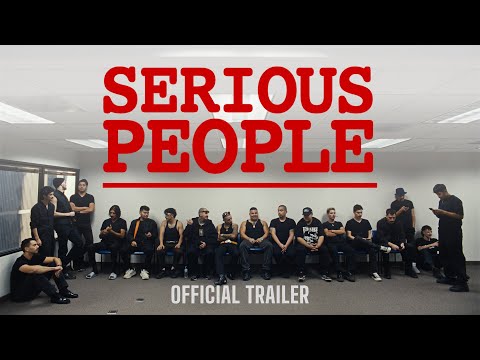
This year, Gutiérrez crossed over into feature filmmaking with his docufiction debut “Serious People,” a deeply personal “cringe comedy” that he co-directed with longtime friend Ben Mullinkosson. Following its premiere at the Sundance Film Festival, the film had a theatrical release in November and is now available to stream on multiple VOD platforms.

On screen, Gutiérrez and Sanchez play versions of themselves: music video directors in an industry that takes itself too seriously. While expecting his first child with partner Christine Yuan, also a filmmaker, Gutiérrez found himself caught between his commitment to his partnership with Sanchez and his responsibility as a soon-to-be father. The Gutiérrez in “Serious People” hires a doppelganger to replace him in his professional commitments.
“There were some things coming our way where if both Raúl and I weren’t available to do it, they would go away. Clients would be uninterested if it wasn’t the Cliqua brand,” Gutiérrez says. “That was deeply frustrating and haunting for me because it was like, ‘Raúl isn’t choosing to have a baby, but I am. And this is affecting us, because he can’t do everything on his own because people aren’t letting him do it.’”
Though both Gutiérrez and Sanchez fit under the generic identity umbrella of “Mexican American,” each of them knowingly embodies a distinct “flavor of Mexican.”
“I definitely identify with Chicano a lot,” says Gutiérrez. “I am second-generation and growing up I knew about lowriders and East L.A. barrio s—.” Raised between East Los Angeles and Pomona, Gutiérrez believes his Latino identity is unique to L.A.
Sanchez, on the other hand, is the child of immigrants from Mexico City and Jalisco. As a first-generation kid in the South Bay city of Gardena, his worldview was shaped differently.
“We’ve always had that split. You represent more what it is to be in this country for more generations, and I feel like I’m new. The culture I associate with more is Mexican but more rancho s—,” Sanchez explains. A vivid memory for Sanchez is his grandfather slaughtering a pig and driving around South Central on his pickup truck selling it. “The Chicano heritage wasn’t a thing for me, it was more the immigrant experience,” he says.
“I grew up speaking more Spanglish,” says Gutiérrez. “But Spanish was Raúl’s first language.”
Their artistic alliance is an amalgamation of what each brings to their friendship. Sanchez got Gutiérrez into Los Tigres del Norte and corridos, while Gutiérrez introduced him to Lil Rob’s “Summer Nights” and the 1993 movie “Blood In Blood Out,” which Gutiérrez considers a foundational cultural artifact in his life.
“Both of us have crossed towards the other’s side a little more,” says Sanchez. The two met through their then-girlfriends (now their wives and mothers of their respective children) almost a decade ago. At that point they each were already directing music videos.
“We really bonded over that shared experience of, ‘What’s it like trying to navigate this industry as a Latino?’” adds Sanchez.
For Gutiérrez, one of five siblings, his interest in filmmaking is linked to one of his older brothers who had a bit of a double life. “He was a gang member, but he was also a low-key cinephile,” he says. “He used to work in art house theaters, and we used to just watch weird stuff for a little kid to watch. A lot of ‘Blood In Blood Out,’ but also stuff like ‘Amélie.’”
With his father’s support, Gutiérrez attended Chapman University to study film production.
“My pops said, ‘Growing up no one ever asked me what I wanted to do. That wasn’t even an option for me,’” Gutiérrez recalls. “‘And the fact that you got accepted to this school, we’ll just find a way. We’ll take all the loans out. Go try and see how it is.’ My father empowered me to follow my dreams for sure.”
Sanchez had a less linear path into filmmaking. He graduated from UC Berkley with a degree in ancient history with the intent of going to law school. Instead, he returned to L.A. to try his hand at film, an interest that evolved from his enjoyment of video games growing up and film studies courses in college.
But how does one break into making music videos?
“In the beginning, a lot of times you’re shooting videos for your friends,” says Gutiérrez. “If you are creative in L.A., you know other creatives and one of them is a music artist or one of them is a rapper or in a rock band. And you start that way.”
“My sister was dating a rapper, so I was shooting his videos,” adds Sanchez.
Still, they both aspired to make feature films.
“Even when we were at the beginnings of Cliqua, the language we have always used to even talk about music videos has always been film-centric,” says Sanchez. “Those are the influences. We speak in movies.”
After meeting and hanging out for a while, Gutiérrez and Sanchez were eager to work together. That opportunity came with the video for J Balvin’s “Reggaeton,” which they had to sign on to do without being able to do much preparation. In the aftermath of that positive experience, they decided to create Cliqua, which originally also included music artist Milkman (MLKMN).
The name comes from the book “Varrio” by Gusmano Cesaretti, an Italian photographer who documented East L.A. culture in the 1970s, including the Klique Car Club.
The video for J Balvin kick-started their careers. They soon found themselves a niche as reggaeton became globally popular and a new crop of artists revitalized its aesthetic. But even as they eventually crossed over to other corners of the industry and landed consistent work with the Weeknd, they were aware of the limits to their creative freedom.
“Music videos are funny because they’re obviously not truly our work either; we’re at the service of another artist,” explains Sanchez. “We’re executing someone else’s vision even if the brief is generally open. It’s not truly us, but we’re in there.”
“Music videos are hard, man,” adds Gutiérrez. “The difficult thing about music videos that’s different from feature filmmaking is that it’s so fast. You get a concept, and you maybe have two days to come up with an idea and write a treatment for it. Then from there, you have a shoot date, but the shoot date can get pushed and it can get pulled depending on the artist.”
In 2023, Gutiérrez and Sanchez released their first narrative short film, “Shut Up and Fish,” about four “Edgars” (young Latino men with bowl cuts) on a boat. Their impetus was to subvert the expectations of stories involving characters from their community.
“We wanted to make it feel like an [Ingmar] Bergman film, because we’d never seen that, especially with these kids,” says Gutiérrez. One of the actors they cast in the short, Miguel Huerta, plays Gutiérrez’s chaotic doppelganger in “Serious People.”
For “Serious People,” Gutiérrez and Mullinkosson invoked arthouse references, such as the vignettes in the films of Swedish auteur Roy Andersson, or the surveillance feel of Jonathan Glazer’s “The Zone of Interest.” Gutiérrez makes a point of mentioning these inspirations in Q&As and interviews in hopes of igniting the curiosity of those watching “Serious People.”
“Making [that culture] accessible has always been a goal, whether that’s conscious or unconscious,” says Gutiérrez.
It was an anxiety-induced dream that first inspired Gutiérrez to write “Serious People” to satirize the entertainment industry. In the dream, Gutiérrez went on Craigslist to hire a look-alike in order to balance his personal and professional commitments. As soon as he woke up, he told his dream in detail to Yuan, who suggested he turn it into a film.
Gutiérrez brought Mullinkosson on board given his background in documentary, and because he thought co-directing it with Sanchez might make it too meta for comfort.
“This industry is so competitive and so demanding that every single director has a fear that if you say no to a single project, you’re never going to get hit up again,” says Mullinkosson on Zoom from Chengdu, China, where he lives. “At the end of the day, we’re just making movies — like, this isn’t that serious.”
Sanchez hesitated at first about the idea of being on camera, but his loyalty to Gutiérrez proved stronger than the reservations. “I actually got a kick out of seeing myself on screen,” Sanchez says. “When you see yourself projected that big, you start to understand what you feel like to other people in the world, which was a very interesting out-of-body experience.”
“Vulnerabilities are what make movies special, especially this one because Pasqual, Raúl and Christine opened their real lives to being on camera, and it’s very personal,” says Mullinkosson. “When you can be as brave as them to share your real life, something beautiful happens.”
Gutiérrez and Sanchez, who also became a father soon after our interview, are currently developing a new feature film, “Golden Boy,” which they describe as a “Stand by Me”-type of story about four Edgars. One of them thinks former boxer Oscar De La Hoya is his long-lost father. They go on a journey across California to confront De La Hoya.
“Music is where we started, but the goal has always been to do long-form, to do features,” says Gutiérrez. “And now with ‘Serious People,’ one is out there.”