dodger stadium

Dodgers’ Emmet Sheehan says timing was key to win over Rangers

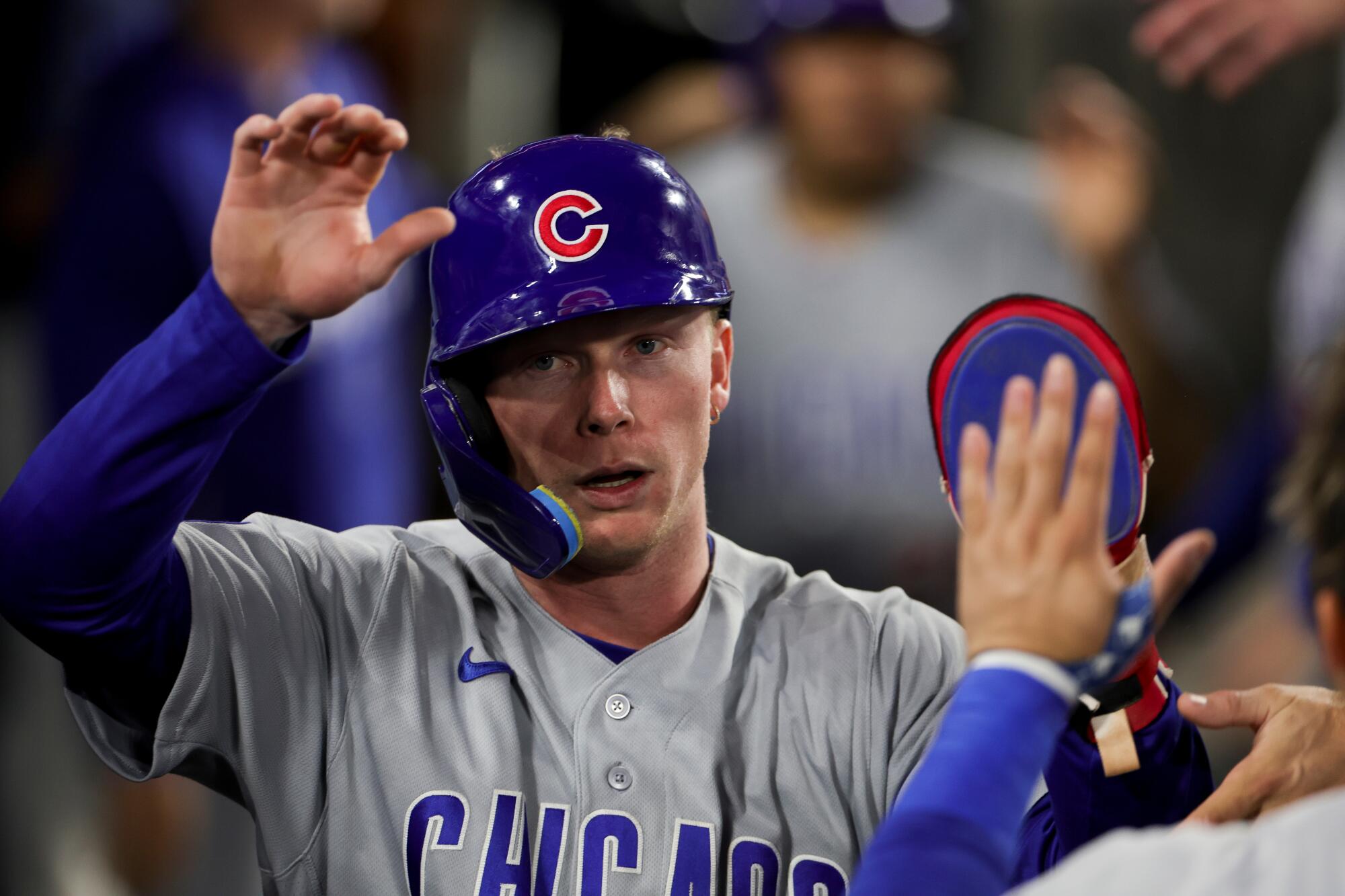
Dodgers manager Dave Roberts was tracking right-hander Emmet Sheehan’s velocity against the Rangers Saturday, but it wasn’t going to be his primary measurement of the start.

“I think right now, where he’s at, the hitters will tell us the most, not the radar gun,” Roberts said before the Dodgers’ 6-3 win.

Sheehan had both in his first quality start of the season.

Just look at the way he attacked Jake Burger in the sixth inning to close his outing. Sheehan threw three fastballs in the at-bat. That pitch averaged at 95.2 mph on Saturday, almost 1 ½ mph over his season average. And even as his pitch count climbed into the mid-70s, he was sitting at around 94 mph.

Dodger Teoscar Hernández watches his three-run homer clear the left center wall during a win over the Texas Rangers.

Dodger Teoscar Hernández watches his three-run homer clear the left center wall during a win over the Texas Rangers Saturday at Dodger Stadium.

(Gina Ferazzi/Los Angeles Times)

The last pitch he threw was a slider off the plate. Burger was able to get a piece of it, but only enough to ground out to first.

Saturday’s start was Sheehan’s best based on both consistency and results. He held the Rangers to three runs and four hits in six innings.

He’d found a cue in his work between starts. And if the adjustment unlocks a consistent run, that would do a lot to stabilize the Dodgers’ rotation at the back end.

“One of the big things this week was the glove tap,” Sheehan said. “Just timing everything up. Before, I feel like I was getting in good positions, I just wasn’t timing everything up the right way. I think that helped a lot.”

He was cruising through most of it — other than the two home runs he surrendered to Rangers leadoff hitter Brandon Nimmo.

Sheehan turned around his start immediately after the first long ball, on the second pitch of the game.

He came in throwing hard, pumping 96.2 mph on the first fastball, a ball inside, and 95.7 on the second. The latter drifted over the plate, and Nimmo lined it to straightaway center field, just over the “395” printed on the wall.

Sheehan, undeterred, retired the next eight batters. Nimmo hit a two-out ground-rule double that bounced over the left-field fence in his next at-bat, but Sheehan struck out Ezequiel Duran on a slider to quickly end the inning.

Only two Rangers besides Nimmo reached base against Sheehan. Evan Carter drew a leadoff walk in the fifth, and Josh Jung led off the sixth with a single into shallow center field.

Other than that, Sheehan recorded six strikeouts and generated mostly groundball contact.

He was also pitching with a lead for most of his outing, thanks to a solo homer from Shohei Ohtani and three-run shot from Teoscar Hernández in the first. The Dodgers added to their lead in the third inning with two walks, a single, and a run-scoring double play.

So, when the Rangers’ lineup turned over again, and Nimmo stepped up to the plate with a runner on base in the sixth, Sheehan was working with a four-run cushion.

Dodgers pitcher Alex Vesia celebrates after earning a save during the Dodgers' win over the Texas Rangers.

Dodgers pitcher Alex Vesia celebrates after earning a save during the Dodgers’ win over the Texas Rangers on Saturday at Dodger Stadium.

(Gina Ferazzi/Los Angeles Times)

Sheehan stayed away from his fastball, but Nimmo managed to get a hold of an inside slider.

Again, Sheehan responded with three straight outs, this time all infield grounders.

The Dodgers’ bullpen turned in a scoreless performance for three innings, even with Roberts staying away from closer Edwin Díaz, whose velocity was down Friday in his first blown save of the season.

And in the eighth, center fielder Andy Pages kept up his red-hot offensive start to the season with an RBI single into left field for insurance.

The Dodgers are off to the best offensive start of any National League team, whether they’re measured by runs (89), batting average (.297), slugging percentage (.507) or offensive fWAR (30.0).

The unknown entering the game was Sheehan, who had been working through directional issues in his delivery.

“There’s a little bit of east-west with him, and that’s kind of how he gets his power,” Roberts said. “But I think that towards the end of the year and spring, it got a little bit too east-west, where you’re just not back to front as far as direction.”

Everything was synced up for him Saturday, and even Nimmo couldn’t ruin that breakthrough.

“It can definitely be tough sometimes,” Sheehan said. “The past like month and a half we’ve been trying to work on it. It felt like at times it wasn’t progressing the way it should, but just stuck with it.”

Snell feels good after live BP

Left-hander Blake Snell threw an inning of live batting practice at Dodger Stadium on Saturday before the Dodgers’ game against the Rangers, taking a new step in his rehab progression.

“It’s very big,” Snell said. “…To be able to face two good hitters and feel good — I’ve got a lot of work to do still, but definitely a big step.”

Snell was delayed in his buildup entering spring training, after pitching through the postseason. He also dealt with shoulder issues last season, sidelined for about four months with what the Dodgers identified as inflammation in his left shoulder.

“I feel great,” Snell said. “I’ve done a lot of different things than I did last year when I was in this position. So I feel way better. I’m just very excited about how I feel right now, where I’m at, getting back to some normalcy again feels really good. I just can’t wait to pitch.”

He revisited old workouts, added Pilates to his routine and changed his diet.

Snell, an avid gamer, has also kept up his Twitch livestream activity while on the injured list. He recently responded to a harsh comment from a critic about his injury while streaming, cursing as he challenged anyone to match his World Series contributions amid pain. The clip naturally circulated widely on social media.

“I’m trying to game with my people, then trolls want to get in there and got something to say,” he said and then broke into a smile. “I should watch my language a little bit, but outside of that, it was pretty true. I’m going to have fun, going to be myself. I’ve got to watch my language though. If my mom sees that. … She probably will.”

He’s bracing for her call if she does.

Snell will continue to build up his workload in a simulated game environment, before eventually leaving on a minor-league rehab assignment. He didn’t say how many live BP sessions he’d need before that next step.

“You got to talk to the jefes,” he said.

Sitting in the dugout, Snell nodded up to the field where some of those bosses — president of baseball operations Andrew Friedman, general manager Brandon Gomes and Roberts — stood talking.

Roberts later speculated that Snell would build up to about three innings before pitching in games.

“I just miss pitching, it’s what I love,” Snell said. “So to be able to do that again, I was very excited coming to the field today. Like, I finally get to throw and pitch and see where I’m at, see if I’m good, bad, kind of figure myself out.”

On Saturday, he just wanted to throw strikes, see how his stuff played, and get feedback from utility player Tommy Edman and outfielder Alex Call, who faced him.

“The next one I want to be more crisp, want to hit locations more,” he said. “I only have so many starts left before I’m back. So I really have to hone in and make sure these weeks are very important.”

Injury updates

Edman, who underwent ankle surgery this offseason, is still on track to be activated around late May, Roberts said Saturday. In addition to taking live batting practice, he’s been running, but not quite at full speed, according to Roberts.

Shortstop Mookie Betts (strained right oblique) played catch on the field before the game Saturday.

Source link

Max Muncy caps his 3-homer night with walk-off blast in Dodgers’ win

It was Max Muncy’s night.

His third home run — a no-doubt-about-it 401-foot walk-off to right-center field, gave the Dodgers an 8-7 victory over the Texas Rangers on Friday at Dodger Stadium.

They improved to 10-3, winning despite closer Edwin Díaz’s first blown save as a Dodger.

Muncy’s first home runs, in the second and fourth innings, gave the Dodgers a 1-0 lead and then pulled them within a run, 3-2.

Those homers — Nos. 2, 3 and 4 this season — gave him 213 for his Dodgers’ tenure, tying and then surpassing Steve Garvey for third-most in the franchise’s Los Angeles history.

Muncy is only the second player in Dodgers history to have a walk-off homer as part of a three-home run game, joining Don Demeter, who accomplished the feat on April 21, 1959, according to the Elias Sports Bureau.

Max Muncy hits a walk-off home run to cap his three-home run night in an 8-7 win over Texas.

It marked the second three-homer game of Muncy’s career and his 20th multi-homer game.

And they kept the Dodgers in a game that went back and forth, up and down, bobblehead style.

Andy Pages went three for three with four RBIs and had a go-ahead two-run double and a two-run home run to provide crucial insurance that kept his club in the game.

His double in the sixth — he smacked Robert Garcia’s 84-mph slider into right field to bring home Muncy and Teoscar Hernández — gave the Dodgers a 5-4 lead.

And Pages’ two-run home run to center field off Luis Curvelo in the eighth brought home Muncy, who had singled. It also brought his MLB-leading batting average to .449 — and wasn’t just icing on the cake but fortification against the Rangers’ hitters who wouldn’t quit.

After Dodgers’ starter Tyler Glasnow exited after pitching six innings and giving up four runs on five hits — including two home runs — while striking out seven, Alex Vesia and Tanner Scott both pitched a scoreless inning before closer Díaz entered in the ninth.

The Dodgers’ closer gave up a single to former Dodger Joc Pedersen and then a two-run home run to Evan Carter that cut the lead to 7-6. Then Ezequiel Duran singled in Sam Haggerty to tie the score.

The Dodgers made it interesting by playing from behind for the ninth time in 13 games: The Rangers quickly responded to Muncy’s first homer, taking a 3-1 lead in the third inning when former Dodger Corey Seager teed off for a 409-foot, three-run home run to center field.

Max Muncy hits a walk-off home run to lift the Dodgers to an 8-7 win over the Texas Rangers at Dodger Stadium.

Max Muncy hits a walk-off home run to lift the Dodgers to an 8-7 win over the Texas Rangers at Dodger Stadium on Friday night.

(Gina Ferazzi / Los Angeles Times)

(Back on June 12, 2024, in his only other game at Dodger Stadium as a member of the Rangers, Seager hit a three-run home run. That one was a go-ahead blast off Walker Buehler that gave Texas a 3-2 victory.)

In the fifth inning Friday, Wyatt Langford deposited a Glasnow curveball into the Dodgers’ bullpen; his first home run this season pushed Texas’ advantage to 4-2.

Shohei Ohtani then singled to right to move Freeland to third — and, notably, to extend his on-base streak to 44 games, the most ever for a Japanese-born player and the fourth-longest such streak in Dodgers history.

Ohtani has also reached base on all seven of his bobblehead nights.

This season, the Dodgers determined that they needed two games — Friday and July 8 — to honor Ohtani’s “Greatest Game” with the bobblehead treatment.

Max Muncy runs the bases after hitting his walk-off home run in the ninth inning against Texas on Friday night.

Max Muncy runs the bases after hitting his walk-off home run in the ninth inning against Texas on Friday night.

(Gina Ferazzi / Los Angeles Times)

On Friday, all 53,675 fans went home with a bobbling figurine of Ohtani at the plate, a memento honoring his performance in Game 4 of the NLCS last October. He not only pitched six shutout innings and struck out 10 in that 5-1 NLCS-clinching victory over the Milwaukee Brewers, but he also hit three home runs that traveled a combined 1,342 feet.

The Dodgers’ Miguel Rojas won’t take bereavement leave or travel back to his native Venezuela following the sudden death of his father, Miguel Rojas Sr., manager Dave Roberts said before the game.

“There’s a lot going on in Venezuela,” the Dodgers manager said. “And a lot of his family is kind of dispersed around the world, essentially. He just feels they’ve got a handle on it down there, so he’s going to stay with us.”

Source link

The signs say Uniqlo Field. You will continue to say Dodger Stadium

It was Dodger Stadium on Wednesday, when the grass outside the baseline and the bright red sign high above center field read “UNIQLO FIELD.” It will be Dodger Stadium on Thursday, when the defending World Series champions open their new season, and forevermore.

The official name of our summer home is now Uniqlo Field at Dodger Stadium. The team announcers will say that, and so will some of the signs. The fans won’t, and the founder of the company that just spent nine figures on the name you won’t use said he completely understands.

“That’s a very natural reaction,” Uniqlo founder Tadashi Yanai told me through an interpreter. “We respect that.”

Yanai said his company’s deal with the Dodgers covers five years. He would say only that the total value was “more” than $125 million. That provides the Dodgers with an annual naming rights payment in line with the ones at Crypto.com Arena, Intuit Dome and Sofi Stadium, without the Dodgers having to sell naming rights to the actual venue.

Are the Dodgers baseball’s version of a gold mine? Yes. Do they spend big and win big? Also yes. Do you mind if Uniqlo essentially covers Freddie Freeman’s salary this season?

“We need a lot of revenue to put out the product that we do,” Dodgers president Stan Kasten said. “That’s not a secret. And we’re proud of everyone who helps us do it: all of our fans, all of our media partners, and all of our sponsor partners. They are all important. It is how this all comes together.”

While Uniqlo would be delighted if you used its name, whatever local fans choose to call the stadium is not critical to the success of the partnership.

For a Japanese company in pursuit of brand awareness and expansion in the United States and elsewhere, there might be nothing better than getting your name in front of millions of fans around the world watching Shohei Ohtani play on television.

Ohtani made an estimated $125 million in endorsements and sponsorships last year, Sportico reported, a larger annual haul “than any other athlete in the history of sports.”

“The Dodgers are such a popular team,” Yanai said. “I usually ask my wife, after I come back from the office, whether Shohei hit a home run. I think all the Japanese people do that.”

Uniqlo Field signs were unveiled Wednesday at Dodger Stadium in the wake of the team's naming rights deal.

Uniqlo Field signs were unveiled Wednesday at Dodger Stadium in the wake of the team’s naming rights deal.

(Beth Harris / Associated Press)

According to Forbes, Yanai is the richest man in Japan, where baseball teams carry corporate names. Why not buy a team and call it, say, the Uniqlo Bears?

“I always keep saying that could be very interesting,” he said, “but my wife turned it down. She keeps telling me, ‘Tadashi, you are not cut out to manage sports teams.’”

Instead, he is managing Uniqlo, an apparel company that pitches itself as blending comfort with quality. “We do not make disposable clothing,” Yanai said in the company’s last annual report.

Uniqlo has 794 stores in Japan but only 77 in the United States, including 14 in the Southland. Koji Yanai, a senior executive officer and Tadashi’s son, said the company aspires to grow annual U.S. revenues from $6 billion to $30 billion.

He shared what might be a more challenging aspiration.

“The Uniqlo Field at Dodger Stadium name may be very new for everyone,” he said, “but I hope in the near future the fans will like it and will love it.”

United Airlines Field at the Coliseum? Yeah, no.

Jeff Marks, the chief executive of Los Angeles-based Innovative Partnerships Group, once brokered a naming rights deal in which the Cal football team would play on Kabam Field at California Memorial Stadium. He tried to find a receptive audience for the name.

“We educated a lot of freshmen, sophomores, and newcomers,” Marks said. “Are you going to go after alumni who have been calling it Memorial Stadium? No. So you didn’t focus on that. You focused on people that could be more impressionable, and it worked.”

With Dodger Stadium, we’ll see. For the 2026 season, it is now time for Dodgers baseball, but not before one reporter at a press conference Wednesday asked company officials whether Uniqlo would provide the Dodgers players with free clothing.

Kasten could not pass up the chance to interject.

“We pay them enough,” he said with a grin, “to shop at Uniqlo stores.”

Source link

A great city needs a walking path to Dodger Stadium. Do it, Frank McCourt

Dodgers fans generally hiss at the mention of Frank McCourt — the former owner took the team into bankruptcy, after all — but today is about tipping our cap to him.

Without him, fans would have no option to take public transit directly to Dodger Stadium. On his watch, the Dodgers helped secure government funding for the shuttle buses that provide free rides between Union Station and Dodger Stadium.

Sixteen years later, beyond the addition of a sister shuttle from the South Bay, that’s it.

The Dodgers boast the best team in the world. Shohei Ohtani is a tourist attraction. So is their historic ballpark. The Dodgers sold a record 4 million tickets last year.

In 1990, the last year Fernando Valenzuela pitched for the Dodgers, Los Angeles County unveiled a report that suggested ways to improve access to Dodger Stadium “for those who cannot or do not wish to drive.”

The options: a monorail, people mover, or light rail extension from the Chinatown Metro station; the shuttle buses that McCourt and Metro launched 20 years later; the gondola that McCourt first pitched in 2018 and continues to pursue; and a walking path.

A passenger exits the Chinatown Metro station in January.

A passenger exits the Chinatown Metro station in January.

(Etienne Laurent/For The Times)

L.A. is all about the car. You will most likely drive to Dodger Stadium, and so will your children.

For decades, the Dodgers have promised to ease traffic by adding amenities that encourage fans to come early and stick around after the game. That has not materialized, and notorious congestion within and around the stadium is as much a tradition as Dodger Dogs.

What if you could walk, for real? What if you could head into the stadium along a beautifully landscaped and wide Dodgers-themed path, a blue ribbon of fans coalescing into a community, with decorations and food carts, shade and lighting, and chants of “Let’s Go Dodgers!” along the way?

You can walk now, sort of. It’s about a mile.

A map indicating the pedestrian path toward Dodger Stadium from the Chinatown Metro station.

There’s a map at the Chinatown Metro station displaying the pedestrian path toward Dodger Stadium.

(Etienne Laurent/For The Times)

At one end of the Chinatown station, there is a map with a pedestrian route, in a glass case that faces away from Dodger Stadium. If you walk out of the station at the other end, or if you just start heading in the direction of Dodger Stadium, good luck finding the map.

There are Metro signs leading you back to the station from Dodger Stadium, but none leading you along the route there.

The Dodgers actually would prefer you did not take that route, or at least the last part of it. I walked it with Alissa Walker, whose Torched newsletter is the go-to place to learn how major sporting events impact the everyday lives of Angelenos.

We entered the Dodger Stadium property at an intersection with no crosswalks, where cars enter and exit the 110 freeway. We stood atop a dirt patch next to a crumbling curb.

“To go a very short distance safely with a feeling that you’re not going to die,” Walker said, “is very difficult.”

With Game 3 of the World Series underway at Dodger Stadium last October, a few folks scurried across a pedestrian bridge with LED lights and blue glow sticks.

The bridge connects Chinatown with Dodger Stadium, traversing the 110. Without this bridge, there is no walking path to Dodger Stadium.

At night, the bridge offers magnificent views of downtown lights. But it had no lights of its own, so the volunteers used the LED lights and glow sticks to attach homemade Dodgers-themed signage to the fence that encloses the bridge.

“Our goal was, just by adding some lights, to make the really dark path at the top of the bridge at night a little bit brighter, so that it felt a little less scary,” transit advocate Jeremy Stutes said, “and to add a little bit of fun and whimsy.”

Pedestrian bridge over the 110 freeway connecting Chinatown to the area where the Dodger Stadium is located.

Glow sticks forming the “LA” logo of the Dodgers were placed on a pedestrian bridge over the 110 Freeway connecting Chinatown to the area where Dodger Stadium is located during the World Series and for several months after. As of last week, the glow sticks were no longer there.

(Etienne Laurent/For The Times)

From the Chinatown Metro station, the bridge is three blocks up College Street and one block down Yale Street. It’s an easy walk, and for now you pass an elementary school, a church, a row of Chinese restaurants, a dirt lot where a hospital once stood, parking lots, and an auto repair facility with a Dodgers flag hung on a wall.

When I did the walk last week, the trash at the foot of the bridge included a plastic cup, socks, a piece of rotting fruit, a half-full bottle of tequila, and half of a turkey sandwich, peeking out from torn plastic wrapping that indicated the sandwich had gone bad three days earlier. On the bridge: shopping bags, a pair of flip-flops, stray clothes scattered at one end, and graffiti everywhere.

A sign painted on the sidewalk indicates the direction toward the Chinatown Metro station.

A sign painted on the sidewalk indicates the direction toward the Chinatown Metro station.

(Etienne Laurent/For The Times)

That was the point those volunteers made last October: Clean up the bridge and light up the bridge — as they did for three days — and fans will walk there.

“It’s not that it’s not used,” Stutes said. “It’s not designed to be a safe space to use as an alternative to driving.”

When you cross the bridge, you can turn right or left along Stadium Way to get to a stadium entrance.

Turn right, as the map tells you to do, and you’ll encounter decaying sidewalks, with cracked and buckled concrete that turns a modest uphill walk into an obstacle course. Once you get onto the stadium grounds, the paint is fading along the pedestrian path, which offers you no protection from passing cars.

Turn left, and you’ll have to walk part of the way in the street, on an unprotected bike lane. You also could walk along the road behind the Fire Department training center, a path with no sidewalks and passing fire trucks. Either route takes longer than the one on the map, but you would enter Dodger Stadium through a pair of protected and brightly painted pedestrian paths. (That entrance, along Vin Scully Avenue, is a quarter-mile from Sunset Boulevard, where two Metro bus routes stop.)

If the primary choices for getting out of Dodger Stadium after a game are car congestion or Dodger Stadium Express shuttle bus congestion, a downhill walk to Chinatown Metro station — 12 minutes, Metro says — would be a nice option. That’s why those folks lit up the bridge over the freeway during the World Series.

“The lights were just a fun way,” transit advocate Kevin Dedicatoria said, “to show, ‘Hey, here’s a bridge so you don’t have to play, ‘Dude, where’s my car?’ or have to worry about waiting for the bus.’”

McCourt hails from Boston, where the local subway drops Red Sox fans a few short blocks from Fenway Park. When McCourt owned the Dodgers, I asked him if he could envision a subway or light rail extension to Dodger Stadium.

He’d love it, he said then, but the Dodgers were a private business, and government should pay for public transit.

Homes line a street in Eylsian Park, where Dodger Stadium is located.

Homes line a street in Eylsian Park, where Dodger Stadium is located.

(ETIENNE LAURENT/For The Times)

It was a fair point. The Dodgers pay taxes. In an era where teams regularly demand stadium and arena deals that exempt them from property tax, the Dodgers have paid $12.8 million in property taxes over the past three years, according to Los Angeles County tax collection records.

Would demand for public transit amid a car culture justify the investment? The Dodger Stadium Express indicates it could: Ridership has just about quadrupled since its inaugural season, from 122,273 in 2010 to 463,147 last year, according to Metro.

Even along the poorly maintained, poorly lit and poorly advertised pedestrian path, Metro said more than 700 riders returned to the Chinatown station on each of the three nights of World Series home games last year.

“As seen in social media videos during the 2025 postseason, the walking path continues to explode in popularity,” Metro spokesman Jose Ubaldo said.

Next steps?

“It’s astonishing to me that the Dodgers have not taken it upon themselves, as this great community partner, to fix this problem,” Walker said. “It is the city’s responsibility, but the Dodgers should be doing this, as part of what they want to represent to this community.”

The walking path includes segments along city streets, a Caltrans bridge, and Dodger Stadium property. Just who is the responsible party?

A Caltrans spokesman said the city is responsible for maintaining the bridge. A spokesman for the city’s department of street services did not provide an answer. A spokesman for the Dodgers declined to comment.

You could almost hear the sigh from city councilwoman Eunisses Hernandez, whose district includes Dodger Stadium.

“That’s what my job is: to bring people and agencies and organizations together to accomplish a goal,” Hernandez said. “We’re already in conversation with all these entities.

“We’re looking at some of the things we can enhance to make this a more walkable and accessible option for people.”

City Council member Eunisses Hernandez, center, talks with Circle outreach workers a homelessness response team.

City Council member Eunisses Hernandez, center, talks with Circle outreach workers in Los Angeles.

(Allen J. Schaben/Los Angeles Times)

How much might those enhancements cost?

Without a look at a city-commissioned Dodger Stadium traffic mitigation study, expected to be completed this fall, Hernandez said she could not put a price tag on it.

“What I can tell you,” she said, “is that it will be less than half a billion dollars, for sure.”

By year’s end, the Los Angeles City Council is expected to vote on McCourt’s gondola project, estimated to cost $500 million and proposed as privately financed. Last November, the council voted 12-1 to urge Metro to kill the project.

Metro granted its approval, but with conditions that included a requirement to explore supplementing the gondola with other Dodger Stadium transit options, including more buses along Sunset Boulevard and a designated walkway from there to the stadium.

The walking path proposed in that 1990 study would have avoided Sunset Boulevard and the current Stadium Way routes — the ones with crumbling sidewalks, or no sidewalks at all — by using escalators and walkways to get fans up and down the hill between Lookout Drive, just off Stadium Way, and Dodger Stadium.

“Pedestrians could be directed through Chinatown,” the study read, “where numerous restaurants, shops and pedestrian amenities are provided.”

It’s hard to sell Chinatown businesses on the benefits of the gondola when fans would ride between Union Station and Dodger Stadium, soaring over Chinatown. It would be easier if a walking path led at least some of those fans through Chinatown, even if only on the way back from the game.

Even if the gondola system really can accomplish what its proponents say it can — loading 35 people into a cabin every 23 seconds — thousands of riders leaving when the game ends could mean a long line to board.

One of the entrances to Dodger Stadium on Stadium Way, the easiest access when walking from Chinatown Metro station.

One of the entrances to Dodger Stadium on Stadium Way, the easiest access when walking from Chinatown Metro station.

(Etienne Laurent/For The Times)

“Also,” the 1990 study said, “passenger waiting following a game is psychologically perceived as being three to four times longer than actual waiting time.”

From this perspective, McCourt might win a few council votes by funding a first-class walking path. The cost, I’m told, would depend on what the enhancements include: signs, lights, trees, shade canopies, sidewalk repairs, escalators, and so on. For something close to $5 million — one one-hundredth of the projected cost of gondola construction — McCourt likely could do an exceptional job.

Is there any sign of progress here? Happily, yes.

In an internal report last December, Metro said Zero Emissions Transit (ZET) — the nonprofit organization now shepherding the gondola project — is pursuing ways to link pedestrians and bicyclists to the transit system and to Dodger Stadium. Those potential improvements include sidewalk repairs and a revitalized pedestrian pathway from the Chinatown Metro station to the bridge across the 110 and then across Stadium Way, to Lookout Drive and the hill above.

“Dodger Walk is envisioned as a series of switchbacks,” the report said, “inspired by the original walking path up Lookout Mountain that existed prior to the construction of Dodger Stadium.”

Whether such switchbacks would make the walk to the stadium longer or shorter than the current path remains to be determined.

In a statement, ZET said: “We embrace and include active transit solutions to increase pedestrian and bike access throughout the project area.” In particular, ZET said, it was “supportive” of a walking path to Dodger Stadium.

The Metro report cautioned the concepts “are in the early planning stage,” so L.A. might get an extravagant walking path, a utilitarian one, or none at all.

Here’s hoping McCourt gives us a path of some kind — whether the city approves the gondola or not — because a pretty walk generations can enjoy would be a prettier civic legacy than driving a team into bankruptcy.


Source link

Yoshinobu Yamamoto smooth in final start before Dodgers opening day

Dodgers right-hander Yoshinobu Yamamoto went into his final start of the spring with a focus on throwing first-pitch strikes, while also hoping to test his composure with men on base.

He achieved both Friday, limiting the traveling half of the Padres’ split squad to three hits in five scoreless innings. The next time Yamamoto takes the mound for a game, it’ll be on opening day at Dodger Stadium against the Arizona Diamondbacks on Thursday.

“There were a few things I wanted to try,” Yamamoto said through an interpreter after his part of the Dodgers’ 4-3 win. “And [Friday] I was able to get into the game very nicely.”

The game featured a possible preview of the Dodger’s opening-day lineup — “I don’t know, we’ll see, it’s some good players,” manager Dave Roberts said with a smile.

Few roster decisions remained, after camp cuts Wednesday included right-handers Kyle Hurt and River Ryan, and infielder Ryan Fitzgerald.

“They’re always difficult with guys hoping, expecting to break with us,” Roberts said of his conversations with cut players. “There’s obviously some good ones where you tell a guy that he’s going to make the club. But I think the main thing that just shouldn’t get lost is, it’s not always just about starting. It’s where you finish.”

As of Friday, Hyeseong Kim and Alex Freeland were still locked in a second-base battle. And the Dodgers had to sort out roles at the back end of the rotation.

Roberts said he expected to carry a swingman who would likely pitch multiple innings out of the bullpen early in the season, when the Dodgers’ schedule includes frequent off days, and later serve as a sixth starter.

Yamamoto, however, had been the clear choice to lead the rotation, long before Roberts made it official Monday.

“It’ll be nice to hand the ball to him and it’s not an elimination game,” Roberts said, referencing Yamamoto’s World Series MVP performance. “That’ll be fun for me.”

Coming off pitching meaningful games in the World Baseball Classic, Yamamoto had one last chance Friday for a tuneup.

He struck out the first three batters he faced, with first-pitch strikes to each.

The next inning, Yamamoto gave up back-to-back one-out singles. He escaped the jam with two more strikeouts. Yamamoto tallied seven strikeouts in an overall smooth performance.

“He came out, really, with a purpose,” Roberts said. “And I thought everything looked good, the fastball — the life to it, the command of it — the cutter, slider, curve ball was good, the split, everything was good. And very efficient. And pretty effortlessly got through five innings, so that was really good to see.”

Source link