The Savannah Bananas embarked on their first so-called world tour five years ago. It included only one stop — in Mobile, Ala.
As the unique brand of baseball entertainment known as Banana Ball expanded into a six-team league, the tours have grown in size and scope but never actually ventured out of the United States.
That will change next year. The 2027 Banana Ball Championship League tour will visit 79 stadiums across 74 cities, including the first-ever international stops. Four teams will travel to Mexico, with the Bananas playing the Texas Tailgaters in Monterrey on Feb. 5 and 6 and the Party Animals taking on the Loco Beach Coconuts in Tijuana on Feb. 12 and 13.
The tour swings to Canada in late summer, with the Bananas playing the Indiananapolis Clowns in Toronto on Aug. 14 and 15 and the Tailgaters facing the Party Animals in Winnipeg on Aug. 26 and 28.
“We got a lot of criticism over the years. ‘It’s not a world tour, you’re playing in one city! It’s not a world tour, you’re playing in seven cities in the southeast!’” Banana Ball creator and owner Jesse Cole said Thursday on ESPN2. “But we saw where we could go, and we’ve always had a vision to create 1 billion fans, one fan at a time. And over the last two or three years, we’ve heard from a lot of different countries all over the world.”
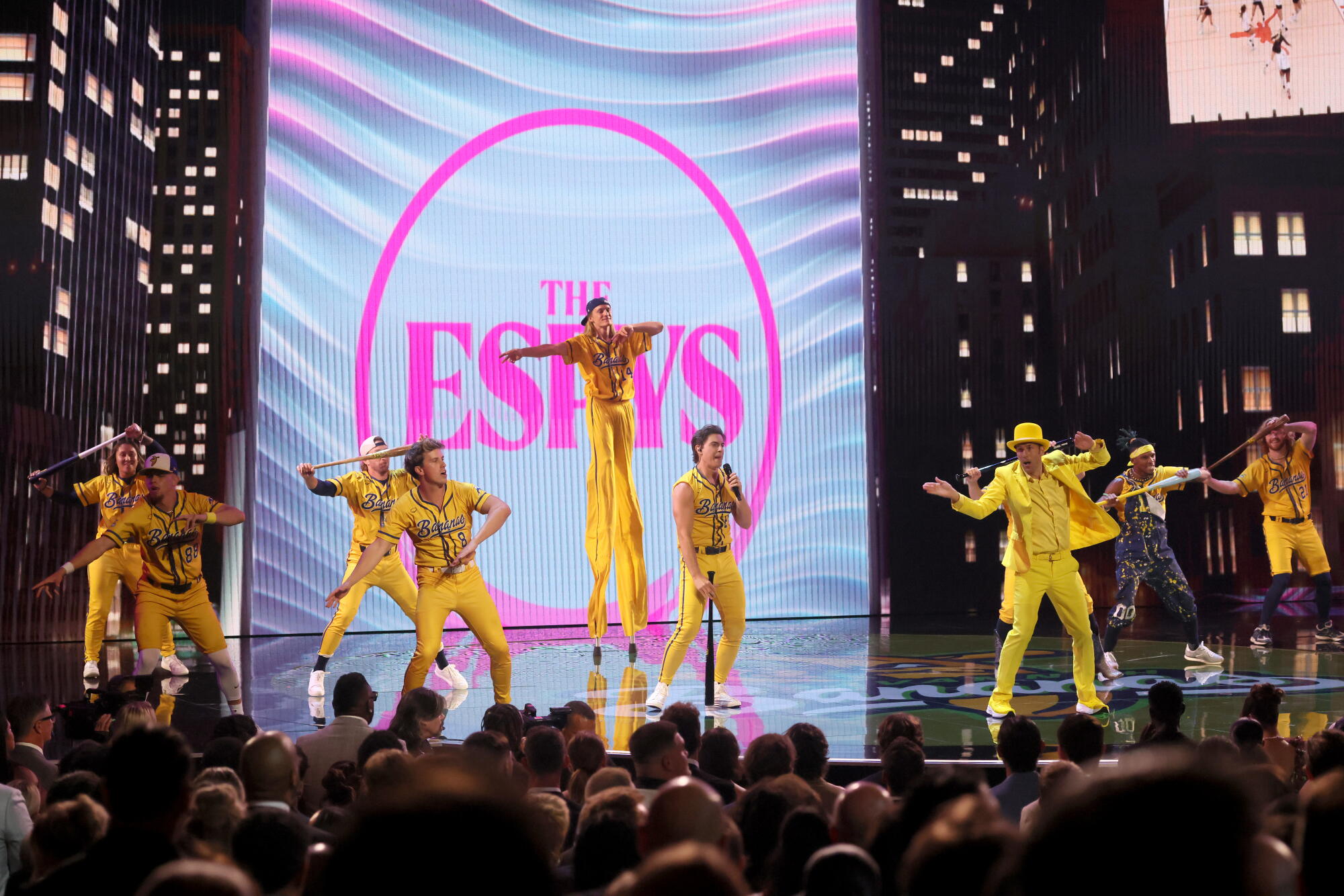
The Savannah Bananas, featuring Banana Ball creator and owner Jesse Cole in his signature yellow suit and derby hat, perform onstage during the 2026 ESPY Awards in New York.
(Mike Coppola / Getty Images)
Cole said he expects the 2027 tour to draw an estimated 4.3 million fans.
“Everything we do is do one experiment and then see where it can go,” he said. “And this crazy experiment of Banana Ball has gone some places we never imagined.”
Another new stop next year will be Dodger Stadium, where the Bananas will play the Firefighters on April 23 and 24. The same teams also will face off at Angel Stadium on July 2 and 3, marking the third consecutive year the Bananas have played at the venue.
The schedule reveal show included a number of announcements, including the debut of a concept called Banana Ball 360 on June 26 at Notre Dame Stadium. Two baseball fields will be set up on opposite ends of the stadium, with the game taking place on each during alternating innings.
“I do believe that fans at that show are going to be able to see things they’ve never seen before, and also every single seat is a great seat,” Cole said. “And that was the idea.”
Also announced were a new Disney-produced film documenting the growth of Banana Ball, which will premiere June 12 at Atlanta’s Truist Park, and the league’s third cruise, “Bananaland at Sea + Puerto Rico,” in January 2028. The cruise will depart from the Port of Miami and will feature a Banana Ball game at Hiram Bithorn Stadium in San Juan.
If the Brewers are going to take down the heavily favored Dodgers, their group of Southland products will be key in the National League Championship Series that begins Sunday in Milwaukee.
Former Westlake star Christian Yelich is Mr. Brewer. He’s a three-time All-Star and the National League MVP in 2018. He’s always been willing to come back to the community and make contributions.
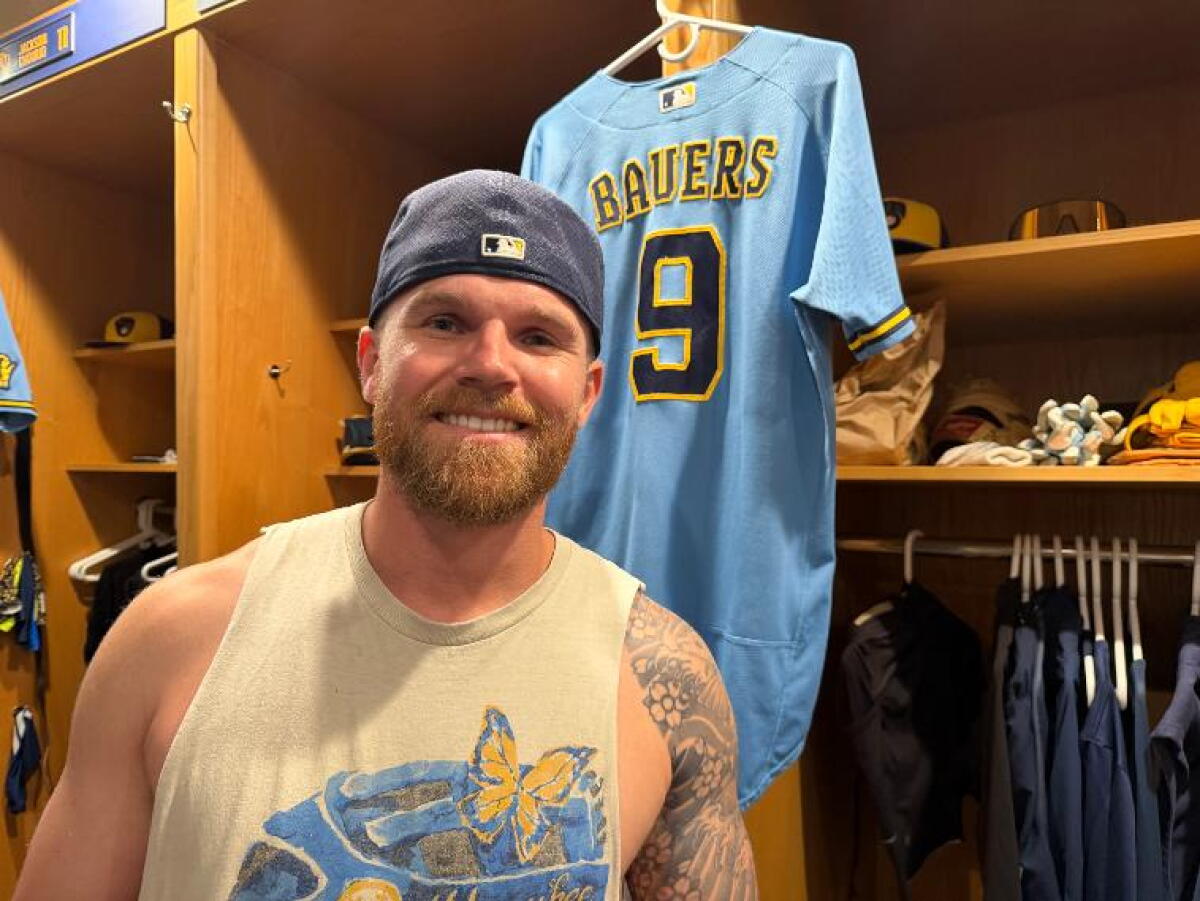
First baseman Jake Bauers is a Marina High graduate who lost in the Southern Section Division 1 championship game at Dodger Stadium to Jack Flaherty and Harvard-Westlake 1-0. Here’s a look at Bauers this season.
Former Marina first baseman Jake Bauers has 21 home runs for the Milwaukee Brewers.
It was so hot a team that averaged nearly 50,000 fans for often meaningless regular-season games beat the Atlanta Braves 5-3 in its first postseason game before thousands of empty seats — some of which were literally too hot to sit in.
It was so hot the Dodgers set up pallets of bottled water near the gates and anyone brave enough to enter the stadium was given a plastic 16-ounce Dasini bottle. Gatorade also set up a cooling tent under the right-field pavilion.
It was so hot Nicolas Gonzalez, a fan sitting in the shade of the reserved level, saw a stadium attendant, overcome by heat, stretchered before the game even started. She wasn’t the only one. By the later innings, other fans on the reserved level were reportedly seeking medical attention on the concourse.
The Dodgers declined comment.
So how hot was it?
The game started 45 minutes after the National Weather Service issued an extreme heat warning, cautioning against “extremely dangerous heat conditions” as the temperature reached 100 degrees at first pitch. By the third inning, the temperature reading atop the left-field scoreboard peaked at 103 degrees, matching the highest first-pitch temperature at 64-year-old Dodger Stadium.
“I’ve been coming to games my whole life and this is easily the hottest game I’ve ever been to,” said Gonzalez, 38, of Culver City. “Having a game in these conditions feels like we’re flying too close to the sun, both literally and figuratively.”
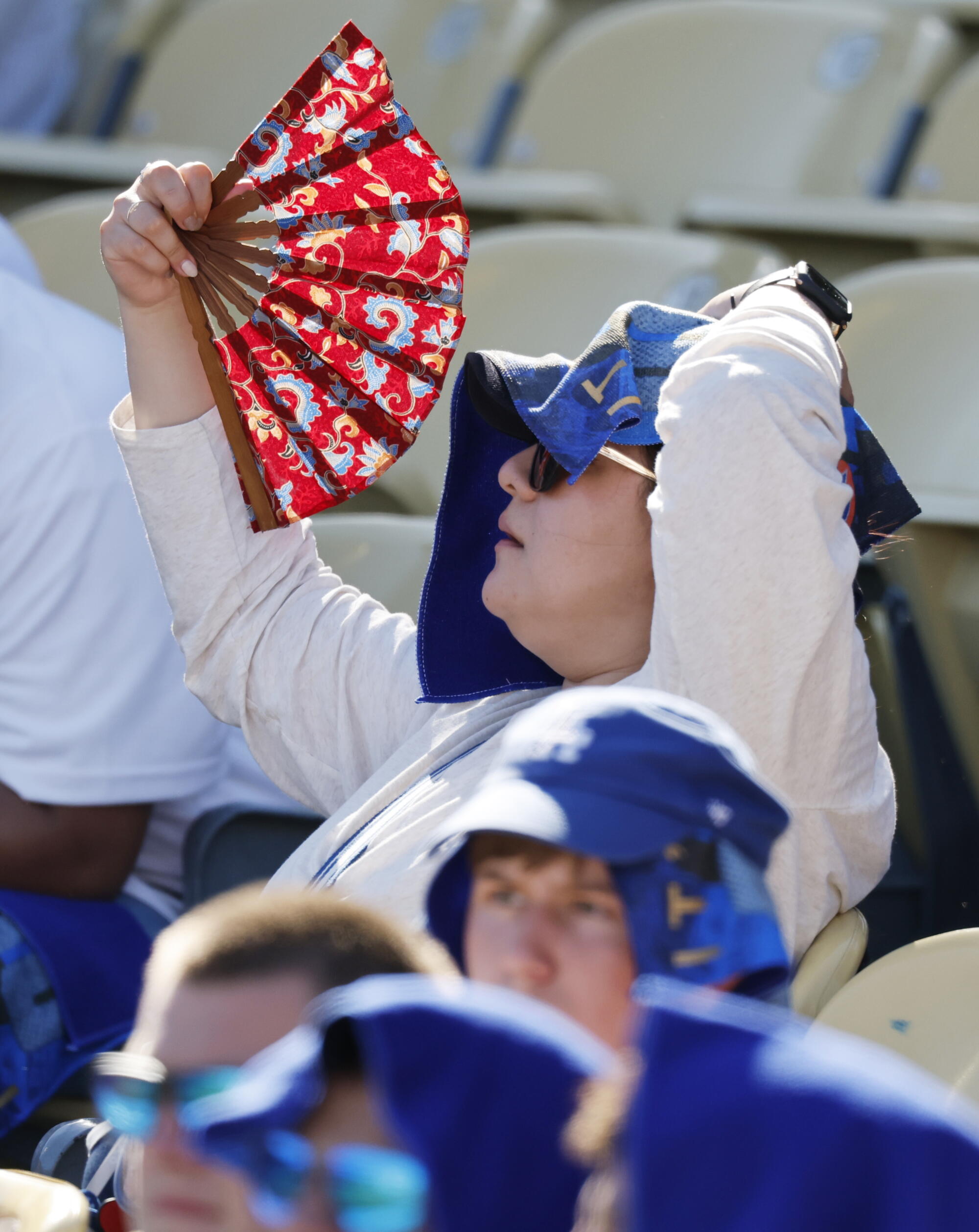
A fan tries to stay cool during Game 1 of the NLDS between the Dodgers and Atlanta Braves at Dodger Stadium on Saturday.
(Gina Ferazzi / Los Angeles Times)
Around him, fans tried to cool themselves by waving makeshift fans. It didn’t work.
But the weather didn’t just effect the way the game was watched. It effected the way it was played, too. The cloudless skies made every pop-up an adventure and the warm, dense air reduced drag, allowing batted balls to travel further. As a result, the teams combined for five homers, accounting for all eight runs.
“That’s probably one of the hottest games that we’ve ever had here. And so shout out to the Dodger fans; they were amazing,” said Max Muncy, who hit of those five homers.
“My feet were hot. Really hot.”
The Dodgers wound up with an early afternoon game in the middle of a historic heat wave because MLB and the TV networks — in this case Fox and TBS — set conditional start times for the four Division Series games before the teams and matchups were known. When the San Diego Padres eliminated the Chicago Cubs in the wild-card round, Saturday’s early NL game went to the Dodgers.
Left-hander Tarik Skubal, who gave up just a run on two hits in six innings to get the win in his Dodger postseason debut, said he didn’t really notice the heat until he came out of the game.
“I walked back into the dugout, and I asked — I forget who, I think it was [Blake] Snell — I was like, ‘has it been this hot all game?’ It’s amazing what your brain can do in certain circumstances and moments,” he said.
“I actually didn’t think it was horrible when I was pitching.”
But then Skubal pitched in much hotter conditions as a kid growing up in northern Arizona.
“I played a Little League game in 127 [degrees]. Lake Havasu,” he said. “[Saturday’s] up there with as hot a baseball game that you can play in.
“Every team’s playing in it, right? They’re playing in the same conditions we are. It shouldn’t really impact how you are mentally or how it’s going to impact how you pitch. Just go out there and play baseball and try to drink water. That’s really it.”
At least Skubal got to drink his water in the relative cool of the dugout between innings. Umpire Roberto Ortiz, wearing 10 pounds of protective gear and a black-and-gray uniform, got no such relief. He had to stand behind the plate for 2 hours 44 minutes and all 290 pitches, one of which smoked him in the seventh inning.
That’s why his five fellow umpires made a point of patting him on the back or shoulder before jogging to their positions for the first pitch.
“He stayed tough,” Dodger catcher Will Smith said of Ortiz. “I’m sure he’ll rehydrate and be ready for tomorrow.”
Speaking of tomorrow, the Dodgers, Braves and the umpires will all get some relief for Game 2. At first pitch Sunday afternoon the Weather Channel is forecasting a temperature of just 97 degrees.
“The dark silver lining,” Gonzalez, the heat-weary fan said in a nod to global warming, “is this might be the coolest October of the rest of our lives.”
Tens of thousands of people walk in and out of Dodger Stadium on any given night, paying scant attention to the trees, plants, and other foliage surrounding it on all sides. Chaz Perea made his peace with that a long time ago.
“Getting to Dodger Stadium is not a small thing,” said Perea, 41, the stadium’s landscape manager. “You’ve got to park in this monster,” he said, motioning to the acres of asphalt around him, “and then go find your seat in that monster.”
1
2
3
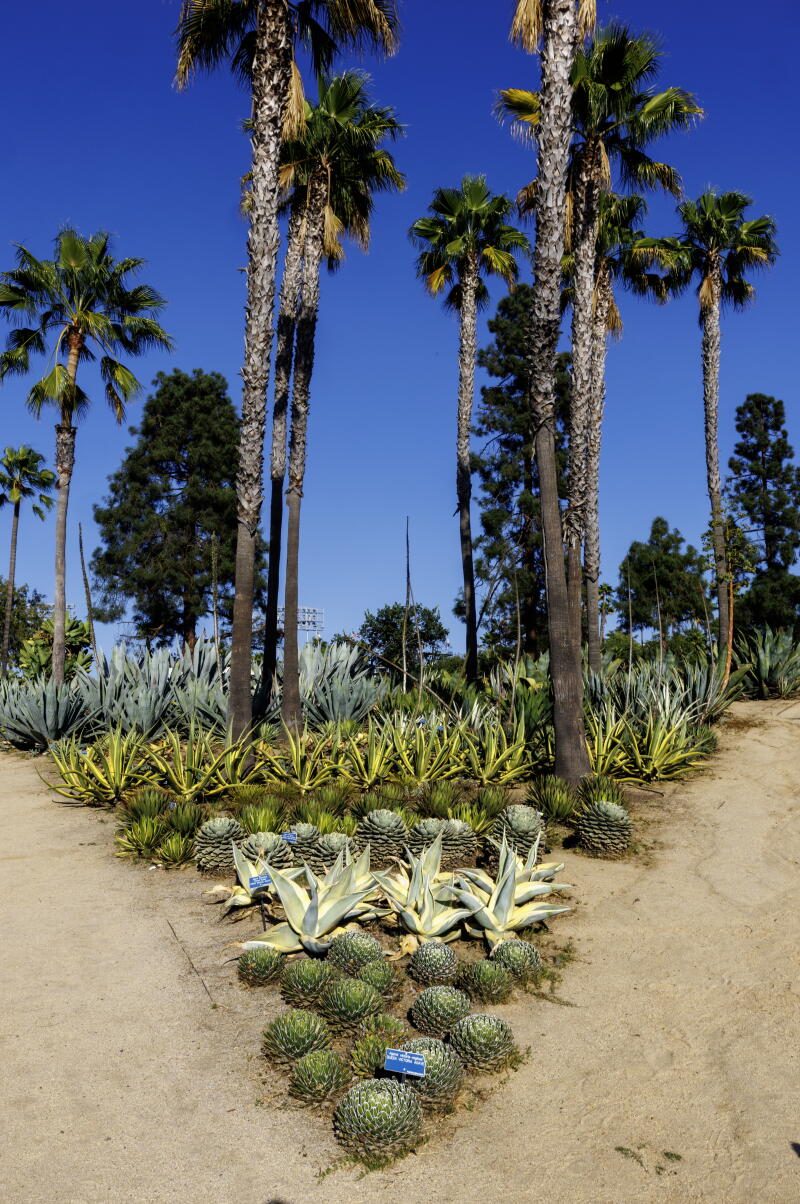
1.The agave garden sits outside Lot B at Dodger Stadium on Friday.(Gina Ferazzi/Los Angeles Times)2.Dodgers fans walk past vibrant plants behind photos of former Dodgerss outside center field at Dodger Stadium on Friday.(Gina Ferazzi/Los Angeles Times)3. A group visits agave island during a tour of Dodger Stadium’s botanic garden on Tuesday.(Christina House/Los Angeles Times)
For the past 17 years, Perea and his four-person crew have been responsible for every bit of stadium landscaping that isn’t the field itself. That’s roughly 300 acres, encompassing the parking lots, the hillsides meeting the 110 Freeway, and 149 concrete planters nicknamed “martinis” for their glass-like shape. The planters are original to the stadium’s 1962 construction, and many had crumbled badly enough over the decades to need painstaking repair.
The landscaping isn’t just about plants and planters. Behind a fence beyond the iconic orange 76 ball in the parking lot once sat a hidden garden. Its centerpiece was an eight-foot-tall stone lantern given to then-Dodgers owner Walter O’Malley by Japanese sports columnist Sotaro Suzuki and his wife, Toku, who had attended the stadium’s grand opening in 1962. Suzuki commissioned the 3,921-pound Kasuga-style lantern, which arrived in five pieces in late 1965 and became the centerpiece of a garden that also featured a small wooden bridge and a collection of rocks.
“For years, it was maintained by our gardener with great pride,” said former Dodgers owner Peter O’Malley, Walter’s son. “But it was remote, and fans couldn’t really get up there easily to see it or sit in the garden. And it got neglected for a few years. Some years later, I forget how many, we had to fence in the whole property.”
In 2024, shortly after the Dodgers signed two-way sensation Shohei Ohtani, the club moved the lantern to a place of prominence outside the top-deck gates, overlooking the downtown skyline. The move was an elaborate, delicate production. Bundled and boarded up, the lantern inched across the parking lot on the back of a flatbed truck that climbed a ring road steep enough to cause concern.
“It was like they were moving the Ark of the Covenant,” Perea said.
No one exhaled until the cargo was unloaded, unswaddled, and confirmed to be in one piece.
An 8-foot-tall stone Kasuga-style lantern is displayed at Dodger Stadium on Tuesday.
(Christina House/Los Angeles Times)
Perea’s crew works out of a large metal shed at the far end of a parking lot, a shop they affectionately call “the Oasis.” Much of what’s inside was retrieved from a dumpster, or scavenged before it landed in one. Perea, who describes himself as a bargain shopper, is passionate about repurposing whatever he can; many of the succulents at the stadium came from his own clippings.
“My general philosophy is I don’t treat the Dodgers like I’m salaried management,” he said. “I treat them like I’m a contractor that they don’t want to get rid of. So I manage the expenses and the labor as such.”
He doesn’t have much interaction with players and executives, though he’s occasionally been called to their homes to help with landscaping problems. One visit stands out.
“Vin Scully is the coolest one I’d stake a claim to,” he said of the legendary play-by-play man. “He was an unbelievable class act. He had a tree issue. He had us out, and was so attentive and appreciative, it was just stunning to me.”
1
2
3
4
1.Landscape manager Chaz Perea gives a tour of Dodger Stadium’s botanic garden.(Christina House/Los Angeles Times)2.A ceramic dog and monkey sit on a golf cart inside the Dodger Stadium landscape team’s shed on Tuesday.(Christina House/Los Angeles Times)3.A photo of Jim Lefebvre, Dodger player from 1965-1972, is surrounded by plants at Dodger Stadium on Tuesday.(Christina House/Los Angeles Times)4.Adolfo Hinojosa checks on the planters near center field at Dodger Stadium on Tuesday.(Christina House/Los Angeles Times)
On the hillside above the shop is an open-air lunch area, its seating made from wooden bleachers salvaged from the old right-field pavilion. Peek through the bushes and the stadium is visible in the distance. Inside the shop, the walls are lined with neatly organized shovels, pickaxes, and ladders. Above them hang paintings, art being another of Perea’s passions, most of them made by his friends.
Perea freely admits he’s an odd fit for the job. He’s not a baseball fan; he prefers beach volleyball and mixed martial arts. He had a rough upbringing in Arizona, dropped out of high school, and got by on $6.75 an hour doing golf-course maintenance, supplementing it with landscaping gigs he ran out of his pickup truck before eventually returning to school.
He came back to the classroom with a purpose, not only finishing high school but going on to earn multiple advanced degrees and, ultimately, a Ph.D. He’s now a professor of horticultural science and co-chair of agricultural science at Mt. San Antonio College.
But it’s his day job that draws clusters of Dodger fans willing to pay $52.25 each for his 90-minute botanic garden tour of the grounds. They explore “Agave Island” near the main entrance, a wedge of land planted with nine palm trees to match the number of players on a baseball field, and the planters outside the club-level entrance, where the crew grows chilies (jalapeños, serranos, habaneros), along with basil, mint, tomatoes, onions, and garlic. That garden spawned an annual salsa competition, in which club employees harvest their own ingredients from the planters, make salsa at home, and bring it back to be judged. Perea and his crew make handmade tortillas and quesadillas for the event.
Landscape manager Chaz Perea gives a tour of Dodger Stadium’s botanic gardens on Tuesday.
(Christina House/Los Angeles Times)
Two more planted islands are devoted entirely to tequila agave. It takes nearly a decade for the plant to mature, and about 110 pounds of its core to yield a single liter of tequila through processing. Perea and his crew hope to eventually try making some themselves, as an in-house project rather than a commercial one.
The landscape looked very different before Perea arrived. He describes the old look as Disneyland-esque: heavy on lawns and flowers, constantly in need of replacement, and thirsty for water. About two years into the job, he began swapping annual flower beds for drought-tolerant succulents. When one executive noticed and ordered the flowers put back in a particular spot, Perea complied there, then made the same swap a little farther down the hillside, out of view.
Turnover among executives and ownership gave him repeated openings to make wholesale changes, a shift that coincided with California’s drought crisis. Within a few years, he had planted 10,000 cuttings and stripped every flower bed from the property.
“A lot of people look at this as the last unpainted canvas in Los Angeles,” Perea said.
Chaz of Chavez Ravine, perpetually painting the corners.