Prep Rally: Southern California dominates top divisions at state basketball finals
Hi, and welcome to another edition of Prep Rally. I’m Eric Sondheimer. The champions have been crowned in high school basketball and soccer. What a weekend it was in Sacramento.
Champions

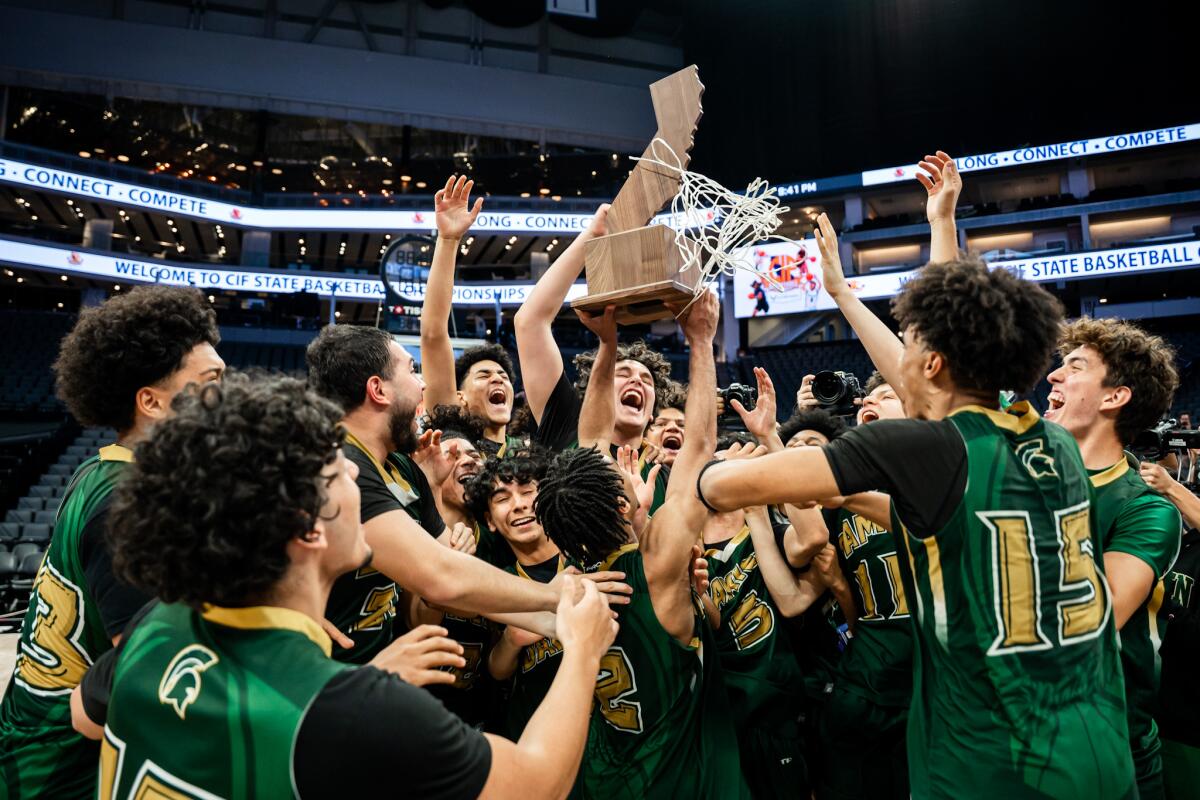
Damien players celebrate their state Division I boys’ basketball title victory over Folsom at the Golden 1 Center in Sacramento on March 13, 2026.
(Greg Stein)
In the highest divisions at the CIF state championships at Golden 1 Center in Sacramento, Southern California basketball teams continue to dominate.
Sierra Canyon and Ontario Christian were crowned Open Division boys and girls champions, respectively. Sierra Canyon overcame the loss of Maxi Adams to an ankle injury in the first quarter to defeat Richmond Salesian 78-70. Here’s the report.

Kaleena Smith of Ontario Christian gets emotional in the first half at Golden 1 Center against Archbishop Mitty.
(Greg Stein)
Ontario Christian received another standout performance from junior guard Kaleena Smith to defeat Archbishop Mitty 56-49. Here’s the report.
Damien won Division I for coach Mike LeDuc. Here’s the report. Corona Centennial’s one-two punch of Sydney Douglas and Cyndee Bryant led the Huskies to the Division I girls title. Here’s the report.
Sylmar and Birmingham came up short trying to become the first City Section teams from the San Fernando Valley to win state titles. Sylmar was beaten in Division V. Here’s the report. Birmingham settled for runner-up in Division III. Here’s the report.
El Dorado’s girls’ team broke through in Division III. Here’s the report.
Soccer

Garfield goalkeeper Javier Zarate gets his photo taken with CIF executive director Ron Nocetti at state soccer finals. Garfield lost 2-0 in Division V.
(CIF)
Garfield was beaten in the Division V state boys final 2-0 by Branson. But sophomore goalie Javier Zarate continues to impress. Here’s a look at his impact.
Mater Dei deserves the name soccer school of the West. The Monarchs won boys and girls state titles in Division I. The boys defeated Salinas Everett Alvarez 2-1. The girls defeated unbeaten Bishop O’Dowd 2-0. Los Alamitos won Division III boys over Watsonville 1-0. Irvine University won Division IV 3-2.
Baseball

Freshman Louis Lappe of Harvard-Westlake receives congratulations after his first high school hit.
(Craig Weston)
Freshman Louis Lappe of Harvard-Westlake, the former El Segundo Little League star who gained national fame for his walk-off home run at the Little League World Series in 2023, hit his first high school home run on Wednesday.
Let’s just say he was a little excited.
Brody Schumaker of Santa Margarita had four hits, including a grand slam, and seven RBIs in a win over Los Osos. He has struck out once in 34 at-bats.

Landon Hovermale of Norco has allowed no runs in 18 2/3 innings this season.
(Nick Koza)
Norco has one of the hottest pitchers around in Landon Hovermale, who has given up no runs in 18 2/3 innings. Here was his latest performance.
Foothill pitchers have thrown three consecutive shutouts.
There’s every indication that the Southern Section is going to introduce a new playoff format for Division 1 baseball only. It’s expected to be a 16-team tournament broken into four pools with double elimination leading to the quarterfinals with the top two teams in each pool advancing, followed by single elimination. The baseball advisory committee has been pushing for such a tournament in Division 1 for years.
Here’s this week’s top 25 rankings by The Times.
Softball
Emily Yoon of El Dorado threw a no-hitter in a win over Villa Park in a league opener.
Here’s last week’s top 20 softball rankings, with unbeaten Murrieta Mesa leading the way.
Track and field
Benjamin Harris of Servite turned on the speed at Redondo Union on Saturday, running a wind legal 10.27 seconds in the 100 meters.
One of the most versatile track and field athletes this season has to be junior Davis Benson of Moorpark. He’s putting up good marks in a variety of events. He’s already set school records in the 110 hurdles of 14.30 and the 300 hurdles in 38.82. And he’s gearing up for a high jump showdown later in the season with Sherman Oaks Notre Dame’s JJ Harel. Benson has gone 6-10.
Carson’s Jayden Rendon stamped himself as a state contender in the 110 hurdles with a time of 13.91 at Redondo Union.
Lawrence Kensinger of Venice, another pupil of Sherman Oaks Notre Dame throwing coach Nick Garcia, is closing in on 60 feet in the shotput. He recorded a career-best 59-8.
Jaslene Massey of Aliso Niguel, already No. 1 in the state in the discus, won the Nike Indoor Nationals in the shotput at 54-2.75, seventh-best mark in California history. She also got a mark of 188-7 in the discus, second-best all-time.
Loyola’s Ejam Yohannes ran 400 meters in a state-leading 46.24. It was a school record.
Bob Johnson dies

Former Mission Viejo coach Bob Johnson died last week. He was 80.
(Los Angeles Times)
High school football fans across Southern California were offering memories of Hall of Fame coach Bob Johnson after his passing Wednesay. He was 80.
Johnson won nine Southern Section titles coaching at Mission Viejo and El Toro.
Here’s the report.
Notes . . .
One of the best sporting events of the year happens Friday night when volleyball powers Mira Costa and Loyola face off at Mira Costa. . . .
Alfred Rowe has resigned after one season as football coach at Long Beach Jordan. . . .
Earl Sanchez has resigned as basketball coach at Sierra Vista. . . .
Former Gardena Serra and UCLA tight end Caleb Wilson has been hired as an assistant coach at Colorado State under former UCLA coach Jim Mora Jr. . . .
Luis Cruz Jr. is the new football coach at Sunny Hills. . . .
The top football player in the state for next season, Honor Fa’alave-Johnson of Cathedral Catholic, announced he has committed to USC.
From the archives: Mason Edwards

In 2023, Left-hander Mason Edwards of Palisades was one top pitchers in the City Section. Now he’s the ace at USC.
(Steve Galluzzo)
Mason Edwards, a junior at USC from Palisades High, is off to one of the best starts by a pitcher in the nation. He entered last week having allowed no runs and only three hits in 24 innings while recording a 3-0 record. He gave up his first run of the season on Friday. He’s left-handed and has 42 strikeouts. He throws between 90 and 93 mph.
Edwards has continued to improve at USC since his arrive in the fall of 2023.
Recommendations
From the Players Tribune, former El Toro pitcher pitcher Paul Skenes offers advice to Little Leaguers.
From the Daily Bruin, a story on Brentwood basketball coach Ryan Bailey, a former UCLA basketball standout.
From the Los Angeles Times, a story on former Chatsworth guard Alijah Arenas keeping his NBA dreams alive.
Tweets you might have missed
Until next time….
Have a question, comment or something you’d like to see in a future Prep Rally newsletter? Email me at eric.sondheimer@latimes.com, and follow me on Twitter at @latsondheimer.
Did you get this newsletter forwarded to you? To sign up and get it in your inbox, click here.