The Heat was set to be ITV’s next big reality show but the culinary programme fronted by Olivia Attwood has been criticised after its first episode
22:38, 25 Feb 2026Updated 22:49, 25 Feb 2026
The Heat has been criticised
Olivia Attwood’s new ITV show, The Heat, reportedly ran into a few hiccups during filming. Former Love Island star Olivia, 34, took on the hosting duties for the new reality TV cooking show. It sees 10 chefs head over to Barcelona to work under multi Michelin Star award-winning chef Jean-Christophe Novelli.
The group is battling it out to become the next rising star in the culinary world. But guests invited into the pop-up establishment were supposedly greeted with non-alcoholic Prosecco.
A source told The Sun: “The diners waited for nearly two hours for their main courses while shouting and screaming could be heard from the kitchen.
“They didn’t even have any alcohol to keep them going – just some warm non-alcoholic Prosecco.”
Ensure our latest headlines always appear at the top of your Google Search by making us a Preferred Source. Click here to activateor add us as your Preferred Source in your Google search settings.
And the insider added that some of the show’s starters were served “lukewarm”. There is also claims that the Spanish omelette that was served on the menu was missing a key ingredient – potatoes. Things took a turn for the worse when the establishment was forced to be evacuated following a small fire, which is shown in the trailer.
In the first episode of the show, it was soon a baptism of fire for the new chefs as they hit the ground running while trying to stay focused on a first service while having fun flirting. In an exclusive first look at the second episode that was obtained by the Mirror, host Olivia is seen on a lavish yacht in the Mediterranean sea.
The presenter says: “Yesterday The Heat opened its doors, the fire was on in the kitchen and later on the team let their hair down but there were sparks there too… Today, a new head chef has to step up and take control. Let’s hope there’s not too many distractions!”
And later, Olivia hilariously asks crew members: “Is my a**e out? I want it to be, I’ll get more likes” to which laughter off camera is heard.
Opening up on what she is usually like in the kitchen, Olivia confessed: “I’m a bit Victoria Beckham-coded. I could eat the same thing every day, I can’t be bothered to make a big mess. I want to eat the food, I don’t want to make it.”
Welcome to the Olympic Edition of the Sports Report, an L.A. Times newsletter published every morning during the Winter Olympics. To sign up to receive it via email (it’s free), go here and select The Sports Report. If you’ve already signed up for the Sports Report, you will receive the Olympics edition as well.
Welcome to your daily review and preview of this year’s Milan-Cortina Olympics. My name is John Cherwa and I’m your tour director for the Games as we learn how thin the line is between greatness and failure.
In the most shocking moment of the Games so far, U.S. figure skater Ilia Malinin had the gold at his doorstep but instead had a dreadful performance, falling twice and giving the gold to Mikhail Shaidorov of Kazakhstan. The feeling in the arena was that there with no way Malinin could lose with his big lead after the short program. Then his main competitor, Yuma Yagiyama of Japan, had a subpar skate just before Malinin took the ice as the last skater of the night.
But Malinin missed his first combo and could never regain his composure in what was likely his worst performance in a major competition in quite some time. He finished eighth but at age 21, we could see him in a future Olympics. It was Malinin’s first loss since Nov. 2023.
In honor of Valentine’s Day, we thought we should look at some of the athlete couples at the Games. We compiled the list from People, so we take no responsibility for last-minute fights or splits (other than time splits, of course).
Madison Chock and Evan Bates: U.S. ice dancers. Won the silver with a gold-medal performance.
Brittany Bowe and Hilary Knight: U.S. speedskater Bowe finished fourth in the women’s 1,000 meters and has the 1,500 and team pursuit to go. Knight plays for the U.S. women’s hockey team, which is in the semifinals.
Nicole Silveira and Kim Meylemans: Both are in the women’s skeleton with Silveira competing for Brazil and Meylemans for Belgium. After two of four heats, Meylemans is eighth and Silveira is 12th.
Marie-Philip Poulin and Laura Stacey: Both are members of the Canadian women’s hockey team, who, despite losing to the U.S. in pool play, is expected to contend for a medal.
Magnus Nedregotten and Kristin Skaslien: This pair’s love is on the rocks … or stones if your prefer. They are curlers for Norway. They finished sixth in the mixed competition.
Jocelyn Peterman and Brett Gallant: It’s another curling pair swept to each other’s brooms. The Canadians finished fifth in the mixed competition.
Ronja Savolainen and Anna Kjellbin: These hockey players play for two different countries, Savolainen for Finland and Kjellbin for Sweden. Both countries made the quarterfinals with Sweden already advancing to the semifinals.
Hunter Powell and Kaysha Love: This U.S. bobsledding couple will see competition soon, Powell in the four-man and Love in both singles and doubles.
Emily and Dominik Fischnaller. This luge couple will bring back some hardware. Dominik, who sleds for Italy, took bronze in singles and team relay. Emily, who competes for the U.S., was 12th in singles.
There are certainly others, and some in the making as we speak, but this is a sampling.
Elsewhere on Friday
Italy is on fire at these Games but were not hot enough to beat the U.S. in women’s hockey. The U.S. won 6-0 and will move to the semifinals.
France, followed by two from Norway, won the biathlon men’s 10-kilometer sprint. The best U.S. finisher was Campbell Wright in 12th.
Johannes Hoesflot Klaebo, the GOAT of cross-country skiing, won his eighth lifetime gold for Norway by winning the men’s 10-kilometer interval start free. He is tied for most lifetime gold medals in the Winter Games and has three more events. John Steel Hagenbuch of the U.S. was 14th.
The U.S. and Canada played each other in both men’s and women’s curling. The women won, 9-8, (now 2-1) and the men lost, 6-3, (1-2).
The U.S. was shut out on snowboard with Australia winning gold in women’s snowboard cross and Japan getting gold and bronze in men’s halfpipe.
Matt Weston, the world champion from Britain, won men’s skeleton. Germans won silver and bronze. Austin Florian of the U.S. was 12th.
A 19-year-old from Czechia won the men’s 10,000 meters in speedskating. The U.S. did not compete.
Best Thing to Watch on TV today
Today is the day to take a breath from figure skating. It also seems to be a good time for your tour guide to admit something: I have absolutely no idea if the skaters are doing three, three and a half, four or four and a half rotations when they are in air in real time. OK, I said it. Are you nodding your head in affirmation right now? Thought so. OK, let’s go to something different for today.
The best bet will be the men’s 500 meters in speed skating. Jordan Stolz, the winner of the 1,000 for the U.S., will be in the 12th pair in the event which starts at 8 a.m PST. This isn’t his best event but he should have confidence and momentum going his way. If you need your hockey fix, the U.S. men play Denmark around 12:10 p.m.
Favorite photo of the day
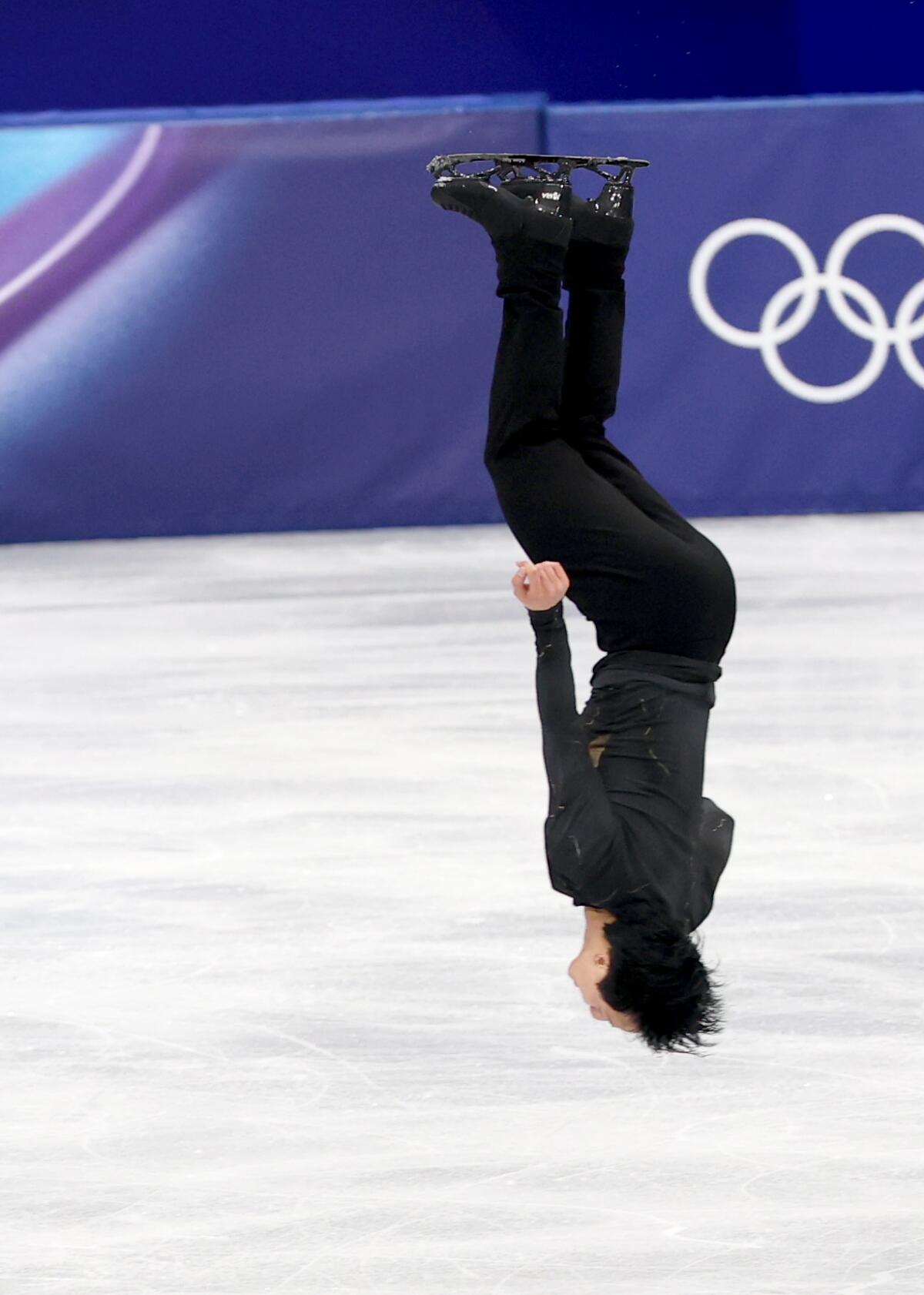
France’s Adam Siao Him Fa performs a backflip while competing in the figure skating men’s free skate Friday.
(Robert Gauthier / Los Angeles Times)
Times photographer Robert Gauthier is at the Winter Olympics. Each day Times newsletter editor Houston Mitchell will select a favorite photo from the many he has taken.
Saturday’s Olympic TV and streaming schedule
Saturday’s live TV and streaming broadcasts for the Milan-Cortina Olympics unless noted (subject to change). All events stream live on Peacock or NBCOlympics.com with a streaming or cable login. All times Pacific. 🏅 — medal event for live broadcasts.
MULTIPLE SPORTS
8 p.m. — “Primetime in Milan” (delay): Alpine skiing, freestyle skiing, speedskating and more. | NBC
ALPINE SKIING 1 a.m. — Men’s giant slalom, Run 1 | USA 4:30 a.m. 🏅Men’s giant slalom, Run 2 | NBC
CURLING Women (round robin) 12:05 a.m. — Britain vs. Canada | Peacock 12:05 a.m. — Italy vs. China | Peacock 12:05 a.m. — Switzerland vs. Japan | Peacock 4:30 a.m. — Britain vs. Canada (delay) | USA Men (round robin) 5:05 a.m. — Germany vs. U.S. | Peacock 5:05 a.m. — Czechia vs. Britain | Peacock 5:05 a.m. — Sweden vs. China | Peacock 5:05 a.m. — Switzerland vs. Canada | Peacock Women (round robin) 5:30 a.m. — Italy vs. China (delay) | CNBC Men (round robin) 10 a.m. — Germany vs. U.S. (delay) | CNBC Women (round robin) 10:05 a.m. — Japan vs. U.S. | Peacock 10:05 a.m. — Canada vs. Switzerland | Peacock 10:05 a.m. — Italy vs. Sweden | Peacock 10:05 a.m. — South Korea vs. Denmark | Peacock 2:30 p.m. — Japan vs. U.S. (delay) | CNBC
HOCKEY Men (group play) 3 a.m. — Germany vs. Latvia | CNBC 3:10 a.m. — Sweden vs. Slovakia | Peacock 7:40 a.m. — Finland vs. Italy | USA Women (quarterfinals) 7:40 a.m. — Canada vs. Germany | CNBC 12:10 p.m. — Finland vs. Switzerland | CNBC Men (group play) 12:10 p.m. — U.S. vs. Denmark | USA
SKELETON 9 a.m. — Women, Run 3 | NBC 10:35 a.m. — Women, final run | Peacock 2:30 p.m. — Women, runs 3-4 (delay) | USA
SHORT TRACK SPEEDSKATING 11:15 a.m. — 🏅Men’s 1,500 meters final and more | Peacock 3:15 p.m. — 🏅Men’s 1,500 meters final and more | USA
SKI JUMPING 8:30 a.m. — Men’s large hill, trial round| Peacock 10 a.m. — 🏅Men’s large hill, final round | USA
SPEEDSKATING 7 a.m. — Women’s team pursuit, qualifying | USA 8 a.m. — 🏅Men’s 500 meters | NBC
In case you missed it …
Check out the following Milan-Cortina Olympics dispatches from the L.A. Times team on the ground in Italy:
That concludes today’s Sports Report Olympic Edition newsletter. If you have any feedback, ideas for improvement or things you’d like to see, email newsletter editor Houston Mitchell at houston.mitchell@latimes.com. To get this newsletter in your inbox, click here and select the Sports Report.