How to watch 2026 Emmys: Date, time, red carpet, nominees and host
As the scorching heat of the summer reaches its peak and the calendar brings hope of cooler temperatures, it’s time to fluff the pillows and settle in to enjoy the comfort of the new television season.
But before we turn the page, the Emmy Awards will honor the shows of the past year that had audiences crying, laughing and glued to their screens — some returning this fall, while others bid adieu last year.
The 78th Emmy Awards, honoring the standouts from the 2025-26 television season, will celebrate the shows that gave viewers plenty of reasons to stay in. Whether it was the nail-biting anxiety over the chaos in HBO Max’s drama “The Pitt,” the most nominated show with 25, or laughing at the silly situations of Apple TV’s “Widow’s Bay,” which earned 19 nominations, television gave viewers different reasons to watch.
Some of the top contenders are already coming into the ceremony as winners after the first round of awards were handed out earlier this month. “Widow’s Bay” currently leads with eight Emmys, following by six for “DTF St. Louis,” and “The Pitt” won four. Notably, Rob Reiner received a posthumous Emmy for his guest appearance in Season 4 of “The Bear.”
Here’s everything you need to know about the 2026 Emmy Awards:
Where are the Emmys?
The 78th Primetime Emmy Awards will take place on Monday beginning at 5 p.m. PT at the Peacock Theater at L.A. Live in downtown Los Angeles.
Earlier this month, a pair of ceremonies, formerly called the Creative Arts Emmys, honored artistic and technical achievements as well as some performance categories. Those ceremonies will be televised Saturday on FXX at 8 p.m. and stream next day on Hulu.
How can I watch the shows?
The live telecast will be broadcast on NBC and streamed simultaneously on Peacock.
Who is hosting?

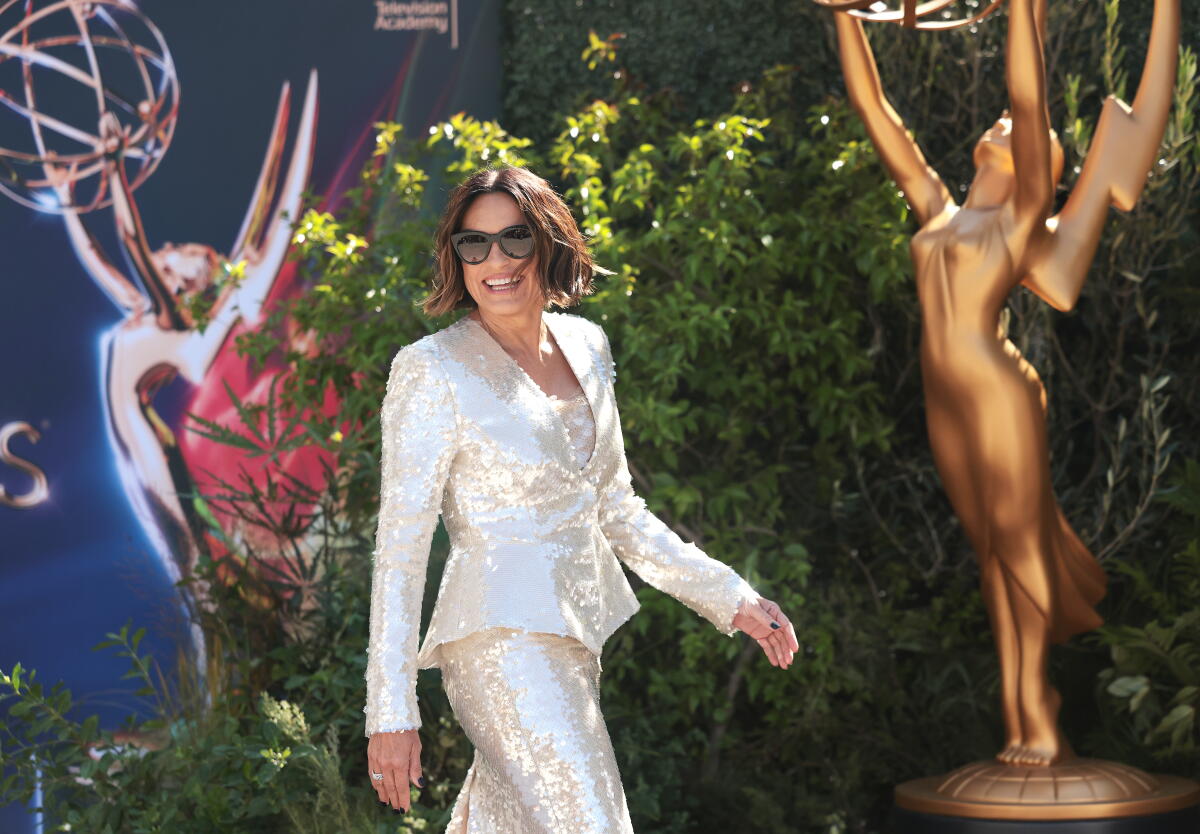
Mariska Hargitay at the blue carpet rollout at L.A. Live in downtown Los Angeles on Thursday.
(Christina House/Los Angeles Times)
Mariska Hargitay, known for playing Olivia Benson on NBC’s “Law & Order: Special Victims Unit,” will make her hosting debut at this year’s award show.
In an interview with The Times, the multihyphenate said she was excited to televise some “razzle-dazzle” and to become the first woman to host in 15 years.
“Am I scared? Of course I am; I’ve never done this,” she recently told The Times. “But at a certain point, you have to go: Why not me? Bring it on.”
When does the red carpet start, and how can I watch that?
The countdown to the award ceremony will begin at 2 p.m., with several opportunities to see your favorite stars arrive on the red carpet — which is actually blue this year in celebration of NBC’s 100th anniversary — at the Peacock Theater.
E! will get the party started with a programming block from 2 to 5 p.m. with “Live From E!: Countdown to the Emmys,” hosted by Erin Lim Rhodes with Lance Bass and Ciara Miller, and “Live From E!: The Emmys,” hosted by Justin Sylvester, Keltie Knight and Will Marfuggi.
People and Entertainment Weekly will be conducting interviews as guests arrive on their websites and social platforms throughout the day, while NBC will be livestreaming pre-show arrivals on the network’s official TikTok account from 4 to 5 p.m.
KTLA will air “Live From the Emmys,” hosted by Jessica Holmes and Melvin Robert with Megan Henderson reporting, from the blue carpet beginning at 3 p.m. And CNN will air “Red Carpet Live: TV’s Biggest Night” beginning at 2 p.m. It will be hosted by CNN’s Elizabeth Wagmeister and Variety co-president and co-editor in chief Ramin Setoodeh.
What shows and actors are nominated?
“The Pitt” will defend its drama series title against “The Diplomat,” “The Gilded Age,” “A Knight of the Seven Kingdoms,” “Paradise,” “Pluribus,” “Slow Horses” and “Your Friends & Neighbors.”
Zendaya (“Euphoria”) is looking to become a three-time winner for lead actress in a drama. She is nominated alongside Carrie Coon (“The Gilded Age”), Chase Infiniti (“The Testaments”), Keri Russell (“The Diplomat”) and Rhea Seehorn (“Pluribus”).
Noah Wyle (“The Pitt”) is again nominated for lead actor in a drama, along with Sterling K. Brown (“Paradise”), Gary Oldman (“Slow Horses”), Mark Ruffalo (“Task”) and Rufus Sewell (“The Diplomat”).
“Hacks” earned the most nominations in a single year for a comedy, with 24. It’s nominated for comedy series, as is “Margo’s Got Money Troubles,” “Nobody Wants This,” “Only Murders in the Building,” “Abbott Elementary,” “The Bear,” “Shrinking” and “Widow’s Bay.”
Jean Smart looks to win her fifth award for lead actress in a comedy series for “Hacks.” She is nominated alongside Quinta Brunson (“Abbott Elementary”), Ayo Edebiri (“The Bear”), Elle Fanning (“Margo’s Got Money Troubles”) and Lisa Kudrow (“The Comeback”).
Yahya Abdul-Mateen II (“Wonder Man”), Steve Carell (“Rooster”), Matthew Rhys (“Widow’s Bay”), Jason Segel (“Shrinking”) and Martin Short (“Only Murders in the Building”) are nominated for lead actor in a comedy.
See the full list of nominees here.
Who’s going to win?
It’s looking like a year where the winners will be easy to decipher, according to awards prognosticators, which includes The Times’ award columnist Glenn Whipp. If you’re an actor attached to either the medical drama “The Pitt” or the horror-comedy “Widow’s Bay,” consider yourself the front runner. Noah Wyle and Matthew Rhys are both the leading contenders in their respective categories.
Jean Smart is predicted to complete her sweep of lead actress in a comedy for the fifth and final season of “Hacks.” In the leading actress in a drama, it’s a tight race between Rhea Seehorn for “Pluribus” and Keri Russell for “The Diplomat.”
The second season of “The Pitt” currently stands as the favorite for drama series, while the comedy series category is a battle between new series “Widow’s Bay” and departing series “Hacks.”
Harrison Ford could win his first major acting award, for supporting actor in a comedy for “Shrinking,” unless another veteran actor takes the spotlight — Stephen Root of “Widow’s Bay.”
Supporting actress in a comedy also comes down to the top shows, likely to be between Kate O’Flynn (“Widow’s Bay”) and Hannah Einbinder (“Hacks”).
Who’s going to present?
A number of nominees will present the awards throughout the night. Past and recent Emmy winners, including Linda Cardellini, Sally Field, David Harbour, Zendaya and Alan Cumming will take the stage.
The Television Academy will celebrate the 30th anniversary of “Buffy the Vampire Slayer” and bring together David Boreanaz and Sarah Michelle Gellar as presenters. They will also honor the 50th anniversary of “Charlie’s Angels,” and reunite Cheryl Ladd, Kate Jackson and Jaclyn Smith.
Other presenters include Odessa A’zion, Macaulay Culkin, Jon Hamm, Marcello Hernández, Peter Krause, Dan Levy, Julianna Margulies, Annie Murphy, Niecy Nash-Betts, Keke Palmer, Amanda Peet, Amy Poehler, Florence Pugh and Rachel Sennott, with more to be announced.
Singer-songwriter Noah Kahan will cover Simon and Garfunkel’s “Bridge Over Troubled Water” during the in-memoriam segment of the show.