Weekly insights and analysis on the latest developments in military technology, strategy, and foreign policy.
Welcome to Bunker Talk. This is a weekend open discussion post for the best commenting crew on the net, in which we can chat about all the stuff that went on this week that we didn’t cover. We can also talk about the stuff we did or whatever else grabs your interest. In other words, it’s an off-topic thread.
This week’s second caption reads:
Col. William C. Hannan, Jr., U.S. Army Corps of Engineers Transatlantic Division commander, examines innovative design feature updates on the U.S. Army Central’s Bunker Retrofit project, designed to increase protection for service members throughout the U.S. Central Command’s area of operations, prior to the U.S. Army Engineer Research and Development Center’s Phase II Live-fire Experiment at Fort Polk, La., Mar. 10.
Also, a reminder:
Prime Directives!
If you want to talk politics, do so respectfully and know that there’s always somebody that isn’t going to agree with you.
If you have political differences, hash it out respectfully, stick to the facts, and no childish name-calling or personal attacks of any kind. If you can’t handle yourself in that manner, then please, discuss virtually anything else.
No drive-by garbage political memes. No conspiracy theory rants. Links to crackpot sites will be axed, too. Trolling and shitposting will not be tolerated. No obsessive behavior about other users. Just don’t interact with folks you don’t like.
Do not be a sucker and feed trolls! That’s as much on you as on them. Use the mute button if you don’t like what you see.
So unless you have something of quality to say, know how to treat people with respect, understand that everyone isn’t going to subscribe to your exact same worldview, and have come to terms with the reality that there is no perfect solution when it comes to moderation of a community like this, it’s probably best to just move on.
Finally, as always, report offenders, please. This doesn’t mean reporting people who don’t share your political views, but we really need your help in this regard.
Weekly insights and analysis on the latest developments in military technology, strategy, and foreign policy.
Welcome to Bunker Talk. This is a weekend open discussion post for the best commenting crew on the net, in which we can chat about all the stuff that went on this week that we didn’t cover. We can also talk about the stuff we did or whatever else grabs your interest. In other words, it’s an off-topic thread.
This week’s second caption reads:
A field medical laboratory belonging to the 512th Field Hospital sits inside an old Soviet-era bunker as part of Exercise Dynamic Employment of Forces to Europe for NATO Deterrence and Enhanced Readiness (DEFENDER) 2025, Vepriai Rocket Base, Lithuania, May 12, 2025. During Swift Response, the initial phase of DEFENDER 25, the Defense Health Agency’s Force Health Protection team is providing essential support and expertise to U.S. Army medical providers assigned to the 512th Field Hospital, 519th Hospital Center, 30th Medical Brigade, and 68th Theater Medical Command. As part of DHA’s Operational Medical Systems Program Management Office, FHP works with combatant commands and regulatory experts across the globe to rapidly provide a treatment, diagnostic, or preventive medical countermeasure against high-consequence threats to the Warfighter when a Food and Drug Administration-approved product is not available. (Defense Health Agency Photo by T. T. Parish/Released)
Also, a reminder:
Prime Directives!
If you want to talk politics, do so respectfully and know that there’s always somebody that isn’t going to agree with you.
If you have political differences, hash it out respectfully, stick to the facts, and no childish name-calling or personal attacks of any kind. If you can’t handle yourself in that manner, then please, discuss virtually anything else.
No drive-by garbage political memes. No conspiracy theory rants. Links to crackpot sites will be axed, too. Trolling and shitposting will not be tolerated. No obsessive behavior about other users. Just don’t interact with folks you don’t like.
Do not be a sucker and feed trolls! That’s as much on you as on them. Use the mute button if you don’t like what you see.
So unless you have something of quality to say, know how to treat people with respect, understand that everyone isn’t going to subscribe to your exact same worldview, and have come to terms with the reality that there is no perfect solution when it comes to moderation of a community like this, it’s probably best to just move on.
Finally, as always, report offenders, please. This doesn’t mean reporting people who don’t share your political views, but we really need your help in this regard.
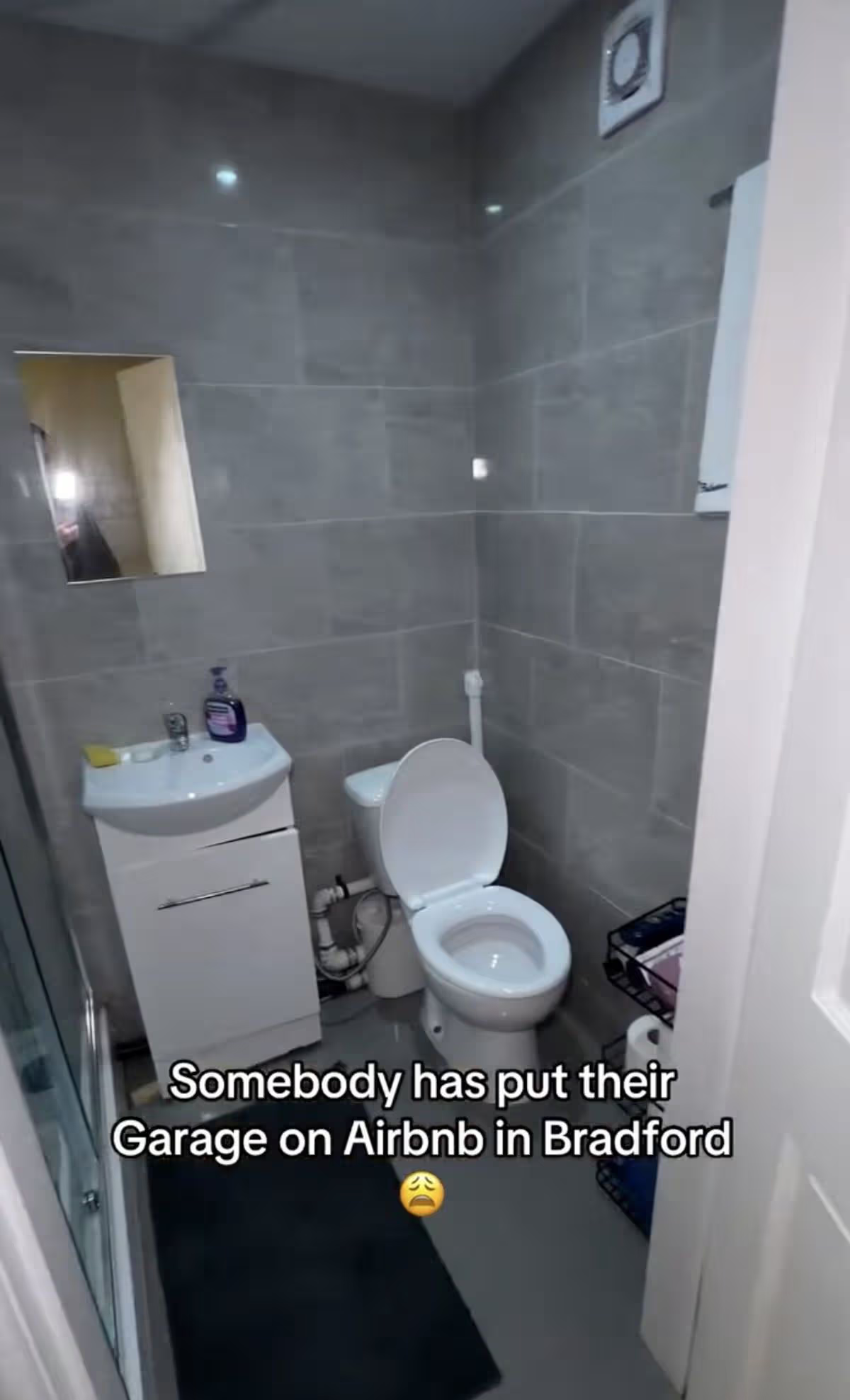
At garage has been put on Airbnb, complete with bed, bathroom and microwave cooker, and r eviewer Zac Jones said he loved it after booking in for a stay.
A video, which has amassed more than 86k likes on social media, showed the property behind an electric security shutter which rose to reveal the entrance door. Inside it was radiator-heated with a double bed, couch, TV, ensuite toilet and shower.
It even had a fridge. Before his stay, Zac said he really didn’t know what to expect. But once inside, he said he was very pleasantly surprised.
He said: “Someone has put a lot of effort in. It’s got snacks, and tea and coffee-making facilities. Shout out to the owner of this place. This has been one of my most interesting check-ins in a while.”
The garage in Bradford, West Yorkshire is available for £30. Viewers were impressed. One person said: “For the price, it actually looks good.” Another viewer added: “30 quid! I’ve stayed in worse for 100.”
And a third commenter said: “This is totally fantastic idea. If all the planning and building controls have been met. The Government should pay attention to ideas like this. Can you just imagine the very quick fix for many of homeless people.”
MIAMI — Secretary of State Marco Rubio testified in court that he had no knowledge that former Florida congressman David Rivera was lobbying on behalf of Venezuela’s government — as prosecutors later alleged — when he met with his longtime friend to discuss U.S. policy toward the South American country several times at the start of the first Trump administration.
“I would’ve been shocked” had I known, Rubio said in almost three hours of testimony Tuesday at Rivera’s federal trial in Miami.
Rivera and an associate were charged in 2022 with money laundering and failing to register as a foreign agent after being awarded a $50-million lobbying contract by Nicolás Maduro’s government.
Prosecutors allege that the goal of the lobbying effort was to persuade the White House to normalize relations with Venezuela, while Rivera’s attorneys argue that the three-month contract, which ended before Rivera met with Rubio, was focused exclusively on luring Exxon Mobil back to Venezuela — commercial work that is generally exempt from the Foreign Agents Registration Act.
As part of his work, Rivera and his co-defendant are accused of trying to arrange meetings for then-Foreign Minister Delcy Rodríguez — now Venezuela’s acting president — in Dallas, New York, Washington and Caracas, Venezuela, with White House officials, members of Congress and the chief executive of Exxon.
Rubio testifies, an unusual move
In sometimes deeply personal testimony Tuesday, Rubio discussed at length friendships that date back to the start of his political career as an aide to Bob Dole’s 1996 presidential campaign and a West Miami council member.
Testifying in a packed courtroom with heightened security, Rubio said he and Rivera became “very close” when they overlapped as members of the Florida Legislature. The two Cuban American Republicans co-owned a house in Tallahassee, celebrated family events together and ardently opposed Venezuela’s socialist government when both went to Washington at the same time — Rubio elected to the Senate, Rivera to the House.
So when Rivera texted Rubio in July 2017 that he needed to see him urgently to discuss Venezuela, they agreed to meet the next day, a Sunday, at a friend’s home in Washington where the then-senator was staying with his family, Rubio said.
At the meeting, Rivera informed Rubio that he was working with Raul Gorrín, a media magnate in Venezuela, on what he described as a plan for Maduro to step aside.
“I was skeptical,” said Rubio, adding that the Maduro government was full of “double dealers” constantly pitching unrealistic plans to unseat Maduro. “But if there was a 1% chance it was real, and I had a role to play alerting the White House, I was open to doing that.”
Rubio said he had no knowledge Rivera was himself working for Maduro, as prosecutors would later allege. Rubio said he doubted Gorrín would betray Maduro even when the former congressman opened his laptop and showed millions of dollars in a Chase bank account that he was told were payments from the businessman to Venezuela’s opposition.
“It was an impressive amount,” Rubio said. “He didn’t tell me whose account it was. He said it was to support the opposition.”
Two days later, borrowing talking points provided by Rivera, Rubio wrote and delivered a speech on the Senate floor signaling the U.S. would not retaliate against Venezuelan insiders who worked to push Maduro from power.
“He provided me with insight into some of the key phrases that regime insiders would’ve wanted to hear to know this was serious,” Rubio testified. “No vengeance, no retribution.”
Rubio also spoke to Trump, alerting the president in his first term that there may be something “brewing” with Venezuela.
‘A total waste of my time’
But the peacemaking effort collapsed almost immediately. At a second meeting at a Washington hotel, Gorrín failed to produce a promised letter from Maduro to Trump that he wanted Rubio to hand-deliver to the president.
“It was a total waste of my time,” Rubio testified.
Shortly afterward, Trump imposed heavy sanctions on Maduro and members of his inner circle for their decision to go forward with what Rubio called a “fake election” to empower a constituent assembly that undercut the opposition-controlled legislature.
By that time, the senator hewed closely to the Trump administration’s hard line. He taped a rare 10-minute address to the Venezuelan people in July 2017, a day after the divisive election, that was broadcast exclusively on Gorrín’s Globovision network.
“For Nicolás Maduro, who I am sure is watching, the current path you are on will not end well for you,” Rubio said in the televised address.
On the stand, Rubio said that had he known Rivera was working with Gorrín on behalf of Maduro, he never would have agreed to deliver the address on the network.
But Rivera said Rubio’s testimony backed his defense that as a lifelong opponent of communism he never worked to strengthen Maduro’s grip on power.
“Marco Rubio made it abundantly clear today that everything we worked on together in 2017 was meant to remove Maduro from power in Venezuela,” he said in a statement.
Throughout his testimony Rubio, a lawyer, spoke calmly and in command of granular details of U.S. policy toward Venezuela over the past decade, even as he struggled to recall the specifics of his text exchanges with Rivera on Venezuela matters.
His testimony was highly unusual. Not since Labor Secretary Raymond Donovan testified at a Mafia trial in 1983 has a sitting member of the president’s Cabinet taken the stand in a criminal trial.
As if to underscore the uniqueness of his appearance in federal court, Rivera’s attorney, Ed Shohat, asked Rubio to sign a copy of his 2012 autobiography, “An American Son,” at the conclusion of his testimony.
Rivera and his co-defendant, political consultant Esther Nuhfer, are among a small number of friends and family Rubio thanks in the acknowledgment section of his memoir.
This seaside town has been named the best in the country and has a resort pedigree that stretches back well over 150 years, but it also has plenty of modern day challenges
This article contains affiliate links, we will receive a commission on any sales we generate from it. Learn more
Blackpool in winter: grey skies, bright spirit
Everyone has a story to tell about Blackpool. Usually a bad one.
Whether it’s tales of optimistic family holidays that turned into washouts, hotels mysteriously burning down, or stag-dos that bump into far-right protests, it’s the kind of place that people enjoy dunking on.
“What’s going on around here?” I asked the bartender of one town centre pub on my first evening in town.
“F*** all!” he said joyfully, before handing over my £3 pint.
In one, quite literal way, he was onto something. Blackpool has a big problem with emptiness. Specifically, empty shops. Wander five minutes down the road from the Tower, and there are rows of crumbling units with boarded-up windows, clearly long vacated. Others seem occupied but shuttered against the winter winds and lack tourists. It’s a jarring experience, walking from the flashing lights and boinging sounds of the mega-arcades into a deserted lot piled with rubble.
The statistics don’t make for good reading. The town of 144,000 has the third-highest rate of empty shops in the country, according to the Centre for Cities, with 17.6% closed. In some areas, like Central Drive, the figure is 30%. Blackpool also has the second-most abandoned buildings, with one for every 45 people.
Some, such as the £7.6m easyJet Hotel on the prom that never materialised, or the vast, long-empty Odeon, are particularly annoying for residents. And for the newly elected Labour MP for Blackpool North, Chris Webb, who beat Tory Scott Benton partly by promising to tackle the problem.
“I am greatly concerned about it. There are far too many empty properties in the town,” he told the Mirror.
“Once you go past South Pier, you get to Bloomfield. It is the most deprived place in the county. The boarded-up shops there have an impact on whether people travel further out to great places like Waterlow Road and Bond Street.”
While a lot needs to be done, progress is being made. When I visited, builders were hammering away inside the Odeon building, which was adorned with a ‘Coming Soon – June 2026’ banner promising a family entertainment megaplex. An ‘Empty Properties Task Force’ was launched last month to target landlords of long-term vacant properties with Compulsory Purchase Orders, while cash is being splashed on modern retail units and green spaces in Central Drive. Under the new ‘High Street Rental Auctions’ initiative, the council can now sell off five-year leases for shops that have remained empty for over a year, which should help to inject a bit of life into the harder-hit areas.
As much as a lick of paint and Pride of Place funding won’t fix all of Blackpool’s deeply rooted deprivation issues or significantly lower its crime rate, it could help to bring the two versions of the town closer together.
In the summer, Blackpool is the same buzzing pleasure resort that has been enthralling millions of beach-dwelling, rock-chomping Brits since the Victorian age.
In the winter, however, it is a different story.
As soon as I stepped off the train on a dark February afternoon, a frosty gust of wind doused me in the famous North West precipitation. Somehow, I’d arrived in the only part of the country that wasn’t enjoying the first sunny shoots of Spring.
The combination of crumbling properties and miserable weather creates a stark vibe, utterly different from the sandcastle-and-donkey-rich summer months.
“It’s dead quiet out,” the Holiday Inn hotel receptionist remarked as we watched a few hunched raincoated figures push through the wind. For a town that relies on tourism to bring in £2 billion a year and support 30% of its jobs, becoming a relative winter wasteland is a big problem. And one that Blackpool might finally be answering.
Trainline data show that Blackpool is at the beginning of an off-season popularity boom.
Sajjad Motamed, the firm’s UK country manager, explained: “We’ve seen winter rail trips to Blackpool rise by more than 90% compared to last year, with particularly strong demand for weekend breaks. What’s striking is that the growth isn’t just coming from the North West – we’re seeing demand from right across the UK, for example, bookings from Edinburgh have more than tripled year-on-year. It suggests people nationwide are rediscovering classic seaside destinations outside of the traditional summer season, whether for a short getaway or to explore somewhere they may not have previously considered.”
Although the particular Thursday afternoon I’d turned up on was grim to the point that everyone sensible decided to stay inside, the spike in train bookings to a town recently named the country’s best by the Telegraph is borne out by official council figures. In 2023, Blackpool welcomed a record 21.5million visitors, a 5.3% rise in just a year. There are high hopes that 2024 and 2025 will increase the numbers further, once the stats are in.
So why are people coming in the winter?
One reason is cost. Blackpool was recently crowned the UK’s cheapest seaside resort, thanks to delights such as £1 burgers at Higgitt’s Las Vegas Arcade, £3.90 fish and chips at Bentley’s on Bond Street, and £6 breakfasts at Peekaboos. Come winter, room rates are slashed as hotels fight to fill the thousands of rooms in a town with the third cheapest property prices in England and Wales, according to Land Registry data.
Another is the growing selection of off-season activities.
I dropped into the 2024 opened Showtown Museum, which tells the story of Blackpool’s entertainment history through highly interactive exhibits and tapdancing staff members. Until April, a fascinating exhibition is telling the story of little people in the entertainment industry. It is difficult to imagine today, but the Blackpool Tower’s skygardens were once converted into a miniature village “populated” by little people.
Now visitors to the town can stop off at Showtown before heading up the Tower and down into the dungeons on the same Blackpool BIG Ticket that delivers 50% savings and costs £31
Throughout the year, there are plenty of free exhibitions on show at the listed Central Library, home to the Grundy Art Gallery.
After soaking up a bit of culture, you can head to the town’s iconic, year-round Coral Island. I’d bet a tub of 2ps that there is no bigger, more impressive or absurd arcade in the country. Stretching across a good number of football pitches’ worth of lurid carpeting, Coral Island is packed with one-armed bandits, coin droppers, the latest VR tech, and an indoor rollercoaster that wheels over the heads of the gamblers below.
Who cares if the Pleasure Beach is shut for the winter when you’ve got that?
As much as Mr Webb insists the town’s “reputation for stag and hen dos is greatly diminished”, it’s hard to argue that Blackpool isn’t a booze town. Whatever the season, across its 166 bars and pubs, you’ll find dozens of drinks deals cheap enough to make any Up From Londoner swoon. For a quiet but affordable pint, the Churchill is a good bet. For something a bit more late-night and rowdy, the Galleon delivers live music and a great atmosphere most nights.
For Mr Webb, the “missing piece” to the winter tourism slump puzzle would be an all-purpose indoor arena, designed for expos and eSports. Its arrival is uncertain and some way off yet, but talks with the owners of a Premier League football club are promising, the MP says.
This seems like a natural step for a town with a deep-rooted entertainment pedigree. From Strictly to George Formby, people have long come to Blackpool for a show. When I visited, Derren Brown was at the Grand as part of his Only Human tour. At the start of the performance, he uncorked several big cannisters of laughing gas into the auditorium to lull the crowd into a pliable state before having his mystifying, merry way with us.
Whether the gas was real or not, what wasn’t fake was the uproarious laughter of the audience throughout his two-hour set. Lancastrians are a friendly bunch. Whether it’s the charming staff in Stefani’s Pizza joint, a smily mum who stopped her pram for an impromptu chat, or the jovial reaction of an audience member publicly outed as a thief by Brown, there’s a good chance Blackpool will offer you a warm welcome, however miserable the weather.
Weekly insights and analysis on the latest developments in military technology, strategy, and foreign policy.
Welcome to Bunker Talk. This is a weekend open discussion post for the best commenting crew on the net, in which we can chat about all the stuff that went on this week that we didn’t cover. We can also talk about the stuff we did or whatever else grabs your interest. In other words, it’s an off-topic thread.
This week’s second caption reads:
U.S. Air Force Lt Col. John Bergmans, 315th Training Squadron commander, enters the Lawn Atlas Missile Base’s missile silo while exploring the narratives of actual personnel deployed to the site during the Cuban Missile Crisis in Lawn, Texas, Dec. 3, 2020. Bergmans attended the Staff Ride to LAMB in support of the 17th Training Wing Heritage Campaign Plan that was founded on Air Force heritage and the Airmen Warrior Ethos among attending personnel.. (U.S. Air Force photo by Senior Airman Abbey Rieves)
Also, a reminder:
Prime Directives!
If you want to talk politics, do so respectfully and know that there’s always somebody that isn’t going to agree with you.
If you have political differences, hash it out respectfully, stick to the facts, and no childish name-calling or personal attacks of any kind. If you can’t handle yourself in that manner, then please, discuss virtually anything else.
No drive-by garbage political memes. No conspiracy theory rants. Links to crackpot sites will be axed, too. Trolling and shitposting will not be tolerated. No obsessive behavior about other users. Just don’t interact with folks you don’t like.
Do not be a sucker and feed trolls! That’s as much on you as on them. Use the mute button if you don’t like what you see.
So unless you have something of quality to say, know how to treat people with respect, understand that everyone isn’t going to subscribe to your exact same worldview, and have come to terms with the reality that there is no perfect solution when it comes to moderation of a community like this, it’s probably best to just move on.
Finally, as always, report offenders, please. This doesn’t mean reporting people who don’t share your political views, but we really need your help in this regard.
JANE FONDA has taken a brutal swipe at Barbra Streisand as she claims the latter ‘didn’t deserve’ to do the Oscars tribute to Robert Redford.
The US actress, 88, attended the Oscar Awards ceremony Sunday night and revealed that she herself would have liked to have paid tribute to the late actor and friend.
Sign up for the Showbiz newsletter
Thank you!
Jane Fonda has taken a brutal swipe against Barbra Streisand as she claims the latter ‘didn’t deserve’ to do Oscars tribute to Robert RedfordCredit: GettyBarbra Streisand paid tribute to Robert Redford during the 98th annual awards In Memoriam segmentCredit: GettyUS actor Robert Redford was an Oscar-winning director who sadly passed away in September last yearCredit: AFP
Popular for her roles in Barbarella, Grace and Frankie, and Monster-in-Law the actress hit out at Barbra over the 98th annual awards In Memoriam segment.
The ceremony honoured Robert Redford, an esteemed actor and Oscar-winning director who sadly passed away in September last year.
Up to the stage to pay tribute to the late star was none other than singer Barbra Streisand, who he famously shared the screen with in 1973 film The Way We Were.
But Fonda seemed put-out by Barbra being chosen to deliver the speech, making her feelings known in a chat with Entertainment Tonight at Vanity Fair’s Oscar after-party.
She said: “I want to know how come Streisand was up there doing that for Redford?”
“She only made one movie with him, I made four! I have more to say.”
The pair were known for their on-screen chemistry which spanned over decades.
They co-starred in the films The Chase (1966), The Electric Horseman (1979), Barefoot in the Park (1967), and their latest collaboration, the Netflix romantic drama Our Souls at Night (2017).
Speaking about Redford, Jane added: “ I was always in love with him. The most gorgeous human being and such great values. And he did a lot for movies, he really changed movies, lifted up independent movies.”
Fonda questioned why Barbra was the one to deliver the speech when she had starred in four movies with RedfordCredit: Kobal Collection – ShutterstockFonda and Redford were known for their on-screen chemistry which spanned over decadesCredit: Kobal Collection – Shutterstock
Streisand had some touching words when she took to the stage to talk about her former co-star during the awards ceremony tribute.
She said: “He was a brilliant, subtle actor.
“And we had a wonderful time playing off each other because we never quite knew what the other one was going to do in the scene.”
Barbra played Katie to Redford’s Hubbell in the movie, which saw two total opposite personalities fall in love with each other.
The Funny Girl actress also sang a rendition of The Way We Were, the hit song from the movie as part of the In Memoriam segment.
Jane Fonda was left devastated by Redford’s death last year.
“It hit me hard this morning when I read that Bob was gone,” she shared at the time.
“I can’t stop crying. He meant a lot to me and was a beautiful person in every way. He stood for an America we have to keep fighting for.”
Streisand had starred with Redford in the romance flick The Way We Were in 1973Credit: Alamy
An Oscars slugfest for the ages ran its course, with “Sinners” and “One Battle After Another” duking it out and tallying up wins while the low but steady hum of host Conan O’Brien’s patented brand of weirdness tied the room together. A few unnecessarily curt speech interruptions threatened the calm, but mainly, this was a smoothly run machine of a show, devoid of mishaps. Even the rare circumstance of a tie was handled expertly by live-action-short award presenter Kumail Nanjiani, never bringing to mind the immortal confusion of “Moonlight” vs. “La La Land.”
But what didn’t make it to the telecast? Here are some flavorful takeaways — small yet memorable — that stick in mind from our several reporters in the room on Sunday.
A parade of praise for Jessie Buckley
Jessie Buckley arrives on the red carpet at the 98th Annual Academy Awards.
(Myung J. Chun / Los Angeles Times)
As she strode through the lobby of the Dolby Theatre pre-show, Jessie Buckley, nominated for lead actress for her role in “Hamnet,” was fanned with praise by other attendees. Even in the restroom, she couldn’t escape the well-wishers. On her way back to the buzzing lobby, she held the train of her red and pink Chanel gown graciously saying, “Thank you, thank you.” — Brittany Levine Beckman
The pressure’s off for stars during commercial breaks
Elle Fanning and Demi Moore hug during the 98th Academy Awards.
(Robert Gauthier / Los Angeles Times)
During the telecast’s first commercial break, supporting actress nominee Elle Fanning of “Sentimental Value” took her loss in stride and leaned over her seat to chat with former “A Complete Unknown” costar Timothée Chalamet, nominated this year for “Marty Supreme,” and his partner, Kylie Jenner.
Across the aisle, “One Battle After Another’s” Leonardo DiCaprio stood up and reached over to lock fingers with Benicio Del Toro. — Yvonne Villarreal
The Oscars address inflation with a goodie box
A note from Conan O’Brien left for attendees in snack boxes.
(Jessica Gelt / Los Angeles Times)
Each year, guests at the Academy Awards are given a small cardboard box of snacks left beneath their seats to get them through the always lengthy ceremony. A note from the host is generally inside. This year’s note, signed by Conan O’Brien, read, “I hope you enjoy this Conan O’Brien ‘Moderately Happy Meal’ ™. These snacks may not look like much but in any movie theater they would run you $85.” The snacks in question were a box of Junior Mints (Times reporter Josh Rottenberg got Raisinets), a small bag of Skinny Pop and a tin bottle of water. — Jessica Gelt
Jesse Plemons won’t succumb to ‘peer pressure’
Kirsten Dunst and Jesse Plemons arrive at the 98th Academy Awards at the Dolby Theatre in Hollywood.
(Myung J. Chun / Los Angeles Times)
“Bugonia” star Jesse Plemons stood near the main lobby bar talking with friends and posing for pictures with fans while finishing the dregs of a drink. A server approached him and asked if he’d like another. Plemons politely declined and the server laughed, saying, “Sorry, I didn’t mean to give you any peer pressure.” — Jessica Gelt
Amy Madigan inquires about press room rules; ‘Is it like bingo?’
Amy Madigan after winning the Oscar for supporting actress for “Weapons.”
(Kayla Bartkowski / Los Angeles Times)
After taking the stage to accept her first Oscar win for “Weapons” on Sunday, Amy Madigan paused operations in the press room to ask how moderators decide who gets to ask questions of the night’s winners.
“Is it like bingo?” the actor asked. As laughter swelled across the crowd in response, she clarified hers was a “serious question.” — Malia Mendez
After a loss, Stellan Skarsgård knows the meaning of ‘Sentimental Value’
Megan Everett-Skarsgård and Stellan Skarsgård at the 98th Annual Academy Awards.
(Myung J. Chun / Los Angeles Times)
Stellan Skarsgård, of “Sentimental Value,” enjoyed a cocktail in a VIP room just off the main auditorium fresh off of losing the Oscar for supporting actor to Sean Penn for his performance in “One Battle After Another.”
Fans rushed Skarsgård anyway, shaking his hand and telling him how much his performance as a troubled alcoholic father and artist resonated with them. “We had four actor nominations on an international film,” Skarsgård told one of them. “That’s never happened before.” — Jessica Gelt
Two of this Oscar season’s tallest figures share a moment
During a commercial break, 6-foot-5 “Frankenstein” star Jacob Elordi and 6-foot-6 Oliver Laxe, director of international feature nominee “Sirāt,” greeted one another at the lobby bar. The pair, who have been impossible to miss as two of the tallest people at various events throughout awards season, shared a warm, high-altitude embrace and Elordi introduced the French-born Laxe to his date for the Oscars: his mother, Melissa. — Josh Rottenberg
‘The Singers’ and ‘Two People Exchanging Saliva’ winners are happy to share their Oscars success
From left, producer Jack Piatt and director Sam A. Davis, makers of “The Singers,” pose with Natalie Musteata and Alexandre Singh, co-directors of “Two People Exchanging Saliva.” All of them won Oscars for live-action short.
(Kayla Bartkowski / Los Angeles Times)
Gasps erupted in the press room after presenter Kumail Nanjiani announced the seventh-ever tie in Academy Awards history Sunday evening, between live-action shorts “The Singers,” directed by Sam A. Davis and produced by Jack Piatt, and “Two People Exchanging Saliva,” directed by Alexandre Singh and Natalie Musteata.
Speaking to the press room after the ultra-rare event, Piatt was unbothered and even enthused by the outcome, saying he wished there could be a “five-way tie” among all the category’s nominees.
Davis agreed, confiding that he’d previously told the “Two People Exchanging Saliva” team “in confidence, that if we lost, I hope we lost to them.”
Shortly thereafter, Musteata said tying with “The Singers” folks was “such a dream.”
“Someone on Reddit asked us if we would be happy to share the award, and we were like, ‘Heck yeah, we would love to share it with another film that is equally beautiful and totally different.’ ” — Malia Mendez
Elle Fanning soothes Timothée Chalamet after lead actor Oscar goes to Michael B. Jordan
Elle Fanning talks with Stellan Skarsgård during the 98th Academy Awards. Timothée Chalamet was seated in front of Fanning during the show.
(Robert Gauthier / Los Angeles Times)
When Michael B. Jordan walked off stage and the show went to commercial break, Timothée Chalamet, who was up against Jordan in the lead actor category, took a sip of his drink as Elle Fanning, sitting behind him, gave him a pat on the back.
Fanning talked to her “A Complete Unknown” co-star throughout the night, who barely turned around to look at her. Kylie Jenner kept rubbing and patting Chalamet’s hand while he nervously jiggled his right leg. — Yvonne Villarreal and Jessica Gelt
Autumn Durald Arkapaw receives standing ovation in press room after historic win
Autumn Durald Arkapaw accepts the Oscar for cinematography for “Sinners” — the first woman to win the award.
(Robert Gauthier / Los Angeles Times)
“Sinners” shooter Autumn Durald Arkapaw on Sunday became the first woman to win the Oscar for cinematography. As she arrived backstage following her historic win, the press room erupted into applause, with many reporters delivering a standing ovation.
Arkapaw was equally thrilled, telling the room, “A lot of little girls that look like me will sleep really well tonight.”
“I heard Karen O say once at a concert… ‘You have to see you to be you,’” she said. “Ryan gives us, the women on this film, and our heads of department, he gives us those opportunities to shine and be ourselves and work in a creative environment where we’re leading.”
Such trust is rarely extended by directors, Arkapaw said, and she is grateful. — Malia Mendez
Weekly insights and analysis on the latest developments in military technology, strategy, and foreign policy.
Welcome to Bunker Talk. This is a weekend open discussion post for the best commenting crew on the net, in which we can chat about all the stuff that went on this week that we didn’t cover. We can also talk about the stuff we did or whatever else grabs your interest. In other words, it’s an off-topic thread.
This week’s second caption reads:
CHEYENNE MOUNTAIN AIR FORCE STATION, Colo.—Runners participating in the North American Aerospace Defense Command 5k Tunnel Run exit the Cheyenne Mountain Complex through the north portal at Cheyenne Mountain Air Force Station, Colorado, May 10, 2018. The run was open to all local military personnel, friends and family and was held to celebrate the 60th Anniversary of NORAD and the U.S. Canadian binational NORAD agreement.. (U.S. Air Force photo by Senior Airman Dennis Hoffman)
Also, a reminder:
Prime Directives!
If you want to talk politics, do so respectfully and know that there’s always somebody that isn’t going to agree with you.
If you have political differences, hash it out respectfully, stick to the facts, and no childish name-calling or personal attacks of any kind. If you can’t handle yourself in that manner, then please, discuss virtually anything else.
No drive-by garbage political memes. No conspiracy theory rants. Links to crackpot sites will be axed, too. Trolling and shitposting will not be tolerated. No obsessive behavior about other users. Just don’t interact with folks you don’t like.
Do not be a sucker and feed trolls! That’s as much on you as on them. Use the mute button if you don’t like what you see.
So unless you have something of quality to say, know how to treat people with respect, understand that everyone isn’t going to subscribe to your exact same worldview, and have come to terms with the reality that there is no perfect solution when it comes to moderation of a community like this, it’s probably best to just move on.
Finally, as always, report offenders, please. This doesn’t mean reporting people who don’t share your political views, but we really need your help in this regard.
Makai Lemon got another chance Thursday to demonstrate his skills for NFL scouts.
About 50 of them — representatives from each of the 32 teams — gathered at USC to spend a few hours evaluating the school’s latest class of draft prospects. Lemon, who won the Biletnikoff Award last fall as college football’s top receiver, had everyone’s attention.
“Running good routes, catching the ball, running fast,” he said of his objectives for the day. “Whatever I showcase, let them know I can do it at a high level.”
It was a more comfortable setting than Indianapolis. At the scouting combine, Lemon’s performance at the podium drew scrutiny — not for anything he said, but for how he said it. He swayed. He was measured, unhurried, visibly unbothered. Some read it as detached. Others saw something else entirely.
“We don’t want a guy who’s phony and coached up,” said one team executive, speaking on condition of anonymity. “We want a guy to be his authentic self. As long as he’s not a jerk, we love it.”
Rams general manager Les Snead, who attended Thursday’s workout of 17 USC players, put it another way. “At the combine you’re usually getting some version of a personality,” he said. “A lot of times it’s, ‘This is my interview personality,’ and that’s not necessarily who they are 365 days a year.”
USC receiver Makai Lemon catches pass during a drill at the NFL combine in Indianapolis last month.
(Julio Cortez / Associated Press)
The other USC prospects who participated in Thursday’s workouts were receivers Ja’Kobi Lane, Jaden Richardson and Jay Fair; running back Eli Sanders; tight end Lake McRee; offensive linemen J’Onre Reed and DJ Wingfield; defensive linemen Anthony Lucas and Keeshawn Silver; linebacker Eric Gentry; cornerbacks DJ Harvey and DeCarlos Nicholson; safeties Bishop Fitzgerald and Kamari Ramsey; punter Sam Johnson; and long snapper Hank Pepper.
Former Trojan linebacker Mason Cobb, who was on the team in 2024, also participated.
Lemon’s credentials are not in dispute. He finished last season with 79 catches for 1,156 yards and 11 touchdowns. At 5-foot-11 and 192 pounds he’s not big for the position, and according to a school release ran the 40 in 4.46 seconds, which is fast but not blistering. But those aren’t his main strengths.
“One of the underrated aspects when you’re watching wide receivers is toughness, and he kind of oozes toughness,” said Daniel Jeremiah, lead draft analyst for NFL Network. “He catches everything. He’s super strong physically and super strong to the ball.”
The technical detail that stands out for Jeremiah: Lemon doesn’t leave his feet to catch unless he has to. He stays grounded, keeps himself in position to do something after the ball arrives. Receivers who lunge and cradle in the air have nowhere to go. Receivers who catch with their feet under them turn completions into more yards.
“He’s got a really good feel for the game,” Jeremiah said. “I think he’s going to be a high-volume guy. I think he’ll catch 90-plus balls every year and be the quarterback’s best friend.”
Snead, who has a history of finding productive receivers that others miss — among them Cooper Kupp and Puka Nacua — is skeptical of the 40 as a measuring stick.
“You rarely see a route in football where the receiver runs straight for 40 yards and then makes his break,” he said. “Even on a go route you’re usually trying to get an edge on the defender, so you’re not running straight. The 40 might tell you how many gears you have in your body. But sometimes you need to run a route in third gear and then shift into fourth or fifth, or decelerate.”
Jeremiah ranks Lemon among the two best receivers in this draft, giving a slight edge to Ohio State’s Carnell Tate, who projects as more of a down-the-field, big-play threat. Comparisons to Detroit’s Amon-Ra St. Brown (also a former USC player) and Tampa Bay’s Emeka Egbuka have circulated. Jeremiah sees those, but also reaches back to Jarvis Landry, the former Louisiana State standout who made five Pro Bowl appearances.
“I actually think Lemon is a better player than Jarvis Landry coming out,” Jeremiah said. “When you’re instinctive, you’re tough and you catch everything, that’s a pretty high floor. Absolute worst case, you’re going to have a steady, dependable, reliable player.”
Watching from the sideline Thursday was Marqise Lee, who won the Biletnikoff in 2012 — the only other USC player to do so — and was a second-round pick of the Jacksonville Jaguars in 2014. He has spent much of the past several months as a mentor to Lemon, and when the combine criticism arrived Lee wasn’t surprised by any of it.
“My biggest thing to him was just enjoy it,” Lee said. “I know he got a lot of backlash about the media stuff and things like that, but when you know the guy, he’s not a big talker. He’s calm, he’s all about business.”
Lee believes Lemon has the skills to thrive at the next level, but knows how much context matters once a player gets there.
“The league is different until you actually get there and get the opportunity to practice and go through it,” Lee said. “Some people have a hard time adapting. Once he gets on a team I’ll be texting him: ‘How’s the comfort level? How’s the offense?’ Because that stuff matters. Offensive coordinator, people loving you — all that matters.”
Lemon, for his part, already sounds like someone who has thought about this.
“I want to go in there and be myself,” he said. “Don’t want to try to be anybody else.”
Weekly insights and analysis on the latest developments in military technology, strategy, and foreign policy.
Welcome to Bunker Talk. This is a weekend open discussion post for the best commenting crew on the net, in which we can chat about all the stuff that went on this week that we didn’t cover. We can also talk about the stuff we did or whatever else grabs your interest. In other words, it’s an off-topic thread.
This week’s second caption reads:
First Lt. Pamela Blanco-Coca, 319th Missile Squadron missile combat crew commander, and 2nd Lt. John Anderson, 319th MS deputy missile combat crew commander, conduct pre-operational checks at a launch control center in the F.E. Warren Air Force Base, Wyo., missile complex Feb. 9, 2016. The missileers worked heavily in conjunction with missile maintainers to conduct a test of Minuteman III weapon system components in a test known as the Simulated Electronic Launch-Minuteman. (U.S. Air Force photo by Senior Airman Jason Wiese)
Also, a reminder:
Prime Directives!
If you want to talk politics, do so respectfully and know that there’s always somebody that isn’t going to agree with you.
If you have political differences, hash it out respectfully, stick to the facts, and no childish name-calling or personal attacks of any kind. If you can’t handle yourself in that manner, then please, discuss virtually anything else.
No drive-by garbage political memes. No conspiracy theory rants. Links to crackpot sites will be axed, too. Trolling and shitposting will not be tolerated. No obsessive behavior about other users. Just don’t interact with folks you don’t like.
Do not be a sucker and feed trolls! That’s as much on you as on them. Use the mute button if you don’t like what you see.
So unless you have something of quality to say, know how to treat people with respect, understand that everyone isn’t going to subscribe to your exact same worldview, and have come to terms with the reality that there is no perfect solution when it comes to moderation of a community like this, it’s probably best to just move on.
Finally, as always, report offenders, please. This doesn’t mean reporting people who don’t share your political views, but we really need your help in this regard.