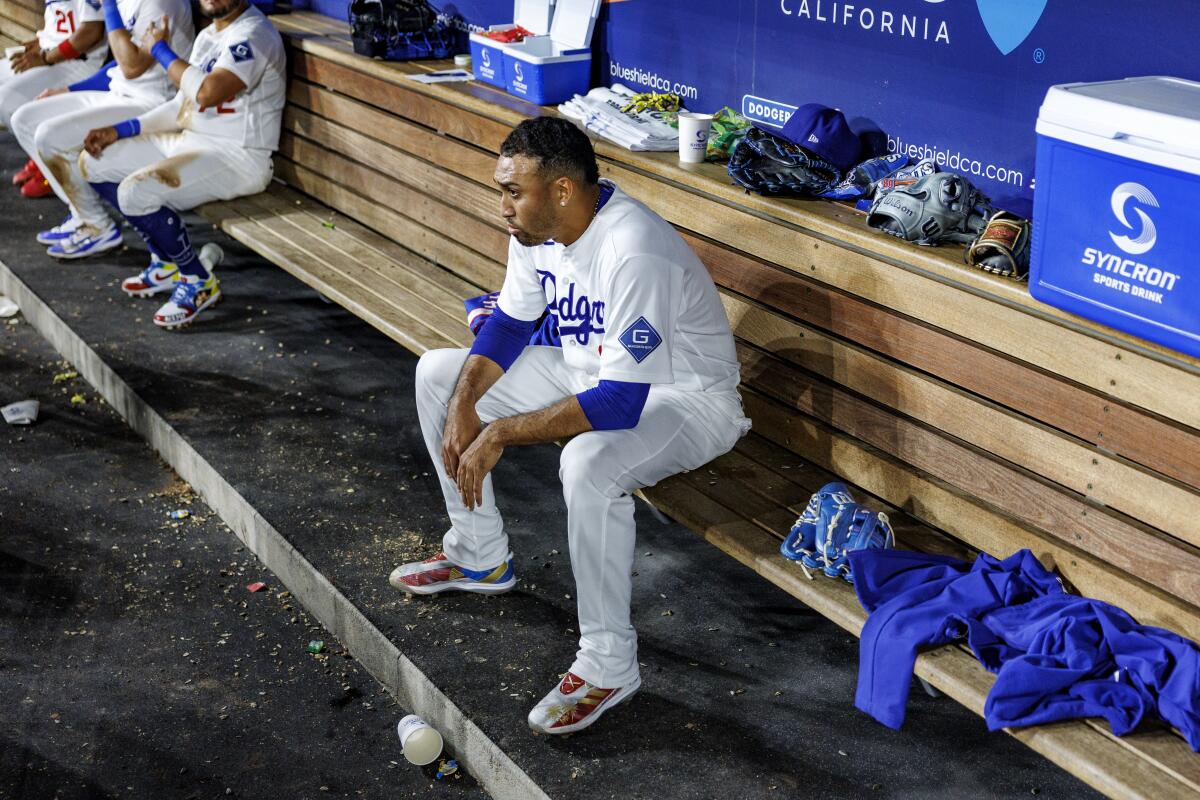
Díaz

Edwin Díaz is the Dodgers’ closer. How rest of the bullpen shapes up

p]:text-cms-story-body-color-text clearfix”>

By Game 7 of last year’s World Series, the Dodgers’ faulty bullpen issues were apparent even in the midst of dramatic triumph.

Not only did the Dodgers use all four starters in their postseason rotation — Shohei Ohtani, Blake Snell, Tyler Glasnow and Yoshinobu Yamamoto — they also tapped Justin Wrobleski and Emmet Sheehan, who combined to start 14 games in the regular season, to navigate the 5-4, 11-inning win that secured the team’s second consecutive championship.

The Dodgers shored up the bullpen over the winter, signing three-time all-star Edwin Díaz to a three-year, $69-million contract. With the closer role firmly defined for the first time since Kenley Jansen was on the team in 2021, how the rest of the bullpen falls into place remains a work in progress during spring training.

“Obviously, adding Díaz to the back end is huge for us and getting Alex Vesia [back] is going to be good, and also Blake [Treinen],” Dodgers manager Dave Roberts said. “Blake wasn’t right last year, clearly. He’s throwing the baseball really well. Having guys that you trust is everything for the pen. … You’ve got to count on those veteran guys for sure.”

Now included in that veteran group is left-hander Tanner Scott, who joined the Dodgers before last season on a four-year, $72-million deal. Scott struggled to find his footing, primarily as a closer, before a left elbow injury placed him on injured list in mid-July, causing him to miss a month of action. He returned the final week of August, and never looked quite right. Scott posted a 4.74 ERA across 61 appearances and 57.0 IP in his first year with the Dodgers.

On Saturday against the Chicago Cubs in a split-squad game at Camelback Ranch, Scott made his Cactus League debut and pitched a scoreless inning, recording a strikeout and giving up one hit on 17 pitches. With the ninth inning spoken for, Roberts believes this will allow for Scott to bounce back this season.

“I think being able to use Tanner in any inning of leverage, is going to be good for him,” Roberts said. “And it’s going to be good for us.”

Díaz, for his part, has settled in, making his second appearance of the spring on Saturday. He worked around two walks to pitch a scoreless inning, striking out one. Vesia, who missed the World Series due to the death of his newborn daughter, has pitched two scoreless innings while Treinen pitched a perfect inning on Thursday against the Chicago White Sox in his first Cactus League outing.

The 37-year-old Treinen, who’s been on all three of the Dodgers’ recent World Series teams and was a stalwart in the 2024 postseason, struggled last season, going 1-5 with a 9.64 ERA in September.

“You never know what the body throttles back,” Treinen said earlier in camp. “I had a UCL injury, so I don’t know if that’s part of the problem, but something was different. I mean, velocity was there, movements were there, execution wasn’t, and when pitches were in the zone, it was a harder-hit rate. So, that tells me something was different, how to handle hitters. So, just trying to go back and cleaning things up to where the ball does more of what it has done most of my career.”

On the flip side, right-hander Brusdar Graterol — who has not pitched since the 2024 World Series — remains in a holding pattern during spring training as he works his way back from right labrum surgery. And right-hander Evan Phillips is not expected back for several months after Tommy John surgery ended his season last June. But for the most part, the relievers who are healthy have shown glimpses of what it could look like this season.

“I don’t think that there’s one way to manage a pen,” Roberts said. “But when you have a guy like Edwin Díaz as your closer, I do think it frees up other guys. … I think that’s freeing for me and allows for getting the matchups we need in the prior innings.”

Source link

What to expect with MLB’s ABS system, and how Dodgers will navigate it

Flashing bleached hair under his cap as he settles in with his new team, Dodgers closer Edwin Díaz threw his first pitch of Thursday’s live bating practice session to Freddie Freeman. It was called a strike. As Díaz got set for his next pitch, Freeman tapped on his helmet in a playful attempt to challenge the call.

In response, Díaz tapped his cap twice.

These gestures will become the norm in major league baseball this season, starting this weekend, thanks to the Automated Ball-Strike (ABS) Challenge System.

Each team will begin games with two challenges, initiated by a pitcher, hitter or catcher tapping their head within seconds of the call — no dugout consultation allowed. The moment it’s challenged, a graphic will show the result of the challenge on the video board and once the call is confirmed or overturned, the game will go on.

Teams retain challenges when they’re successful and lose them when they’re not.

The added layer of strategy intrigues Stephen Nelson, the Dodgers’ radio play-by-play voice.

“As humans we are naturally resistant to change, especially baseball fans, and I say that as a baseball fan,” Nelson said this week at the team’s Camelback Ranch training facility. “So there’s definitely going to be that early period where everybody’s probably going to hate it, but you got to get through that.”

In recent years, MLB has tweaked the game — implementing a replay system to challenge calls on the field, placing a runner on second base to start extra innings, using a pitch clock. The ABS system has been tested in the minor leagues since 2022, and major leaguers got a taste of it during spring training last year and also in the All-Star Game.

In 288 spring games last year, there was an average of 4.1 challenges per game, adding an average of 57 seconds to it. Pitchers and catchers successfully overturned calls more often than hitters.

So who will be in charge of making challenges during at-bats?

“I will let the catcher dictate if he [wants] to challenge or not,” Díaz said this week. “I won’t do it … he’s been there all day long, they know the strike zone for the umpire.”

Dodgers manager Dave Roberts was hesitant to say the club will have a hard rule on who can call for challenges. He feels more comfortable with his catcher doing it than a hitter or pitcher, but if a catcher decides to challenge, he expects them to be right.

“He better be right,” Roberts said Friday.

“It’s good that we’re practicing in spring, but we’re having conversations about leverage and how to use it to our advantage,” he added.

Roberts said if hitters want to make a call, they need to be honest with themselves about their personal knowledge of the strike zone and their baseball IQ and understand when to challenge a call and when not to.

“There’s no perfect science to it, but we’re just going to keep talking about it, trying to educate our guys,” he said.

Luis Cruz, a former player and now a Spanish-language announcer for the Dodgers, said hitters don’t need to be thinking about challenging a call.

“I don’t want to have another thing in my mind … then you lose your focus on your at-bat,” he said.

Jackson Ferris to start Sunday’s game

Left-hander Jackson Ferris, the Dodgers’ minor league pitcher of the year in 2024, will start Sunday’s game against the San Diego Padres at the Peoria Sports Complex.

Ferris, acquired along with outfield prospect Zyhir Hope from the Chicago Cubs for Michael Busch two years ago, logged a 3.86 ERA and 1.46 walks plus hits per inning pitched across 26 games and 126 innings at double-A Tulsa last season.

“I like Jackson,” Roberts said. “I like the player. He’s a good kid. A lot of talent. I think for me, it’s just trying to harness his arsenal. It’s a good fastball. He needs to continue to get ahead, be able to put hitters away with the secondary pitches, be efficient with his pitches per inning, but I like Jackson. He’s really talented. He’s scratching the surface, but he’s gotta go out there and perform, so I’m excited to see him on Sunday, and throughout the spring.”

Source link