On Monday came the latest evidence of dysfunction within the Trump administration’s counterterrorism apparatus, when Joe Kent, the director of the National Counterterrorism Center, resigned, citing his opposition to the war in Iran. But the disarray is not new.
In July 2025, Sebastian Gorka, the senior director for counterterrorism on President Trump’s National Security Council, announced that he was “on the cusp of releasing the unclassified new presidential U.S. counterterrorism policy.” Yet eight months later, while America wages war on a notorious state sponsor of terrorism, the strategy has yet to be released.
Meanwhile, the Department of Homeland Security has not published a National Terrorism Advisory since September and has failed to issue the annual Homeland Threat Assessment report since Trump returned to office. This remains the case, even as counterterrorism experts have warned about the possibility of Iranian-backed sleeper cells being activated because of the current conflict with Iran.
Without a strategy that clearly lays out American priorities and responses, America’s counterterrorism defenses are divided, disorganized and under-resourced. It is this malfunction that left Trump answering a question about whether Americans should expect more violence in the homeland with an effective shoulder shrug: “I guess.”
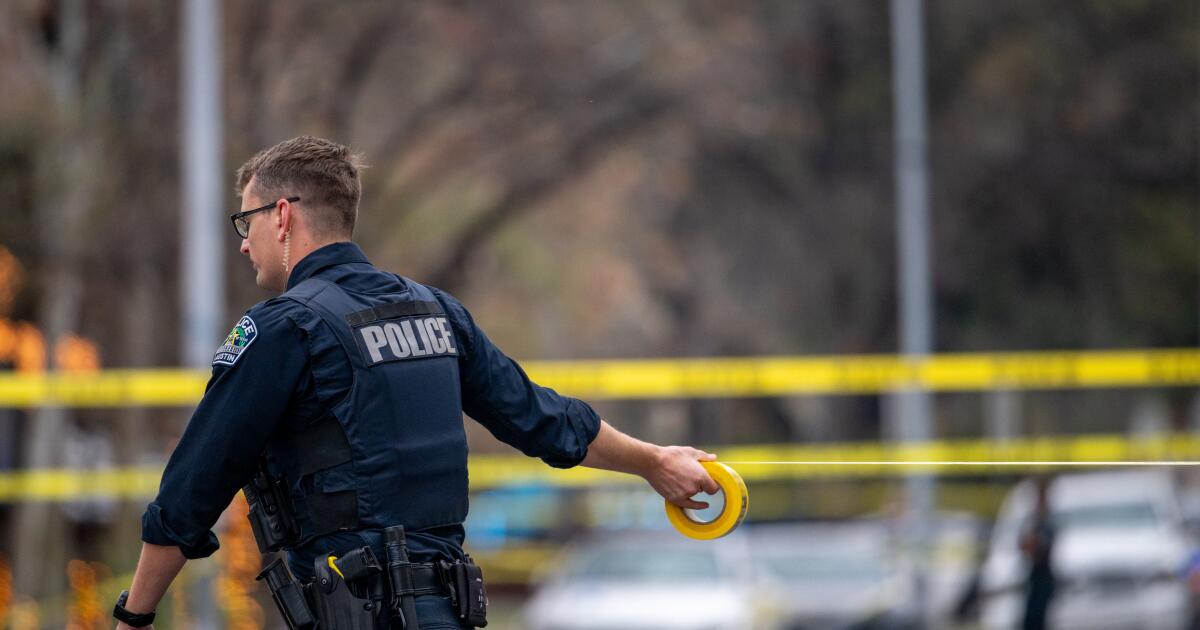
The homegrown backlash to the Iran conflict began on March 1, when a naturalized U.S. citizen opened fire at a bar in Austin, Texas. The gunman, who was wearing clothing pointing to his support of Iran, killed three before being killed by police gunfire. On March 7, two Islamic State-inspired teens hurled improvised explosive devices at a group of far-right protesters outside the New York City mayor’s mansion. March 12 then saw two attacks. First, a shooting erupted at Old Dominion University, as a former U.S. National Guardsman who had been prosecuted for Islamic State-related plotting killed an ROTC instructor. Then, a U.S. citizen with family ties to Lebanon drove his vehicle into Temple Israel in West Bloomfield, Mich., before dying in an exchange of gunfire with synagogue security officers.
In three of the four attacks, further violence was stopped by heroic takedowns on scene. Perhaps most notably, the Old Dominion attacker was neutralized by students, who stabbed the gunman to death. The heroic stories, while worth uplifting, underscore a bleaker truth: amid war abroad, Americans have been forced to take counterterrorism into their own hands in their own communities, left to fend for themselves against AR-15s, improvised explosive devices and weaponized vehicles.
The diversity of the attacks and the perpetrators makes matters worse. The attackers include a U.S. National Guard veteran who served several years in prison on terrorism charges, two teenagers who traveled to a different state with violent intentions, a man with an apparently long history of mental illness, and a U.S. citizen who lost family members in the latest Israeli-Hezbollah hostilities. Their targets also point to a complex and unpredictable terrorism environment.
Absent more predictable trends, law enforcement will be spread thin, asked to protect an impossible array of locations across the country against an impossible diversity of threats. In this environment, an effective national counterterrorism strategy would likely point to stopping terrorism further upstream, interrupting radicalization and violent mobilization at an earlier stage. Yet the Trump administration has effectively eviscerated its prevention infrastructure, largely dismantling the Department of Homeland Security’s Center for Prevention Programs and Partnerships.
Notably, too, none of the attacks to date seem to be coordinated or directed by the Iranian regime, with the war instead inspiring Western lone actors to attack their own communities. Yet Iran has long engaged in assassination plots in the United States, often by enlisting third-party criminal groups, and may yet seek to activate such a program. As journalists Peter Beck and Seamus Hughes warn: “Iran’s past calculus was low-grade operations in the United States, enough to keep the FBI busy but not large enough to trigger serious military consequences. With the latter now already a reality, the Islamic Republic has less to lose by orchestrating bolder attacks.”
The Trump administration has repeatedly invoked Iran’s history of support for terrorist proxies to justify the conflict: On March 2, for instance, Trump explained that one of the operation’s objectives was “ensuring that the Iranian regime cannot continue to arm, fund and direct terrorist armies outside of their borders.” Indeed, should it follow its historical model, Iran will likely continue to make external operations and inspired violence a significant part of its response, adding sleeper cell activation and sponsored individuals to the ranks of homegrown violent extremists who have so far plagued America’s homeland since hostilities broke out. But without a more defined strategy, America will likely struggle to mount an effective response.
If, as the old saying goes, “all politics is local,” then the modern-day corollary in an era of smartphones is, “all conflict is global.” Whenever there is a war in the Middle East, as kicked off in Gaza following the Hamas terror attacks in southern Israel on Oct. 7, 2023, it exacerbates the terrorism threat landscape around the world, including in the West. When images and videos of the errant U.S. missile attack on a girls’ school flood the internet, it raises the temperature, making attacks by lone actors and other violent extremists with only tangential connections to the conflict more likely.
The breadth of the violence, however, was not guaranteed or pre-ordained. As a Shiite-majority nation, Iran has long held fractious and even hostile relationships with Sunni jihadist actors. The extent of the violence indicates a broader anti-American sentiment prevailing across diaspora communities, likely precipitated by the decades-long war on terror, greatly aggravated by Israeli abuses in Gaza since Oct. 7, 2023, and punctuated by the killings of schoolchildren. The Iran war, in other words, seems to be superseding earlier grievances and instead uniting disparate extremist forces against the United States.
In this environment, the Trump administration needs to stop being so cavalier about counterterrorism. Devoid of an actual strategy and without a director of the National Counterterrorism Center, the United States is even more vulnerable to an attack on the homeland than it would be with those in place. Writing on X, Robert A. Pape, a longtime scholar of terrorism, posted: “After tracking terrorism for 25 years, this is a flashing red light — as bright as I’ve seen prior to a serious attack.”
Only a serious approach to countering terrorism will keep the United States safe, and this is the moment for the Trump administration to demonstrate that it recognizes the stakes. In counterterrorism, inattention can be deadly.
Jacob Ware is a terrorism researcher and the co-author of “God, Guns, and Sedition: Far-Right Terrorism in America.” Colin P. Clarke is the executive director of the Soufan Center. His research focuses on terrorism, counterterrorism and armed conflict.