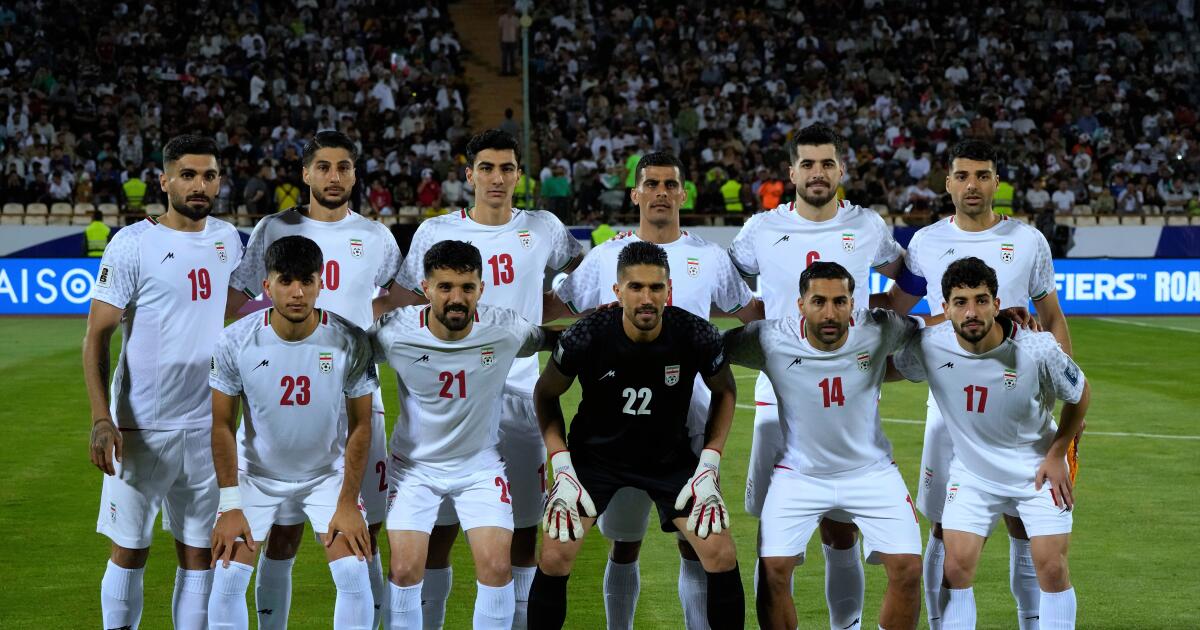
GENEVA — The public wrangling between Iran, FIFA and U.S. President Donald Trump over the narrative of playing in the World Cup shifted on Tuesday to Mexico where President Claudia Sheinbaum seemed open to a suggestion by Islamic Republic diplomats that Iran’s games in June be moved to her country.
The Iranian ambassador and embassy in Mexico City said the country was negotiating with FIFA to move Iran’s three group-stage matches from the United States to Mexico after Trump last week discouraged the team from attending the 48-nation tournament, citing safety concerns.
It was already unclear whether such talks were even happening before FIFA said such unprecedented changes in World Cup history were not planned to a match schedule agreed three months ago.
Sheinbaum was asked about it Tuesday during her daily briefing.
“They are discussing with FIFA whether it’s feasible because they were going to hold the [games] in the United States,” she said. “They are looking into whether they can hold [them] in Mexico, and we will inform you when the time comes. Mexico has relations with all countries in the world. We’ll see what FIFA decides and then we’ll announce it.”
In a statement, FIFA said it is “in regular contact with all participating member associations, including [the Islamic Republic of] Iran, to discuss planning for the FIFA World Cup 2026. FIFA is looking forward to all participating teams competing as per the match schedule announced on Dec. 6, 2025.”
The Feb. 28 start of U.S. and Israeli bombing of Iran that killed the Islamic Republic’s Supreme Leader Ayatollah Ali Khamenei and senior officials immediately cast doubt on the national soccer team going to play at least three World Cup games in the U.S., which is co-hosting the most watched global sports event with Mexico and Canada.
Iran’s soccer federation has not canceled its World Cup entry with FIFA, though official comments have variously suggested the U.S. is unable or unwilling to ensure the delegation’s secure arrival and accommodation.
Since last week, Trump has variously said “I don’t really care” if the Iran team comes, that it was welcome and would be treated like all players as stars, and that the players’ safety was at risk.
In comments posted late Monday on the embassy website, Iran’s Ambassador to Mexico Abolfazl Pasandideh urged FIFA to move the team’s games to Mexico, saying the U.S. was not cooperative on visas.
“We love the Mexican people very much and for us, the best situation is for our games to be held in Mexico,” he was quoted as saying by state-run news agency IRNA.
An Iranian government spokesman and the team itself have said in recent days it is up to FIFA and the U.S. to keep the team safe during the World Cup. The Iran team’s planned training camp is in Tucson.
Pasandideh’s embassy in Mexico City also posted a statement attributed to national soccer federation president Mehdi Taj saying Iran wants to move its group-stage matches out of the U.S.
“When Trump has explicitly stated that he cannot ensure the security of the Iranian national team, we will certainly not travel to America,” the statement said. “We are currently negotiating with FIFA to hold Iran’s matches in the World Cup in Mexico.”
Iran is scheduled to play New Zealand on June 15 and Belgium on June 21 at SoFi Stadium before finishing group play in Seattle against Egypt on June 26.
Moving the games would be remarkable less than three months before the World Cup and risks being judged a failure in the history of tournament hosting.
It also is not envisaged by Iran’s first opponent.
New Zealand soccer federation chief executive Andrew Pragnell said Monday: “I also don’t foresee it as remotely feasible” to move scheduled games to another country. Tens of thousands of tickets have been sold for Iran games, including to visiting fans who have booked flights to the U.S.
“By trying to move the match schedule, you actually create more problems down the track,” Pragnell told New Zealand media outlet Stuff, adding “I don’t think it’ll happen.”
The Belgian soccer federation declined to comment Tuesday.
Trump said last week that the Iran team was welcome at the World Cup despite the ongoing war in the Middle East but “I really don’t believe it is appropriate that they be there, for their own life and safety.”
Iran’s mixed signals include Sports Minister Ahmad Donyamali telling state TV last week that it was not possible to play “due to the wicked acts they have done against Iran.”
But after Trump’s post the national team said on Instagram that “no one can exclude” it from the tournament and a government spokesman in Tehran stressed it was the responsibility of FIFA and the U.S. as a co-host nation to keep players safe and secure.
“FIFA is the organizer of the World Cup,” Iran Foreign Ministry spokesman Esmail Baghaei said. “When warnings are issued at the highest level about the environment being unsafe for Iranian football players, this indicates that the host country apparently lacks the capacity and ability to provide security for such an important sporting event.”
Soccer is followed passionately in Iran, a nation of more than 90 million people which has qualified for seven men’s World Cups and each of the past four editions. The team is ranked No. 20 in the world by FIFA and behind only Japan from Asia.
FIFA has not commented in recent days beyond an Instagram post by president Gianni Infantino last week that he’d received assurances from Trump that Iran was welcome at the tournament.
Dunbar and Pye write for the Associated Press. Amir-Hussein Rajdy in Cairo and Fabiola Sanchez in Mexico City contributed to this report.
Alireza Enayati says relations with Saudi Arabia are ‘progressing naturally’ and he’s in direct contact with Saudi officials.
Published On 15 Mar 202615 Mar 2026
Share
Iran’s ambassador to Saudi Arabia denied Tehran is responsible for attacks on Saudi Arabia’s oil infrastructure, saying if it was behind the strikes, it would have announced it.
Alireza Enayati did not suggest who carried out the attacks, but added Iran is only attacking United States and Israeli military targets and interests during the ongoing war, Reuters news agency quoted him as saying on Sunday.
Recommended Stories
list of 4 itemsend of list
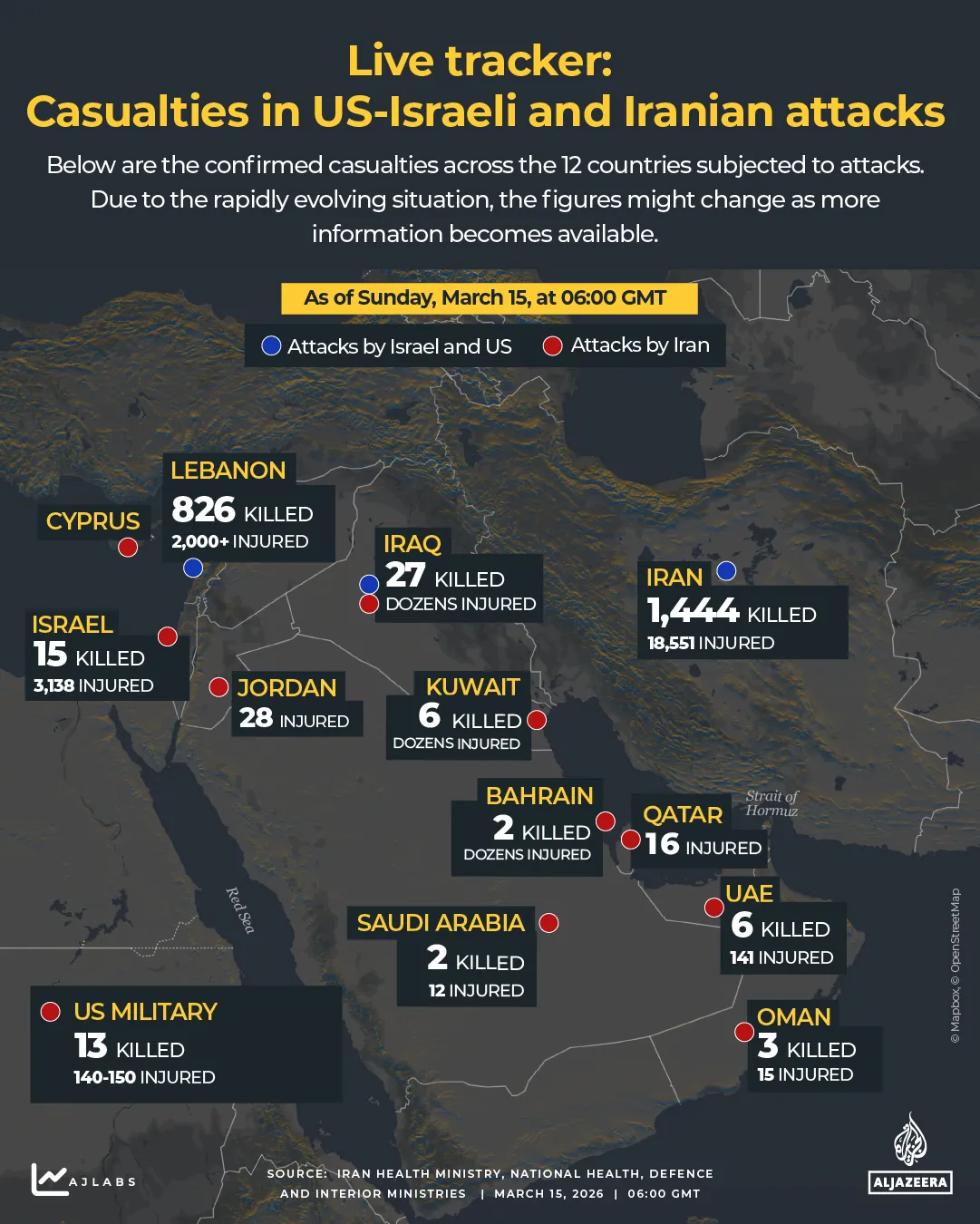
After the US and Israel launched attacks on Iran at the end of February, Tehran retaliated against US and Israeli military assets, including in Saudi Arabia, Qatar, Bahrain, Jordan, Iraq, and the United Arab Emirates (UAE).
Last week, the Ras Tanura oil refinery was forced to stop operations after debris from a drone caused a small fire. Attempted attacks were also reported on the Shaybah oilfield in the desert near the border with the UAE.
So far, Saudi Arabia’s Defence Ministry has not blamed anyone for the attacks.
Enayati said he’s in direct contact with Saudi officials, explaining that relations are “progressing naturally” in many areas.
Talks included Saudi Arabia’s publicly stated position that its land, sea, and air would not be used to target Iran. He didn’t elaborate.
Iran and Saudi Arabia re-established diplomatic relations in 2023, in a deal brokered by China, that saw the two sides, which backed rival groups across the region, agree on a new chapter in bilateral relations.
‘Reliance on external powers’
Enayati reiterated to the Gulf states that the war “has been imposed on us and the region” following coordinated US and Israeli attacks.
Asked about the attacks on Gulf nations, Enayati replied: “We are neighbours, and we cannot do without each other; we will need a serious review.”
“What the region has witnessed over the past five decades is the result of an exclusionary approach and an excessive reliance on external powers,” he said, calling for deeper ties between the Gulf Cooperation Council’s six members along with Iraq and Iran.
Iran’s Foreign Minister Abbas Araghchi also denied his country is targeting civilian or residential areas in the Middle East, and said Tehran is ready to form a committee with its neighbours to investigate the responsibility for such strikes.
So far, the UAE, which normalised relations with Israel in 2020, has faced the brunt of Iran’s attacks, with US bases and oil refineries heavily targeted.
While all countries targeted have strongly condemned Iran’s missile and drone strikes, regional sources say there remains growing frustration at the United States for dragging them into a war they did not sign up for but are now paying the heaviest price for, Reuters reported.
Enayati said to resolve the conflict, the US and Israel need to stop their attacks, and international security guarantees to prevent future “aggression” must be given.
Paul Musgrave, associate professor at Georgetown University in Qatar, said the administration of US President Donald Trump has lost much of its leverage in the region, and the US engaged in the wrong conflict at the wrong moment, without proper planning.
Iran’s strategy, meanwhile, now seems to be “not who has a bigger bomb or bigger munitions, but who has the highest threshold for pain”, Musgrave told Al Jazeera.
Weekly insights and analysis on the latest developments in military technology, strategy, and foreign policy.
U.S. Central Command (CENTCOM) has denied claims circulating online of the loss of another F-15E Strike Eagle, this time over enemy territory, as part of ongoing operations against Iran. Earlier this week, three Strike Eagles were downed in an apparent friendly fire incident, reportedly by a Kuwaiti F/A-18 Hornet. All of this comes as the U.S.-Israeli air campaign continued to expand, and as the overall conflict has otherwise spilled further through the region.
You can catch up with our latest coverage of ongoing operations against Iran here.
“Rumors circulating on social media of a U.S. F-15E crash in Iran early Wednesday are baseless and NOT TRUE,” CENTCOM stated on X Thursday morning.
A CENTCOM spokesperson also told TWZ directly that there have been no aircraft downed other than those in Kuwait.
The denial came after a now-deleted post from the popular @sentdefender account on X claiming a F-15E had gone down went viral, with at least nearly 800,000 views. The post said the aircraft had gone down during a strike mission over southwestern Iran, but said the proximate cause was unknown. The Strike Eagles were said to have been able to eject safely and were then recovered in a joint U.S.-Israeli combat search and rescue mission. Claims about the loss had already been swirling amongst the open-source community.
via X
“We have made the decision to delete reports made last night regarding the crash of a USAF F-15E Strike Eagle in Iran and the successful evacuation of the crewmembers by U.S. and Israeli Combat Search and Rescue (CSAR),” the account wrote in a new post today. “Defender Media maintains confidence in its sources, however, the story is as of now being officially and publicly denied by U.S. Central Command (CENTCOM).”
We have made the decision to delete reports made last night regarding the crash of a USAF F-15E Strike Eagle in Iran and the successful evacuation of the crewmembers by U.S. and Israeli Combat Search and Rescue (CSAR). Defender Media maintains confidence in its sources, however,… pic.twitter.com/E1IYxcAwXs
TWZ has reached out to @sentdefender for further comment.
This is not the first time CENTCOM has taken part in the online information war that has become standard for conflicts in the social media era. Yesterday, the command took to X to refute several claims made by Iran about killing 100 Marines, sinking a destroyer, taking down other aircraft, and forcing U.S. troops to withdraw from the conflict.
“ALL LIES,” CENTCOM stated in its post.
More fake news from the Iranian regime: 🚫The regime claims U.S. forces are withdrawing. 🚫They say they sank a U.S. destroyer. 🚫IRGC claims to have taken down U.S. fighter aircraft. 🚫The regime says they killed 100 U.S. Marines. ALL LIES.
What is true is that the U.S.-Israeli air war over Iran is expanding and includes an increasing number of aircraft employing stand-in munitions closer to their targets. Potential risks can only be magnified, at least to a degree, as operations push deeper into Iran. There is always the potential for aircraft to go down for reasons other than enemy fire, as well.
The rest of our ongoing rolling coverage of the conflict continues below, with the latest updates at the top.
UPDATE: 4:57 PM EST –
U.S. Central Command edited a post on X that originally said “Rumors are circulating on social media of a U.S. fighter jet crash over Basra. These are baseless and NOT TRUE.” to read instead that “Rumors are circulating on social media of a U.S. fighter jet shot down over Basra. These are baseless and NOT TRUE.”
In speaking directly to TWZ, U.S. Central Command had also denied claims that a U.S. military aircraft had been shot down over Iraq, and said the change in the X post’s language was simply a matter of semantics.
Al Jazeera and Rudaw had earlier reported that a search was underway for a U.S. pilot after their plane went down in Iraq’s Basra region, citing local police officials, but did not give a reason for why the aircraft had come down.
#BREAKING: Basra Police Command in Iraq reportedly told Al Jazeera: “Our elements have been dispatched to search for an American pilot who crashed within the province’s borders and has not been found yet” https://t.co/JUDSPSAqGd
#BREAKING: Basra Police confirm to Rudaw that a US aircraft has crashed within the borders of the province. Security forces have launched a search operation for the pilot. pic.twitter.com/8SpZJz5YF9
Regardless, TWZ continues to highlight the potential risks associated with the expanding U.S.-Israeli air campaign against Iran. This all comes amid widespread misconceptions about the degree to which air superiority, let alone air supremacy, has been achieved, as you can read more about in our new piece here.
UPDATE: 3:45 PM EST –
“We are now moving to the next phase of the campaign, in which we will increase the damage to the foundations of the regime and its military capabilities,” IDF Chief-of-Staff Lt. Gen. Eyal Zamir has said in a statement. “We have additional surprising moves, which I do not intend to reveal. We will pursue our enemies, all of them, and we will find them.”
“The Israeli Air Force has carried out 2,500 strikes and dropped over 6,000 munitions,” Zamir also said. “We have neutralized and destroyed more than 60 percent of the ballistic missile launchers” and 80 percent of Iran’s air defense systems.
IDF Chief-of-Staff Eyal Zamir:
“We are now moving to the next phase of the campaign, in which we will increase the damage to the foundations of the regime and its military capabilities. We have additional surprising moves, which I do not intend to reveal. We will pursue our… pic.twitter.com/xUc2k4d5Uj
— Ariel Oseran أريئل أوسيران (@ariel_oseran) March 5, 2026
IDF Chief of Staff Lt. Gen. Eyal Zamir in a press statement says Israel has destroyed 80% of Iran’s air defense systems, “and achieved almost complete air superiority in the skies of Iran.”
“The Israeli Air Force has carried out 2,500 strikes and dropped over 6,000 munitions,”…
— Emanuel (Mannie) Fabian (@manniefabian) March 5, 2026
The IDF continues to release footage from strikes in Iran and Lebanon.
The IDF releases footage of airstrikes targeting several Iranian soldiers in Iran earlier today.
The attacks took place amid a wave of strikes against some 200 targets in western and central Iran, according to the military. pic.twitter.com/zoeMaBrkbU
— Emanuel (Mannie) Fabian (@manniefabian) March 5, 2026
A top Hezbollah commander was killed in an Israeli airstrike in Beirut yesterday, the military announces.
According to the IDF, Zaid Ali Jumaa was responsible for Hezbollah’s “firepower management” and served as the head of its artillery forces in southern Lebanon.
— Emanuel (Mannie) Fabian (@manniefabian) March 5, 2026
The IDF says its aircraft collectively flew more than 7,000 flight hours and struck more than 750 targets in the first 100 hours of Operation Roaring Lion.
The videos below are said to show a major strike in Iran’s Bushehr region earlier in the week. There are reports that Bushehr Air Base was the target.
The Ministry of Defense of the United Arab Emirates (UAE) has released a new tally of interceptions of Iranian missiles and drones in the course of the conflict so far. The country’s forces have downed 196 ballistic missiles, eight cruise missiles, and 1,072 drones, per the latest data.
There are reports of a drone attack in Iraq’s Duhok province near an oilfield operated by U.S. firm HKN Energy.
Two drones have fallen near the Chamanke town of Duhok province in the northern Kurdistan Region-Iraq. HKN, an American oil company, is operating an oilfield in the area. pic.twitter.com/Nln1RrIuMN
The U.S. State Department has suspended operations at the American Embassy in Kuwait City, Kuwait, indefinitely. “While there have been no reported injuries to U.S. personnel, the safety of Americans abroad remains the highest priority of the U.S. Department of State,” the Embassy said in a press release.
Israeli Defense Minister Israel Katz has said that his government made the decision to kill Iranian Supreme Leader Ayollah Ali Khamenei back in November and planned to do so within a six-month timeframe, according to Reuters.
JERUSALEM, March 5 (Reuters) – Israel took the decision to kill Iran’s Supreme Leader Ali Khamenei in November and was planning to carry out the operation around six months later, Defence Minister Israel Katz said on Thursday.
The picture below is said to show Iranian sailors from the IRIS Bushehr being brought ashore in Sri Lanka.
The 208 crew members of the Iranian vessel “IRIS Bushehr” anchored near the Port of Colombo are being brought ashore by the Sri Lanka Navy.
They will be taken to the Welisara Naval Base, while the vessel is expected to be moved to the Port of Trincomalee, the President said. pic.twitter.com/5cJAUgYC1P
— Vidharshana Fernando (@MsVidharshana) March 5, 2026
UPDATE: 2:23 PM EST –
The IDF says it has now conducted 12 waves of strikes on Tehran. Israeli forces also continue to hit targets elsewhere in Iran.
⭕️The IDF completed its 12th wave of strikes across Tehran.
📍Alborz province: The headquarters of the special unit responsible for all internal security forces was targeted.
📍Tehran: Targets belonging to the Iranian Revolutionary Guard Corps, the Basij organization, and a…
The IDF issues an “urgent warning” to Iranians in industrial zones near Tehran of ahead of planned airstrikes.
“Urgent warning to all individuals located in the Abbas Abad industrial area and also the Shenzar industrial area near Sharif Abad in eastern Pakdasht. In the coming… pic.twitter.com/Cgr7LmYI0x
— Emanuel (Mannie) Fabian (@manniefabian) March 5, 2026
In its latest wave of airstrikes in the Tehran area, the IDF says it struck the headquarters of Iran’s special forces, bases of the Basij paramilitary force, and other regime sites.
Some 90 Israeli Air Force fighter jets participated in the strikes, hitting some 40 targets with… pic.twitter.com/To8jbW4APy
— Emanuel (Mannie) Fabian (@manniefabian) March 5, 2026
Iranian authorities say the total death toll from U.S.-Israeli strikes is now 1,230, but again with no breakdown between civilians and members of the country’s military and security forces.
Iran said the death toll in the country from U.S.-Israeli strikes had risen to 1,230 people.
Israeli operations in Lebanon also continue to expand. Alerts were issued earlier in the day advising residents in broad swaths of the Beqaa Valley and the capital Beirut to evacuate ahead of air strikes. Lebanese authorities say that 102 people have died and 638 more have been wounded in Israeli strikes so far.
The IDF issues a wide evacuation warning in Lebanon’s eastern Beqaa Valley ahead of airstrikes on Hezbollah sites.
“Urgent warning to the residents of the Beqaa area, specifically the residents of the villages and towns: Douris, Brital and Majdaloun. Hezbollah’s activities in… pic.twitter.com/2uO7VUbObT
— Emanuel (Mannie) Fabian (@manniefabian) March 5, 2026
Previous evacuation warnings in Beirut have been for specific buildings that the IDF has then struck. The latest order covers four major neighborhoods in the southern suburbs of the city.
— Emanuel (Mannie) Fabian (@manniefabian) March 5, 2026
Lebanon’s health ministry says 102 people dead, 638 wounded in Israeli attacks on Lebanon since monday.
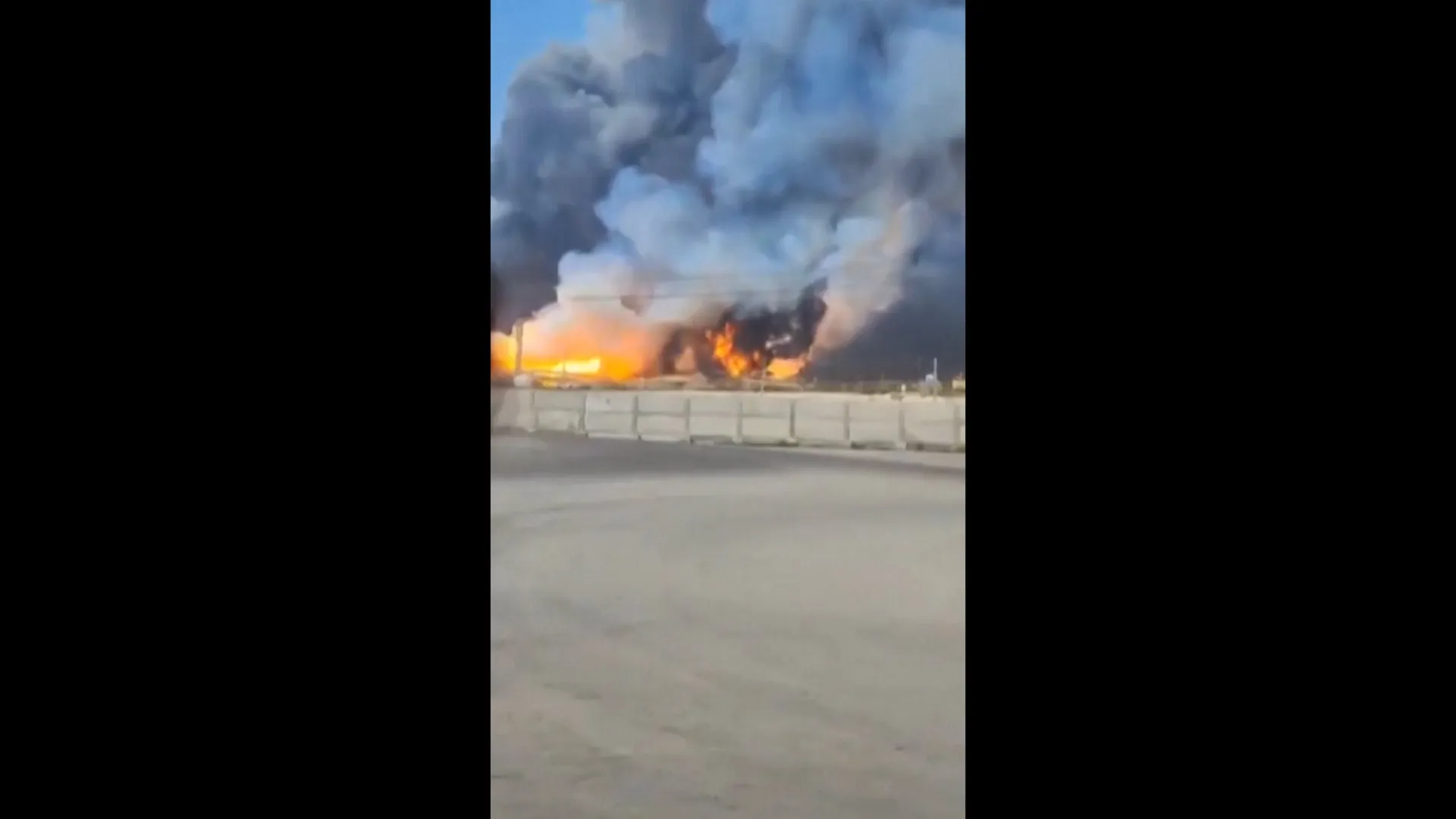
The video and pictures below are said to show a fire at the Bahrain Petroleum Company’s (BAPCO) oil refinery in the Ma’ameer following an Iranian attack.
The earlier Iranian attack on Azerbaijan has caused that country to close a portion of its airspace over the southern end of the country. This adds to already significant airspace closures across the broader region.
Following drone strikes on Nakhchivan International Airport (NAJ) earlier today, Azerbaijan has closed the airspace in its southern sector. Learn more about this, and more, in our updated list of airspace closures and restrictions: https://t.co/AU0KOdzprtpic.twitter.com/X19SnOglD5
Iranian Foreign Minister Abbas Araghchi has told NBC News that his country is prepared for a ground invasion in a new interview. He also said that Iran is still refusing to engage with the United States and has not asked for a ceasefire.
BREAKING: Iranian Foreign Minister tells NBC News that Iran is ready for a U.S. ground invasion of the country as the war between Iran, the U.S. and Israel has quickly spread across the region.
He also refuses any negotiations with the U.S. and says that Iran had not asked for a…
The IDF issues an “urgent warning” to Iranians in industrial zones near Tehran of ahead of planned airstrikes.
“Urgent warning to all individuals located in the Abbas Abad industrial area and also the Shenzar industrial area near Sharif Abad in eastern Pakdasht. In the coming… pic.twitter.com/Cgr7LmYI0x
— Emanuel (Mannie) Fabian (@manniefabian) March 5, 2026
In its latest wave of airstrikes in the Tehran area, the IDF says it struck the headquarters of Iran’s special forces, bases of the Basij paramilitary force, and other regime sites.
Some 90 Israeli Air Force fighter jets participated in the strikes, hitting some 40 targets with… pic.twitter.com/To8jbW4APy
— Emanuel (Mannie) Fabian (@manniefabian) March 5, 2026
Iranian authorities say the total death toll from U.S.-Israeli strikes is now 1,230, but again with no breakdown between civilians and members of the country’s military and security forces.
Iran said the death toll in the country from U.S.-Israeli strikes had risen to 1,230 people.
Israeli operations in Lebanon also continue to expand. Alerts were issued earlier in the day advising residents in broad swaths of the Beqaa Valley and the capital Beirut to evacuate ahead of air strikes. Lebanese authorities say that 102 people have died and 638 more have been wounded in Israeli strikes so far.
The IDF issues a wide evacuation warning in Lebanon’s eastern Beqaa Valley ahead of airstrikes on Hezbollah sites.
“Urgent warning to the residents of the Beqaa area, specifically the residents of the villages and towns: Douris, Brital and Majdaloun. Hezbollah’s activities in… pic.twitter.com/2uO7VUbObT
— Emanuel (Mannie) Fabian (@manniefabian) March 5, 2026
Previous evacuation warnings in Beirut have been for specific buildings that the IDF has then struck. The latest order covers four major neighborhoods in the southern suburbs of the city.
— Emanuel (Mannie) Fabian (@manniefabian) March 5, 2026
Lebanon’s health ministry says 102 people dead, 638 wounded in Israeli attacks on Lebanon since monday.
The video below is said to show strikes on an Iranian missile base in the country’s mountainous Damavand region.
The IRGC’s Damavand missile base, an underground facility east of Tehran used to store ballistic missiles and air defense systems, was heavily struck today. pic.twitter.com/vdf093dYB5
U.S. President Donald Trump has insisted that the U.S. government will have a role in choosing Iran’s future leadership, per Reuters. Trump said today that he would be personally involved in such a selection, according to Axios.
Trump spoke with @steveholland1 and reiterated that the U.S. would have a role in choosing Iran’s next leader. “We don’t have to go back every five years and do this again and again … Somebody that’s going to be great for the people, great for the country,” Trump said. https://t.co/UM8E0hStIA
U.S. Central Command has released a new video showing B-52 bombers flying in support of Operation Epic Fury. Closer inspection of the footage shows the aircraft carrying loads of AGM-158 Joint Air-to-Surface Standoff Missile (JASSM) air-launched cruise missiles.
“This came up in one of my threads yesterday as to B-52s and B-1s likely executing standoff strikes using cruise missiles fired from outside Iran, not direct attacks,” our own Tyler Rogoway has written on X. “This video confirms it, AGM-158 JASSMs on the wings. They were not ready to push anything but B-2s over Iran.”
This came up in one of my threads yesterday as to B-52s and B-1s likely executing standoff strikes using cruise missiles fired from outside Iran, not direct attacks. This video confirms it, AGM-158 JASSMs on the wings. They were not ready to push anything but B-2s over Iran. https://t.co/iYmHgUy2jK
The Washington Post has reported on the U.S. military’s use of artificial intelligence (AI) driven tools to help with developing target packages and other tasks in support of Operation Epic Fury. U.S. Air Force Gen. Dan Caine, Chairman of the Joint Chiefs of Staff, very briefly mentioned the contributions of AI at a press conference at the Pentagon yesterday.
Israeli Prime Minister Benjamin Netanyahu has visited Ovda Air Base, which is currently hosting U.S. combat jets. Pictures show U.S. Air Force F-22 Raptors, which were reported to have arrived last week, as well as at least one F/A-18F Super Hornet. The presence of Super Hornets at Ovda does not look to have been previously disclosed.
IDF Logistics Command says it has already provided “hundreds of millions of liters of fuel” to support ongoing operations, according to The Jerusalem Post. Israel’s small fleet of KC-707 tankers has conducted 550 individual aerial refuelings, according to the Israeli Air Force. Before the conflict erupted, TWZ highlighted the immense value that U.S. tanker support would bring to any future operations against Iran.
The IDF Logistics Command said on Thursday that it has provided a staggering number of hundreds of millions of liters of fuel to enable the game-changing air war against Iran.
כ-550 תדלוקים אוויריים בוצעו עד כה במבצע ״שאגת הארי״, על-ידי מטוסי התדלוק של טייסת 120 (״ענקי המדבר״). מדובר בהיקף המהווה יותר מ-50% מסך התדלוקים שבוצעו בכל מבצע ״עם כלביא״.
התדלוק האווירי של מטוסי הקרב מהווה רכיב הכרחי בפעילות חיל-האוויר באיראן, ומאפשר את שימור העליונות… pic.twitter.com/j1NmEiJ55d
The Institute for the Study of War has published additional satellite imagery analysis of damage to Ali al Salem Airbase in Kuwait from Iranian attacks.
2/ Iranian strikes targeting US bases in the region have caused some material damage and casualties. Commercially available satellite imagery captured on March 4 shows that Iranian airstrikes on the Ali al Salem Airbase in Kuwait damaged several buildings, including aircraft… pic.twitter.com/Gm4lS7sfJT
— Institute for the Study of War (@TheStudyofWar) March 5, 2026
Iranian authorities claim to be engaged in “preemptive” operations targeting Iraqi-based “separatist groups.” This follows still conflicting reports that began emerging yesterday regarding the possibility of a ground incursion by armed Iranian Kurdish groups.
BREAKING: IRGC and the Iranian Ministry of Intelligence announce “preemptive joint operations” against “separatist groups” in Iraq who “intend to enter from the western borders of the country and carry out terrorist attacks with separatist goals in urban and border areas”
Reports that speak about a role of the Kurdistan Region and the allegations claiming that we are part of a plan to arm and send Kurdish opposition parties into Iranian territory are completely unfounded. We categorically deny them and affirm that they are being published…
Iranian state media has also carried threats, attributed to unnamed officials, of attacks targeting the Israeli nuclear site at Dimona in the event of any concerted effort to unseat the current regime in Tehran.
Italian authorities say they are joining the multinational effort to bolster the defense of Cyprus in the face of Iranian attacks.
BREAKING:
Italian Defense Minister Guido Crosetto:
“We will deploy a multi-domain force in the Middle East, with air-defense systems against drones and missiles.
Together with the Spanish and the French, we will bring assistance to Cyprus” pic.twitter.com/ZzzgXIdS7T
In a new interview with Bloomberg, Antony Blinken, who was U.S. Secretary of State under President Joe Biden, has suggested the Trump administration could seek to declare victory based on achievements so far as a possible off-ramp to the current conflict. Blinken also highlighted concerns about the impacts on U.S. munitions stocks and global energy markets if the fighting drags on.
Former U.S. Secretary of State Blinken: One possible off-ramp from the war with Iran is simply declaring victory.
Saying the ayatollah is gone and Iran’s nuclear and missile programs have been degraded — and leaving the future of the regime to the Iranian people.
Blinken: Watch the markets — oil, stocks, and bonds. President Trump is very attentive to them. If stocks and bonds fall, or oil rises sharply and stays there, that could become a limiting factor.
Blinken: One risk of the war with Iran is depleting U.S. arsenals so much that it takes years to rebuild them, leaving America at a disadvantage against powers like China or Russia.
If you undertake something like this, you must factor that in.
There are reports that 1,000 commercial vessels, roughly half of which are oil and natural gas tankers, are currently anchored in and around the Persian Gulf as operators weigh the risks of attempting to sail in and out of the region, citing data from Lloyd’s Market Association. As already noted, ships are being attacked while sailing and at anchor in the Persian Gulf, as well as the Gulf of Oman.
Around 1,000 vessels, roughly half oil and gas tankers, are currently in the Gulf and surrounding waters with an aggregate hull value exceeding $25 billion, Lloyd’s Market Association CEO says.
AFP Infographic with a map of the Strait of Hormuz showing ships that reported attacks or incidents to the UK Maritime Trade Operations (UKMTO) between March 1 and March 4 at 1700 GMT pic.twitter.com/bECVuFSvvP
Strait of Hormuz closure puts Dubai’s import lifeline under strain
Access to key Gulf container ports including Jebel Ali, Khalifa Port, Dammam, and ports in Qatar, Bahrain and Kuwait is currently blocked, with vessel crossings through the Strait of Hormuz down by an estimated… pic.twitter.com/1ZXcMVg2hV
As the joint U.S.-Israeli Operation Epic Fury attack on Iran continues into a sixth day, the war is spreading beyond the Middle East. On Thursday, Azerbaijani officials said Iranian drones struck territory and vowed to retaliate. The country shares a border with northwestern Iran.
“At around midday on 5 March, drone attacks were carried out against the Nakhchivan Autonomous Republic of the Republic of Azerbaijan from the territory of the Islamic Republic of Iran,” the Azerbaijan Foreign Ministry said in a statement. “One drone struck the terminal building of the airport in the Nakhchivan Autonomous Republic, while another drone fell near a school building in the village of Shakarabad. We strongly condemn these drone attacks launched from the territory of the Islamic Republic of Iran, which resulted in damage to the airport building and injuries of two civilians.”
AZ
İran İslam Respublikası ərazisindən Azərbaycan Respublikasının Naxçıvan Muxtar Respublikasına dron hücumları barədə bəyanat
Four people were injured in the attack, according to Azerbaijani officials, and Azerbaijan’s president Ilham Aliyev told a meeting of his Security Council that his country would respond militarily.
“We will not tolerate this unprovoked act of terror and aggression against Azerbaijan,” he proclaimed, according to Reuters. “Our Armed Forces have been instructed to prepare and implement appropriate retaliatory measures. We are ready to demonstrate our strength against any hostile force – and they should not forget this in Iran.”
Aliyev did not offer specifics about what kind of retaliation.
Video seen below is said to show the aftermath of these attacks.
BREAKING:
Iranian suicide drones keep striking Nakhchivan Airport in Azerbaijan.
Iran is now attacking almost every country they can. The neighboring countries won’t put up with this craziness for too long. pic.twitter.com/RhUkOAQtee
Meanwhile, several nations continue to send more military assets to Cyprus. Sky News reported on X that the U.K., Italy, Spain, and the Netherlands are all deploying warships to help bolster the island nation’s defenses. Notably, French President Emmanuel Macron has ordered the aircraft carrier Charles de Gaulle to head to the eastern Mediterranean. In addition, Greece has already deployed four F-16s to the island.
Italy, Spain and Netherlands will send naval ships to protect Cyprus, it’s been announced. They’ll join a Greek warship (already in place), French warship (also in place) and British warship (once it leaves UK next week)
This comes as RAF Akrotiri, a British air base on Cyprus, continues to come under attack. On Thursday, an image emerged showing what appears to be a hole punctured in a hangar regularly used by U.S. Air Force U-2 Dragon Lady spy planes operating from the base. A one-way attack drone hit the RAF Akrotiri base late on Sunday, March 1. It is unclear if any aircraft were there at the time.
The U.K. Defense Ministry told us that there were no casualties and that damage to the base was “minimal.” There was “no damage to equipment inside the hangar,” the official added.
We’ve reached out to the U.S. Air Force and U.S. European Command for comment and will update this story with any pertinent details provided.
🚨 SCOOP: Photo of damage to secret US spy site on RAF Akrotiri.
The drone hit a hangar for US U-2 spy planes on Operation Olive Harvest
Is this “minimal” as per John Healey?
UK Home Sec Yvette Cooper claimed the drone hit the runway. Not true.https://t.co/RsWYSDy9De
Iran claims it has now begun employing Khorramshahr-4 medium-range ballistic missiles (MRBM) in strikes on Israel, but firm corroborating evidence has yet to emerge. The IRGC said it fired a volley of these missiles at Israel’s Ben Gurion Airport earlier today.
NEW: Iranian state media reported that a Khorramshahr-4 heavy missile was launched early this morning toward Israeli territory.
According to the report, the missile carries a one-ton warhead and has an estimated range of about 2,000 kilometers. pic.twitter.com/3sqMLxRv0a
The Khorramshahr-4 is said to carry a 3,300-pound warhead, the heaviest payload of any of Iran’s ballistic missiles, which would allow for a broader swath of targets to be threatened with greater damage from any successful impacts. Khorramshahr-4s could also be fired from areas further in the eastern interior of the country, reducing vulnerability to U.S. and Israeli strikes that have already significantly degraded Iran’s ability to launch missiles and drones. You can read more about what is known about this missile, which is derived from a North Korean design, here.
So far, Israel has not reported any casualties or major damage resulting from Iranian volleys today, and authorities in the country have highlighted a notable drop in overall attacks.
There are no reports of injuries following the latest Iranian ballistic missile salvo on central Israel, medics say.
A small number of missiles were launched in the attack, according to preliminary military assessments. There are no reports of impacts in residential areas.… https://t.co/PsOdR4AWv4
— Emanuel (Mannie) Fabian (@manniefabian) March 5, 2026
The rate of Iran’s ballistic missile fire on Israel continues to slow, according to the Israeli military, with all projectiles fired overnight being successfully intercepted by air defenses.
Iran fired at central Israel three times overnight, lobbing a handful of ballistic…
— Emanuel (Mannie) Fabian (@manniefabian) March 5, 2026
The IDF has now released a video of yesterday’s shootdown of one of Iran’s Russian-made Yak-130 light jets by an F-35I Adir fighter, which appears to be a view from the latter’s targeting system. You can read more about this engagement, which is the first known instance of an F-35 of any kind destroying a crewed aircraft, here.
The Pentagon and at least one Gulf Arab nation have reportedly reached out to Ukraine for cheap interceptors to help fend off waves of low-cost Iranian drones that have killed American troops and caused widespread damage across the Middle East. The talks, reported by the Financial Times, come amid continuing questions about the sufficiency of stocks of anti-air interceptors as Iran’s retaliatory attacks continue. As we have frequently noted, Ukraine has made significant investments in the development of new, lower-cost interceptors in response to years now of Russian drone attacks.
On Thursday, Ukrainian President Volodymyr Zelensky also acknowledged the interest in his country’s counter-drone systems.
“We received signals from partners in the Middle East,” he explained on X. “There have been strikes by Iranian ‘Shaheds’ on civilians in those countries. They are seeking our expertise. We are open. If their representatives come, we will provide the expertise. Especially since there is also a request from Europeans and from the United States. Requests have come to us to share our experience with partners in the Middle East.”
However, Zelensky also stated his oft-repeated concern about his own country’s stock of interceptors and suggested a swap of those for Patriot missiles.
“Regarding weapons: we ourselves are at war. And I said, completely frankly, that we have a shortage of what they have,” the Ukrainian leader noted. “They have missiles for the Patriots, but hundreds or thousands of ‘Shaheds’ cannot be intercepted with Patriot missiles – it is too costly. Nothing is too much for the people, of course, but they simply do not have that many missiles. That is why they need interceptor drones, which we have. Meanwhile, we have a shortage of PAC-2 and PAC-3 missiles. So, when it comes to technology or weapons exchange, I believe our country will be open to it.”
We received signals from partners in the Middle East. There have been strikes by Iranian “shaheds” on civilians in those countries. They are seeking our expertise. We are open. If their representatives come, we will provide the expertise. Especially since there is also a request…
— Volodymyr Zelenskyy / Володимир Зеленський (@ZelenskyyUa) March 5, 2026
While the Pentagon eyes Ukrainian interceptors, U.S. Central Command is reportedly seeking additional personnel to help handle the flow of intelligence pouring in from the Middle East. CENTCOM “is asking the Pentagon to send more military intelligence officers to its headquarters in Tampa, Florida, to support operations against Iran for at least 100 days but likely through September,” Politico reported, citing a notification it obtained.
“It’s the first known call for additional intelligence personnel for the Iran war by the administration, and a sign the Pentagon is already allocating funding for operations that may stretch long beyond President Donald Trump’s initial four-week timeline for the conflict,” the outlet posited. “The rush to add people and resources to support efforts that are often organized well in advance of U.S. military action highlights how the Trump team had not fully anticipated the wide fallout of the war it launched alongside Israel on Saturday.”
“U.S. Central Command, meanwhile, is asking the Pentagon to send more military intelligence officers to its headquarters in Tampa, Florida, to support operations against Iran for at least 100 days but likely through September, according to a notification obtained by POLITICO.”…
It has been pointed out that the “through September” timeline for these temporary deployments may simply be dictated by standard personnel management procedures.
I’m seeing a lot of commentary about CENTCOM’s request for intelligence officers to support ops in Iran “through September”. Worldwide Individual Augmentee System taskers often reassign personnel on a temporary basis for 179 days (through September). pic.twitter.com/KmyjPrZJjQ
CENTCOM has released a new video showing attacks on Iranian hardened shelters and aircraft out in the open.
The Iranian regime’s ability to impact U.S. forces and regional partners is rapidly declining, while American combat power continues to build. pic.twitter.com/21TXHbWwFi
CENTCOM has also highlighted new attacks on Iranian mobile missile launchers. As we noted yesterday, these strikes have been a big focus of Epic Fury and have helped drastically reduce the number of missiles Iran has launched.
The effort to eliminate the Iranian regime’s mobile missile launch capabilities continues. We are finding and destroying these threats with lethal precision. pic.twitter.com/AkGRYOjnOz
A new uncrewed surface vessel attack on a commercial ship has been reported. The Bahamas-flagged crude oil tanker Sonangol Namibe, which was anchored in Iraqi waters, is said to have been struck. As we previously reported, the first Iranian kamikaze boat attack during Epic Fury took place on March 2 on a ship in the Gulf of Oman.
BASRA, Iraq, March 5 (Reuters) – An Iranian remote controlled boat laden with explosives was used on Thursday to target and damage the Bahamas flagged crude oil tanker Sonangol Namibe anchored in Iraqi waters, according to initial assessments from two Iraqi port security sources.… https://t.co/cvaQ25S1pZpic.twitter.com/l4pDRmaNHc
— Sal Mercogliano (WGOW Shipping) 🚢⚓🐪🚒🏴☠️ (@mercoglianos) March 5, 2026
A video emerged on social media purporting to show the moment that USV hit the Sonangol Namibe.
In the wake of the sinking of an Iranian frigate by a U.S. Navy fast attack submarine, Iran’s Foreign Minister Seyed Abbas Araghchi called the incident an “atrocity” and vowed revenge. The unnamed American submarine sank the Moudge class frigate IRIS Dena in the Indian Ocean near the island of Sri Lanka. Our sister site Task & Purpose has reported that a Los Angeles class submarine was responsible. Regardless, it is was the first sinking by a U.S. Navy submarine since World War II.
“Mark my words,” he stated on X. “The U.S. will come to bitterly regret [the] precedent it has set.”
The U.S. has perpetrated an atrocity at sea, 2,000 miles away from Iran’s shores.
Frigate Dena, a guest of India’s Navy carrying almost 130 sailors, was struck in international waters without warning.
The Indian government has also now released a statement with details about the rescue effort after the IRIS Dena was torpedoed.
Satellite imagery collected today shows what appears to be oil on the surface of the water near Galle, Sri Lanka, which could be tied to the sinking of the IRIS Dena.
Imagery collected earlier today shows oil floating on the water surface 25-nautical miles west of Galle, Sri Lanka in the vicinity of where a Sri Lankan naval vessel was observed patrolling yesterday – possibly linked to the sinking of Iranian Navy Ship Dena https://t.co/9o2AX3qi5dpic.twitter.com/IjSiqnBxgK
Meanwhile, another Iranian ship is seeking shelter in Sri Lanka.
“The Sri Lankan minister Nalinda Jayatissa told parliament that another Iranian vessel was sailing close to Sri Lanka’s territorial waters on Thursday morning,” The Guardian reported. “We are making necessary interventions to resolve this issue, restrict the threat to lives and to ensure regional security.”
Unnamed sources told The Guardian that “the ship was a logistical pipe-laying vessel, which is not categorised as a warship. It may be as close as 10 nautical miles from the western coast of Sri Lanka, putting it within the country’s sovereign waters.”
Sri Lanka has granted approval for an Iranian vessel IRINS Bushehr to dock at Trincomalee Harbour, with passengers to be evacuated and transferred to Colombo before the vessel proceeds to Trincomalee. pic.twitter.com/e8ePf31NO5
The sources told the news outlet that the ship, which is reported to have a crew of more than 100 onboard, “had made an urgent request to dock at Colombo port for engine repairs.”
March 2 (UPI) — The royal editor for The Daily Mail on Monday denied using a private investigator to steal information about Prince Harry and his former girlfriend Chelsy Davy.
Prince Harry is suing Associated Newspapers Ltd., which owns The Daily Mail, along with six other plaintiffs including Elton John and Elizabeth Hurley, for using information they obtained illegally.
ANL denies all wrongdoing and said it gathered all information for its stories legally.
The testimony Monday mostly hinged on Mike Behr, a South Africa-based private investigator. Rebecca English, royal editor, said she knew Behr only as “a freelance journalist who could help on Africa stories,” The Guardian reported.
Lawyers asked English about an email from Behr that shared the exact flights that Davy was taking on a vacation with Harry in 2007.
Behr asked in the email if English and the Sun reporter “can plant someone next to her?”
Plaintiffs’ lawyer David Sherborne said the email “could only have been obtained from the computer system” of an airline. That means it came from a “blag” — British slang for a way of obtaining information illegally.
English responded that she didn’t remember the email or ask for those flight details.
“[Behr] was never asked for anything like this, ever,” she said. “That is something I would never even consider doing, now or then,” The Guardian reported.
Sherborne asked about planting someone next to Davy, and English replied: “It’s an absolutely shameful suggestion both by him and by you … clearly there’s no reply to this email, which emphasizes my belief that I never actually saw it.”
He then accused her of using illegal information in a story about a “make-or-break holiday” for the couple. But English said the information was likely from students at the University of Leeds, where Davy was enrolled, “who were friends with Chelsy Davy and part of her circle.”
Sherborne also asked English about a story with the headline, “How Harry fell in love,” from 2004. The story alleged that Harry had shared details of his relationship with Davy with friends at a campfire in Botswana. English said the campfire info came from her coworker Sam Greenhill.
“Sam told me that one of the people that Prince Harry had spoken with ’round the campfire got in touch with the newspaper when news of the relationship broke and gave this information to us,” The Independent reported.
“Prince Harry hadn’t told them who his girlfriend was but had described her so that, when the stories about Chelsy Davy broke, they realized the significance of what they had been told.
“I thought at the time that the tip was from a contact of Sam’s, but now understand it just came in to the news desk. I think that Sam gave it to me because he knew that I was new to my job as a royal reporter and thought it might be helpful to me.”
Harry testified last month that the people at the campfire — his “closest friends” — would not have shared that information, and if they had, there “would be a lot more out there.”
WASHINGTON — The late Rev. Jesse Jackson will not lie in honor in the United States Capitol Rotunda after a request for the commemoration was denied by the House Speaker Mike Johnson’s office due to past precedent.
Johnson’s office said it received a request from the family to have Jackson’s remains lie in honor at the Capitol, but the request was denied, because of the precedent that the space is typically reserved for former presidents, the military and select officials.
The civil rights leader died this week at the age of 84. The family and some House Democrats had filed a request for Jackson to be honored at the U.S. Capitol.
Amid the country’s political divisions, there have been flare-ups over who is memorialized at the Capitol with a service to lie in state, or honor, in the Rotunda. During such events, the public is generally allowed to visit the Capitol and pay their respects.
Recent requests had similarly been made, and denied, to honor Charlie Kirk, the slain conservative activist, and former Vice President Dick Cheney.
There is no specific rule about who qualifies for the honor, a decision that is controlled by concurrence from both the House and Senate.
The Jackson family has announced scheduled dates for memorial services beginning next week that will honor the late reverend’s life in Chicago, Washington, D.C., and South Carolina. In a statement, the Jackson family said it had heard from leaders in South Carolina, Jackson’s native state, and Washington offering for Jackson to be celebrated in both locations. Talks are ongoing with lawmakers about where those proceedings will take place. His final memorial services will be held in Chicago on March 6 and 7.
Typically, the Capitol and its Rotunda have been reserved for the “most eminent citizens,” according to the Architect of the Capitol’s website. It said government and military officials lie in state, while private citizens in honor.
In 2020, Rep. John Lewis, another veteran of the civil rights movement, was the first Black lawmaker to lie in state in the Capitol Rotunda after a ceremony honoring his legacy was held outside on the Capitol steps because of pandemic restrictions at the time.
Later that year, then-House Speaker Nancy Pelosi (D-San Francisco) allowed services for Supreme Court Justice Ruth Bader Ginsburg at the Capitol’s Statuary Hall after agreement could not be reached for services in the Capitol’s Rotunda.
It is rare for private citizens to be honored at the Capitol, but there is precedent — most notably civil rights icon Rosa Parks, in 2005, and the Rev. Billy Graham, in 2018.
A passionate civil rights leader and globally minded humanitarian, Jackson’s fiery speeches and dual 1984 and 1988 presidential campaigns transformed American politics for generations. Jackson’s organization, the Rainbow PUSH Coalition, became a hub for progressive organizers across the country.
His unapologetic calls for a progressive economic agenda and more inclusive policies for all racial groups, religions, genders and orientations laid the groundwork for the progressive movement within the Democratic Party.
Jackson also garnered a global reputation as a champion for human rights. He conducted the release of American hostages on multiple continents and argued for greater connections between civil rights movements around the world, most notably as a fierce critic of the policies of apartheid in South Africa.