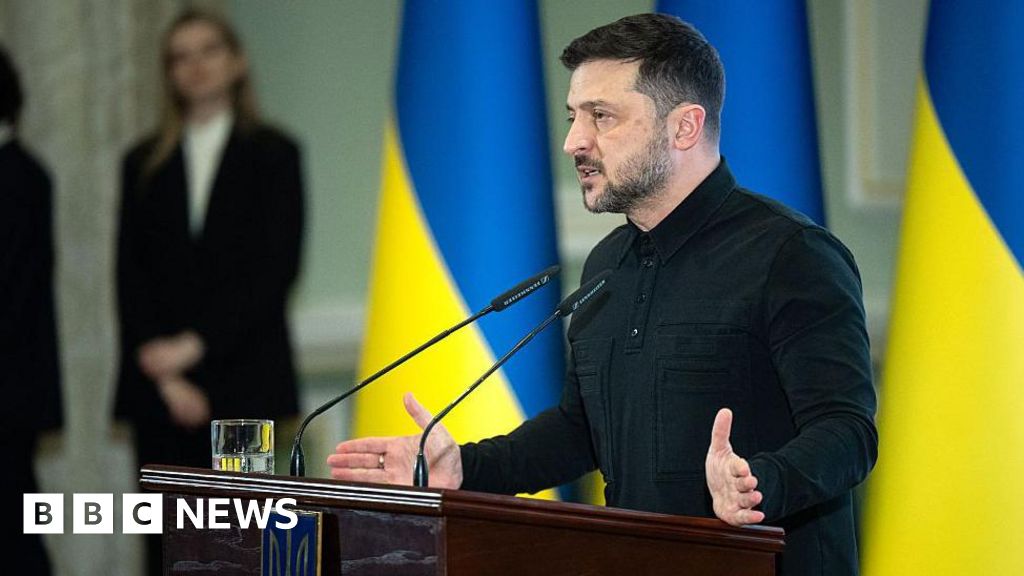
Zelensky moves towards demilitarised zones in latest peace plan for Ukraine
Ukraine’s President Volodymyr Zelensky has given details of an updated peace plan that offers Russia the potential withdrawal of Ukrainian troops from the east that Moscow has demanded.
Giving details of the 20-point plan agreed by US and Ukrainian negotiators in Florida at the weekend, Zelensky said the Russians would respond on Wednesday once the Americans had spoken to them.
Describing the plan as “the main framework for ending the war” Zelensky said it proposed security guarantees from the US, Nato and Europeans for a co-ordinated military response if Russia invaded Ukraine again.
On the key question of Ukraine’s eastern Donbas, Zelensky said a “free economic zone” was a potential option.
He told journalists that as Ukraine was against withdrawal, US negotiators were looking to establish a demilitarised zone or a free economic zone. Any area that Ukrainian troops pulled out of would have to be policed by Ukraine, he stressed.
“There are two options,” Zelensky said, “either the war continues, or something will have to be decided regarding all potential economic zones.”
The 20-point plan is seen as an update of an original 28-point document, agreed by US envoy Steve Witkoff with the Russians several weeks ago, which was widely seen as heavily geared towards the Kremlin’s demands.
The Russians have insisted that Ukraine pulls out of almost a quarter of its own territory in the eastern Donetsk region in return for a peace deal. The rest is already under Russian occupation.
Sensitive issues including questions over territory would have to be resolved “at the leaders’ level”, but the new draft would provide Ukraine with strong security guarantees and a military strength of 800,000, Zelensky explained.
Much of the updated plan resembles what came out of recent talks in Berlin involving US negotiators Witkoff and Jared Kushner with Ukrainian and European leaders. The setting then moved to Miami last weekend where US President Donald Trump’s team spoke separately to Russian envoy Kirill Dmitriev and then Ukrainian and European officials.
There now appears to be far more detail on the territorial issue, although it is clear the Ukrainian side was unable to reach a consensus with the Americans.
Zelensky explained that if Ukraine was prepared to pull its heavy forces back by five, 10 or 40km in the 25% of Donetsk it still held to create an economic zone, making it virtually demilitarised, then Russia would have to do the same “accordingly by five, 10, or 40km”.
Russian troops are currently about 40km (25 miles) east of Ukraine’s “fortress belt” cities of Sloviansk and Kramatorsk, having captured the town of Siversk.
Russian President Vladimir Putin is unlikely to be impressed by the kind of compromise being proposed for Donetsk. He said this month that Russia would take control of the entire east of Ukraine by force if Ukrainian troops did not pull out.
Zelensky made clear that such a free economic zone would have to be under Ukrainian administration and police – “definitely not the so-called Russian police”. The current front line would then become the boundary of the economic zone with international forces on the ground along the contact line to ensure no Russian infiltration.
Russia has so far rejected a European proposal to police any peace deal through a Coalition of the Willing as a “brazen threat”.
A referendum would need to be held on the whole peace plan, Zelensky said, ad only a referendum could decide on the idea of a potential free economic zone in Donbas.
He emphasised that an economic zone would also have to be set up around the Zaporizhzhia nuclear power plant currently occupied by Russia, and that Russian troops would have to pull out of four other Ukrainian regions – Dnipropetrovsk, Mykolaiv, Sumy, and Kharkiv.
The main points of the plan reaffirm Ukraine’s sovereignty and propose a non-aggression pact between Russia and its neighbour with a monitoring mechanism.
As well as strong security guarantees mirroring Nato’s Article Five, which requires members to aid an ally under attack, Ukraine is to be allowed a maximum military strength of 800,000 in peacetime.
Discussions are still going on over a US plan to receive compensation in return for security guarantees, so Zelensky says it is not currently part of the document.
There is no reference barring Ukraine from joining Nato, which was in the original 28-point plan and something Russia has consistently demanded.
And the latest framework proposes that Ukraine joins the European Union with a defined date of accession. It is currently a candidate, but a number of other candidate countries are seen as first in line, such as Albania.
There are plans for a Ukraine investment fund of about $200bn involving both the US and Europe.
Among the other points is a requirement for Ukraine to hold elections as soon as possible after the deal is signed. Russia and the US have both pushed for a vote, even though Ukraine is under martial law because of the full-scale invasion.