“Sinners,” the blockbuster film that has been a major contender during awards season, was the dominant winner at the 57th NAACP Image Awards.
The film scored trophies for outstanding motion picture and most of the acting awards, including breakthrough performance, awarded to Miles Caton. Michael B. Jordan, who won for actor in a motion picture, also won entertainer of the year.
Before the ceremony, Ryan Coogler won writing and directing honors, while Wunmi Mosaku and Delroy Lindo won the supporting actress and actor awards, respectively.
But the ceremony was not only about honoring Black excellence in entertainment. The event was also flavored by several remarks from celebrities addressing the divisive political climate and recent events that have targeted and affected Black entertainers.
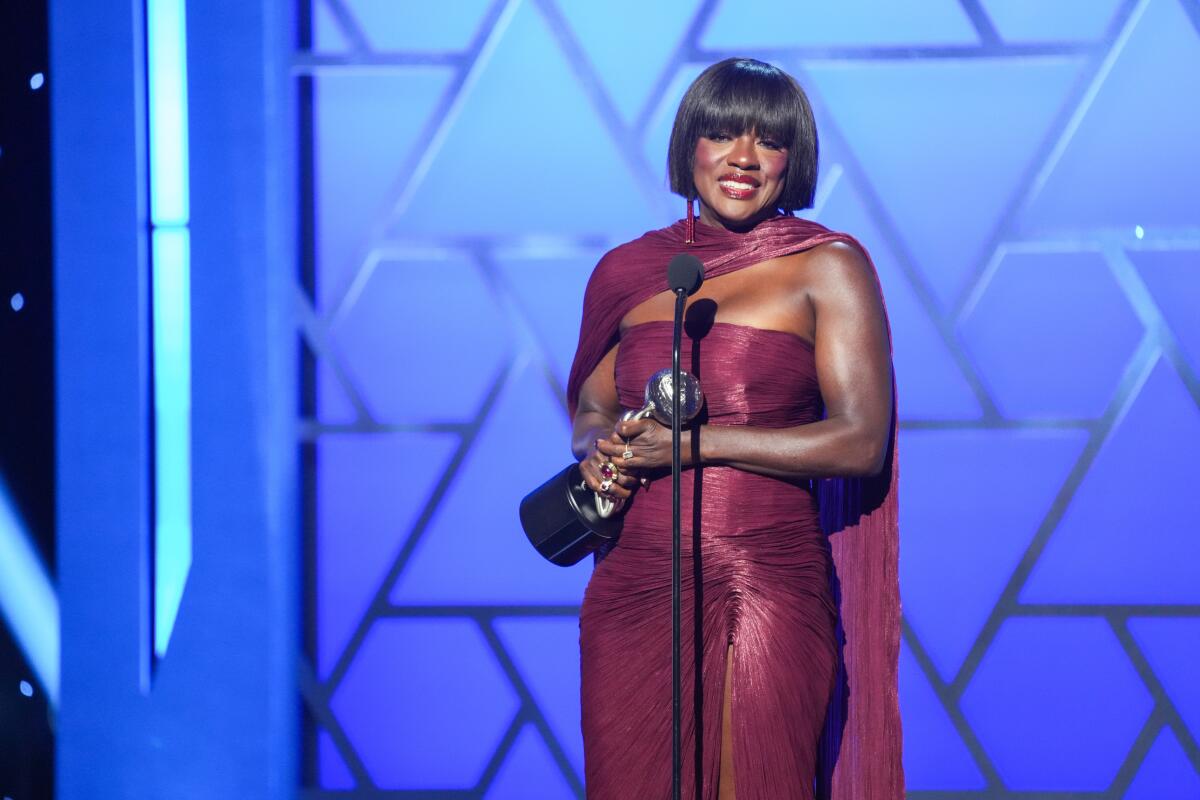
Viola Davis received the chairman’s award during the 57th NAACP Image Awards on Saturday.
(Chris Pizzello / Chris Pizzello/invision/ap)
Host Deon Cole kicked off the ceremony by welcoming the audience to “the Trump Image Awards. Because you know he wants his name on everything.”
Asking permission to “buy a curse word,” he made a joke that was bleeped out during the live stream, but was apparently aimed at federal ICE agents. The comment sparked a standing ovation from the predominantly black-tie audience, many of whom wore anti-ICE pins.
“I don’t want to see no ICE ever again,” he said. “When I looked at the guest list, I took off Ice Cube, Ice-T, Ice Spice. I don’t want no ice cream, I don’t want no ice in my drink.”
Utilizing one of Jackson’s trademark slogans, Jackson said, “We will not be erased from this country’s history because I am somebody.”
And in accepting the award for actor in a drama series for “Paradise,” Sterling K. Brown added, “Like Sam said, they can’t erase us because there is no country without us.”
The event also continued to put a spotlight on the uproar surrounding the shouting of a racial slur during the BAFTA Awards last week.
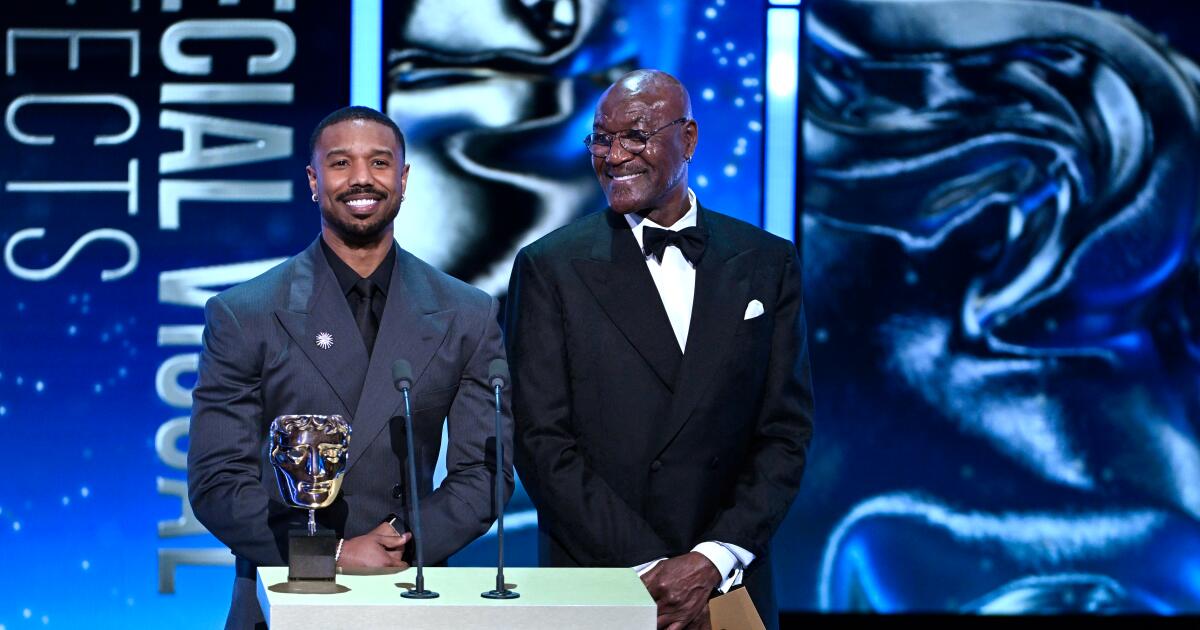
Jordan and Lindo were presenters during the BAFTA Awards, which took place at London’s Royal Festival Hall. As they were introducing the visual effects category, a member of the audience shouted the N-word. The two actors paused momentarily before continuing.
Director Ryan Coogler, left, and actor Delroy Lindo presenting the award for actress in a motion picture. The pair addressed the incident at the BAFTAs in their remarks.
(Chris Pizzello / invision/AP)
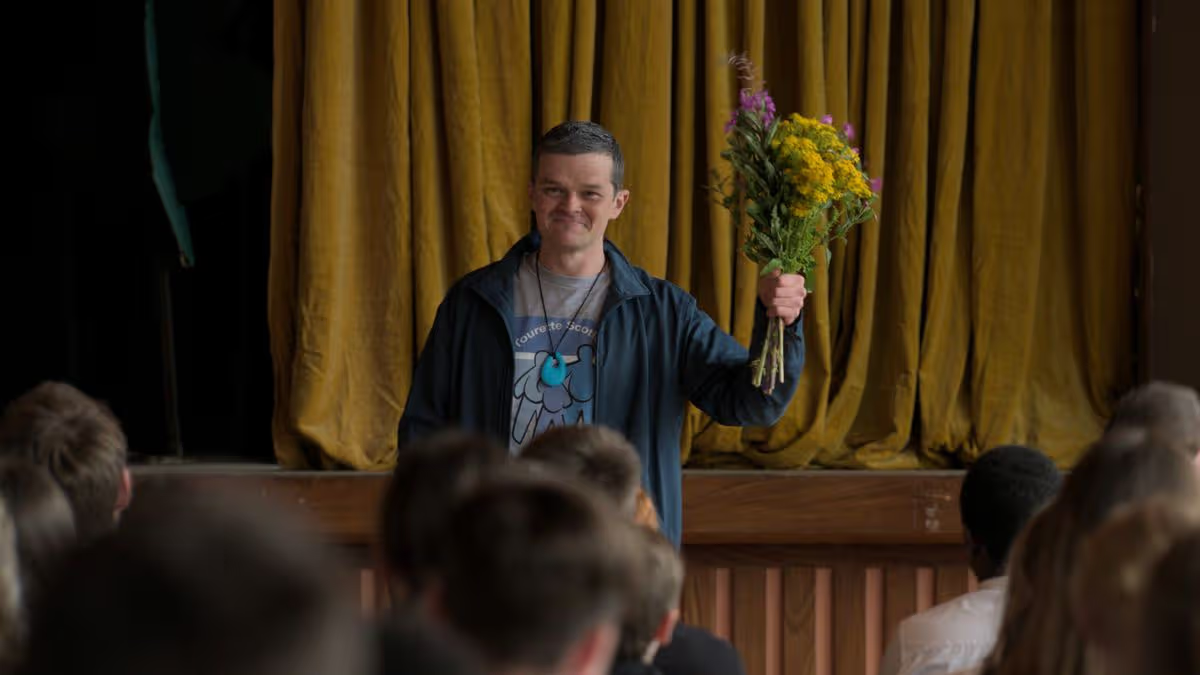
Later, awards host Alan Cumming addressed the outburst, referencing the nominated film “I Swear,” which is about Scottish campaigner John Davidson, who has Tourette syndrome and shouted the racist slur from the audience. Cumming apologized, while Davidson, an executive producer for the BAFTA-nominated film, left his seat midway through the ceremony. BAFTA later issued an apology to the actors.
Cole delivered a comic prayer referencing the incident: “Lord, if there are any white men out there with Tourette’s, I advise you to tell them to read the room tonight, Lord. It might not go the way they think.”
Actor Rebecca Hall early in the awards show said she wanted to pay tribute to “two kings. Thank you for your grace.”
Lindo later in the ceremony said, “We appreciate all the support we’ve been shown in the aftermath of what happened last weekend. It is an honor to be here among our people this evening … It’s a classic case of something that could have been very negative becoming very positive.”
The overseeing body of the annual BAFTA Awards says it is taking “full responsibility” for the racist slur an audience member with Tourette syndrome shouted while “Sinners” stars Michael B. Jordan and Delroy Lindo took the stage at Sunday’s ceremony.
“We take full responsibility for putting our guests in a very difficult situation and we apologise to all,” the British Academy of Film and Television Arts said in a statement published Monday morning following widespread public outcry. “We will learn from this, and keep inclusion at the core of all we do, maintaining our belief in film and storytelling as a critical conduit for compassion and empathy.”
Jordan and Lindo were presenters for the awards show, which aired after a two-hour delay on the BBC, and took the stage at London’s Royal Festival Hall to present the visual effects category. Their segment was quickly interrupted when someone in the audience off-screen shouted the N-word. The co-stars, who are both Black, paused before their presentation.
Later in the program, BAFTA Awards host Alan Cumming addressed the outburst, referencing the nominated film “I Swear,” about Scottish Tourette syndrome campaigner John Davidson. Davidson, an executive producer for the BAFTA-nominated film, was in the audience and left his seat midway through the ceremony.
“The tics you have heard tonight are involuntary — that means the person who has Tourette syndrome has no control over their language and we apologize if it has caused offense,” Cumming explained.
The Mayo Clinic defines Tourette syndrome as a disorder that “involves repetitive movements or unwanted sounds (tics) that can’t be easily controlled.” According to the Tourette Assn. of America, some people who live with Tourette syndrome can also experience coprolalia, “an involuntary outburst of obscene words or socially inappropriate and derogatory remarks” that do not necessarily reflect the person’s “thoughts, beliefs or opinions.”
BAFTA echoed this sentiment in its statement and said it had made efforts to ensure attendees “were aware of the tics,” informing audiences at the beginning of the show that Davidson was in the room and “they may hear strong language, involuntary noises or movements during the ceremony.
Concerning Davidson’s use of the racist slur, BAFTA said “we apologise unreservedly to [Jordan and Lindo], and to all those impacted.”
“We would like to thank Michael and Delroy for their incredible dignity and professionalism,” BAFTA said.
The organization also acknowledged Davidson who, after leaving the ceremony, watched the rest of the show from a screen. Actor Robert Aramayo, who portrays Davidson in “I Swear,” bested Hollywood favorites for the leading actor prize.
Though representatives for Jordan and Lindo did not immediately respond to a request for comment Monday, the co-stars spoke to Vanity Fair about the controversy. Lindo said he and his co-star “did what we had to do” for the ceremony, but he added he wished “someone from BAFTA spoke to us afterward.”
Davidson, in a statement published by Deadline, said that while his tics and outbursts do not reflect his beliefs, he is always “deeply mortified if anyone considers my involuntary tics to be intentional or to carry any meaning.” He did not directly mention Jordan or Lindo.
BBC apologized for not editing out the slur before broadcasting the ceremony, according to the Associated Press. The network had managed to edit out other portions of the ceremony — including filmmaker Akinola Davies Jr. saying “Free Palestine” — but not the racist slur, “Good Morning America” reported. The Guardian reported that producers also failed to hear the inappropriate remark during the original taping.
BBC said Monday that it will edit out the slur.
The controversial BAFTA Awards moment spurred backlash and conversations about Tourette syndrome. On social media, “Sinners” production designer Hannah Beachler alleged similar outbursts occurred three times through the course of the evening, once “directed at myself” and another “at a Black woman.”
“But what made the situation worse was the throw away apology of ‘if you were offended at the end of the show,” she posted on X. “Of course we were offended…but our frequency, our spiritual vibration is tuned to a higher level than what happened.”
Also on X, journalist Jemele Hill, “Superman” actor Wendell Pierce and Black List founder Franklin Leonard called out the expectation for Jordan and Lindo to carry on as normal after facing the racist slur, and the lack of immediate accountability from BAFTA.
“It’s infuriating that the first reaction wasn’t complete and full throatted [sic] apologies to Delroy Lindo and Michael B. Jordan,” Pierce tweeted. “The insult to them takes priority. It doesn’t matter the reasoning for the racist slur.”
Jamie Foxx and “The Breakfast Club” host Charlamagne tha God also shared their takes on Davidson’s outbursts. Foxx alleged in a handful of Instagram comments that Davidson’s use of the racist slur was intentional. Charlamagne that God sought accountability from the teams behind Sunday’s awards ceremony and speculated that “somebody somewhere taught [Davidson] the language.”
“It’s just convenient he saved his most offensive outburst for Black people. OK?” he said. “I can be respectful of the condition but I don’t respect none of y’all that allowed him to be there with the condition.”
The radio host added: “Just because you have a disability does not mean we will tolerate the disrespect.”
Tourettes Action, an organization and research charity based in the United Kingdom, addressed the negative comments regarding Davidson’s outbursts and called for understanding and education about Tourette Syndrome.
“The price of being misunderstood is increased isolation, risk of anxiety and depression and death by suicide,” the organization said. “We hope that those commenting will take the time to watch the film, learn about Tourette’s, and understand the experiences behind moments like these. Education is key, and compassion makes a world of difference.”
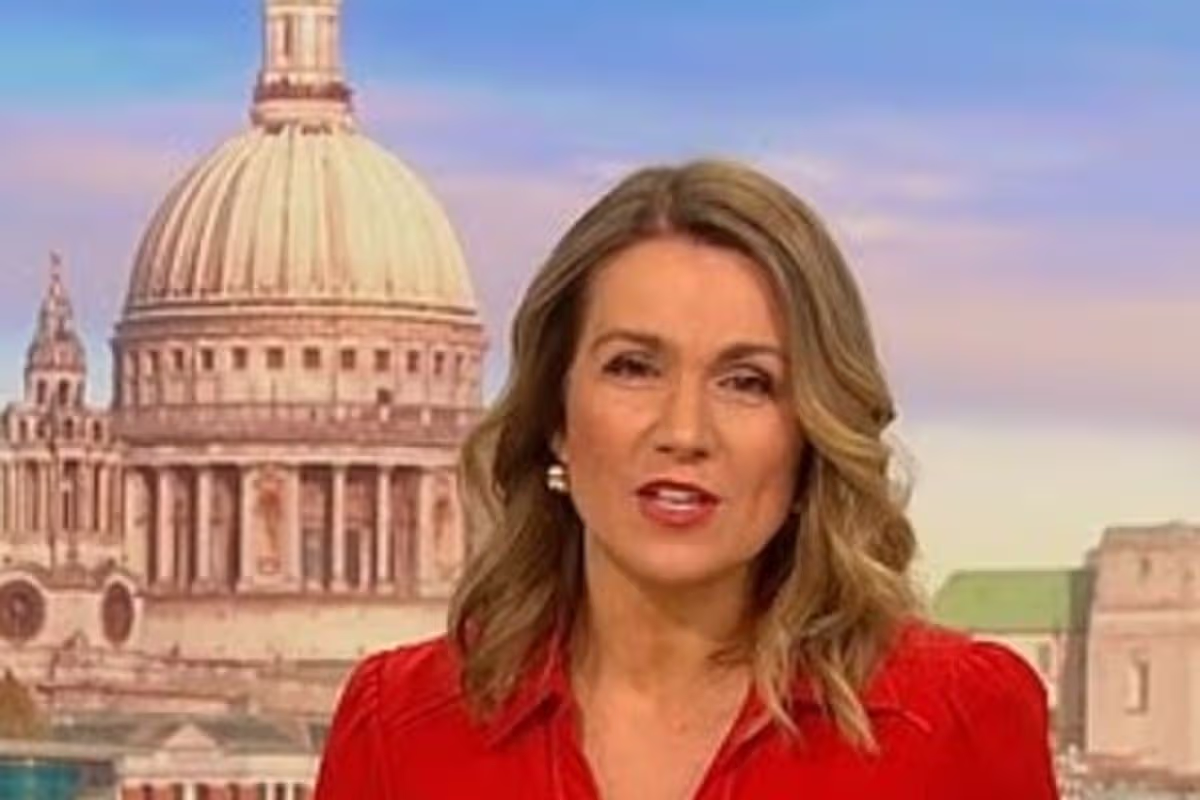
Good Morning Britain star Susanna Reid has been criticised for the comments she made about Tourettes syndrome, with some branding it a ‘totally uncaring, stupid and dismissive’ remark
11:03, 23 Feb 2026Updated 11:03, 23 Feb 2026
Susanna and Ed hosted Good Morning Britain today(Image: itv)
Susanna Reid has been slammed by ITV viewers for a “totally uncaring, stupid and dismissive” remark about Tourette syndrome during a discussion on Good Morning Britain.
The presenter has come under fire for comments she made whilst discussing John Davidson, a Tourette’s campaigner who had his life serialised in new movie I Swear. Actor Robert Aramayo played the role of John in the movie, which he won Best Actor for last night.
Now, Susanna Reid has been criticised for her comments about Tourettes whilst discussing the news. She said that she was still “thinking about the language'” and branded it “completely unacceptable”.
She referenced that people with Tourettes couldn’t control their ticks, but added: “There’s plenty of people watching who say, ‘Why should a racial slur ever be accepted or simply brushed away?'”
Ed then said: ‘There’s two different issues. If this racial slur was said at the awards ceremony, it shouldn’t have been broadcast. The guy who has Tourette’s – apologising for his disability is not fair or right. It’s not in his control. If it was me, I would have bleeped out the racial slur and not had the apology.”
Ensure our latest headlines always appear at the top of your Google Search by making us a Preferred Source. Click here to activate or add us as your Preferred Source in your Google search settings.
Susanna added: “But it’s absolutely vital that you apologise for it. A racial slur is always something, presumably, that needs to be apologised for.” Ed then replied: “They ought to have apologised for having it on the programme, but apologising for the gentleman with Tourette’s, you can’t apologise for his disability.”
Fans of the ITV show fumed over Susanna’s comment, with one writing: “The actor in the film regarding Tourette’s wins an award but Susanna states that we need to apologise for the consequence of that disability in real life.” Another added: “You shouldn’t apologise for #TouretteSyndrome, it can’t be helped. You should never apologise for an illness…no one asked to have the illness.”
Yesterday, at the awards, host Alan Cumming addressed the comments. He told the audience: “You may have heard some strong offensive language tonight, but if you’ve seen the film I Swear, it’s about the experience of a person with Tourette syndrome.
“It is a disability and the ticks you have heard tonight are involuntary that means the person who has Tourette syndrome has no control over their language and we apologise if it has caused offence.”
A BBC spokesperson added: “Some viewers may have heard strong and offensive language during the Bafta Film Awards 2026. This arose from involuntary verbal tics associated with Tourette syndrome, and was not intentional. We apologise for any offence caused by the language heard.”
Six months and 16 Oscar nominations ago, Delroy Lindo hopped on a Zoom call with the awards consultants running the campaign for Ryan Coogler’s genre-defying American horror story, “Sinners.” Actors don’t often participate in these meetings. But Lindo had received so much love for his turn as bluesman Delta Slim since “Sinners” premiered in April, he figured, “Why not sit in?” Mostly, he just wanted to ask one simple question: How can we make the most of this moment?
“I don’t know what their answer was, but it seems to have worked,” I tell him over lunch recently.
Lindo starts rapping on the wood table separating us and doesn’t stop until I ask if he’s a man given to superstition.
“Can I tell you where I think it comes from?” he asks. “I’m acutely aware absolutely nothing is promised. There’s no such thing as a sure thing. Anything can happen. So in knocking wood, one is trying to increase one’s chances that the outcome will be what one wants.”
So you’ve been knocking on wood for the last six months?
Now I’m the one who’s laughing, which Lindo appreciates. But he has more to say on the subject.
“You have to understand something,” he continues. “When an actor does a piece of work and it really touches people and has an impact like it did with Delta Slim and ‘Sinners,’ you can’t help but think how it might be broadened. I try to maintain an emotional distance because I have no control over much of it. Awards season.” He shakes his head. “So …” Lindo pounds on the table again. “Knock … on … wood.”
You want an illustration of the unpredictable nature of the acting profession? Lindo and I wouldn’t be at this table talking and rapping and toasting the first Oscar nomination of his long career if one particular cut of “Sinners,” the version Coogler showed him at the Imax headquarters in Playa Vista more than a year ago, had gone out into the world.
Lindo, left, on the set of “Sinners” with co-star Michael B. Jordan and writer-director Ryan Coogler.
(Eli Ade / Warner Bros. Pictures)
If you’ve seen the film, you’ll no doubt remember Delta Slim delivering a monologue in the car riding to the juke joint with Stack (Michael B. Jordan) and Preacher Boy (Miles Caton) where he recalls the lynching of a fellow musician. The scene ends with Lindo breaking into a guttural humming and drumming, expressing pain that transcends words.
When Lindo saw the movie that first time, the monologue had been truncated, and the scene preceding it, where their car passes a chain gang and Delta Slim stands and exhorts the prisoners to “hold your heads,” was gone too.
After the credits finished rolling and the lights came up, Coogler asked Lindo what he thought of the film. Lindo looked at him. “Can we talk, man?” They went outside, and Lindo laid out in his steady, resonant baritone why he thought Coogler needed to reinstate the chain-gang scene, which reveals Delta Slim’s origin story — and surely, since the chain-gang scene is intertwined with the monologue in the car, that should go back into the movie too.
“What Ryan did so brilliantly is he took the time to introduce all of the main characters in their native environments so the audience gets invested in them and what they mean to the community,” Lindo says. “For Delta Slim, those scenes were the fundamental building blocks.”
“The Delta Slim monologue had a lot of ‘Is it in, is it out?’ debate,” “Sinners” film editor Michael P. Shawver says. “But I knew in my heart and soul I was never going let the movie out without that being in it.”
Coogler, it turns out, saw it that way too.
Delroy Lindo.
(Bexx Francois / For The Times)
“I couldn’t imagine making a movie about the blues without giving some deeper context on what that music really signifies,” Coogler writes in an email. “It’s easy to get lost in the rhythm and the artistry of it all, but the blues was born from a lot of pain and adversity in a particular time and place. When I wrote the script, I felt like I needed a living, breathing embodiment of that, and Delroy nailed it.”
“We could have filmed that monologue a thousand different times and it would have taken on new life with each take,” Coogler continues. “The gut-punch way he ends it, going from telling the story of a lynching to drumming along and humming … it’s macabre, sorrowful and beautiful all at the same time. It shows you exactly why Delroy’s such a masterful actor. If you ever needed to give someone the world’s fastest lesson in what the blues is about, he gives it to you right there.”
“God bless him,” Lindo says.
“Working for the camera, we’re at the mercy of the editing process,” Lindo notes. He speaks slowly, deliberately, always choosing his words carefully because language is important to him. It’s his currency.
How does he feel about that loss of control?
“It’s scary,” Lindo says. “One had better make one’s peace with that very quickly. If you don’t, you will get your feelings hurt. It’ll be a problem.”
Asked to pinpoint when he came to terms with that, Lindo remembers “Clockers,” the 1995 Spike Lee crime drama in which he played the intimidating drug kingpin Rodney Little. It was his third collaboration with Lee, following “Malcolm X” and “Crooklyn,” and the two enjoyed a mutual respect and rapport. But Lee still cut three of Lindo’s scenes, which Lindo understood — “kind of, sort of.” Lee was looking at the larger story. Those scenes weren’t essential.
“Making one’s peace with it is not the same as accepting it and being happy with it,” Lindo says, raising an index finger, a gesture he often makes when telling you something he considers important. “It’s just the way it is. It’s a fact of life.”
When talking about his career, Lindo, 73, tells me more than once that “it’s not where you start, it’s where you finish.”
The first time he tells me this we are talking about one of his early lead acting turns, starring in the 1983 Yale Repertory Theatre production of “A Raisin in the Sun,” the story of a struggling Black family dealing with discrimination in 1950s South Chicago. Lindo played the frustrated patriarch, Walter Lee, and won some strong reviews. But he felt like he was the “weak link” in the production. In a GQ profile, it was written that Lindo, born in London, couldn’t convince himself that the African American experience was his to interpret.
“Nope,” Lindo says. “I did not say that.” Again, the index finger. “You’re giving me the opportunity to set the record straight.” He pauses and closes his eyes. “Doing that play, I had an inner monologue playing in my head that cast doubt on my ability to play the part successfully. And it continued and it grew. It became a tape and then an album and then a series of albums. It eroded my confidence.”
“You know what it was?” he continues. “It was a self-esteem issue. It was an issue of me saying to myself, ‘You’re not good enough. You want to do one of the great parts in the theater? No. You don’t have it.’ Now, what’s the root of all that?” Lindo laughs, clasps his hands together and raises them. “The roots of that are food for myself and a therapist.”
But there is a happy ending to the story. Lindo was cast once more as Walter Lee, for a production of “A Raisin in the Sun” mounted at the Kennedy Center in 1986. Lloyd Richards again was directing, indicating to Lindo that maybe he wasn’t as bad as he thought he had been. Richards did tell Lindo that he needed to jettison some of the neurotic choices he was making as an actor.
“Those are the words he used, ‘neurotic choices,’” Lindo says, shaking his head. He pauses. “Man, I’m giving you a lot here. But it’s OK. You know why it’s OK?”
Because you’re enjoying our conversation? I venture.
Delroy Lindo.
(Bexx Francois / For The Times)
“No,” Lindo says. “I’m not particularly enjoying telling you about my failures. But this was an absolute period of growth for me as an actor all because I learned the most important thing: preparation, preparation, preparation.”
For his reprise of “A Raisin in the Sun,” Lindo called musical multihyphenate Oscar Brown Jr. and asked if he could fly to Chicago and pick his brain about life on the city’s South Side in the 1950s. Lindo walked the streets where “Raisin” playwright Lorraine Hansberry lived, steeping himself in what it meant to exist in that place and time. After that, the tape was no longer playing in his head, even when co-star Esther Rolle’s face fell after she realized that Lindo had been cast as Walter Lee. She thought she’d be headlining with Glynn Turman, but Turman had dropped out.
“Eight days, maybe nine into rehearsals, Esther turned to me — and this is when I knew it was going to be all right — and she said, ‘You’re a nice actor,’” Lindo remembers, smiling.
Preparation, preparation, preparation. For Delta Slim, Lindo read books on the blues, listened to Son House, Muddy Waters and Howlin’ Wolf and immersed himself in the culture of the Mississippi Delta. When it came time to shoot that monologue in the car, he was ready. On the next-to-last take, Lindo improvised, letting music take the place of words. Jordan went with it, turning to Caton in character, saying, “You got that guitar in your hand, don’t you, boy?” Caton begins playing.
“Man, we were all in the work,” Lindo says.
Where did that improvisation come from? I ask.
“It’s the musical manifestation of the pain I’m feeling,” Lindo says. “It’s the only thing I know how to do in that moment.”
It’s the blues.
“It’s the blues, man,” Lindo says. “I’ve heard it said numerous times: That’s where the blues comes from. And as an actor who participated in that moment, communicating that is extraordinary and profoundly gratifying.”
Chris Evans has made a major comeback with the relaunch of TFI Friday and brought the iconic programme to his radio station almost 30 years after it first aired
22:48, 08 Feb 2026Updated 22:48, 08 Feb 2026
Chris Evans has relaunched TFI Friday(Image: Channel 4 )
Chris Evans has relaunched his hit 90s series TFI Friday. The presenter, 59, fronted the hit series during its initial run on Channel 4 from 1996 until 2000 and it became staple viewing at the start of the weekend.
The format featured a mix of live performances and celebrity interviews. Chris left the programme after the fifth series, and big names like the Spice Girls, Davina McCall and Elton John stepped in to take the reins for the last run of episodes in the build up to Christmas 2000. Now best known for fronting his radio show on Virgin, the TV star, who also presented the short-lived revival in 2015, has brought the programme back once more.
The revamped version of the iconic series is currently being released on Virgin Radio’s YouTube channel, and welcoming the audience to the first episode, Chris said: “Hello friends. Thank you for tuning in! Welcome to TFI Unplugged.
“On the way today, Delroy Lindo, currently nominated for Academy Award, Hollywood Sim Car of course. Also on the way, the hilarious Ross Noble going to be here!”
Some of the more regular segments during the original run of the show included Freak or Unique, which encouraged participants to show off a strange talent. Other items included Fishbowl Challenge, Show Us Your Face Then and Sink Or Swim.
The show also ran a segment called Someone’s Going to Be a Millionaire!, based on Who Wants To Be A Millionaire?, and on Christmas Eve 1999, TFI Friday became the first British programme to issue a £1 million prize, almost a year before one player won the jackpot on the ITV game show.
Chris became a major television star in the early 1990s, as the Channel 4 show The Big Breakfast which he presented alongside Gaby Roslin, before other showbiz favourites like Denise Van Outen, Zoe Ball and Kelly Brook took on the hosting role.
He wrote and presented TFI Friday whilst working on the BBC Radio 1 Breakfast Show, which he eventually resigned from whilst he was live on air in 1997 after Radio 1 refused to allow him to work a four-day week.
He also presented The One Show on Fridays between 2010 and 2015, and later became the lead host of Top Gear in 2015 after the sacking of Jeremy Clarkson.
In 2022, Chris explained on his radio show that a reboot of TFI Friday didn’t need to be on television anymore thanks to the advent of streaming. He said: “Can I tell you a bit more about it?
“Oh, sure. The thing is, you don’t need a TV channel now. You don’t don’t need one. It’s amazing what you can do. TFI Friday doesn’t have to be an hour long, it could be longer, we could livestream it!”