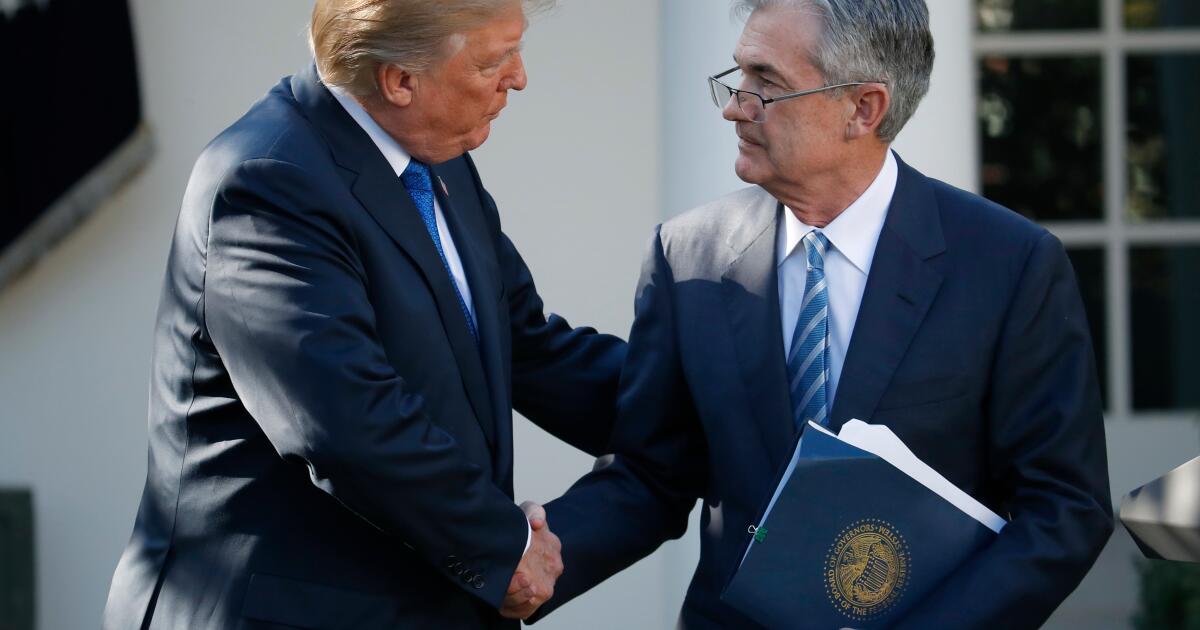
Defiant independence from the Federal Reserve catches Trump off guard
WASHINGTON — White House officials were caught by surprise when a post appeared Sunday night on the Federal Reserve’s official social media channel, with Jerome Powell, its chairman, delivering a plain and clear message.
President Trump was not only weaponizing the Justice Department to intimidate him, Powell said to the camera, standing before an American flag. This time, he added, it wasn’t going to work.
The lack of any warning for officials in the West Wing, confirmed to The Times, was yet another exertion of independence from a Fed chair whose stern resistance to presidential pressure has made him an outlier in Trump’s Washington.
Powell was responding to grand jury subpoenas delivered to the Fed on Friday related to his congressional testimony over the summer regarding construction work at the Reserve.
“The threat of criminal charges is a consequence of the Federal Reserve setting interest rates based on our best assessment of what will serve the public, rather than following the preferences of the president,” Powell said.
“This is about whether the Fed will be able to continue to set interest rates based on evidence and economic conditions,” he added, “or whether instead monetary policy will be directed by political pressure or intimidation.”
For months, Trump and his aides have harshly criticized Powell for his decision-making on interest rates, which the president believes should be dropped faster. On various occasions, Trump has threatened to fire Powell — a move that legal experts, and Powell himself, have said would be illegal — before pulling back.
The Trump administration is currently arguing before the Supreme Court that the president should have the ability to fire the heads of independent agencies at will, despite prior rulings from the high court underscoring the unique independence of the central bank.
The decision by the Justice Department to subpoena the Fed over the construction — a $2.5-billion project to overhaul two Fed buildings, operating unrenovated since the 1930s — comes at a critical juncture for the U.S. economy, which has been issuing conflicting signals over its health.
Employers added only 50,000 jobs last month, fewer than in November, even as the unemployment rate dipped a tenth of a point to 4.4%, for its first decline since June. The figures indicate that businesses aren’t hiring much despite inflation slowing down and growth picking up.
The government reported last month that inflation dropped to an annual rate of 2.7% in November, down from 3% in September, while economic growth rose unexpectedly to an annual rate of 4.3% in the third quarter.
However, the long government shutdown interrupted data collection, lending doubt to the numbers. At the same time, there is uncertainty about the legality of $150 billion or more in tariffs imposed on China and dozens of countries through the International Emergency Economic Powers Act, which has been challenged and is under review by the Supreme Court.
As inflation has cooled, the Fed under Powell has incrementally cut the federal funds rate, the target interest rate at which banks lend to one another and the bank’s primary tool for influencing inflation and growth. The Fed held the rate steady at a range of 4.25% to 4.5% through August, before a series of fall cuts left it at 3.5% to 3.75%.
That hasn’t been enough for Trump, who has called for the rate to be lowered faster and to a nearly rock bottom 1%. The last time the central bank dropped the rate so low was in the dark days of the early pandemic in March 2020. It began raising rates in 2022 as inflation took off and proved stubborn despite the bank’s efforts to rein it in.
Mark Zandi, chief economist at Moody’s Analytics, said there is room to continue lowering the federal funds rate to 3%, where it should be in a “well functioning economy, neither supporting or restraining growth.”
However, muscling the Fed to lower rates and reduce or destroy its independence is another matter.
“There’s no upside to that. It’s all downside, different shades of gray and black, depending on how things unfold,” he said. “It ends in higher inflation and ultimately a much diminished economy and potentially a financial crisis.”
Zandi said much will hinge on the Supreme Court’s decision on whether Trump can remove Federal Reserve Governor Lisa Cook, which he sought to do last year, citing allegations of mortgage fraud she denies.
While Powell’s term as chairman ends in May, his term as a governor — influencing interest-rate decisions — extends to January 2028. A criminal indictment over the construction project could provide Trump the legal justification he needs to remove him altogether.
“When he steps down in May, will he stay on the board or does he leave? That will make a difference,” Zandi said.
A key issue will be how much independence the Fed retains, he said, given the central bank’s role in establishing the U.S. as a safe haven for international bond investors who play a key role funding the federal deficit.
The investors rely on the bank to keep inflation under control, or they will demand the government pay more for its long term bonds — though the subpoenas had little effect so far Monday on bond prices.
“There are scenarios where the bond market says, ‘Oh my gosh, we’re going to see much higher inflation, and there’s a bond sell-off and a spike in long-term rates,” he said. “That’s a crisis.”
Zandi said that even if the worst-case scenarios don’t play out, it will take time for the Federal Reserve to reestablish its reputation as an independent bank not influenced by politics.
“I’m not sure investors will ever forget this,” he said. “Most importantly, it depends on who Trump nominates to be the next chair of the Federal Reserve — and how that person views his or her job.”
Lawmakers from both parties have questioned the motivation behind the investigation.
North Carolina Sen. Thom Tillis, a Republican member of the Senate Committee on Banking, Housing and Urban Affairs, has said he plans to oppose the confirmation of any nominee for the Fed until the legal matter is “fully resolved.”
“If there were any remaining doubt whether advisers within the Trump administration are actively pushing to end the independence of the Federal Reserve, there should now be none,” Tillis wrote in a social media post.
Sen. Elizabeth Warren, the top Democrat on that committee, accused Trump of trying to “install another sock puppet to complete his corrupt takeover of America’s central bank.”
“Trump is abusing the authorities of the Department of Justice like a wannabe dictator so the Fed serves his interests, along with his billionaire friends,” Warren said in a statement.
Rep. French Hill (R-Ark.), the chairman of the House Financial Services Committee, also expressed skepticism about the inquiry, which he characterized as an “unnecessary distraction.”
“The Federal Reserve is led by strong, capable individuals appointed by President Trump, and this action could undermine this and future Administrations’ ability to make sound monetary public decisions,” Hill wrote in a statement.
As Hill raised concerns about the investigation, he added he personally knew Powell to be a “person of the highest integrity.”
House Speaker Mike Johnson (R-La.), meanwhile, dismissed the idea that the Justice Department was being weaponized against Powell. When asked by a reporter if he thought that was the case, he said: “Of course not.”
Times staff writers Wilner and Ceballos reported from Washington and Darmiento from Los Angeles.