The US defence secretary designated the AI company a ‘supply chain risk’ after it refused to remove guardrails on its technology.
Published On 18 Mar 202618 Mar 2026
The administration of United States President Donald Trump has said in a court filing that the Pentagon’s blacklisting of Anthropic was justified and lawful, opposing the artificial intelligence company’s high-stakes lawsuit challenging the decision.
The administration made its comments in a court filing on Tuesday.
Recommended Stories
list of 3 itemsend of list
Defense Secretary Pete Hegseth designated Anthropic, the maker of popular AI assistant Claude, a national security supply chain risk on March 3 after the company refused to remove guardrails against its technology being used for autonomous weapons and domestic surveillance.
The Trump administration’s filing says Anthropic is unlikely to succeed in its claims that the US government’s action violated speech protections under the US Constitution’s First Amendment, asserting that the dispute stems from contract negotiations and national security concerns, not retaliation.
“It was only when Anthropic refused to release the restrictions on the use of its products — which refusal is conduct, not protected speech — that the President directed all federal agencies to terminate their business relationships with Anthropic,” the administration’s legal filing said. The filing, from the US Justice Department, said that “no one has purported to restrict Anthropic’s expressive activity”.
Anthropic’s lawsuit in California federal court asks a judge to block the Pentagon’s decision while the case plays out. Some legal experts say the company appears to have a strong case that the government overreached.
In a statement, Anthropic said it was reviewing the government’s filing. The company said that “seeking judicial review does not change our longstanding commitment to harnessing AI to protect our national security, but this is a necessary step to protect our business, our customers, and our partners.”
The White House did not immediately respond to a request for comment.
Supply chain risk
Trump has backed Hegseth’s move, which excludes Anthropic from a limited set of military contracts. But it could damage the company’s reputation and cause billions of dollars in losses this year, according to its executives.
The designation came after months of negotiations between the Pentagon and Anthropic reached an impasse, prompting Trump and Hegseth to denounce the company and accuse it of endangering American lives with its use restrictions.
Anthropic has disputed those claims and said AI is not yet safe enough to be used in autonomous weapons. The company said it opposes domestic surveillance as a matter of principle.
In its March 9 lawsuit, Anthropic said that the “unprecedented and unlawful” designation violated its free speech and due process rights, while running afoul of a law requiring federal agencies to follow specific procedures when making decisions.
The Pentagon separately designated Anthropic a supply chain risk under a different law that could expand the order to the entire government.
Anthropic is challenging that move in a second lawsuit in a Washington, DC, appeals court.
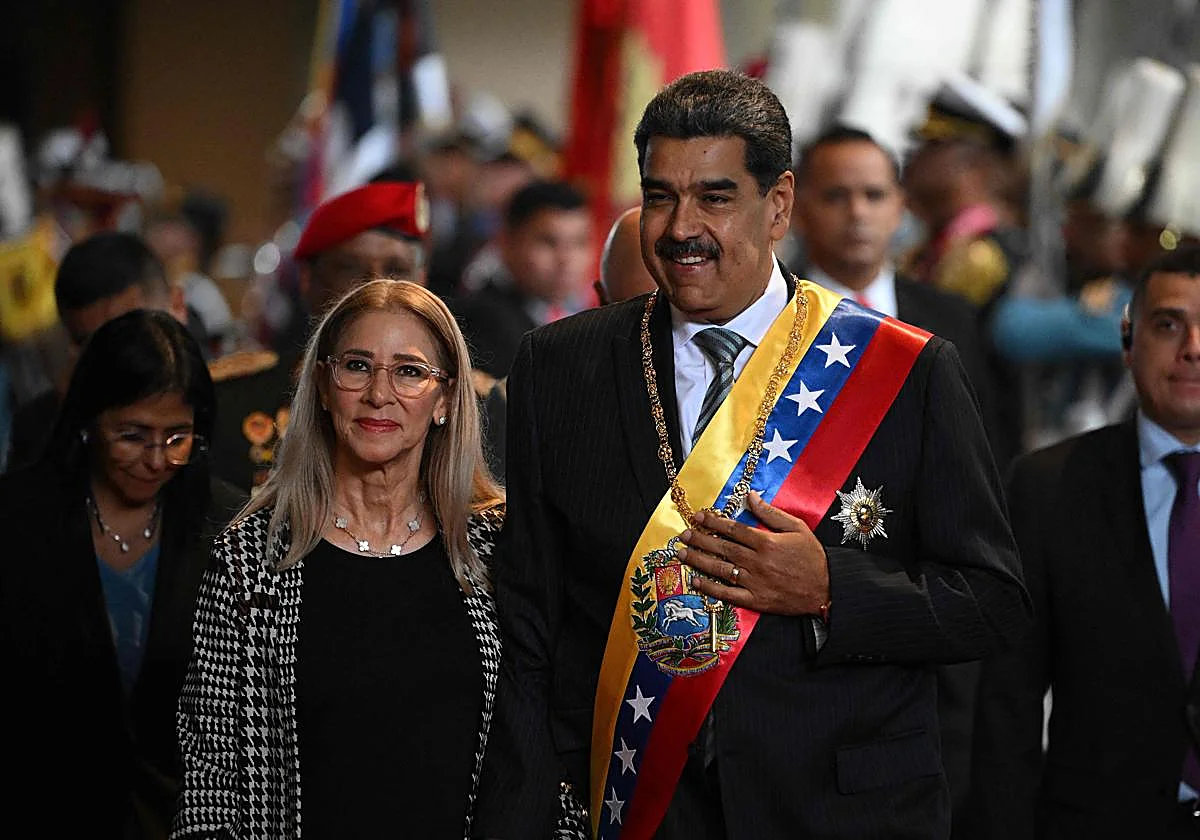
Maduro and Flores will have a court hearing on March 26. (AFP)
Caracas, March 17, 2026 (venezuelanalysis.com) – The Trump administration has opposed a motion from Venezuelan President Nicolás Maduro and First Lady Cilia Flores for the dismissal of US criminal charges on the grounds of the US Treasury blocking their legal defense funds.
In a court filing, US Justice Department prosecutors argued that “the defendants and their former regime” have been sanctioned by the US government for several years and that regulations from the Office of Foreign Assets Control (OFAC) “expressly prohibit” that funds from a “sanctioned entity” be used to pay a “sanctioned person’s” legal expenses.
“OFAC’s denial of that request does not mean the [US] government violated the defendants’ due process rights. The motions to dismiss should be denied,” the statement read.
Last month, Maduro and Flores’ legal teams urged Judge Alvin Hellerstein to throw out the cases over the US government’s interference with their “ability to retain counsel.” Defense attorney for the Venezuelan president, Barry Pollack, argued that Washington’s actions violated Maduro’s Sixth Amendment rights.
In a sworn statement handed to the court, Maduro declared that under Venezuelan law he is “entitled” to have his legal expenses covered by Caracas and confirmed that Pollack is his “counsel of choice.”
Pollack further added that, on January 9, OFAC issued permission for the Venezuelan government to cover Maduro and Flores’ legal fees, only to withdraw it hours later. The high-profile attorney has announced plans to invoke Maduro’s immunity as a sitting president as part of his legal strategy.
US prosecutors have claimed that the defendants are allowed to use “personal funds” to pay their attorneys’ fees. However, both Maduro and Flores, as well as multiple immediate relatives, are under OFAC sanctions, making it illegal for US persons and entities to engage in financial transactions with them.
The Venezuelan Communications Ministry did not immediately respond to a request for comment. Venezuelan officials, including Acting President Delcy Rodríguez, have yet to weigh in on the Trump administration’s efforts to hamper Maduro and Flores’ defense efforts.
President Maduro and his wife, who is also a National Assembly deputy, were kidnapped by US Special forces on January 3 amid a bombing campaign against Caracas and nearby areas. Rodríguez, as sitting vice president, assumed the presidency on an acting basis after the Venezuelan Supreme Court decreed that Maduro’s abduction constituted a “temporary absence.”
Maduro was indicted on charges of “narcoterrorism conspiracy, cocaine importation conspiracy, possession of machineguns and destructive devices, and conspiracy to possess machineguns and destructive devices against the United States.” Flores faces the latter three counts. Both pleaded not guilty in their arraignment hearing on January 5. The next hearing is scheduled for March 26.
Despite reiterated “narcoterrorism” accusations, US officials have not presented evidence tying Maduro and other high-ranking officials to narcotics activities. Specialized reports have likewise found Venezuela to play a marginal role in global drug trafficking.
Following the January 3 attacks and presidential kidnapping, Rodríguez has fast-tracked a diplomatic rapprochement with the Trump administration. The acting president has hosted several US officials in Caracas while promoting a pro-business overhaul of the country’s oil and mining laws aimed at courting Western corporations.
Caracas and Washington reestablished diplomatic ties on March 5 following a seven-year hiatus, with the White House formally recognizing Rodríguez as Venezuela’s “sole leader” last week.
Since January 3, Venezuelan government supporters have staged multiple demonstrations to condemn the US attacks and demand the immediate release of the Venezuelan president and first lady.
US-based solidarity movements have also organized rallies in support of Maduro and Flores, including outside the Metropolitan Detention Center in Brooklyn where they are detained.
Katie Price appeared on Good Morning Britain on Monday, where she said no topic was ‘off limit’ during the bombshell interview
10:00, 16 Mar 2026Updated 10:12, 16 Mar 2026
Katie Price appeared on Good Morning Britain on Monday, where she said no topic was off limit (Image: ITV)
Katie Price appeared on Good Morning Britain on Monday to set the record straight on several details in her life, insisting no topic was ‘off limit’.
Katie, 47, recently left her family reeling when she announced she’d got hitched for the fourth time to businessman Lee Andrews, 43, who she had only known for a week. Her shocked mum and sisteronly found out after she announced the news on social media.
Since the reveal of her new relationship and marriage, the couple have been forced to hit back at a series of claims. Only recently, Katie spoke out to defend her husband Lee, hitting back at claims he’s a conman and insisting she has seen proof of his wealth.
Appearing on Monday’s Good Morning Britain, Katie encouraged hosts Susanna Reid and Ed Balls to grill her, insisting that no topic was ‘off limit’.
Real marriage date and Lee Andrews relationship
Katie said: “I’m doing really good. Really good. Really happy. I’m so excited to be here today for you to ask me anything you want”, adding: “The reason I say that is because there’s been so much speculation in the media, online, and no one can really hear my voice. So I’m glad I’ve got you guys. As you know, you can ask me anything.”
Talking about marrying Lee so quickly, she said: “Now, do you ever really know anyone? If you look at my past marriages, did I ever know they would be what they would be? And sometimes, I don’t think you can ever know who anyone is.”
She added: “So for me, I’ve gone through so much, as everyone knows, so much, so many different relationships. And I normally went from one to the other, to the other. And I recently, well, two years ago, I did relationships, healthy relationships”, adding that before then, she had always been in “toxic” relationships.
Katie continued: “But now, like two years ago, I now know signs of red flags. And you know, all of this, I’ve been there, done it. Now, I am older, I can make my own decisions. And there’s nothing to say that you have to wait for anything. So I’ve met Lee. It’s hard for anyone to understand.”
It was at this point that Katie revealed when she first met Lee, which was January, and when they got married, saying: “We got married two weeks ago. Although it looked like we did the ceremony in January, we did get engaged then.”
Lee has been accused of sending desperate voice notes of him begging for cash and complaining about surviving on 20 ready meals days before his lavish proposal to Katie in January and whirwild wedding. It has been claimed that in one voice note, Lee claims he’s “desperate” and “trying to survive”.
Lee has denied the claims in an Instagram post, simply commenting on a post making the claims: “This is not me”.
Meanwhile, Lee also took to his Instagram story to double down on claims that fake voice notes featuring his voice are circulating. He shared a screenshot of three Instagram accounts pretending to be him and wrote on top: “Warning Ignore the fake accounts and fake voice notes”.
This is a breaking showbiz story and is being constantly updated. Please refresh the page regularly to get the latest news, pictures and videos.You can also get email updates on the day’s biggest stories straight to your inbox by signing up for our newsletters.
Good Morning Britain continues on weekdays at 6am on ITV and ITV X.
For the latest showbiz, TV, movie and streaming news, go to the new **Everything Gossip** website.
The outgoing Director General for the BBC, Tim Davie, has spoken out in the defence of the licence fee, which has risen to a huge £15 a month, making it more expensive than multiple streaming services
06:00, 12 Mar 2026Updated 06:30, 12 Mar 2026
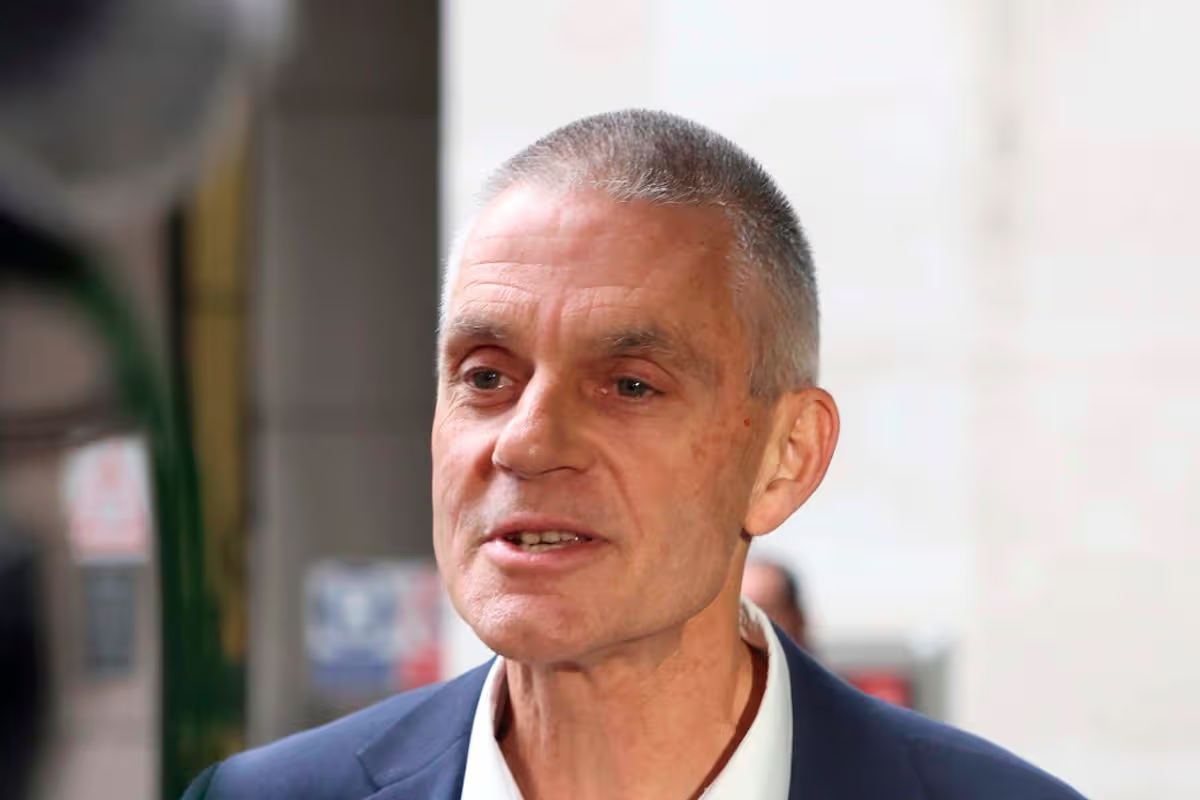
Davie agreed that the BBC and other institutions were in ‘crisis’(Image: Ian Vogler / Daily Mirror)
The BBC is in “crisis,” departing Director General Tim Davie has said. The broadcaster has been criticised for its planned increase to the licence fee, which will rise to £180, from April 1.The increase, required by the 2022 Licence Fee Settlement, will rise by £5.50 for the year. This means a standard colour TV licence will now cost each home £15 a month, more than a subscription to various streaming platforms.
Speaking on The Rest Is Entertainment podcast, Davie insisted that the BBC – and other institutions – are certainly in “crisis”. He says: “Trust is built and I’m semi-obsessed by this – trust is built by people absolutely believing that someone is acting in their interest and that they listen to them. And if you think about an old-school broadcaster, it broadcasts….
“I think there have been too many instances where institutions and the BBC is definitely not exempt from this – where, call it what you will, metropolitan, a certain lens on life.”
According to Davie, as long as the BBC is providing value, then there should be no problems about an increase in the licence fee.
“We’re at a consultation phase, but we have set out a very clear preference which is and I would do this to the point about restarting where we’re at – I think there is a model which says: look, if we can deliver value for every household and really work at that, then everyone contributes fairly, and I think that is a model that’s worth fighting for,” he says.
“I don’t see it as something potentially trapped in the past. I actually think it could be something exciting for the future – quite enlightened. You don’t have to go exactly where the market is going currently. You have to make markets, and I think we can do that.”
The BBC have been hit by serious allegations that one of their Panorama documentaries misled viewers by editing a speech by Donald Trump. The BBC’s director general Tim Davie and head of news Deborah Turness both resigned in November.
It had been alleged in a leaked internal BBC memo that those working on the Panorama programme edited two parts of the speech together so that Trump appeared to explicitly encourage the Capitol Hill riot back in 2021. Trump has since launched a multi-billion dollar lawsuit against the BBC, which is scheduled to go to trial in February 2027.
He did not explicitly reference any specific errors the BBC had made under his tenure but he said the world was in an age of “weaponisation”, where the broadcaster was under strict scrutiny over one thing – but not referencing all the good work they’ve done.
“We’ve made mistakes, sometimes serious mistakes, which we regret. But weaponisation is selectively taking one fact – it may be a fact, so you’re standing on a fact – but what you’re not standing on is any effort to be proportionate,” he says.
“You’re not saying, look, a thousand stories run, we’re running, and one didn’t get it right, or overall this is where there’s no balance of data. It’s literally just selecting a fact to make a case.”
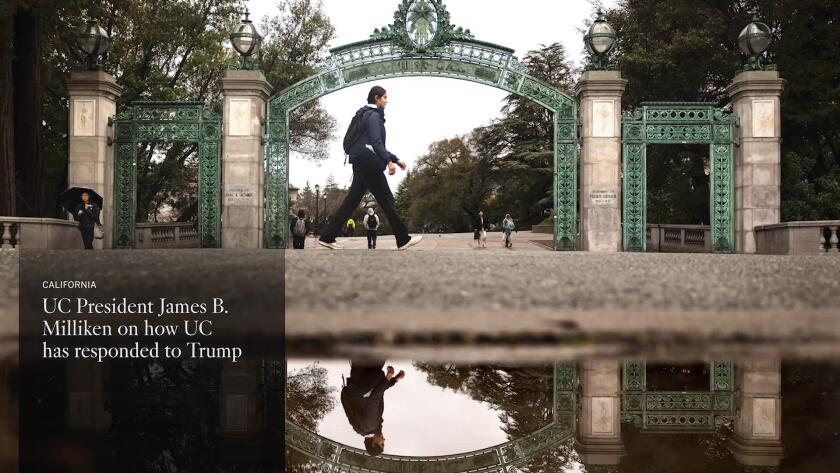
BERKELEY — University of California President James B. Milliken, in his first extensive interview since taking the helm of the nation’s premier public higher education system, defended UC’s diplomatic approach to President Trump’s fusillade of actions against the institution — contrasting it with the more aggressive fight Harvard is waging with the government.
UC has not repeatedly sued the federal government or publicly criticized Trump, while Harvard battles the administration in and outside court amid billions in White House funding freezes.
Share via
“We could have said, ‘We’re going to sue tomorrow.’ We saw that movie with Harvard,” Milliken said of his first seven months on the job dominated by federal attacks. “Harvard is still in negotiations to settle the federal government’s actions, but they have had a series of devastating enforcement actions taken … Given our responsibility to the university and to the state of California, the better course for us was to engage.”
Yet days after the interview, the U.S. Department of Justice leveled another strike against UC in a lawsuit alleging UCLA “routinely ignored” and “failed to report” employee complaints of antisemitism since 2023.
In a statement after the interview, Milliken said UC has already committed to combating anti-Jewish hatred without court interference.
“Antisemitism has no place at UC and we have taken important actions to protect our Jewish students, faculty and staff … We will always have work to do, and our commitment to our community is unwavering,” the statement said. “In light of this — and our oft-cited willingness to work with the government in good faith — the new lawsuit is unfortunate and, in our view, unnecessary.”
In a wide-ranging interview at UC Berkeley’s Grimes Engineering Center, Milliken, 68, offered his assessment of Trump’s actions to overhaul higher education and declined to say whether UC would pay an amount smaller than the $1.2-billion proposed fine over UCLA’s alleged campus antisemitism.
On federal talks, Milliken said UC would “never compromise” on its independence, governance, values and academic freedom.
James B. Milliken.
(Christina House / Los Angeles Times)
He touted UC’s accomplishments despite the challenges: Four faculty members received Nobel prizes last year — the largest ever number from one institution — and UC secured more patents for inventions last year than any university in the world.
Aside from Trump, UC faces internal pressures: multiple campuses, including UCLA, are in deficit. Labor unions are demanding better job conditions. Members of the UAW 4811 academic workers union have authorized a potential strike.
Milliken spoke in favor of diversity, celebrated immigrants and said he wanted to expand student access to the university. He said UC should lead on artificial intelligence.
Milliken started in August after more than six years as chancellor of the University of Texas system. He previously held top roles at the City University of New York, the University of Nebraska and the University of North Carolina. A news and history buff and former Wall Street lawyer who prefers reading paper over pixels, he often cites his study of “The Gold and the Blue,” a two-volume chronicle of UC’s ascent in the 1950s and struggles during the political turmoil of 1960s written by former UC Berkeley Chancellor turned UC President Clark Kerr.
He said his job is “to do everything we can to demonstrate the value that’s delivered by these amazing places … I don’t want to underestimate the difficulty in the current political environment,” but, he added, universities have been a national boon “over generations.”
Trump and higher education
Adjusting to the possibility of further retrenchment of Washington’s university research funding is among Milliken’s top concerns.
UC relies on $17.5 billion annually in federal monies, including research grants, Pell grants and hospital payments for Medicare and Medicaid. Last year, the government suspended $584 million in UCLA federal medical, science and energy research grants before a UC faculty-led lawsuit restored the money. But roughly $170 million in grants is still on hold systemwide.
Another independent faculty- and union-led federal suit has temporarily halted the $1.2-billion UCLA settlement demand seeking rightward ideological change on campus. But UC remains open to talks to quash federal probes on its own terms.
James B. Milliken.
(Christina House / Los Angeles Times)
Milliken was vague on the status of negotiations and whether UC would pay a fine — such as the $200 million Columbia University signed off on last year — to settle federal investigations.
“It would be foolhardy of me to speculate on what ultimately might be proposed to the University of California or what we might find acceptable,” he said.
He declined to specify how he would uphold his promises to protect UC’s independence, governance, values and academic freedom.
“I’m not going to go into detail on those because it gets pretty close to the line of what could be a discussion with the federal government,” Milliken said.
Educational access
Milliken was more verbose on the role of higher education and his big-picture visions for UC.
College “helps make sure that we have an educated citizenry that is prepared to actively participate in a democracy that understands our civic traditions, that understands our political system, that understands how our economic system works,” Milliken said.
“Talent is universal,” he said, “but opportunity often isn’t.” Universities “match this talent with the opportunity.”
But federal moves have threatened to change access to education. The Trump administration has sued California’s public universities and community colleges for allowing undocumented immigrants to pay in-state tuition. A Trump travel ban on dozens of countries has stalled student and faculty applications from Asian, African and South American nations, while a $100,000 fee for new H-1B visas for highly skilled foreign hires could hurt university and hospital recruitment.
Share via
Milliken pledged to protect immigrants.
“I think we need to take a step back and recognize how fundamental the country’s embrace of people from around the world has been,” Milliken said. “It has been an enormous boon in terms of talent and culture and the kinds of things that make this country what it is today. I know people are worried, they’re anxious. In some cases, they’re afraid … One of the things that our university presidents and chancellors think about every day is keeping these communities safe.”
Lifelong learning
UC — home to several of the most selective and prestigious campuses in the nation — continues to grow in size and popularity. The system set a record enrollment of about 301,000 students in 2025. And 252,000 high school and transfer students have submitted applications for the coming fall, another record high. Yet, vast numbers of academically qualified students do not get in, especially to UCLA and UC Berkeley.
Campuses, including UCLA, have upped professional certificate programs and extension school offerings in recent years. Milliken said universities should further embrace learning programs outside of the undergraduate experience. UCLA is developing a plan called “UCLA for Life” to reimagine the Westwood campus’ role for professionals.
“A four-year baccalaureate experience is not enough to prepare you for 40 years or 50 years of a career. You’re going to need to retool, going to need to re-skill. And I look at universities. Students ought to turn to their alma maters. There’s a relationship that you ought to have for life,” Milliken said.
The university’s future and evolution
Milliken wants UC to take on a lead role in AI.
“The continued adaptation of AI is inevitable, and there are good things and not so good things about that. But UC is the most important, impactful university in the world, and it should not be following others in developing what is the ethical and responsible,” Milliken said. “… We’re in a place where I think leadership, whether we wanted it or not, is a responsibility.”
Share via
More Californians should take stock of UC’s role outside of undergraduate education, he said.
“Two-thirds of our students are undergraduates. It’s a hugely important thing. But so is the research we do. So is the healthcare that we do across the state. So is the work we do at national laboratories which support incredible innovation and national security,” he said.
Milliken said he hoped the cuts to university research were a short-term “aberration.”
New research funding state bond bill
UC has put its weight behind a $23-billion bond proposal that will be on the November ballot to create a California Foundation for Science and Health Research, which would fund university and private institutions in ways similar to the National Institutes of Health.
If voters pass it, Milliken said the measure would “go an enormous way” toward making up for federal losses but that it was “impossible to speculate” on the extent as federal research funding, priorities and procedures fluctuate.
“I hope we never get to the question of whether California can replace federal funding,” he said. “Would I like to see it supplement, ensure that disruptions — even if shorter term — don’t derail the important science that’s going on here and the preparation of the next generation of scientists? Yes, I think that’s an incredibly worthwhile endeavor for the state.”
Spokesman Esmaeil Baghaei says Iran’s attacks on US targets across the region are legitimate defensive actions.
Published On 28 Feb 202628 Feb 2026
Share
Iran is entitled to defend itself from Israeli and US attacks, the spokesman for Iran’s Ministry of Foreign Affairs has stressed.
“We have every right in accordance with international law, with the UN Charter, to defend ourselves with all might”, Esmaeil Baghaei said in an interview with Al Jazeera on Saturday.
Recommended Stories
list of 3 itemsend of list
The US and Israel launched a wave of attacks across multiple Iranian cities, including Tehran, on Saturday, in what US President Donald Trump described as “major combat operations”.
At least 201 people have been killed, according to Iranian media, citing the Red Crescent.
A plume of smoke rises following a reported explosion in Tehran on February 28, 2026 [AFP]
Iran responded by firing missiles towards Israel and US military targets in multiple countries, including Bahrain, Iraq, Jordan, Kuwait, Saudi Arabia, Qatar and the United Arab Emirates.
Baghaei said the country’s armed forces “are defending national sovereignty and the territorial integrity of Iran against these barbaric acts of aggression”.
The US-Israeli attacks came after a third round of indirect negotiations on Iran’s nuclear programme between the US and Iran ended on Friday.
“We were supposed to meet on Monday to talk about technical aspects of any possible deal on [the] nuclear issue,” Baghaei said. “And the Americans themselves acknowledged that these negotiations went quite well. The mediator, [the] foreign minister of Oman, qualified this round of negotiations as being of significant progress.”
It was the second time in less than a year that diplomacy had been scuttled by an attack on Iran, Baghaei noted. Iran and the US had engaged in several rounds of negotiations last year, when Israel launched a 12-day war on Iran in June, which the US briefly joined, despite Trump saying he was committed to a diplomatic resolution.
Baghaei said the US “launching an act of aggression against another member of the United Nations” also threatened the international body, as its main pillar, “the UN Charter, is the provision of the use of force.”
“So, I think what is at stake is not only the security and peace of the region and that of Iran, but also the whole fabric of international law. And the normative system that has been created by the United Nations Charter,” he added.
Friends in the region
Baghaei defended Iran’s retaliatory attacks in several countries across the region.
“Under international law, any place, any location, any logistical support that are given to the aggressor [is a] legitimate target for the victim state,” he said. “So, we are not attacking any country in the region. We are friendly with all countries of the region. What we are doing is just taking defensive actions.”
“We have proven that we trust our friends in the region,” Baghaei said. “That’s why we try to get together with the countries of the region in furtherance of this diplomatic process. The problem is that the United States is conducting this war of aggression at the cost of everyone, including the countries of the region.”
South Korean President Lee Jae-myung speaks during the National Startup Era Strategy Meeting to discuss strategies to nurture startups at the main building of the Cheong Wa Dae presidential office in Seoul, South Korea, 30 January 2026. File. Photo by YONHAP / EPA
Feb. 25 (Asia Today) — President Lee Jae-myung on Tuesday defended his directive to review a comprehensive survey and possible sale orders for uncultivated farmland, rejecting criticism that the move amounts to communist-style policy.
Lee said on social media that some critics “misunderstand the constitutional principle of land to the tiller and talk about the Communist Party” in response to his order.
He clarified that the review does not target inherited farmland or land left uncultivated due to age or unavoidable circumstances. Instead, he said it focuses on cases in which individuals submit farming plans for speculative purposes, acquire farmland and then fail to cultivate it themselves.
Under South Korea’s Constitution and the Farmland Act, only those who intend to farm the land directly may acquire farmland. Prospective buyers must submit a farming plan detailing how they will cultivate it. If they fail to do so, authorities may issue a sale order through legal procedures.
Lee emphasized that the “land to the tiller” principle was enshrined in the Constitution under former President Syngman Rhee, who also led postwar land redistribution by acquiring land from non-farming landlords and distributing it to farmers.
“The government’s land reform based on this principle became the foundation of South Korea’s economic development,” Lee said, adding that even critics of Rhee acknowledge his achievements in land reform. “Syngman Rhee was not a communist,” he said.
At a Cabinet meeting Monday, Lee said high farmland prices are making it difficult for people seeking to return to farming or rural life.
“We need to lower the cost of returning to farming, and fundamentally that requires bringing down land prices,” he said, calling for a full-scale investigation and possible sale orders if illegal activity is found.
Lee added that soaring real estate prices are at the root of many social and economic problems in the country.
WASHINGTON — To defend an increasingly unpopular immigration crackdown during his State of the Union speech, President Trump highlighted the victims of crimes perpetuated by undocumented immigrants.
But as Democrats pointed out, the president’s lengthy speech made no reference to the U.S. citizens, including Renee Good and Alex Pretti in Minneapolis, who were killed by immigration agents.
Recent polls show public approval of Trump’s immigration policies has fallen to record lows level since he returned to the White House. One poll, released Feb. 17 by Reuters and the market research firm Ipsos, showed just 38% of respondents felt Trump was doing a good job on immigration.
Another poll, published last month by Fox News, showed 59% of voters say U.S. Immigration and Customs Enforcement is “too aggressive.”
“As President Trump brags about his immigration enforcement at tonight’s State of the Union, I can think only of Renee Nicole Good, Alex Pretti and the three dozen people who have died in ICE custody since Trump took office,” Rep. Mark DeSaulnier (D-Concord) wrote on X.
Within the first few minutes of his address on Tuesday night, Trump highlighted “the strongest and most secure border in American history, by far.” He also offered — at least momentarily — a softer tone, adding that “We will always allow people to come in legally, people that will love our country and will work hard to maintain our country.”
In reality, the administration has restricted legal immigration. It has revoked humanitarian benefits for hundreds of thousands of people, and an indefinite pause on all asylum applications filed with U.S. Citizenship and Immigration Services.
Guests invited by various lawmakers to attend Trump’s speech offered dueling visions of the administration’s mass deportation effort.
Rep. Randy Feenstra (R-Iowa) said he would bring the father and brother of Sarah Root, who was killed in 2016 after a drunk driver, who was in the U.S. illegally, crashed into her vehicle. Trump held an event Monday for “angel families,” those with a relative who was killed by an undocumented immigrant, and signed a proclamation honoring such victims of crimes.
Democrats, meanwhile, invited immigrants, family members of those detained or deported, and U.S. citizens who were violently arrested by immigration agents.
Rep. Mike Levin (D-San Juan Capistrano), for example, said he was bringing the daughter of a Laguna Niguel couple deported last year to Colombia after their arrest during a routine check-in with ICE. And Rep. Jesus Garcia (D-Ill.) invited Marimar Martinez, a Chicago woman shot five times by Border Patrol Agent Charles Exum.
On X, the Department of Homeland Security shot back at Democrats with immigrant guests, saying the lawmakers are “once again prioritizing illegal aliens above the safety of American citizens.”
On Tuesday morning, Rep. Maria Elvira Salazar (R-Fla.) held a news conference on “the state of immigration,” flanked by Christian pastors, in which she touted her Dignity Act, which would provide permanent legal status to immigrants who meet certain benchmarks.
“Throughout the Scripture, there are two kinds of leaders: those who persecute faith communities and those who protect them,” she said.
California Sen. Adam Schiff was among the Democrats to boycott Trump’s speech, and he cited immigration enforcement as one reason for his absence.
“I have not missed the State of the Union in the 25 years I’ve been in Congress, but we have never had a president violate the Constitution, the laws every day with seeming impunity,” Schiff told Meidas Touch outside the Capitol. “We’ve never had masked armed, poorly trained agents, victimizing our cities, demanding to see people’s papers.”
Trump repeated claims about immigration that have been debunked, such as his assertion that President Biden’s immigration polices allowed millions of people to pour into the U.S. from prisons and mental institutions.
Trump also highlighted a figure he has often turned to — that Democrats let in “11,888 murderers.” That number, an inaccurate description of federal data, refers to immigrants who, over the course of decades (including the first Trump administration) were convicted of homicide, usually after their arrival in the U.S. Those immigrants are listed on ICE’s “non-detained docket” typically because they are currently serving their prison sentences.
Turning to Minnesota, Trump said Somalis have defrauded $19 billion from American taxpayers and referred to them derogatorily as “Somali pirates.”
Trump went beyond Somalis to disparage many immigrants, saying “there are large parts of the world where bribery, corruptions and lawlessness are the norm, not the exception.”
“Importing these cultures through unrestricted immigration and open borders brings those problems right here to the USA, and it is the American people who pay the price,” he said.
Trump also highlighted the case of Dalilah Coleman, 6, of Bakersfield who was left with a traumatic brain injury after a 2024 car crash in California.
He called on Congress to pass the Dalilah Law, which would bar states from granting commercial drivers licenses to immigrants without lawful status. He said, without proof, that “most illegal aliens do not speak English and cannot read even the most basic road signs.”
A year after Dalilah’s accident her family met with Partap Singh, the detained Indian immigrant responsible for the crash, at the Mesa Verde ICE Processing Center in Bakersfield. Marcus Coleman, her father, told Fox26 News that the focus shouldn’t be on Singh’s legal status because similar accidents happen every day.
Also present Tuesday night were the parents of Sarah Beckstrom, the West Virginia National Guard member shot and killed in Washington, D.C. by an Afghan immigrant, as well as Andrew Wolfe, who was also shot and survived.
Trump awarded Wolfe and Beckstrom the Purple Heart. He called Rahmanullah Lakanwal, the man charged in the shooting, a “terrorist monster.” Lakanwal legally entered the U.S. from Afghanistan through a Biden administration program in 2021 and his asylum application was approved under the Trump administration last April.
Turning his attention the fall’s midterm elections, Trump warned his supporters that if allowed back into power, Democrats would reopen the borders “to some of the worst criminals anywhere in the world.”
Trump then invited legislators to stand if they agreed with him that “the first duty of the American government is to protect American citizens, not illegal aliens.”
Republicans stood, offering one of the longest standing ovations of the night. Democrats remained seated.
Trump told Democrats they should be ashamed for not standing up.
“You have killed Americans!” Rep. Ilhan Omar (D-Minn.) yelled from the audience. “You should be ashamed.”