declines

Call the Midwife fan favourites return as Sister Monica Joan’s health declines

Call the Midwife sees the comeback of popular characters as the nun’s health continues to spiral following her recent diagnosis.

Call the Midwife is welcoming back one much-loved family, and fans will be ecstatic.

In recent episodes of the BBC One drama, Sister Monica Joan (Judy Parfitt) has been rapidly declining in health, leaving her loved ones at Nonnatus House very concerned. On Sunday, 15 February, Doctor Patrick Turner (Stephen McGann) confirmed that the nun’s loss of appetite and exhaustion are the result of a chronic kidney disease.

The GP then devastatingly added, “Unless we can persuade her to accept what treatment there is, she’ll progress to end-stage renal failure fairly quickly”, as he also implied her deterioration has been rapid.

In the past, Sister Monica Joan has made miraculous recoveries from her medical issues, but this time, a subtle comment from her, “Maybe I do not care to go on for a long time”, appeared to seal her fate.

In forthcoming scenes airing during episode eight on Sunday, 8 March, Sister Monica Joan reunites with Bernie Mullocks (Christopher Reilly). The much-loved Mullocks’ family were introduced during series five before returning in series six as part of the ongoing Thalidomide story.

Who are the Mullucks family in Call the Midwife?

In 2016, Rhoda Mullucks (Liz White) gave birth to a daughter, Susan, who was born with birth defects after taking medication prescribed by Doctor Turner. During birth, the nurses immediately realised Susan was born without properly developed arms and legs as the newborn struggled to breathe.

Rhoda and her partner Bernie were left surprised by the developments but dedicated themselves to being the best parents they could.

The show tackled the Thalidomide scandal again in series six, catching up with the Mullucks family 18 months after Susan’s birth, as Dr Turner helped fit her with prosthetic limbs before enrolling in nursery school. Bernie found Susan’s condition hard to comprehend, and even walked out of a meeting as tears filled his eyes.

Over the years, Bernie went from despising his child he once cruelly called a “monster”, to being terrified into over-protectiveness, afraid she would be the object of ridicule.

In 2022, the Mullocks family returned as Rhoda and Bernie welcomed another baby into their beautiful family. Their story continued as the parents’ mental health was also explored.

In an advance glimpse of the Call the Midwife episode, Bernie sits beside his wife, Rhoda, as she lies in a hospital. The couple hold hands as they look dishevelled, though it is unclear why Rhoda was admitted to the hospital.

In another sneak peek, Bernie is seen pushing a frail Sister Monica Joan in a wheelchair through the streets of Poplar, carrying a bouquet of white flowers.

Bernie and Sister Monica Joan also visit a church together, though it is currently unknown what brings the two back together.

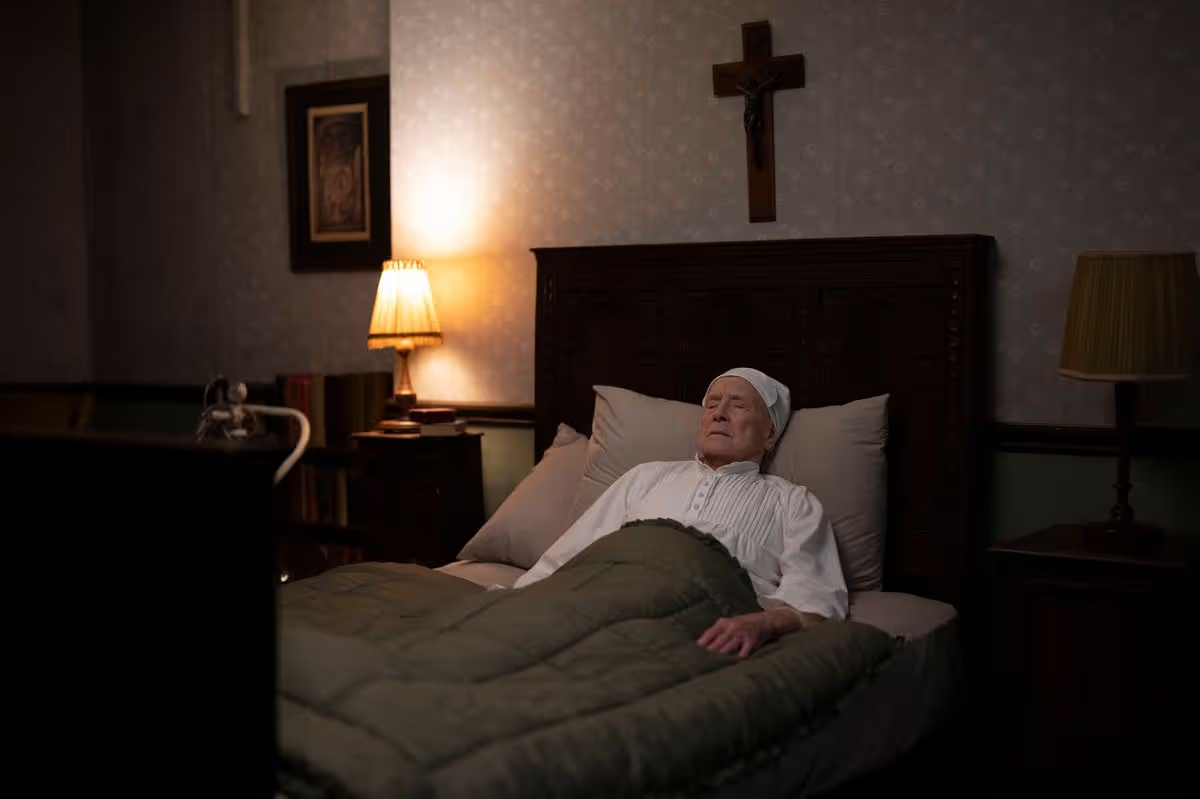
The BBC drama has also released a photo of Sister Monica Joan lying in bed, eyes closed, with her hands by her side. Is this the end for the adored sister? Viewers will have to wait and see what lies ahead for Sister Monica Joan.

Call the Midwife airs Sunday at 8pm on BBC One and iPlayer

For the latest showbiz, TV, movie and streaming news, go to the new **Everything Gossip** website.

Ensure our latest headlines always appear at the top of your Google Search by making us a Preferred Source.** Click here to activate**** or add us as your Preferred Source in your Google search settings.**

Source link

US treasury secretary declines to rule out future Federal Reserve lawsuits | Donald Trump News

Treasury Secretary Scott Bessent has faced questions from the United States Senate about President Donald Trump’s ongoing campaign to slash interest rates, despite concerns that such a move could turbo-charge inflation.

Bessent appeared on Thursday before the Senate’s Financial Stability Oversight Council.

Recommended Stories

list of 3 itemsend of list

There, he received a grilling from Democrats over rising consumer prices and concerns about Trump’s attempts to influence the Federal Reserve, the US central bank.

One of his early clashes came with Senator Elizabeth Warren, who sought answers about a report in The Wall Street Journal that indicated Trump joked about suing his nominee for the Federal Reserve chair, Kevin Warsh, if he failed to comply with presidential demands.

“Mr Secretary, can you commit right here and now that Trump’s Fed nominee Kevin Warsh will not be sued, will not be investigated by the Department of Justice, if he doesn’t cut interest rates exactly the way that Donald Trump wants?” Warren asked.

Bessent evaded making such a commitment. “That is up to the president,” he replied.

Senators Elizabeth Warren and Tim Scott on a congressional panel
Senators Tim Scott and Elizabeth Warren speak during a hearing on the Financial Stability Oversight Council’s annual report to Congress [Jonathan Ernst/Reuters]

Pressure on Federal Reserve members

Last week, Trump announced Warsh would be his pick to replace the current Federal Reserve chair, Jerome Powell, who has faced bitter criticism over his decision to lower interest rates gradually.

By contrast, Trump has repeatedly demanded that interest rates be chopped as low as possible, as soon as possible.

In December, for instance, he told The Wall Street Journal that he would like to see interest rates at “one percent and maybe lower than that”.

“We should have the lowest rate in the world,” he told the newspaper. Currently, the federal interest rate sits around 3.6 percent.

Experts say a sudden drop in that percentage could trigger a short-term market surge, as loans become cheaper and money floods the economy. But that excess cash could drive down the value of the dollar, leading to higher prices in the long term.

Traditionally, the Federal Reserve has served as an independent government agency, on the premise that monetary decisions for the country should be made without political interference or favour.

But Trump, a Republican, has sought to bring the Federal Reserve under his control, and his critics have accused him of using the threat of legal action to pressure Federal Reserve members to comply with his demands.

In August, for instance, he attempted to fire Federal Reserve Governor Lisa Cook based on allegations of mortgage fraud, which she has denied.

Cook had been appointed to the central bank by Trump’s predecessor and rival, Democrat Joe Biden, and she has accused Trump of seeking her dismissal on political grounds. The Supreme Court is currently hearing the case.

Then, in early January, the Department of Justice opened a criminal investigation into Powell, echoing accusations Trump made, alleging that Powell had mismanaged renovations to the Federal Reserve building.

Powell issued a rare statement in response, accusing Trump of seeking to bully Federal Reserve leaders into compliance with his interest rate policy.

“The threat of criminal charges is a consequence of the Federal Reserve setting interest rates based on our best assessment of what will serve the public, rather than following the preferences of the President,” Powell wrote.

Thom Tillis speaks on a Senate panel
Senator Thom Tillis, a Republican who is not seeking reelection, has been critical of the probe of Federal Reserve Chair Jerome Powell [Jonathan Ernst/Reuters]

Bipartisan scrutiny of Powell probe

Given the string of aggressive actions against Powell and Cook, Trump’s joke about suing Warsh fuelled rumours that the Federal Reserve’s independence could be in peril.

Within hours of making the joke on January 31, Trump himself faced questions about how serious he might have been.

“It’s a roast. It’s a comedy thing,” Trump said of his remarks as he spoke to reporters on Air Force One. “It was all comedy.”

Warren, however, pressed Bessent about Trump’s remarks and chided the Treasury chief for not rejecting them.

“I don’t think the American people are laughing,” Warren told Bessent. “They’re the ones who were struggling with the affordability.”

The prospect of Trump exerting undue influence over the Federal Reserve even earned a measure of bipartisan criticism during Thursday’s council meeting.

Senator Thom Tillis, a Republican from North Carolina, opened his remarks to Bessent with a statement denouncing the probe into Powell, even though he acknowledged he was “disappointed” with the current Fed chair.

Still, Tillis emphasised his belief that Powell committed no crime, and that the investigation would discourage transparency at future Senate hearings.

He imagined future government hearings becoming impeded by legal formalities, for fear of undue prosecution.

“They’re going to be flanked with attorneys, and anytime that they think that they’re in the middle of a perjury trap, they’re probably just going to say, ‘I’ll submit it to the record after consultation with my attorneys,’” Tillis said, sketching out the scenario.

“Is that really the way we want oversight to go in the future?”

For his part, Bessent indicated that he backed the Federal Reserve’s long-term goal to keep interest rates at about 2 percent.

“It is undesirable to completely eliminate inflation,” Bessent said. “What is desirable is to get back to the Fed’s 2 percent target, and for the past three months, we’ve been at 2.1 percent.”

A screen shows Scott Bessent testifying at a Senate committee hearing. A photographer sits on the floor next to the screen.
Treasury Secretary Scott Bessent attends a Senate Banking, Housing and Urban Affairs Committee hearing on the Financial Stability Oversight Council on February 5 [Jonathan Ernst/Reuters]

Scrutinising the lawsuit against the IRS

As Thursday’s hearing continued, Bessent was forced to defend the Trump administration on several fronts, ranging from its sweeping tariff policy to its struggle to lower consumer prices.

But another element of Trump’s agenda took centre stage when Democrat Ruben Gallego of Arizona had his turn at the microphone.

Gallego sought to shine a light on the revelation in January that Trump had filed a lawsuit against the Internal Revenue Service (IRS) — part of his own executive branch.

Trump is seeking $10bn in damages for the leak of his tax returns during his first term as president. The IRS itself was not the source of the leak, but rather a former government contractor named Charles Littlejohn, who was sentenced to five years in prison.

Bessent was not named as a defendant in the lawsuit, though he currently serves both as the Treasury secretary and the acting commissioner of the Internal Revenue Service.

Critics have argued that Trump’s lawsuit amounts to self-dealing: He holds significant sway over the Justice Department, which would defend the federal government against such lawsuits, and he could therefore green-light his own settlement package.

In Thursday’s exchange with Gallego, Bessent acknowledged that any damages paid to Trump would come from taxpayer funds.

“ Where would that $10bn come from?” Gallego asked.

“ It would come from Treasury,” Bessent replied. He then underscored that Trump has indicated any money would go to charity and that the Treasury itself would not make the decision to award damages.

Still, Gallego pressed Bessent, pointing out that the Treasury would ultimately have to disburse the funds — and that Bessent would be in charge of that decision.

That circumstance, Gallego argued, creates a conflict of interest, since Bessent is Trump’s political appointee and can be fired by the president.

“Have you recused yourself from any decisions about paying the president on these claims?” Gallego asked.

Bessent sidestepped the question, answering instead, “I will follow the law.”

Source link

US judge declines to halt immigration surge in Minnesota amid protests | Donald Trump News

A judge in the United States has declined to order President Donald Trump’s administration to halt its immigration crackdown in Minnesota, amid mass protests over deadly shootings by federal agents in the US state.

US District Judge Kate Menendez on Saturday denied a preliminary injunction sought in a lawsuit filed this month by state Attorney General Keith Ellison and the mayors of Minneapolis and Saint Paul.

Recommended Stories

list of 3 itemsend of list

She said state authorities made a strong showing that immigration agents’ tactics, including shootings and evidence of racial profiling, were having “profound and even heartbreaking consequences on the State of Minnesota, the Twin Cities, and Minnesotans”.

But Menendez wrote in her ruling that, “ultimately, the Court finds that the balance of harms does not decisively favor an injunction”.

The lawsuit seeks to block or rein in a Department of Homeland Security (DHS) operation that sent thousands of immigration agents to the Minneapolis-Saint Paul area, sparking mass protests and leading to the killings of two US citizens by federal agents.

Tensions have soared since an Immigration and Customs Enforcement agent shot and killed Minneapolis mother Renee Nicole Good in her car on January 7.

Federal border agents also killed 37-year-old nurse Alex Pretti in the city on January 24, stoking more public anger and calls for accountability.

Tom Homan, Trump’s so-called “border czar”, told reporters earlier this week that the administration was working to make the immigration operation “safer, more efficient [and] by the book”.

But that has not stopped the demonstrations, with thousands of protesters taking to the streets of Minneapolis on Friday amid a nationwide strike to denounce the Trump administration’s crackdown.

Speaking to Al Jazeera from a memorial rally in Saint Paul on Saturday, city councillor Cheniqua Johnson said, “It feels more like the federal government is here to [lay] siege [to] Minnesota than to protect us.”

She said residents have said they are afraid to leave their homes to get groceries. “I’m receiving calls … from community members are struggling just to be able to do [everyday] things,” Johnson said.

“That’s why you’re seeing folks being willing to stand in Minnesota, in negative-degree weather, thousands of folks marching … in opposition to the injustice that we are seeing when law and order is not being upheld.”

Protesters convene on the Bishop Whipple Federal Building to oppose ICE detentions almost week after Alex Pretti was killed by ICE agents in Minneapolis, Minnesota, on January 30, 2026.
Protesters rally to oppose ICE detentions, in Minneapolis, Minnesota, on January 30, 2026 [AFP]

Racial profiling accusations

In their lawsuit, Minnesota state and local officials have argued that the immigration crackdown amounts to retaliation after Washington’s initial attempts to withhold federal funding to try to force immigration cooperation failed.

They maintain that the surge has amounted to an unconstitutional drain on state and local resources, noting that schools and businesses have been shuttered in the wake of what local officials say are aggressive, poorly trained and armed federal officers.

Ellison, the Minnesota attorney general, also has accused federal agents of racially profiling citizens, unlawfully detaining lawful residents for hours, and stoking fear with their heavy-handed tactics.

The Trump administration has said its operation is aimed at enforcing federal immigration laws as part of the president’s push to carry out the largest deportation operation in US history.

On Saturday, Menendez, the district court judge, said she was not making a final judgement on the state’s overall case in her decision not to issue a temporary restraining order, something that would follow arguments in court.

She also made no determination on whether the immigration crackdown in Minnesota had broken the law.

US Attorney General Pam Bondi called the judge’s decision a “HUGE” win for the Department of Justice.

“Neither sanctuary policies nor meritless litigation will stop the Trump Administration from enforcing federal law in Minnesota,” she wrote on X.

Minneapolis Mayor Jacob Frey said he was disappointed by the ruling.

“This decision doesn’t change what people here have lived through — fear, disruption, and harm caused by a federal operation that never belonged in Minneapolis in the first place,” Frey said in a statement.

“This operation has not brought public safety. It’s brought the opposite and has detracted from the order we need for a working city. It’s an invasion, and it needs to stop.”

Source link