How two California indie publishers are reshaping literary success
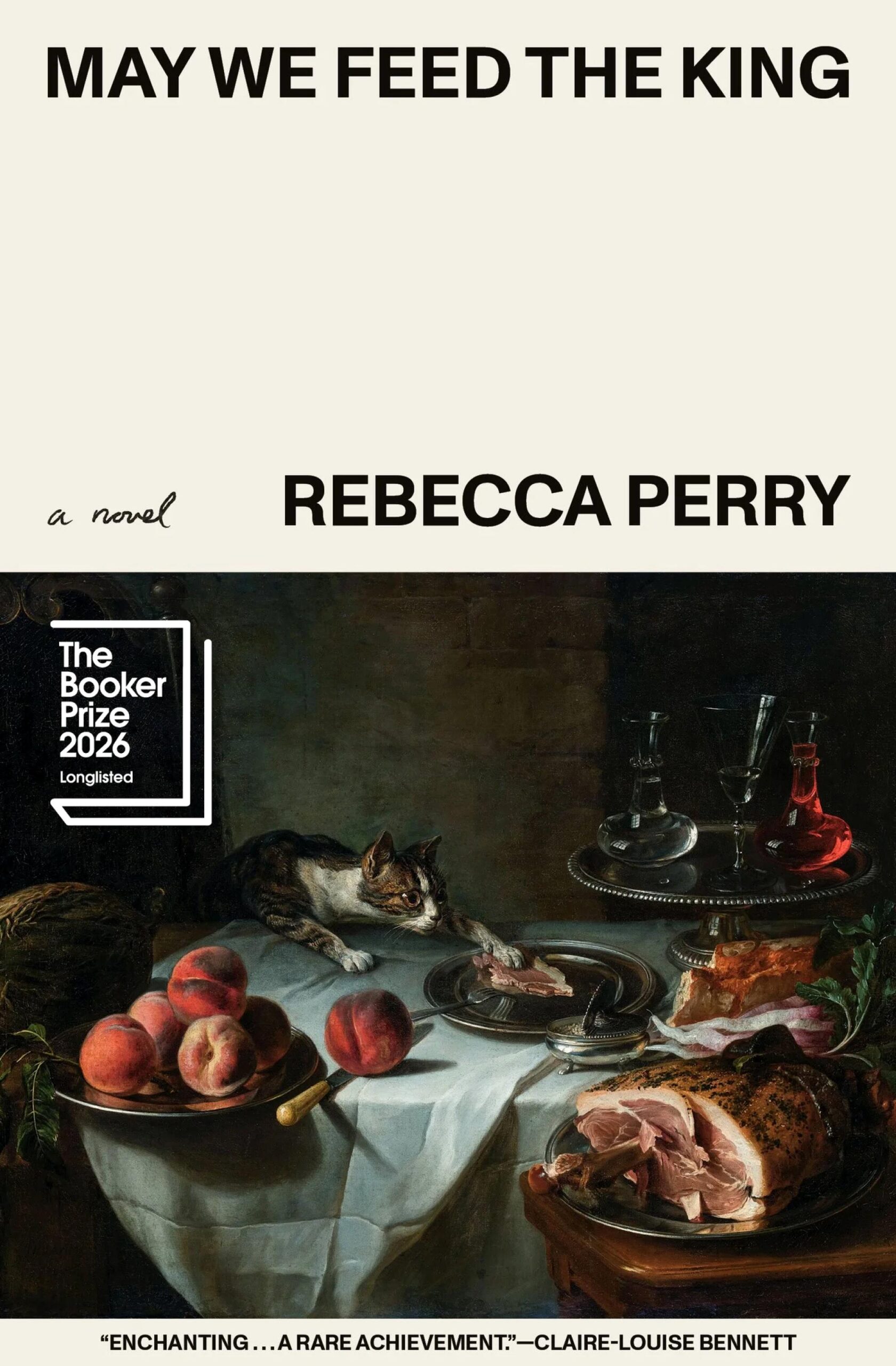
When the Booker Prize longlist was recently announced, it included a book with the memorable title “May We Feed the King.” The debut novel by British author Rebecca Perry isn’t yet available in the U.S., and when it does hit shelves, it will be coming from Transit Books, a small Bay Area publisher run by the husband-and-wife team Adam Z. Levy and Ashley Nelson Levy.
Cited by the Booker committee as “a playful, stirring meditation on history and storytelling” about a curator and a king, the book “has been an early favorite with indie booksellers,” Ashley says.

“May We Feed the King” by Rebecca Perry
(Transit)
“We knew the book was special when we acquired it,” Adam adds. “Ever since, we’ve been crossing our fingers and knocking on wood and sending up flares to the Booker gods, and sent the book to the printer a little earlier than usual just in case.”
Transit, known for publishing intelligent international fiction, began about a decade ago, when Ashley and Adam were convinced that great works of literature were being passed over by New York publishers, and that those books should have a place in America.
There were, Adam says, “really great authors who might have incredible reputations elsewhere not finding publishing houses here that are able to champion them in a way that gets them to access to a broader readership.”
The two were working full-time jobs while talking about their literary dreams over the dining room table. They had met at Columbia in New York and both worked in publishing there before moving to California, where Ashley is from.

Adam Z. Levy and Ashley Nelson Levy, co-publishers of the Bay Area nonprofit publisher Transit Books.
(Jennifer Baquing)
They carefully set out to connect with the international literary community and went through the slow process of launching Transit as a nonprofit. They now have a small staff, an office in Berkeley and count a Nobel Prizewinner, Jon Fosse, among their authors.
For the record:
9:20 a.m. Aug. 19, 2026An earlier version of this article stated that Transit’s office is located in Oakland. It is based in Berkeley.
At the same time Transit was starting out in Northern California, a pair of not-married friends in Los Angeles saw the same possibilities. Chris Heiser and Olivia Taylor Smith were convinced that they could begin a publishing house, starting with international noir.
Smith, who is now a senior editor at Simon & Schuster and lives in Germany, recalled those early days for me over Zoom. “We launched it at a time when it was almost the golden age of independent, small publishing, a lot of which was translation-focused,” she says.
They jumped right in, came up with a name, Ricochet, and a logo. Then they got a cease-and-desist letter — a small poetry press was also starting as Ricochet. “We had to change names,” Heiser says. “We were literally unnamed.” That’s how they launched Unnamed Press.

“A Certain Hunger” by Chelsea G. Summers
(Unnamed Press)
“I’m very grateful to the litigious poets who forced us to change our name,” Heiser adds. Their original crime-fiction focus rapidly expanded. Science fiction? Nonfiction? Feminist cannibal fiction? Yes, yes, yes.
That last was “A Certain Hunger” by Chelsea Summers, which Smith acquired. “I really loved that it is violent and intense and so visceral,” Smith said. “The prose is incredible and it absolutely was a cut above. Not to use a cannibalistic meat pun.” To date, the 2021 novel has been Unnamed Press’ biggest seller.
Where many literary novels from small presses sell fewer than 2,500 copies, “A Certain Hunger” has sold close to 200,000. “We’re a hits-driven business, you know — you have to have a book that does well enough to keep you going,” Heiser says.
Heiser remains with Unnamed as its publisher, and continues to guide it to unpredictable destinations. In 2022, the press opened North Figueroa Bookshop in Highland Park with fellow L.A. publisher Rare Bird Books — it stocks all publishers’ titles, not just their own.

Guests gather at the North Figueroa gallery for Unnamed Press’ launch of “Four Nose Jobs a Day,” a poetry book with an accompanying vinyl album by Devendra Banhart, center.
(Hoda Mallone)
And next door is the gallery they opened late last year. In June they held a gala launch for Devendra Banhart’s new collection of poems, “Four Nose Jobs a Day” in the North Figueroa gallery, published by Unnamed as both book and record album. The party was a little livelier than your typical book launch: Heiser says it “featured a reading backed by an excellent jazz trio, ceramic noses, a scent-maker, mimes and speed therapy, among many other things.”
Where Unnamed often makes unexpected turns, Transit has stuck close to its original mission: to translate a handful of books a year, often works of translation themselves, with a certain aesthetic.
For readers in sync with Transit’s sensibility — literary, bold and with an edge that feels fresh — they offer subscriptions. Their biggest swerve was adding children’s books. “The quality of the writing is really important, first and foremost,” Ashley said on a Zoom call with Adam and their executive editor, Lizzie Davis.
“We’re really attracted to literature that takes risks on the page,” Adam said. They began publishing acclaimed Norwegian author Jon Fosse’s work three years before he was awarded the Nobel Prize in literature. Transit is the American home of Fosse’s big and bold “Septology,” translated into English by Damion Searls.

“Septology 1-VII,” by Jon Fosse
(Transit Books)
Despite years of a cohort within the publishing community advocating for international literature, such as the National Book Awards’ translated literature prize being relaunched in 2018, translated works remain only 3% of the U.S. publishing market. Transit has remained committed to publishing works in translation, and has had genuine success.
Small publishers can be caught in a catch-22 when they have a sudden success. They have to pay to print books and get them distributed, then wait months before the profits (or unsold returns) come back. An author winning the Nobel Prize in literature is about as big a bonanza of demand as you can imagine.
When Fosse won the Nobel in 2023, that meant publishing a big run of his almost 700-page masterwork. “It was a bit of a cash crunch for us,” Adam admits, “but I think we were also lucky in a lot of ways.” The year before they had published “I Who Have Never Known Men” by Jacqueline Harpman, a Belgian novelist who died 20 years before — hardly a guaranteed success.

“Stories, Like Illnesses” by James Elkins
(Unnamed Press)
The publishers themselves can’t fully describe what happened — it was well-reviewed, it went viral, it kept selling, it went viral again. Now, the novel has sold more than 450,000 copies. “I feel like for a small press you really need to, not just catch a break, but catch a break every time,” Adam said, “if you want to last.” Those two pillars — the Fosse and Harpman — allowed the Levys to open their office in Oakland in 2024.
Transit recently released another Harpman book, “We Were Forbidden,” a trio of never-before translated novellas. In September, in addition to Perry’s book, they’ll also be publishing two novels by esteemed French writer Marie Darrieussecq.
Unnamed Press’ fall schedule includes James Elkins’ “Stories, Like Illnesses,” the third installment of a multivolume work called “Five Strange Languages.” Unnamed is publishing in five volumes over five years, “an epic publishing project for any publisher,” Heiser says. Luckily, the first volume got a boost when Jacob Elordi was photographed reading it during a marathon Frankenstein makeup session.
The Levys and Heiser all maintain that there was something about being in California that gave them the creative space to launch their publishing houses.
From their similar visions a decade ago, Transit and Unnamed were born separately, and have taken very different paths to sustainability. The Levys were deliberate and focused; Unnamed spontaneous and evolving. Both are flourishing and show what a little freedom can do.