deadline

Trump sets ambitious deadline for coronavirus vaccine

President Trump outlined an ambitious effort Friday to develop, produce and distribute a fully-approved COVID-19 vaccine by the end of the year, a timeline that even those in charge of the project acknowledge is highly unlikely.

Trump said the $10-billion program would have a goal of producing 300 million doses to administer to Americans by January.

Officials said the initiative would seek to streamline and coordinate the work of government agencies, private industry and the military. A former pharmaceutical executive and an Army four-star general will head the effort, which the White House called Operation Warp Speed.

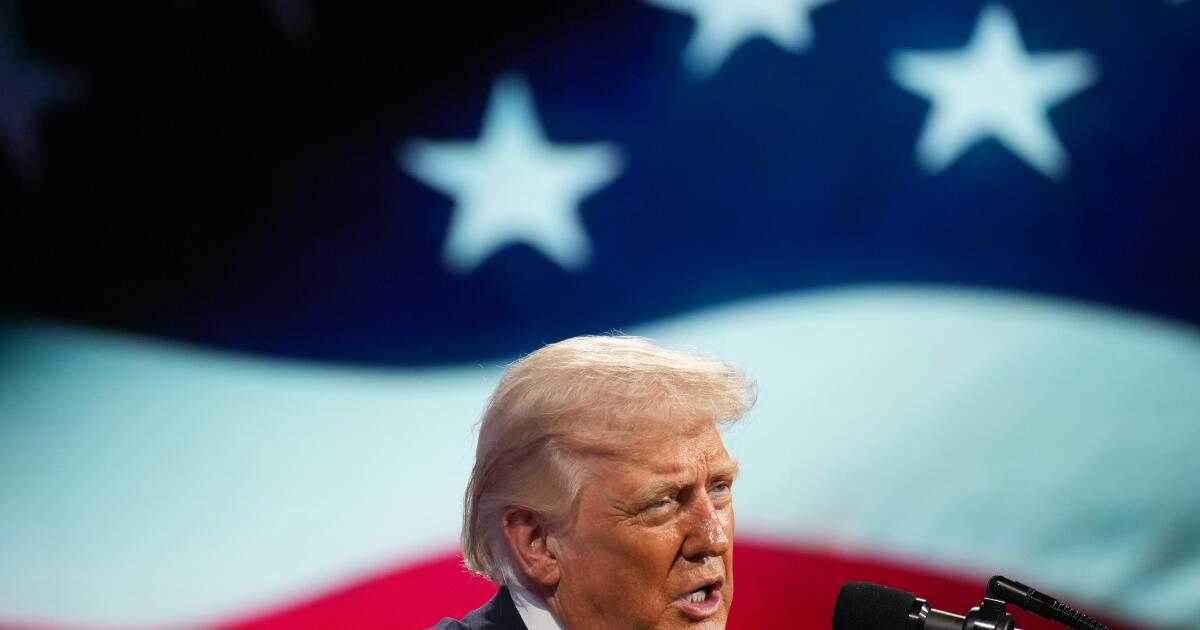
“We’re looking to get it by the end of the year if we can,” Trump said in the Rose Garden. “Tremendous strides are being made.”

But Trump also hedged on the importance of the effort, declaring that America is already on the rebound from the coronavirus outbreak, which has killed about 87,000 Americans and cratered the economy.

“I want to make one thing clear — vaccine or no vaccine, we’re back,” he said. He repeated a claim he’s made since the first U.S. coronavirus cases were reported three months ago, that the virus will eventually “go away” on its own.

“I don’t want people to think this is all dependent on a vaccine,” he said.

Public health officials worry about bringing a potential vaccine to market without several rounds of clinical trials to ensure that it is safe and effective.

The National Institutes of Health says one or two possible vaccine candidates could be ready for large-scale testing by July, with several others likely to follow. Elsewhere around the world, about a dozen vaccine candidates are teed up for small-scale testing or safety studies.

The tests are necessary to determine proper dosages and to avoid negative side effects. The process usually takes several years, but some of the world’s largest pharmaceutical companies are working with governments around the globe in an effort to speed up the search.

Dr. Amesh Adalja, an infectious diseases physician at Johns Hopkins Center for Health Security, said setting a deadline for a vaccine is “dangerous because you’re going to give people a false sense of hope and security.”

But he said it’s possible scientists can accelerate the usual timeline given changes in laboratory practices, including the use of “vaccine platform technologies” that allow researchers to test various candidates without developing each one from scratch, and the decision to prepare factories for mass production before officials know for certain that a particular vaccine will work.

“All of that’s going to shave time off, but everything has to go perfectly,” he said.

Dr. Jere W. McBride, an infectious diseases specialist at the Sealy Institute for Vaccine Sciences at the University of Texas, noted that no vaccine has been “developed that fast before.”

“Everything has to work and in science that’s often not the case,” he added. “Is it possible? Certainly.”

Officials involved in the new initiative echoed the president’s optimism.

Moncef Slaoui, who was chairman of vaccines at British pharmaceutical giant GlaxoSmithKline until 2017, will lead the effort. He said early clinical trials have been encouraging.

“These data make me feel even more confident that we will be able to deliver a few hundred million doses of vaccine by the end of 2020,” Slaoui said. “And we will do the best we can.”

Gen. Gustave Perna, the commanding general of the Army’s Materiel Command, will serve as chief operational officer. He called the project “a herculean task,” but expressed confidence in its success.

“Winning matters and we will deliver by the end of this year a vaccine at scale,” said Defense Secretary Mark Esper.

Part of the effort involves using the military to boost production capacity before the vaccine is ready in order to expedite distribution when one is determined safe and reliable.

Dr. Stephen Hahn, the commissioner of the Food and Drug Administration, said Tuesday at a Senate hearing that his agency would evaluate about 10 vaccine candidates in early studies, and then select three to five to progress into larger studies in humans.

Dr. Rick Bright, the ousted former head of the government agency charged with developing vaccines, has cast doubt on the administration’s rush to find a vaccine.

“My concern is if we rush too quickly, and consider cutting out critical steps, we may not have a full assessment of the safety of that vaccine,” Bright told a House committee on Thursday. “So it’s still going to take some time.”

Trump’s comments in the Rose Garden were at times drowned out by loud horns from truckers parked near the White House who were protesting reduced shipping rates. Trump dismissed the din as a “sign of love” for him.

Dr. Deborah Birx, the White House coronavirus response coordinator, and Dr. Anthony Fauci, the government’s top immunologist, stood behind Trump but did not speak. Both wore face masks, although Trump did not.

Source link

Oscar Isaac would return to ‘Star Wars’ under one condition

Don’t expect to see Oscar Isaac reprise his role as hot-shot pilot Poe Dameron in the “Star Wars” franchise any time soon.

The “Frankenstein” star admitted in a GQ interview released Monday that he’s not interested in working for the media company given its acquiescence to the Trump administration.

“I’d be open to [returning to ‘Star Wars’], although right now I’m not so open to working with Disney,” Isaac said. “But if they can kinda figure it out and, you know, not succumb to fascism, that would be great.”

The interview, while released this week, was conducted in the days immediately following the shooting death of conservative influencer Charlie Kirk and Walt Disney Co.-owned broadcaster ABC saying it was pulling “Jimmy Kimmel Live!” indefinitely following sharp backlash over the host’s remarks about Kirk’s death. Kimmel’s program ultimately returned to ABC on Sept. 23, after nearly a full week off air.

“But if that happens, then yeah, I’d be open to having a conversation about a galaxy far away. Or any number of other things,” Isaac continued.

The 46-year-old actor was also the lead in the 2022 Disney+ original series “Moon Knight,” based on the Marvel superhero of the same name who first appeared in print in 1975.

In a 2020 interview with Deadline, Isaac voiced hesitation about returning to the “Star Wars” franchise following 2019’s “The Rise of Skywalker.”

“I enjoyed the challenge of those films and working with a very large group of incredible artists and actors, prop makers, set designers and all that was really fun,” he said five years ago. “It’s not really what I set out to do. What I set out to do was to make handmade movies, and to work with people that inspire me.”

When asked point blank if he would accept a “Star Wars” role again, Isaac blankly answered in 2020, “Probably, but who knows. If I need another house or something.”

Responding to the flippant nature of his previous response, Isaac noted how seemingly obnoxious that quote sounded.

“Yeah. That was a real likable quote. Jesus Christ,” the “Dune” actor said in the recent GQ interview. “Y’know, people ask you things, you say stuff, you don’t really think about it that much. I said a slightly d— thing.”

Source link

Trump administration says SNAP will be partially funded after judges’ rulings

President Trump’s administration said Monday that it will partially fund SNAP after a pair of judges’ rulings required it to keep the food aid program running.

The U.S. Department of Agriculture had planned to freeze payments to the Supplemental Nutrition Assistance Program starting Nov. 1 because it said it could no longer keep funding it due to the shutdown. The program serves about 1 in 8 Americans and is a major piece of the nation’s social safety net. It costs about $8 billion per month nationally.

It’s not clear how much beneficiaries will receive, nor how quickly beneficiaries will see value show up on the debit cards they use to buy groceries. The process of loading the SNAP cards, which involves steps by state and federal government agencies and vendors, can take up to two weeks in some states. The average monthly benefit is usually about $190 per person.

The U.S. Department of Agriculture, which oversees the nation’s largest food program, said last month that benefits for November wouldn’t be paid out due to the federal government shutdown. That set off a scramble by food banks, state governments and the nearly 42 million Americans who receive the aid to find ways to ensure access to groceries.

Most states have boosted aid to food banks, and some are setting up systems to reload benefit cards with state taxpayer dollars.

It also spurred lawsuits.

Federal judges in Massachusetts and Rhode Island ruled separately but similarly Friday, telling the government that it was required to use one fund with about $5 billion to pay for the program, at least in part. The benefits and administration cost over $8 billion per month.

The judges gave the government the option to use additional money to fully fund the program and a deadline of Monday to decide.

Judge John J. McConnell Jr., in Providence, Rhode Island, said if the government chose full funding, it would need to make payments Monday. With a partial version, which would require recalculating benefits, the payment deadline is Wednesday.

Trump said on social media Friday that he does “NOT want Americans to go hungry just because the Radical Democrats refuse to do the right thing and REOPEN THE GOVERNMENT.” He said he was telling government lawyers to prepare SNAP payments as soon as possible.

Benefits will be delayed in November because many beneficiaries have their cards recharged early in the month and the process of loading cards can take weeks in many states.

Democratic state attorneys general or governors from 25 states, as well as the District of Columbia, challenged the plan to pause the program, contending that the administration has a legal obligation to keep it running in their jurisdictions. Cities and nonprofits also filed a lawsuit.

The USDA has a $5 billion contingency fund for the program, but the Trump administration reversed an earlier plan to use that money to keep SNAP running. Democratic officials argue that the administration could also use a separate fund of about $23 billion.

U.S. District Judge John J. McConnell in Providence, Rhode Island, said SNAP must be funded using at least contingency funds, and he asked for an update on progress by Monday.

In an additional order Saturday, McConnell said if the government makes full payments, it must do so by the end of the day Monday. If it chooses partial ones — which involve recalculating how much recipients get — those would need to be issued by Wednesday.

That does not mean people would necessarily see the payments that quickly, because the process of loading cards can take up to two weeks in some circumstances.

McConnell also ruled that all previous work requirement waivers must continue to be honored. During the shutdown, the USDA has terminated existing waivers that exempted work requirements for older adults, veterans and others.

In Boston, U.S. District Judge Indira Talwani ruled the suspension was unlawful and said USDA has to pay for SNAP. Talwani ordered the federal government to advise by Monday whether they will use emergency reserve funds to provide reduced SNAP benefits for November or fully fund the program using both contingency funds and additional available funds.

Advocates and beneficiaries say halting the food aid would force people to choose between buying groceries and paying other bills. The majority of states have announced more or expedited funding for food banks or novel ways to load at least some benefits onto the SNAP debit cards.

Rhode Island officials said Monday that under their program, SNAP beneficiaries who also receive benefits from another federal program, Temporary Assistance for Needy Families, received payments Saturday equal to one-fourth of what they typically get from SNAP. Officials in Delaware are telling recipients that benefits there won’t be available until at least Nov. 7.

To qualify for SNAP in 2025, a household’s net income after certain expenses can’t exceed the federal poverty line. For a family of four, that’s about $32,000 per year. Last year, SNAP assisted nearly 42 million people, about two-thirds of whom were families with children.

Mulvihill writes for the Associated Press. AP reporter Kimberlee Kruesi in Providence, R.I., contributed to this report.

Source link