Ranting about the decline of comedy specials while releasing a new one at the same time feels a bit like an oxymoron. But somehow it still makes sense coming from alt-comedy pioneer David Cross, who isn’t just complaining; he’s finding his own route to making specials feel special again. The only way to do that is by putting one out in the manner he’d like to see more often — starting by making the whole crowd stand up too.
Capturing the energy of a concert at the famous 40 Watt Club in Athens, Ga., was the first step in differentiating “The End of the Beginning of the End” from the typical hour you watch on a big streamer. And, with this new special, Cross is able to get back to his own beginnings of touring across the country with love bands as his openers, performing for crowds for as long as he could until he had to run offstage to pee.
Premiering the special earlier this month on his website (and on April 7, it will be available on YouTube via production company 800 Pound Gorilla), Cross is hoping the special connects with comedy fans in a way that we’ve forgotten specials could.
This interview has been edited for length and clarity
Your new special is called “The End of the Beginning of the End.” What does that title mean to you as it relates to the impending doom of what we’re all living right now.
David Cross: Well, you can look at it in a couple different ways. To me, it signifies that the beginning of the end has occurred. And we are now at the end of the beginning of the end. And from where you go with that, that’s for you to decide.
One of the things I love about the special is the fact that you shoot it at a club in the style of a live–music concert.
I’ve shot specials in theaters and it’s just different, not that one is better than the other, but they’re just different. You have a different relationship with the audience. When I first started touring, I would go to music venues and I’d have a band open for me and then I would just go up and pretty much [perform] as long as I could until I had to pee. Sometimes I’d have a band playing, sometimes two bands, then I’d go out. And I did that a couple of times, and then stopped doing that and did theaters, and I decided for the last two specials I’m going to go to, when I shoot it, I’ll go to a music venue, and I was at the 40 Watt Club in Athens this last time, I was at the Metro in Chicago before that, both places I played on earlier tours, and, you know, it’s not seated. People are standing there at the stage, and I prefer it. It’s more fun. It’s not as lucrative but, to me, a more fun show to do.
Comedian David Cross
(Jason Armond / Los Angeles Times)
The ambience of it was great.You can hear people shouting and drinking and having a good time, and the crowd work is also a little more spontaneous and fun than it would be in a regular venue.
Yeah, well, there’s more opportunity for that. But my thing has never been about crowd work. I like engaging with it, it’s kind of a nice distraction from the set that you’ve been doing 100 times, 150 times at that point. So it’s always fun to have that thing happen and that feeling of spontaneity. And like the guy [who I talk to in the crowd during the special], I could not have asked for [someone better]. I mean, even if it was scripted, it wouldn’t have been as good. The guy who [I talk to] during the stuff about hiking Machu Picchu [with Bob Odenkirk], that’s just… [chef’s kiss].
Speaking of Bob Odenkirk, you guys have this long relationship. How would you describe the dynamic of working with Bob and just how you guys bounce ideas off each other?
I mean, it’s great. We have an inordinate amount of respect for each other, both as people and as creative partners. And so there’s never any real issues. There’s things we will definitely disagree with, but we’re both decent people. So you know somebody backs off and says, “OK, let’s do it that way.” But even then, there aren’t that many of those [issues]. We just have really worked well at building something or molding it, creating it and shaping it. And our aforementioned hike to Machu Picchu, we have a documentary about that, that will be premiering at a fancy festival at some point in the near-future. And so we got that doc and we’ve been working on that. And for the way we work now, because he lives in L.A. and I live in New York, and it’s been like that for a while, he’ll write a bunch of stuff, I’ll make notes, I’ll write my things, send it back. And so we’re able to do that and not necessarily have to be in the same room because we’ve had 30-plus years of working with each other.
It’s a kind of like an unspoken language you guys probably have in terms of comedy, which is super important, I imagine, just for collaborating.
Yeah, and it’s something we discovered very early on … before there was even “Mr. Show,” what would ultimately become “Mr. Show,” when we got together to write sketches for this bigger kind of comedy collective thing, and these shows that we would all do with each other, for each other, and the stuff that we would write together was just, like, really good, easy writing — again, one person adding this thing and one person saying here’s a switch yeah and another person adding this thing in. It was fun, it’s cool, still is. One thing he doesn’t get credit for is he’s a really decent human being. And with all the awfulness in the world that’s magnified, every sense is bombarded with it — it’s just good to be hanging with somebody whose energy is a good person, a decent person and an equitable, nice guy, so that’s good as well.
Comedian David Cross poses for a portrait ahead of his comedy special “The End of the Beginning of the End.”
(Jason Armond / Los Angeles Times)
One thing you guys also have in common is you both have kids, and he has a comedy show for kids called “The Appropriate Show.” Have you taken your daughter to see it?
It’s a sketch show [in which] all the sketches are appropriate for kids to watch. And the sketches have been done in other sketch shows onstage, live. And he puts together this thing once, twice a year here in L.A. And I took my daughter to it last year. It’s just sketches that kids can [understand]. At least if they don’t understand the actual references they get the archetype. “Oh, that’s the boss, that’s that uh… And it’s great, it’s a really cool idea uh… “ And would an ass— think of [a show like] that? No, one good decent person; a good man. But listen, this interview isn’t about me, it’s about Bob Odenkirk, so let’s get back to that.
Well, speaking of having comedy geared toward kids, your daughter’s at an age where she’s probably consumed or seen some of your comedy at this point.
Not, not really. No, no.
Do you shield her from your stuff, or are you not so concerned about it?
I don’t actively shield her, but I don’t introduce her to anything. So I was a little bummed out, and I got over it pretty quickly, but when I found out that she had seen a little bit of “Alvin and the Chipmunks,” and only because I don’t want to spoil the enjoyment of what movies are and what kids’ movies are and how things work. And I feel like that would introduce an element of reality that I want her to be able to just enjoy these things without — she’s seen “Kung Fu Panda”when she was younger, like, I don’t know, three, four, five times, has no idea that I’m in that, that my voice is in there. She knows I do stand-up, she gets that now. And when she was younger, she’d say, “Daddy’s silly for a living.” … I’m just trying to ride the balance of letting her have those childhood joys and experiences.
Comedian David Cross.
(Jason Armond / Los Angeles Times)
Does having a kid make you think about what’s coming up in the future of comedy, or what kids are gonna maybe find funny, or what they find funny now? Do you have any thoughts on kid comedy in general?
Not really. I mean, I can see that she and her friends, who are kind of like-minded, are naturally funny, and then that’s kind of encouraging and heartwarming and they’re silly, but I’ll be long gone when that generation is is providing comedy. And I’m still, although I’ve kind of given up, I’m still trying to grasp what works now. I mean, it’s short-term TikTok, Instagram stuff. There are some amazing, like really, really great things being done as far as film sketches for YouTube channels. “Almost Friday,” they’ve got genius-level stuff. I mean, really good. And where the sketch goes in a place, you’re never ahead of it, goes in a place where you’re not expecting. It’s really well written and well performed.
What are your thoughts on what a comedy special is nowadays or what it should be?
I mean, that’s a great question. I think anybody who plays with the form, whether I think it’s that funny or not, is different. But I’m happy when anybody kind of tries at least to play with a form. I just went to Rory Scovel‘s taping last week of his latest special. I don’t know when that’ll air, but if you’ve seen the beginning to his first special, stuff like that where you’re like, “Wait, what’s happening? What’s going on?” I love stuff like that.
I still get excited to watch specials by some of my favorite comics, but there’s a quality that’s missing. And these are stand-ups I love, and they’re not that great. They’re not bad but they’re not special, you know? And all those guys I mentioned, and more, have great specials. Like, you can go back and they’re great. And I don’t know why that is. I mean, there’s still funny stuff, but I don’t ever want to get to that place where its just feels a little phoned-in a little bit… that is, in part, why the last two specials were shot in this more intimate setting that feels special. And … as I said, the energy’s different, it’s a little bit different, and it’s less slick. It feels like you’re in the moment. You don’t need a million dollars to shoot a special. You don’t 28 camera angles, it‘s just bull—. And it takes something away.
Comedian David Cross
(Jason Armond / Los Angeles Times)
It all should feel the right amount of unsafe as well, I think.
That’s never gonna happen at a theater show. You’re never gonna feel that. And I don’t know, it really does feel almost like maybe we peaked in a sense, like there’s too much, and because of that, these things aren’t special. They’re not revelatory, they’re not unique. I dunno, can 18,000 people in an arena really relate to a … billionaire talking about how they’re gonna get canceled. I mean, is that a thing I guess? Those other big, slick specials that are shot in, like, a 3,200-seat, 3,500-seat theater, it just feels like, “Oh this person is up there and I’m listening to their jokes.” There’s nothing wrong with that. They’re often very funny jokes, but it doesn’t go beyond that. It’s just like, “All right, tell me your joke.” It might as well be an audio thing, you know?
Well, hopefully the robots aren’t coming for your job anytime soon.
Absolutely not. I mean, this could be naive, but I feel 100% safe that you are never going to replicate an evening of stand-up at a nigtclub like that. And not sitting down at tables while you’re having drinks and waitresses are coming by. I’m talking about everybody’s up on the stage, sold-out, maximum capacity; everybody’s there, focused, we’re all sharing that thing. You can’t. AI’s not going to be able to do that.
Yeah, the robots can’t do that, Terminator can’t do that..
Oh, I forgot about Terminator. He could do that. G— it.
Hello! I’m Mark Olsen. Welcome to another edition of your regular field guide to a world of Only Good Movies.
In another busy week for new releases, the horror-comedy “Forbidden Fruits” is among the standouts. Having just premiered at SXSW, it is the feature debut for director Meredith Alloway, who co-wrote the screenplay with Lily Houghton, adapting Houghton’s play. Diablo Cody is a producer on the film, and the movie shares a sensibility with her beloved “Jennifer’s Body.”
Set at a Texas shopping mall, the plot follows a group of female employees at a boutique who are secretly a coven of witches after hours. They bring a new employee into their fold. Lili Reinhart, Lola Tung, Victoria Pedretti and Alexandra Shipp star.
Alexandra Shipp, from left, Victoria Pedretti, Lili Reinhart and Lola Tung in the movie “Forbidden Fruits.”
(Sabrina Lantos / Independent Film Co. / Shudder)
Though Katie Walsh gave the film a mixed review, declaring it “essentially the fast fashion of girly pop horror,” the film casts a spell when it is working.
Pedretti in particular is a standout, and Malia Mendez spoke to her about the role. “It asks a lot of people to try to step into a world like this one,” Pedretti said of the film’s knowing, campy style. “And as nerve-racking as it may be to take that big swing, you gotta take the big swing.”
Also opening in L.A. this week is Sofia Coppola’s “Marc by Sofia.” The director’s first documentary, it’s more a snapshot than a definitive portrait of the life and career of her longtime friend, fashion designer Marc Jacobs, as he prepares for his spring 2024 collection. While not as in-depth or revealing as one would hope, the film has a warmth and charm all its own. And anyone feeling nostalgic for ’90s New York after watching the recent TV series “Love Story” will get a buzz from this too.
Larry Karaszewski on ‘Last Summer’
Richard Thomas, left, Barbara Hershey and Bruce Davison in the movie “Last Summer.”
(Warner Archive)
The American Cinematheque at the Aero Theatre on Sunday will host the world premiere of a new restoration of the theatrical version of 1969’s “Last Summer,” directed by Frank Perry from a screenplay by Eleanor Perry. Actors Barbara Hershey and Bruce Davison will be there for a Q&A moderated by screenwriter Larry Karaszewski.
“This is one of the holy grails for movie nerds,” says Karaszewski in a recent phone interview. The restoration happened in no small part thanks to his persistent and vocal fandom of the film. Best known for his work with writing partner Scott Alexander (including “Dolemite Is My Name” and “Ed Wood”) and currently a governor in the academy’s writer’s branch, Karaszewski is also a pillar of the repertory scene around Los Angeles, frequently moderating Q&As and an avid moviegoer.
Richard Thomas, left, Barbara Hershey and Bruce Davison in the movie “Last Summer.”
(Warner Archive)
“Last Summer” follows three teenagers (Hershey, Davison and Richard Thomas) whiling away the summer at the beach on New York’s Fire Island. As a certain psychosexual energy escalates among them, winding each other up, they turn their attention to a younger girl (Catherine Burns) and torment her in increasingly sadistic ways.
For her performance, Burns was nominated for an Oscar for supporting actress, while Hershey briefly changed her last name to Seagull after a bird was accidentally injured on set.
In his original July 1969 review, The Times’ Charles Champlin called “Last Summer” “a compelling and disturbing movie, with moments of quite extraordinary power and poignance.”
“This was a movie that people who saw it were just fascinated by,” says Karaszewski. “Even though it came out in ’69, it feels like an important ’70s-style movie, a really rough youth film that used the new freedom that cinema had at that time. But you couldn’t see it.”
Director Frank Perry and screenwriter Eleanor Perry during production of “Last Summer.”
(Warner Archive)
Over time, the rights to the movie changed hands, elements went missing and it became a rarity. Due to an intense rape scene, the movie was also briefly released to some theaters with an X-rating, though Karaszewski says the differences to the R-rated version are minimal — a matter of a few frames and a single word. Released on VHS, “Last Summer” has never been on DVD or Blu-ray. (The Warner Archive label will release a disc of the new restoration later this year.) An edited TV version of the film has circulated, and the last few times “Last Summer” has shown in Los Angeles, it has been from a print discovered at an archive in Australia.
Karaszewski has long had a fascination with the film, one that was only fueled by its inaccessibility.
“It became famous as just, ‘Oh, that’s the movie Larry champions, that’s the movie that Larry won’t stop talking about,’ ” he says. Karaszewski jokes that he won’t know what to do with himself now that his longtime obsession with seeing the film revived has been fulfilled.
“I’ve been championing it so long,” he says. “It could have been just like, ‘Oh, Larry’s a little crazy. He loves this movie.’ And that would’ve been fine too. I’m a person that feels like every movie should have its day in the spotlight.”
The complete Akira Kurosawa in 35mm
An image from Akira Kurosawa’s “Ran.”
(Rialto Pictures)
On Saturday, the Academy Museum launches “Darkness and Humanity: The Complete Akira Kurosawa,” a comprehensive retrospective of the Japanese filmmaker’s 30 existing features, all of which will screen in 35mm. The series opens with two of Kurosawa’s best-known films, “Seven Samurai” and “Rashomon.” Other highlights include “Throne of Blood,” “Ikiru,” “Hidden Fortress,” “Stray Dog,” “High and Low,” “Dreams” and “Ran.” This is a rare opportunity to take in the true breadth of Kurosawa’s work.
Writing about the filmmaker in 2009 to commemorate the centennial of his birth, Dennis Lim said, “The wonder of Akira Kurosawa’s 50-year career is that it was at once remarkably varied and satisfyingly coherent …. But the constant in his films was the principle of heroism, not as a vaporous ideal but a way of life, an awareness of individual agency and personal responsibility in a world that does not always reward or even allow heroic behavior.”
Toshiro Mifune in Akira Kurosawa’s “Yojimbo.”
(Janus Films)
Kurosawa’s influence on other filmmakers around the world has been widely acknowledged. Upon the news of Kurosawa’s death, Steven Spielberg proclaimed him “the visual Shakespeare of our time” and added, “I am deeply saddened by Kurosawa’s death. But what encourages me is that he … is the only director who right until the end of his life continued to make films that were recognized as, or will be recognized as, classics.”
In 1985, while in Los Angeles for a screening of his film “Ran,” Kurosawa described his own work by saying, “I just make up stories and film them. When I am lucky, the stories have a lifelike quality that makes them appealing to people and the film is successful.”
Points of interest
‘To Sleep With Anger’ in 35mm
Actor Danny Glover and director Charles Burnett during production of “To Sleep With Anger.”
(Samuel Goldwyn Company / Photofest)
To celebrate the release of Ashley Clark’s new book “The World of Black Film: A Journey Through Cinematic Blackness in 100 Films,” the UCLA Film and Television Archive will screen Charles Burnett’s 1990 drama “To Sleep With Anger” in 35mm at the Billy Wilder Theater on Sunday. Clark will be there for a book signing, and Burnett will join him for a Q&A.
Recently included as part of The Times’ ranked list of the 101 best Los Angeles movies, “Anger” stars Danny Glover in a galvanizing performance as Harry, an old friend from the South who arrives for an unexpected visit to a family in South Central L.A., upending their lives.
In his book, Clark describes the film as “a singular work with a distinct yet tantalizingly hard-to-pin-down performance from Danny Glover, who, as the inscrutable Harry, flickers between menace and charm, using all of his six-foot-four-inch stature to dominate the frame.”
In a 1990 Times story by David Wallace, Burnett spoke about how the film was meant to evoke a sense of Black cultural history, saying, “I didn’t appreciate the [storytelling] tradition until it disappeared. I had a sense of who I was because of that experience. … This film was an attempt to go back and deal with the past. To tell a story about a story.”
Added Glover: “I think there is a little of Harry in all of us. We’re constantly in conflict between the good side and the other. Harry’s involvement with the dark side is not that uncommon.”
Clark will also appear at the Academy Museum on Monday for the world premiere of Ngozi Onwurah’s restored 1995 film “Welcome II the Terrordome.”
‘Thank You for Smoking’
Aaron Eckhart in the movie “Thank You for Smoking.”
(Dale Robinette / Fox Searchlight Pictures)
On Saturday, Vidiots will host a 20th anniversary screening of Jason Reitman’s debut feature “Thank You for Smoking” in 35mm, with the filmmaker in attendance for a Q&A. Adapted by Reitman from a novel by Christopher Buckley, the film is media satire that follows the misadventures of a lobbyist (Aaron Eckhart) for Big Tobacco. The cast also includes Katie Holmes, Robert Duvall, William H. Macy and Sam Elliott.
In his original review, Kenneth Turan called the movie “that rare film that actually has a sense of humor,” before adding, “Reitman’s script and direction retain the novel’s rhythms and black comic sensibility while at the same time eliminating and/or rearranging large chunks of its plot. He’s also figured out a way to make the story more conventionally audience-friendly without losing the extraordinary bite that made the book so successful.”
I recall an afternoon spent on the Fox lot talking to Reitman and Buckley together for a piece I wrote in 2006. The political climate that the film examines, one of extreme partisanship, has only heightened in the years since.
“The compliment the book always got,” said Reitman at the time, “which I thought was wonderful, was Democrats always thought it was theirs and Republicans always thought it was theirs. Like all good satire, the book was a mirror. … It doesn’t feel like it’s coming from one way or the other. It’s ridiculing both, and hopefully the film does the same thing.”
It is now three years since Brooks emotionally returned to the Premier League in March 2023, when he came off the bench to applause from all four sides of the ground at Aston Villa.
There was a loan spell with Southampton before re-establishing himself at the Vitality, earning a new four-year deal a few months back.
“I thought he was Bournemouth’s best player in pre-season and he carried that on when the season started,” adds Mepham, with Brooks now remarkably looking like he’s never been away rather than missed almost two years of top-flight football.
“There have never been any question marks around his ability, the only concerns have been about his fitness, but his running data in games was a lot higher than before.”
It would have to be, given the style of Bournemouth’s approach under Andoni Iraola, both the Cherries and Craig Bellamy’s Wales sharing an intensity to the way they want to play.
There is an effectiveness too. Brooks is fifth highest in the Premier League for expected assists averaged over 90 minutes, and in the top ten for carries with the ball that result in a chance.
“I think he’s really stepped up,” says former Bournemouth and Wales Under 21 defender Joe Partington, part of the BBC Solent team that regularly cover the Cherries.
“You can see the influence he has on and off the pitch – he’s been captain and you don’t get that if the manager doesn’t have real faith in what you can do as a player.
“I think it would have been natural for people to wonder if he would reach the levels again, but he’s done that and when you think about it, it’s incredible.”
A sentiment agreed with wonderment by Kieffer Moore, another former Bournemouth team-mate who also shared Wales’ Euro 2020 dressing room with Brooks.
“He’s gone from strength to strength – remarkable, really, given what his body and mind have been through,” says the Wrexham striker.
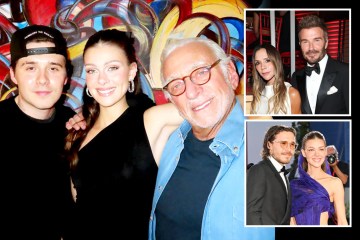
SIR David Beckham was just miles from his estranged son Brooklyn in LA on Monday — but the pair failed to meet.
Insiders said Becks, 50, was in the US city for work following a ski break in Canada with son Romeo.
Sign up for the Showbiz newsletter
Thank you!
David and Romeo Beckham on a ski break in CanadaCredit: InstagramNicola Peltz shared this black and white photo of her and BrooklynCredit: InstagramThe pair were at Sir Elton John’s Aids Foundation Oscars viewing party on SundayCredit: Getty
A source said: “David was in Los Angeles for a new ad campaign, but given Brooklyn’s decision to cut off his family, there was no meeting between them.
“David had just come back from a ski trip with Romeo and friends in Canada when he flew to Los Angeles for work.
“Brooklyn would have just been miles away from him in the house he shares with Nicola.”
In October insiders confirmed Brooklyn had no interest in making amends with his family.
By January he was communicating with them through lawyers.
Days later, Brooklyn released a bombshell statement confirming the story.
Brooklyn and father David snapped in 2019, before their bombshell falloutCredit: Getty
He went on to make allegations against his family, including claiming fashion designer Victoria had “hijacked” his first dance with Nicola at their wedding in 2022.
On the track, Cruz sings: “Loneliest boy, mama don’t talk too much. It’s breaking her heart.
“It shows in the small things that you don’t do.
“I guess in the end that it’s you, yourself, and you.
“Tell me how do you live, when you’ve got nobody to lose?”
The Beckham clan and Nicola pre feudCredit: Splash
Brooklyn and wife Nicola were all smiles when they were invited by his godfather Sir Elton to be guests at his Oscars bash in Los Angeles on Sunday night.
Yesterday, Nicola shared a series of pictures of the night on her Instagram, including a black and white photo of her and Brooklyn.
She wrote: “What a beautiful evening for such an important cause. Thank you for having us Elton John and David Furnish, we love you both so much.”
On Sunday, Brooklyn’s social media followers rounded on him after he shared photos of mother-in-law, Claudia Peltz, who had celebrated her 71st birthday a few days earlier.
His post coincided with Mother’s Day. Mum Victoria shared tributes from Romeo, Cruz and Harper on Instagram, but fans noted there was no message from Brooklyn.
Those close to Brooklyn and Nicola said there was no going back in the feud with his parents.
A source said: “Brooklyn has said his piece. He is done. Moving on with his life with Nicola is his priority now.”
The popular crime drama first aired back in 2021 and has featured the likes of Stephen Graham, Jodie Whittaker and Bella Ramsey.
David Tennant is starring in the upcoming series(Image: Getty Images for BAFTA)
The wait is almost over as the BBC has confirmed a third series of Jimmy McGovern’s BAFTA-winning hit drama, Time, is coming back.
With filming set to begin in Belfast, the broadcaster has announced viewers can expect to see David Tennant and Siobhan Finneran in the upcoming instalment.
This week, the broadcaster shared further casting as Vinette Robinson, Jo Joyner, Daniel Ryan, Warren Brown, Louis McCartney, Ollie McNulty and Chukwubuikem Molokwu will star in the third series.
BBC viewers will also welcome the likes of Ethaniel Davy, Victor Zhao, Paul Smith Junior, Finn Kearns and Jack Barnes.
Set in a Young Offenders Institution, the third series of Time will explore the impact of locking up teenagers and the impact on those who look after them.
A synopsis reads: “Prison Chaplain Marie-Louise comes to the YOI having lost her faith. When tragedy strikes within the prison, Marie-Louise clashes with veteran officer Bailey, a man in the midst of his own crisis.
“Bailey knows more about the circumstances that led to this major incident – but will he come clean before the guilt gets too much?
“Meanwhile, two teenage young offenders, Peter and James, struggle through the terrifying first weeks and months of their incarceration.
“Can James ever face his broken parents after an unforgivable act of violence and will Peter tell the truth about the death of an innocent man, or does family loyalty mean more? An unlikely friendship between them looks to shift the trajectory of their futures, but in an increasingly unstable environment, is change ever possible?”
Sharing an image of the new cast members joining the show in Instagram, it wasn’t long before people commented on the post, sharing their excitement.
One person said: “Fantastic news.” Another wrote: “Can’t wait! Congrats on the casting, amazing announcements.”
Someone else shared: “ANOTHER SEASON OF TIME?!? I’m ready to get my heart absolutely broken yet again.” As one fan added: “A good line-up of actors and actresses.”
Another commented: “Can’t wait for this also great casting!” While someone else added: “Can’t wait for this, Siobhan smashed the first 2 series.”
Time series one and two are available to stream on BBC iPlayer
For the latest showbiz, TV, movie and streaming news, go to the new **Everything Gossip** website.
Bayern Munich set to rival Manchester United for Nottingham Forest‘s Elliot Anderson, Morgan Rogers could leave Aston Villa if they fail to qualify for the Champions League, while Arsenal trio face uncertain future at the club.
Aston Villa‘s English winger Morgan Rogers, 23, may be tempted to look for Champions League football elsewhere if Unai Emery’s side fail to qualify for next season’s competition. (Talksport), external
Arsenal‘s Brazilian winger Gabriel Martinelli, 24, faces an uncertain future at the club along with English left-back Myles Lewis-Skelly, 19, and 18-year-old English winger Ethan Nwaneri. (Times – subscription required), external
Manchester Citydefender Nathan Ake is a target for AC Milan and Inter Milan with the Netherlands international, 31, unable to command a regular starting spot this season. (Caughtoffside), external
Arsenal have little intention of allowing 23-year-old Italian defender Riccardo Calafiori to leave this summer despite growing interest from Serie A clubs including Inter Milan, AC Milan, Juventus and Napoli. (Teamtalk), external
Paris St-Germain have no plans whatsoever to sell 25-year-old Georgian winger Khvicha Kvaratskhelia to Arsenal. (Fabrizio Romano), external
Roma captain Lorenzo Pellegrini is wanted by Juventus with the 29-year-old Italian attacking midfielder out of contract at the Giallorossi at the end of the season. (Gazzetta dello Sport – in Italian), external
There are few greater muses than one’s own childhood. In recent months, this idea has taken visual form across fashion runways, with brands from Chanel to Acne Studios showcasing childlike sketches, often referred to as ‘naive design’. The aesthetic favors deliberate roughness and mistakes over a sterile, polished sheen.
Book covers are the latest medium to embrace the trend. Scribbles, doodles, crayon marks and stickers — evoking Lisa Frank and anime cartoons — have begun appearing on prominent Gen Z contemporary fiction covers. The more childish and unrefined, the better.
The covers, which often accompany literary fiction written by women, signal a particular emotional register of naive, sticky chaos that youth promises. The visual language recalls a simpler time — a reclamation of an innocence lost. For millennials and Gen Z readers who worship collectibles like Labubus, friendship bracelets and butterfly hair clips, it’s natural that art direction would follow suit — sometimes with an ironic twist. Often, the design’s playfulness obscures the protagonist’s malaise.
The book cover trend, imbued with nostalgia for childhood, promises fiction that grapples with the pangs of adulthood in an age of precarity. In her Substack, cultural critic and novelist Natasha Stagg commented on the trend, noting, “Reverse-image searching these images turn up books on early childhood education, dealing with anxiety or migraines, or teaching a kid to color outside the lines as an artistic parent.” The book trend cover suggests collective angst about adulthood, highlighted by a cultural fixation on “girlhood” that sparked a spate of online think pieces in recent years.
It’s fitting, then, that the aesthetic has been adopted by Gen Z fiction writers like Honor Levy, whose paperback edition of “My First Book” includes girlish heart stickers on a hot pink background. The Y2K aesthetic elicits a young girl’s diary. Meanwhile, the 2025 novel “Unfit” by Ariana Harwicz, about a mother losing her children in a custody battle, uses erratic crayon scribbles on its cover. In the fall, McSweeney’s Quarterly Concern was contained in a binder with a Lisa Frank-style aquatic wonderland on the cover. This month, Cazzie David released a book of essays about early adulthood titled “Delusions: Of Grandeur, of Romance, of Process” with a cover resembling a child’s birthday cake.
(New Directions Publishing, Penguin Books)
Writer and culture critic Drew Zeiba noted the trend in his June 2025 Substack post. “I wonder if it represents a fed-up-ness with prior or concurrent trends in book design,” writes Zeiba over email. “A move away from the layered, the blobby, the clean — to something with more illusion of or allusion to an id.”
“Not for nothing, I assume adult coloring books sell better than literary fiction,” says Zeiba. “I’m struck by that in a way the crayon or marker drawing is provisional — there’s no final form to it.”
This January, novelist and Forever Magazine co-founder Madeline Cash released her highly anticipated debut novel, “Lost Lambs.” The story follows a family unraveling amid open marriages, conspiracy and emotional turmoil. Designed by Na Song, the cover features drooping blue crayon text and a small illustration of a girl.
The cover was heavily influenced by Henry Darger’s Vivian Girls. “I was attached to this Henry Darger painting when I was writing the book. I felt like that was a really accurate visual representation of little girls running away from utter chaos,” says Cash.
“The childish scribbling handwriting is also a red herring for some of the more serious and sinister themes in the book, “ says Cash.
“Having read Cash’s, I’m struck by the fact that the children in the book — and children are central to the book — are really insightful and transformative, and ‘lost lambs’ actually refers in the text to a specific group of adults,” adds Zeiba.
A similar artistic logic underpins Sophie Kemp’s breakout 2025 novel, “Paradise Logic,” which gained attention for its unsettling cover. The book cover is an existing painting by Brooklyn-based artist Naruki Kukita, selected by veteran art director Martha Kennedy with Kemp’s input. Kennedy had come across “Virtual Temptation in Eden” in a weekly art newsletter called “It’s Nice That.” The image invokes a children’s coloring book with darker undertones, blending various cartoon and drawing styles to depict Adam and Eve in paradise. A cartoon snake lurks behind them.
The design mirrors the memorable prose. “This novel showcased one of the most original voices I’ve ever read. I would describe it as a psychosexual fever dream,” says Kennedy. “I recall the editor calling it ‘the first true Gen Z novel.’”
Kemp recalls sending a lengthy email about the book cover inspiration. “I want something super maximalist. I want it to be a preexisting image. And I wanted to do something that is shocking or crazy,” says Kemp. Kennedy presented Kukita’s painting, and it was love at first sight for Kemp.
(New Directions Publishing, Simon & Schuster)
“Kukita’s combination of finely crafted painterly portraiture and flat graphic anime (often in very intense sexual combination) seemed like a perfect match for the tone of this novel,” says Martha Kennedy, who served as the art director at Simon & Schuster.
Then, enter Comic Sans typeface — a perfect dash of irony. “Let’s use a typeface that feels kind of wrong,” Kemp recalls prescribing. “I used Comic Sans for the first time in my 35-year career for the rest of the type. I felt that was some sort of weird pinnacle in itself,” Kennedy explains over email.
Kemp sees a thematic alignment between her and Cash’s book designs. “Mine and Madeline’s books are about naive female characters,” Kemp says. “It makes a lot of sense with the protagonist of my novel, who’s an extremely naive young woman, for the book cover to match that tone that I created.”
While working in marketing, Cash recalls another book cover trend she calls “book blob.” The blob was earth-toned and splashed bestselling covers for years. “With any kind of viral aesthetic: one of those books did well, so they engineered every cover to emulate that, because people were drawn to them,” says Cash. “It looks like all the content was the same and ubiquitous. It is a disservice to a lot of those books.”
“I really wanted it to stand out,” says Cash about her own cover.
Connors is a writer living in Los Angeles. She hosts the literary reading event Unreliable Narrators at Nico’s Wines in Atwater Village every month.
If David Nihill was a philosopher, his credo might be “I digress, therefore I am.”
Instead, Nihill is a comedian. Kind of. “I don’t know if I think of myself in those terms,” says Nihill, whose “Cultural Appreciation” special has 2.5 million views on YouTube. “I wouldn’t even call mine comedy specials.”
Nihill is a conversational storyteller who rarely even moves on stage. “I don’t know how to do performance,” he says, “but I do know how to talk.”
His current show, “Taking Tangents,” which takes him to Irvine, Pasadena and Los Angeles from March 13 to 17, is a wide-ranging collection of tales, with some material shifting from show to show. We’ll come back to it, but first, a few tangents.
Growing up in Ireland, Nihill, 47, struggled to learn, hampered by dyslexia — “I came in the lowest five percentile in the whole country of Ireland for spelling, and I didn’t even spell my name right on the test” — and an aversion to math. He was made to feel inferior because of his difficulties. “I was 100% in the ‘I am a moron’ category,” he says.
Nihill was shoved into a vocational program and most of his friends dropped out of school. He stayed in, but even when his father offered to buy him a Super Nintendo for certain math scores, Nihill fell short. His father bought it for him anyway, he says, “but I sold it and bought myself a motorcycle even though I was 15 and not legally old enough to drive.”
He finished high school and became a poorly paid, overworked apprentice electrician. That was enough to motivate him to go to college; there, he figured out how his brain worked and how to learn. He even developed a passion for reading: His last show, “Shelf Life,” wove in dozens of book recommendations.
During our conversation via video after a New York show, I’d ask one question, then follow Nihill as he ambled through his personal history. He started with a story about jumping off a cliff in Greece and shattering his leg — a part of “Tangents” — then going to Australia, before he stumbled into a master’s degree studying business back in Ireland (despite botching his application). A new friend there took him to his first-ever comedy show in Glasgow — there are even tangents within his digressions — before getting him a job with Enterprise Ireland, the government’s investment fund to boost Irish business overseas. That landed him in San Francisco, part of the “Cultural Appreciation” special. He left to pursue business opportunities in Mexico but, due to a hurricane, somehow ended up in Chile, spent a year wandering north toward America, and then scored an internship in Colombia.
Nihill is a conversational storyteller who rarely even moves on stage. “I don’t know how to do performance,” he says, “but I do know how to talk.”
(Jim McCambridge)
Eventually, Nihill’s story works its way to his current career, which began by accident. “It was never a dream or a goal,” he says. A friend in San Francisco had suffered a spinal cord injury and Nihill wanted to run a fundraiser, but dreaded public speaking.
That leads to a minor diversion, back to a college public speaking course in which Nihill was so terrified that he got drunk before his presentation and introduced himself “as an exchange student from Southern Yemen.”
In San Francisco, he started doing live comedy to overcome that fear. Meanwhile, his business background led him to see an opportunity and he created FunnyBizz, a company and conference where comedians help teach business leaders, like Kevin Harrington of “As Seen on TV,” how to use humor to communicate. The business bankrolled Nihill’s early days in comedy.
While Nihill has lived in America for years, most recently in Los Angeles, he remains passionately Irish, which shapes his shows in several ways.
In Ireland, “your nature is to just default to funny stories.”
He says American stand-up is about taking a topic and making it funny, aspiring for a five-minute joke-filled late night TV spot. Irish comedians say, “This thing happened to me and I think that’s funny. Let me just repeat it.”
The new show is named after “tangents” so that Nihill can go down different rabbit holes each night if he wants. “My head is always doing 60 different things,” he says, and he loves keeping his storytelling “free form and unfiltered,” whether he’s in a pub or on stage (or, apparently, in an interview).
The new show’s subjects will be familiar to Nihill’s fans: his parents, his foolish behavior (there are drunken college-age antics in a story that somehow eventually weaves in White House press secretary Karoline Leavitt) and Irish culture. “There are few countries that punch above their weight in social justice and social impact,” he says, and he always looks to draw connections with other cultures around the world. But the observations and connections he draws are new.
In New York, he added a bit about how 35% of Jamaicans have some Irish roots, quipping “imagine how fast they’d be without that” (in a nod to legendary sprinters like Usain Bolt). But for Nihill, that joke only works if it’s couched within the larger context of the cross-cultural connections, including the fact that Jamaican-born political activist Marcus Garvey drew upon the Irish independence movement for inspiration.
“There has to be some social value to doing it,” he says, although he’s quick to add his comedy isn’t overtly political. “My dad’s a teacher and that lives inside of me. Humor can be the ultimate tool for social activism. I am deliberately getting people to expand their minds in understanding these connections. I want comedy that makes everyone feel good and maybe learn something.”
Nihill on stage at Hollywood Improv.
(Jim McCambridge)
That “feel good” part is central: While he discusses his mother’s death from cancer last year, he leaves out a beautiful but poignant part of their final days together. “I’m deliberately avoiding that,” he says, because he wants to maintain an upbeat mood.
He digresses to tell me the story, however, and it’s literally longer than this entire article’s word count. “A very long answer to a very short question,” he admits, before swerving into a tale about back when his father had overstayed his visa in New York — it involves his dad being interviewed on CNN, getting into a bar fight and avoiding deportation because the immigration officer hailed from County Cork and Nihill’s dad burst into a song from there, earning him a six-month visa extension. The humanity of that scene “in contrast to a 5-year-old being dragged off to a detention center” may end up in a future Nihill show.
Nihill loves sharing the stories that come from observing and listening to people but says he doesn’t love the spotlight, which, he admits, makes comedy an odd career choice. He says he prefers telling stories to just a few people.
“With comedy, the best part for me is that before a show I eat half a chocolate bar and I leave the other half in the hotel room,” he says. “After the show, I get to finish it. That’s true happiness.”
Hello! I’m Mark Olsen. Welcome to another edition of your regular field guide to a world of Only Good Movies.
If you are anything like me, you felt pretty out of sorts this week, not sure how to process the news that we are suddenly, apparently, a nation again at war. It can make the movies seem frivolous — a glorious, privileged sandbox to stick your head in — but it is also times like these that make them seem most vital and necessary: a place to focus energy and anxiety and maybe figure things out.
I was particularly struck by something New York Times critic Wesley Morris said in an appearance on the podcast “The Big Picture.” He was ostensibly talking about the downside of the Paramount-Warner Bros. merger news (“These people are f— with our dreams here” is how he began) but he landed on why movies matter in their moment, crucial to “how we develop as a culture, how we come to understand ourselves as a people, what this country ought to or should look like 40 years from now.”
The week’s big new release is Maggie Gyllenhaal’s “The Bride!” a sort-of adaptation of 1935’s “Bride of Frankenstein” starring Jessie Buckley and Christian Bale that is also very much its own thing, purpose-built to drive some people up a tree and already sharply dividing critics.
Christian Bale and Jessie Buckley in the movie “The Bride!”
(Niko Tavernise / Warner Bros. Pictures)
In her largely positive review, Amy Nicholson calls the movie “an unhinged scream,” adding, “‘Every wacky second, you’re well aware how perilously close it is to falling apart at the seams. This spiritual sequel to ‘Frankenstein’ is a romantic tale of obsession, possession and fantasy — adjectives that also apply to its filmmaker, Maggie Gyllenhaal, who expends massive quantities of energy jolting it to life. She succeeds by the skin of her teeth.”
I interviewed Gyllenhaal about “The Bride!” — including the significance of that exclamation point in the title. There have been numerous reports about a back-and-forth between the filmmaker and execs at Warner Bros. and Gyllenhaal didn’t shy away from talking about it. She had specific praise for Pam Abdy, co-chair and co-chief executive of Warner Bros. Motion Picture Group.
“Something really alive was born, and I think the movie is better for the work that she and I did together,” Gyllenhaal told me. “I know that’s an unusual thing to say. I know that you have lots of people saying like, ‘Ah, the studio f— my movie up.’ That is not my experience. It’s really not.”
Louis Malle’s ‘…and the Pursuit of Happiness’
A scene from Louis Malle’s documentary “…and the Pursuit of Happiness.”
(Janus Films)
On Saturday, in a co-presentation of 7th House at the Philosophical Research Society and El Cine, the will be a 16mm screening of director Louis Malle’s 1986 “…and the Pursuit of Happiness,” a documentary made for television that explores the immigrant experience in America. The French-born filmmaker traveled across the U.S. interviewing recent arrivals from all walks of life.
Writing about the film in 1988, The Times’ Kevin Thomas called it “an often amusing and always insightful survey of the contemporary emigre experience. … an irresistible array of vignettes depicting cultural accommodation and assimilation in all its variety.”
I got on a video call this week with 7th House programmer Alex McDonald and El Cine founder Mariana Da Silva to talk about why this movie matters now.
The movie is streaming on the Criterion Channel right now. Why was it important to also put this movie in front of audiences right now?
Alex McDonald: I think Mariana and I are on the same page with this. I never let streaming or home video availability deter programming. Growing up, the theater was a holy place, a cathedral of congregation. I feel like these films are meant to be seen with an audience. And thankfully, I feel like our audience recognizes that as well, even if the film is out there. Particularly in our current moment, it’s a very prescient film and it’s one that will be all the more powerful within community.
Mariana Da Silva: I agree fully. One of the biggest things within our program is the communal aspects — just seeing the same people come back, that trust that develops with the audience. The best part I love about going to movie theaters is standing outside with people I maybe would never speak to and having a conversation about a film.
A scene from Louis Malle’s documentary “…and the Pursuit of Happiness.”
(Janus Films)
Do you respond to a movie like this as a sort of time capsule of how things were, or is it important to you that it is saying something about what’s happening right now?
McDonald: That’s something I’m very conscious of when I program repertory titles. When I program social, politically minded films, a lot of what I’m trying to do is to show that the issues within these things have not really changed — the ways in which things have progressed, the way in which we have regressed. Malle has such a humane view on all of these people in the film. He narrates but he doesn’t really editorialize. He just sort of observes, and in doing so, he’s making the most compelling argument for the richness of diversity and everything that these people contribute to this country, what they lose in assimilation, what they have to give up and what they bring. There’s a complexity to it. There are certainly dissenting voices in it and those resonate differently now.
It wasn’t perfect then. Obviously, there’s always been conflict, but I think there was an open-heartedness that has really shifted. And this is kind of a poignant reminder of what we need to try to get back to and recognize.
Da Silva: If we were able to have these conversations more openly, it would put us all on an even playing field. Humans are flawed. There’s been a lot of miseducation. In this moment, especially for me as somebody who is an immigrant, I feel like there’s so many people who I know who are so liberal and so aware, but then they don’t really understand the experience of the immigrant. And it’s not their fault in any capacity. They just haven’t been exposed to somebody like me before.
I think we can all come together on the things we celebrate, but we also need to be very open and come together on the things that we differ on too.
Points of interest
‘Good Night, and Good Luck’ in 35mm
George Clooney, left, and David Strathairn in the 2005 movie “Good Night, and Good Luck.”
(Melinda Sue Gordon / Warner Independent Pictures)
On Sunday afternoon at the Los Feliz Theater, as part of the American Cinematheque’s ongoing “Sunday Print Edition” series, there will be a 35mm screening of George Clooney’s “Good Night, and Good Luck,” introduced by The Times’ own Rosanna Xia.
Starring David Strathairn as pioneering television journalist Edward R. Murrow at the height of the McCarthy era, the film was nominated for six Oscars, including picture, director, actor and original screenplay.
As Kenneth Turan wrote in his original review, “‘Good Night, and Good Luck’ couldn’t be more unlikely, more unfashionable — or more compelling. Everything about it — its look, its style, even its sound — stands in stark opposition to the trends of the moment. Yet by sticking to events that are half a century old, it tells a story whose implications for today are inescapable. … The son of a TV anchorman, Clooney had the nerve to believe that a drama of ideas could be as entertaining as ‘Desperate Housewives.’ He insisted that a fight for America’s soul, a clash of values over critical intellectual issues like freedom of the press and the excesses of government, had an inherent intensity that would carry everything before it. And it does.”
‘Days and Nights in the Forest’ 4K restoration
An image from Satyajit Ray’s 1970 drama “Days and Nights in the Forest.”
(Janus Films)
Now playing at the Laemmle Royal in a new 4K restoration undertaken by the Film Foundation is Satyajit Ray’s 1970 “Days and Nights in the Forest.” In this examination of masculinity and class, four male friends drive from the bustling city of Kolkata to a rural village, mixing with the locals with volatile results.
In a special video introduction, Wes Anderson, a longtime admirer of Ray, admits he lifted a scene from “Days and Nights” for one of his own films — 2023’s “Asteroid City” — and says, “Anything by Satyajit Ray must be cherished and preserved, but ‘Days and Nights in the Forest,’ I think you will agree, is one of the special gems among his many treasures.”
‘Grease 2’ returns
Michelle Pfeiffer on the set of “Grease 2” in 1981.
(Vinnie Zuffante / Getty Images)
The Cinematic Void series at the American Cinematheque will show 1982’s pastiche musical “Grease 2” on Monday. Directed by choreographer-turned-filmmaker Patricia Birch, the film is, of course, a sequel to 1978’s megahit “Grease” but it is also very much its own thing. Largely dismissed on initial release, it has found a growing following over the years thanks in large part to its extremely engaging young cast, including an on-the-rise Michelle Pfeiffer.
In his initial review (more complementary than one might expect), Kevin Thomas wrote, “There’s so much youthful talent and vitality in ‘Grease 2’ that it’s depressing to discover it is so unblushing and relentless and paean to ignorance. … This is a pity, because Birch displays an organic sense of how to make dance evolve out of the kids’ everyday activities — converging en mass at Rydell High on the first day of school or having fun at the bowling alley. But Birch has scant opportunity beyond letting us know she cares for these ignoramuses, most of who seem likable enough beneath aggressively crude exteriors.”
Anti-fascist films at UCLA
Ingrid Bergman and Charles Boyer in the 1948 drama “Arch of Triumph.”
(Enterprise-UA / Photofest)
The ongoing series at the UCLA Film and Television Archive titled “From John Doe to Lonesome Rhodes: Anti-fascism from the Archive” hits a real stride this weekend for two nights of restored rarities. On Friday comes a restored 35mm print of 1948’s “Arch of Triumph,” directed by Lewis Milestone and starring Ingrid Bergman, Charles Boyer and Charles Laughton in a romantic drama of refugees in 1938 Paris. Also playing is Arthur Ripley’s rare 1944 emigree drama “Voice in the Wind.”
Much of the press around the film at the time of its release had to do with the challenge of bringing the racier aspects of the novel by Erich Maria Remarque (“All Quiet on the Western Front”) to the screen. As producer David Lewis told The Times’ Philip K. Scheuer, “I promise you that as Joan, Ingrid Bergman will set the town on its ear. They’ll never think of her as anything but sexy again.”
Saturday brings the world premiere of the 35mm restoration of Walter Comes’ 1947 “The Burning Cross,” in which a returning veteran is recruited into the KKK. John Reinhardt’s 1948 “Open Secret,” about antisemitism, will also play in a 35mm restoration.
The series concludes next week with a 35mm screening of Elia Kazan’s 1957 “A Face in the Crowd,” starring Andy Griffith in an examination of the dark side of populist politics and media manipulation.
The Northumberland islands are a haven for wildlife with 43,000 pairs of puffins, Atlantic grey seals, dolphins and over 200,000 breeding seabirds
These UK islands are loved by Sir David Attenborough(Image: Getty Images)
A stunning collection of UK islands are Sir David Attenborough’s ‘favourite’ destinations for observing wildlife in Britain, boasting around 23 bird species, seals and dolphins.
Located off the Northumberland coast are the Farne Islands, a leading wildlife sanctuary amidst some of the most spectacular landscapes. Their isolated position means they’re only reachable by a boat trip leaving from Seahouses harbour, which is roughly an hour’s drive from Newcastle, yet what lies in wait is certainly worth the journey.
The group of islands are a sanctuary for wildlife and is home to a substantial colony of Atlantic grey seals, along with adorable white seal pups. There will seldom be a moment when tourists won’t be able to see their bobbing heads appearing above the water, or photograph the marine mammals during a stroll around some of the larger islands with lighthouses and vantage points.
Dolphins have even been known to be seen amongst the lapping waves. Taking centre stage during the warmer months are the 43,000 pairs of breeding Puffins that inhabit the rugged cliffs.
The Farne Islands are one of the finest locations to observe the colourful birds that breed in large colonies atop coastal cliffs or at offshore islands across the North Atlantic. During the beginning of summer, around 200,000 breeding seabirds, including Arctic terns, guillemots, eider ducks, razorbills and cormorants, can be spotted amongst the UK islands, reports the Express.
It’s a haven for keen birdwatchers, nature enthusiasts, or anyone wanting to marvel at the wonders of this remarkable wildlife, which is difficult to encounter elsewhere. It’s received such acclaim that broadcaster, writer, and naturalist Sir David Attenborough himself named the Farne Islands as one of his ‘favourite places’ for wildlife in the UK, and he highlighted the islands during his BBC series, Wild Isles.
Experts at Arbtech also listed the Farne Islands amongst the finest UK destinations to observe wildlife this year, owing to its ‘internationally significant breeding colony of seabirds and Atlantic grey seals’. The group of islands provides a unique opportunity to witness the UK’s most flourishing wildlife population, which has declined by 19 per cent since 1970, as Arbtech highlighted.
It’s advised that the optimal time to visit the islands is between mid-April to late July, especially if you’re hoping to catch sight of the seabird colony. Boat excursions are available to book that set off from the harbour at Seahouses in north east Northumberland, to cruise around the Farne Islands in a truly spectacular experience.
Some of the boat trips on offer to book at Seahouses harbour include Serenity Farne Island Boat Tours, Billy Shiel Boat Trips, and the Golden Gate Farne Island Tours. They all depart daily during weekends and throughout the summer months, but it’s advisable to check availability directly with the operator.
The other top locations in the UK to observe wildlife, as identified by Arbtech, include:.
A spokesperson for Arbtech said: “We want to put the spotlight on these incredible wildlife spots to showcase just how important conservation projects are, and how nature can thrive in this country when it’s protected.
“Our survey shows that the majority of Brits do care about the decline of wildlife, but many may not know what they can do to help. Supporting local conservation efforts or even making small changes at home can make a real difference.
“Seeing wildlife in its natural habitat is a powerful reminder of what we have to lose if we don’t act now, and could inspire people to take steps to protect species for future generations.”
Make sure our latest lifestyle and travel content always appears at the top of your Google Search by making us a Preferred Source. Click here to activate or add us as your Preferred Source in your Google search settings.
Have you got a travel story to share? Email webtravel@reachplc.com.
Silent Witness star David Caves has hinted at the BBC crime drama’s future after the latest series concluded
Fans are hoping for another series of Silent Witness(Image: BBC)
Silent Witness star David Caves has dropped a hint about the future of the show as the current series concluded.
The 29th series of the BBC crime drama, which centres on a team of pathologists probing mysterious deaths, finished on Tuesday night (March 3) with a nail-biting episode where Dr Nikki Alexander (Emilia Fox) found herself in peril after being drugged.
The programme has been a huge success with audiences and has been airing since 1996, so fans are hopeful for a 30th instalment, reports the Express.
As the final episode aired, David – who portrays Nikki’s spouse and colleague Jack Hodgson – gave a clue on X (formerly Twitter), posting: “Can’t believe that’s it for another series. To everyone who has watched and supported – thank you!”
“Here’s to the stories we’ve told – and to those still to come…” he added, tagging co-stars Emilia, Francesca Mills and Maggie Steed.
The latest series of the show kicked off in February and has featured several gripping tales including two-part finale Shame, which began on Monday (March 2).
It saw the team investigating what seemed to be the suicide of a British-Chinese pro-democracy activist, whose body was found floating in a lake.
However, as Nikki and Harriet Maven (Maggie Steed) delved deeper into the woman’s fate, evidence started to suggest something far more sinister had transpired and it became evident that things were not as they appeared.
There has already been a hint that Silent Witness is poised for a 30th series, after a photo emerged last month showing some cast and crew seemingly on location.
The image was posted on Instagram by Bodenham Arboretum in Worcestershire, accompanied by a caption which read: “For those of you who have visited Bodenham in the last two weeks you may have wondered what was going on… cryptic signage, trailers, security etc, occupying two of our car parks… well now all can be revealed..
“Bodenham had the privilege of being chosen as the BBC drama’s Silent Witness base camp whilst filming locally for the 30th series.”
For the latest showbiz, TV, movie and streaming news, go to the new **Everything Gossip** website.
Ensure our latest headlines always appear at the top of your Google Search by making us a Preferred Source.** Click here to activate**** or add us as your Preferred Source in your Google search settings.**
Silent Witness airs on BBC One and is available on BBC iPlayer