David Attenborough

David Attenborough marks 100th birthday with announcement of next huge BBC series

He’s made more programmes in the last decade than at any point before, and despite reaching the age of 100, David is showing no signs of slowing down

Sir David Attenborough will narrate Blue Planet III when it hits the screen on BBC1 this autumn. The veteran broadcaster, who celebrates his 100th birthday today, has already recorded his voice-over for the six-part series, which is returning for a third outing 25 years after the first one aired.

This time around, it aims to take the Blue Planet brand “to extraordinary new depths”. In 2001, it was the first ever natural history series to take a deep dive into the state of the world’s oceans, attracting huge audiences across the globe.

In 2017, the Blue Planet II sequel galvanised a huge campaign to rid the sea of single use plastic, with Sir David even taking to the stage at the Glastonbury Festival to hammer home the point.

READ MORE: ‘I’ve worked with David Attenborough for 40 years – this is what he’s really like’READ MORE: Sir David Attenborough issues 100th birthday message as hundreds of cards arrive at his house

Where Blue Planet II exposed the threats to the world’s oceans, Blue Planet III aims to explore stories of adaptation and resilience, showing both hope and recovery. The first five episodes will focus on the planet’s five key underwater habitats: Tropical Seas; Open Ocean; Seasonal Seas; Polar Waters; and The Deep. As is now traditional, the sixth and final episode, Future Seas, will turn to the issue of conservation and examine what further changes must be made.

Jonny Keeling, head of BBC Studios’ Natural History Unit, said they were thrilled to have the world-famous naturalist take the lead on the latest landmark programme to address the issue of our oceans.

“We are so excited to have David narrate this new blockbuster series,” he said. “It’s full of never-before-seen animal behaviour, new locations, new science, and heartfelt storytelling. David is the perfect voice to inspire audiences across the globe to love, understand and protect the oceans.”

BBC specialist factual boss Jack Bootle, added: “I’m thrilled that David is taking the helm of Blue Planet once again. His extraordinary talent for storytelling has shaped the way generations of audiences understand and connect with the natural world, and his voice remains synonymous with the very best of the BBC’s natural history output. I’m absolutely delighted that he’ll be once more bringing his unique skill and authority to Blue Planet III.

Expert oceanographer Dr Phillip Sexton, who is an academic consultant on the upcoming series, said that this third run would build on the ground-breaking legacy of the last two, and “offer rays of hope” when it comes to further saving the planet.

“Blue Planet II catapulted issues surrounding our oceans’ health into the public consciousness and demonstrably changed people’s attitudes and behaviour with regard to our oceans,” Dr Sexton explained. “Underpinned by breakthroughs in marine science and cutting-edge technology, this new series will transform our view of what is possible for life on Earth and offer rays of hope for us to conserve the ecological wonders that lie beneath the waves.”

The series will make new breakthroughs in underwater film-making thanks to a “whole new generation” of camera technology, to reveal brand new and previously untold stories. It will build on the legacy of the previous two series to reveal brand new and untold stories from magical underwater worlds using new technology including splash drones and long-term remote underwater cameras.

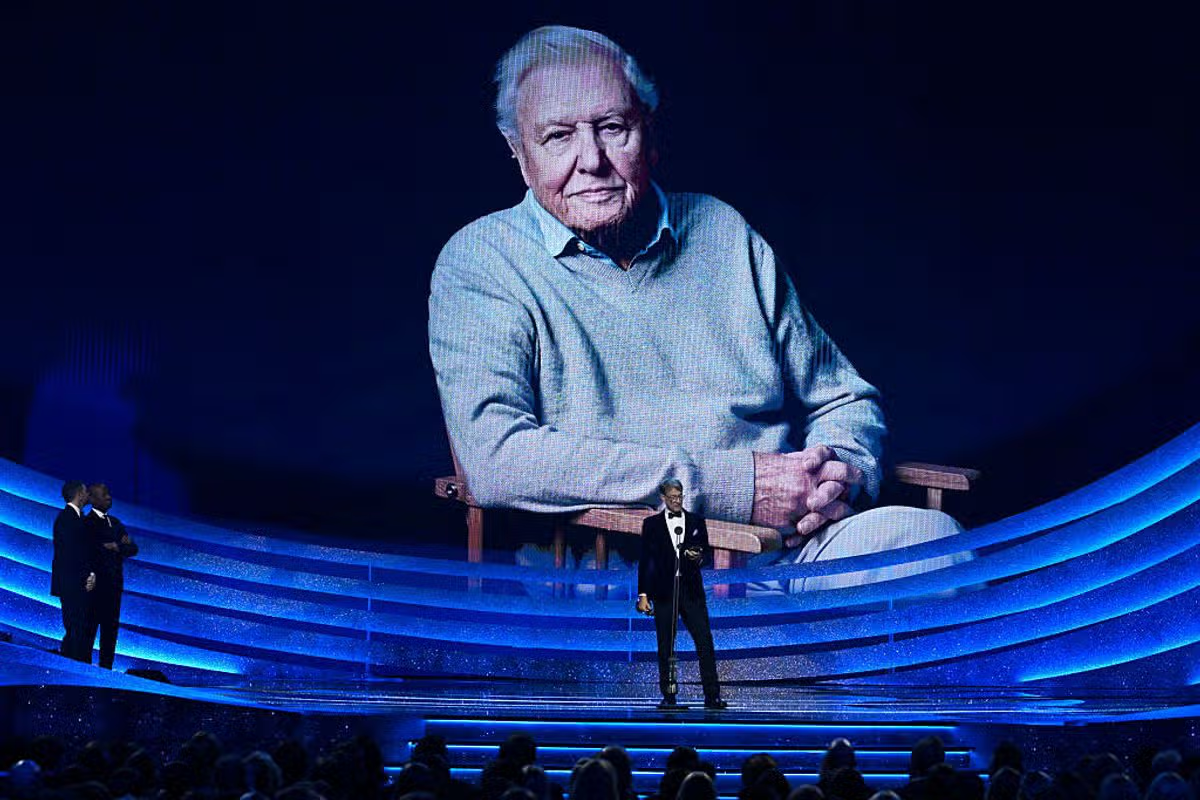
Blue Planet III was announced by Liz Bonnin and Steve Backshall at an event held at the Royal Albert Hall last night to mark Sir David’s milestone birthday. The glittering show included music from the BBC Concert Orchestra and many clips showing iconic moments from his programmes over the decades.

Tributes were paid by both King Charles and Prince William, and he was also sent a heartfelt message from Felix Ndagijimana at the Dian Fossey Gorilla Fund Karisoke research centre in Rwanda, giving an update on how they all are doing since his visit there fifty years ago.

Celebrities paying tribute and sending birthday wishes on the night included Chris Packham, Michael Palin, Dame Judi Dench, Chris Martin, Hamza Yassin, Kate Winslet and even Paddington Bear. They were joined by more celebrities interested in conservation work, including Leonardo di Caprio, Cate Blanchett, Nile Rodgers, Phoebe Waller-Bridge, Louis Theroux, Camila Cabello and Alan Titchmarsh.

After many musical performances from the likes of Bastille, Icelandic band Sigur Rós and Sienna Spiro – performing music that has been used in series including Planet Earth – the evening closed with a clip of the presenter in action as Sir David recorded his narration to Blue Planet III, followed by him reading the lyrics from the song What a Wonderful World, accompanied by stunning wildlife footage.

Like this story? For more of the latest showbiz news and gossip, follow Mirror Celebs on TikTok, Snapchat, Instagram, Twitter, Facebook, YouTube and Threads.

Source link

David Attenborough’s BBC future confirmed in major announcement

A special announcement was made during his birthday celebration special programme on BBC One.

The BBC has made a major announcement about the future of Sir David Attenborough.

The legendary broadcaster was honoured with a special event at the Royal Albert Hall to mark his 100th birthday.

Hosted by Kirsty Young, it saw guest appearances from the likes of Dame Judi Dench and Sir Michael Palin, as well as historic clips of Sir David’s TV career.

And while he may be 100 years old, the national treasure clearly has no plans to slow down, as the BBC has now confirmed a new series of Blue Planet.

Moments before David Attenborough’s 100 Years on Planet Earth came to an end, Kirsty announced: “Well, even though it’s his birthday week, David has still been hard at work, voicing a brand new series.

“Tonight, I am thrilled to announce that launching this autumn is Blue Planet III.

“We felt that we couldn’t go this evening without sharing a little glimpse, recorded just a few days ago, into 100-year-old David Attenborough’s typical working day.”

The show then aired a clip of Sir David voicing over an animal’s ‘mating call’, with Kirsty hailing him “an inspiration to us all”.

As the latest Blue Planet series was announced, viewers took to social media to share their excitement.

“Ooohh Blue Planet III so excited,” one person said, while another wrote: “Blue Planet 3!!! Always so hyped and it’s not even out yet.”

Wildlife documentary series Blue Planet first aired in 2001, with the sequel following in 2017.

This comes after a film producer who has worked with Sir David addressed the centenarian “slowing down”.

Joe Loncraine appeared on Good Morning Britain last month, where he recalled the privilege of working with him over the last decade.

He said: “I first worked with him just before his 90th birthday, and I thought, I’m so glad I got to work with him because surely he won’t be making films for much longer now that he’s nearly 90.

“Since then, I’ve worked with him on five projects, five different films over that time in the last ten years, and I’ve stopped thinking he’ll be slowing down. You’ll lose that bet if you have it any time.

“He always surprises us, he’s always wanting to do more. He remains very curious about the world and wants to learn more and show people what he’s learnt and show people what he’s excited about.

“I imagine he’ll probably rest a bit more, he’s earnt it. But I wouldn’t be surprised if he keeps doing stuff for as long as we want him, which will be as long as we can have him.”

Back in 2019, Sir David, then 91, said he would retire from broadcasting if his work became substandard, or if he could no longer walk up and down stairs.

“I would like to think I would be able to detect when I couldn’t find the right words any more,” he told the Radio Times. “If I think I’m not producing commentary with any freshness or which is apposite or to the point, I hope I would be able to recognise it before someone else told me.

“If I thought I was turning in substandard work, that would stop me.”

He added: ““If I can’t walk up and down steps any more, that will stop me.

“Yes I do dread not working, although there are things I can do without running up steps six times – books to be written, things I’ve never got round to.”

David Attenborough’s 100 Years on Planet Earth is available to watch on BBC iPlayer.

Source link

Sir David Attenborough issues 100th birthday message as hundreds of cards arrive at his house

The much-revered broadcaster and natural historian has been sent hundreds of items in the post

Sir David Attenborough thanks fans for 100th birthday wishes

As birthdays go, they don’t come much bigger than Sir David Attenborough turning 100 – as the postmen of Richmond-upon-Thames have discovered.

In the run up to the big day today (FRI) the BBC natural history star has been inundated with hundreds of cards, packages and gifts from across the UK – with some even coming from abroad.

Yesterday Sir David issued a statement of gratitude. In it, he admitted that he’d been hoping for his milestone anniversary to slip by unnoticed, but added that he’d been “completely overwhelmed” by the messages he’d received.

READ MORE: Sir David Attenborough’s inspiring career at 100 from selling newts to teaching the world

In a message recorded for social media he is shown holding a harvest mouse, from the Wild Isles series about British wildlife. He said: “I had rather thought that I would celebrate my 100th birthday quietly – but it seems that many of you have had other ideas.

“I’ve been completely overwhelmed by birthday greetings, from preschool groups to care home residents and countless individuals and families of all ages.

“I simply can’t reply to each of you all separately, but I would like to thank you all most sincerely for your kind messages and wish those of you who have planned your own local events tomorrow, have a very happy day.”

As the posties have arrived carrying armfuls and boxes of letters in recent days, Sir David has been seen answering the door to his home in Richmond, south west London, looking surprised and delighted by the scores of thoughtful messages people have sent for his birthday.

He will mark the day itself with close family in the daytime and then attend a live event staged in his honour at the Royal Albert Hall, to be shown on BBC1.

Called David Attenborough’s 100 Years on Planet Earth it aims to showcase his groundbreaking career at the forefront of natural history storytelling and will feature the BBC Concert Orchestra plus special guests expected to include Prince William.

The event will take audiences on “a journey through a century of exploration and discovery in the natural world, seen through the prism of David’s extraordinary life”. It will feature wildlife stories accompanied by live music from his programmes, plus reflections from leading advocates for the natural world and those he has collaborated with over the decades.

Accompanied by the BBC Concert Orchestra, it will feature original compositions from some of David’s best-known landmark series. Alongside the music, guests will include some of those he has collaborated with from the world of conservation and wildlife filmmaking.

It was commissioned by BBC specialist factual boss Jack Bootle who said at the time: “It’s impossible to overstate what Sir David Attenborough has given us. His programmes have changed how we see our planet and our place within it.”

He added: “It’s also a moment for all of us at the BBC to say thank you to David — for his generosity, for his brilliance, and for a lifetime spent bringing the wonders of nature into our homes.”

Like this story? For more of the latest showbiz news and gossip, follow Mirror Celebs on TikTok, Snapchat, Instagram, Twitter, Facebook, YouTube and Threads.


Source link

David Attenborough worrying prediction for 2030 could spell disaster for the world

As he reaches 100, broadcaster and naturalist Sir David Attenborough has spoken of the changes he has seen in his lifetime – and the horrifying consequences of climate change in the years to come

Legendary broadcaster Sir David Attenborough made a worrying prediction for 2030 – and predicted the state of the planet is likely to get worse after that. The iconic naturalist celebrates his 100th birthday on Friday (May 8) and he has long been heralded as the natural world’s biggest champion.

He has also been vocal about the threats facing the Earth. In 2020, as the world was in lockdown as a precaution against Covid-19, Sir David made what he called a “personal witness statement” about the threat of climate change. Many of the dire predictions he made about the world are beginning to come true.

Back in 2020 he warned that 10 years from that date, with much of the Amazon rainforest becoming a dry desert and the polar icecaps shrinking, the effects of climate change will become truly irreversible – and threaten the extinction of humanity.

As he released his Netflix documentary, A Life on Our Planet, Sir David made a personal appeal to world leaders. He said: “There are short-term problems and long-term problems. Politicians are tempted to deal with short-term problems all the time and neglect long-term problems.

“{Climate change] is not only a long-term problem, it is the biggest problem humanity has ever faced. Please examine it, and please respond.”

The prognosis for the rest of the century looks pretty bleak if Sir David’s predictions are to be believed. He said that if he had been born in 2020, instead of 1926, he would be witness to the full range of climate collapse: “In the 2030s, The Amazon Rainforest, cut down until it can no longer produce enough moisture, degrades into a dry savannah, bringing catastrophic species loss… and altering the global water cycle.

“At the same time, the Arctic becomes ice-free in the summer. Without the white ice cap, less of the sun’s energy is reflected back out to space. And the speed of global warming increases.”

By the 2040s, just 14 years from today, Sir David predicts: “Throughout the north, frozen soils thaw, releasing methane, a greenhouse gas many times more potent than carbon dioxide, accelerating the rate of climate change dramatically.”

Through the 2050s, as today’s schoolchildren reach middle age, the world’s seas will become a sterile desert: “As the ocean continues to heat and becomes more acidic, coral reefs around the world die. Fish populations crash.”

Into the 2080s, mankind truly becomes an endangered species: “Global food production enters a crisis as soils become exhausted by overuse. Pollinating insects disappear… and the weather is more and more unpredictable.”

The stable climate that has endured longer than human civilisation will be lost forever by 2100, Sir David says.

“Our planet becomes four degrees Celsius warmer,” he adds, “Large parts of the earth are uninhabitable. Millions of people rendered homeless. A sixth mass extinction event… is well underway.”

He describes these various tipping-points as “a series of one-way doors,” with each bringing irreversible change.”

As he muses on his long life, Sir David warren that someone born today who lives as long as he has will see almost unimaginable change: “Within the span of the next lifetime, the security and stability of the Holocene, our Garden of Eden… will be lost.”

Average global temperatures have risen by more than 1C since the 1850s. Since 2015, every successive year has brought record high temperatures – causing heatwaves, floods, droughts, and fires as well as irrevocable habitat loss for many species.

Sir David thinks that humanity is the species most under threat. He said: “I used to think this was about saving the planet, and now I realise it’s not …nature will always look after itself. It’s about saving us.”

He was one of the first to sound the alarm about humanity’s impact on the environment. In 1937, the total human population was around 2.3billion. Carbon in the atmosphere was measured at 280 parts per million, and 66% of the planet remained unspoiled wilderness: “Everywhere you’d go, there was wilderness. Sparkling coastal seas. Vast forests. Immense grasslands. You could fly for hours over the untouched wilderness,” Sir David said.

Sir David was one of the first to sound the alarm about humanity’s impact on the environment. In 1937, the total human population was around 2.3billion. Carbon in the atmosphere was measured at 280 parts per million, and 66% of the planet remained unspoiled wilderness: “Everywhere you’d go, there was wilderness. Sparkling coastal seas. Vast forests. Immense grasslands. You could fly for hours over the untouched wilderness,” Sir David said.

By 1960, less than 30 years later, the change was already measurable. The global population was now three billion, atmospheric carbon was measured at 315 parts per million, and the remaining wilderness had shrunk to 62%.

Fast forward to 1997, the population had more than doubled to almost six billion, carbon in the atmosphere had increased to 360 parts per million, and much more wilderness had been lost – now down to 46%.

“The global air temperature had been relatively stable till the ’90s,” Sir David said. “But it now appeared this was only because the ocean was absorbing much of the excess heat, masking our impact. It was the first indication to me that the earth was beginning to lose its balance.”

Unsustainable logging, overfishing, and above all the reckless use of fossil fuels was pushing the planet to a tipping point, he warned: “The average global temperature today is one degree Celsius warmer than it was when I was born,” he said in A Life on Our Planet,” speed of change that exceeds any in the last 10,000 years. Summer sea ice in the Arctic has reduced by 40% in 40 years.”

The wildlife that has been Sir David’s lifelong interest has been pushed to the margins: “Half of the fertile land on earth is now farmland. 70% of the mass of birds on this planet are domestic birds. The vast majority, chickens.

“We account for over one-third of the weight of mammals on earth. A further 60% are the animals we raise to eat. The rest, from mice to whales, make up just 4%.”

Despite the bleak outlook, Sir David says all hope is not lost. One is to stabilise population growth and another is to switch to renewable energy.

Source link

Late Queen’s grandson tells of ‘amazement’ at royal secret ‘literally nobody knew’

As BBC marks what would have been Queen Elizabeth II’s 100th birthday, Peter Phillips says that his grandmother stunned them all in 2012

As the nation remembers Queen Elizabeth II on what would have been her 100th birthday next week, one grandson has given fresh insight into the subterfuge that went into her astonishing James Bond moment from the 2012 Olympics.

Peter Phillips was gripped by the scenes, along with the rest of the nation, in which the monarch comes face to face with Daniel Craig’s 007, before they seemingly parachute into the stadium from a helicopter.

But speaking in a new BBC documentary, Peter says even the family were kept totally in the dark about the extraordinary stunt. “When the clip first started we were like, ‘I wonder who they’ve got playing the Queen?’ And then she turned around. And we were like ‘wow’. It was sheer amazement. That was one of the best-kept secrets, because literally nobody knew.”

READ MORE: ITV reveals last ever outing for cast of 7 Up this year – but some faces will be missingREAD MORE: Iconic 90s TV show returning to Channel 4 for first time since 2015

The tribute film, which airs tomorrow, takes viewers through all the key moments of her reign, with insights provided by leaders, celebrities, experts and loved ones.

Queen Camilla speaks of her deep admiration for her late mother-in-law. Looking back at how she came the first female member of the royal family to join the army full time, when she joined the Auxiliary Territorial Service during the war, Camilla says: “I think duty has over-ridden everything. I don’t think I’ve ever seen anybody have a sense of duty like she had.”

Ex-US president Barack Obama agreed, commending the late Queen’s “combination of a sense of duty, with a very human quality of kindness and consideration and a sense of humour”. He adds: “I think that’s what made her so beloved, not just in Great Britain but around the world.”

Former Labour Prime Minister Tony Blair also had deep respect for Elizabeth II. “She was not a queen, but the queen,” he says. “I don’t think we’ll see her like again.”

Camilla recalls that celebrating the Queen’s platinum jubilee in February 2022, just as the Covid pandemic finally came to a close, was particularly joyous coming, as it would turn out, just a few months before the Queen’s death.

“I remember there were thousands and thousands of people lining the streets and lining The Mall – we were all looking for something to cheer us all up,” she says. “People hadn’t been out, they’d been stuck in their houses so it was an incredible jubilee. She was very much centre stage, I’ve never seen anything like it. Everybody was in a good mood.”

Helen Mirren, who put in as Oscar-winning performance as Elizabeth II in The Queen, agrees that the monarch’s profound sense of duty came naturally to her and says her death in 2022 left many feeling bereft. “She’d become such an intrinsic part of the tapestry of our life, it was as if you were going to pull a thread and the whole thing was going to fall apart.”

To research the role for the 2006 movie, Helen studied hours of footage, including plenty of when the monarch was a child. She laughs when shown an archive reel of a three-year-old Elizabeth. “I’ve never seen this before, so young! And her hair is almost the same as when she died. That’s incredible.”

Another clip shows Elizabeth aged around 10. “When I played the Queen I watched a particular piece of film over and over again of her getting out of a big black car,” the actress explains. “You see how she steps forwards and does what she knows she’s supposed to do, which is shake hands. She naturally had a sense of self control and duty.”

That innate sense of how to behave was again in evidence when Elizabeth’s father, George VI, died suddenly while she and her new husband Prince Philip were just six days in to a tour of the Commonwealth in 1951. Returning swiftly to Britain, she was filmed smiling and shaking hands with the many top-hatted, male politicians who were on the tarmac to greet her.

“She’s only just been told that her beloved, beloved father has died without her being there,” Helen 80, says. “I think that would have been so devastating to her, that she never had the chance to say goodbye.What you see happening is the duty stepping in, she does exactly what she’s supposed to do.”

Camilla is also astonished to see how calm and composed the young queen looks in this challenging moment, when she is dealing with her own grief. “It must have been so difficult being surrounded by much older men. There weren’t women prime ministers or women presidents, she was the only one. So I think she carved her own role.”

Over the course of her life Elizabeth faced plenty of difficult times, including the marriages of three of her children ending in the same year and the loss of many loved ones.

When her husband of 73 years, the Duke of Edinburgh, died during the pandemic, the Queen refused to break the rules governing the nation and instead broke hearts as she sat at his funeral all alone. Watching the sad clip of his isolated grandmother, Peter Phillips says all he wanted to do at the time was “give her a hug”.

But there were also times when the Queen came in for criticism rather than sympathy, never moreso than after the death of Princess Diana in 1997, when she opted to remain at Balmoral for more than a week rather than return to London.

BBC royal presenter Kirsty Young remembers: “There was tangible anger. Whether it was the flag being brought down to half mast or the Queen making a statement, these things were not happening. There was radio silence. There was a sense in which people might almost storm the gates of the palace.”

But the Queen then turned public opinion around with her heartfelt TV broadcast to the nation. Describing the former monarch as “quietly radical”, Kirsty adds: “I think the address by the Queen after the death of Diana illustrated beautifully that she had an ear to the public and that she was willing to do things that had never been done before.”

Blair agrees it was one of the Queen’s most challenging moments. “We had a series of really intense conversations where the Queen was having to balance the impact on her family, on her grandchildren, with the need to respond to what was a national mood at the time. Her genius was, in a way, to steer the monarchy through all of that whilst not really changing much herself.”

For her part, actress Helen believes the Queen was absolutely right to stay with her grandsons after the devastating loss of their mother. “I think she was right to stay in Balmoral with the children and then when she came out and did the very difficult walk with the flowers and everything, that was the right thing to do.”

Born just a couple of weeks after the Queen, Sir David Attenborough was running the BBC at one point in the late 1960s when it was decided the royals needed to become more relatable. This led to the BBC documentary Royal Family, an early example of reality TV, where they let the cameras in. “There was a feeling that the royal family was getting a bit remote and I remember the discussions we had in the BBC, that the image of the family should be softened in some way,” Sir David explains. It was huge hit with more than 30million UK viewers tuning in – but afterwards the Queen regretted her decision to display their private lives. The series has not been shown since the 1970s, with Elizabeth ordering it was locked away in the royal archives.

But tonight viewers can see rare clips from the series, showing a relaxed Philip cooking sausages and the queen laughing and joking with her children.

– Queen Elizabeth II: Her Story, Our Century, BBC1, 9pm, Sunday

Source link

‘SNL UK’ review: Tina Fey kicks off British version of sketch show

After 50 years of being practically synonymous with New York City, “Saturday Night Live” has opened the door to London with “Saturday Night Live UK,” following in the steps of “Law & Order UK” and possibly nothing else. Of all the cities in the world that might conceivably replicate the spirit of the NBC original, the British capital, with its urban dynamism, media concentration and 20,000 comedians, feels like the obvious, and perhaps only, choice. (“Saturday Night Live Italia” might prove me wrong, if that day ever comes.) And, of course, we’ve been in a reciprocal comedy arrangement with Britain — or at least we have been nicking their ideas for shows — for years.

The show premiered in the U.K. this past Saturday on Sky One and NOW, and began streaming stateside Sunday on Peacock, with our own Tina Fey as the first guest host. (“It’s an absolute honor and kind of historic,” she said to studio audience. “Guys, I am the youngest person to ever host ‘SNL UK!’”)

As a “Saturday Night Live” star, writer and head writer; and the co-creator of “30 Rock” — her show about a sketch show set in the very same building as “SNL” — they couldn’t have appointed a better ambassador. Lorne Michaels doubtless has her on speed dial.

Here’s the short review: In the course of a single episode, “SNL UK” managed to feel very much like its parent show — which is to say, some of it worked well and some of it worked less well, but very little of it didn’t work at all. There were sketches that ran too long, or ended weakly, but were generally redeemed by a young(ish), confident 11-member cast that made the most of them. Some will already be recognizable to British viewers. Many have had notable, or anyway noticed, careers in stand-up; in the sort of stand-up that amounts to theater; in straight theater (including Shakespeare, naturally) and/or in television and film. Fey promised to “stay out of their way as much as possible,” but she came to play, and appeared in most every sketch.

The evening followed established protocol. Cold open. (Prime Minister Keir Starmer, played by George Fouracres, is afraid to tell President Trump, whom he regards as a sort of bad boyfriend, that he’ll send no more ships to the Strait of Hormuz: “I know how badly you want to start World War III, and that’s great. You absolutely do that but we can’t be part of it.”) Hammed Animashaun and Jack Shep accompanied Fouracres in the sketch and shared the glory of shouting, “Live from London, it’s ‘Saturday Night!’” They would continue to dominate the episode.

Two men flank a man sitting at a desk speaking into a cell phone.

Jack Shep, George Fouracres and Hammed Animashaun in the “SNL UK” cold open, set at 10 Downing Street, in the prime minister’s office.

(NBCUniversal)

Next: Opening credits featuring the cast members out and about in the city. Monologue, with guest appearances from Nicola Coughlan, Michael Cera and Graham Norton. (The set is very much in the style of various American iterations over the years, clock included, with the band onstage.) Film bits and sketches. Musical guest. (Wet Leg, surly.) “Weekend Update.” More skits. Musical guest returns. More comedy. Whole cast onstage at the end, ready to party.

Among other things: A Shakespeare skit found the Bard (Fouracres again) returning to Stratford from London between plays, each time more affected, beginning with an earring and finishing with an electric scooter, sunglasses and a bag of ketamine. A Paddington Bear immersive experience, with an actual bear, turns bloody, recalling Dan Aykroyd’s 1978 classic Julia Child sketch. As a bra salesperson giving an ego boost to Fey‘s customer, Emma Sidi was funnier than the sketch she was in. (It did include a cameo by Regé-Jean Page, from “Bridgerton.”) In another, David Attenborough (Fouracres again, again), using “Jurassic Park” technology, hosts a “last supper” featuring great dead Britons including Winston Churchill, Isaac Newton, Agatha Christie (Fey), “Freddie Mercury, from Queen, Elizabeth the First, from being the Queen,” and Shep’s Princess Diana, pulling focus at Attenborough’s right shoulder; all they manage to discuss is how many starters to get for the table. It had the added bonus of getting the entire cast, and guest host, onstage.

The film bits were first-rate. (Not being live has its advantages.) One advertised an anti-aging cream — Undérage, with a soft “g” — “that works so well everyone will think your man is a nonce.” (That is, a pedophile.) “My skin looks so fresh,” says a happy customer, “my husband can’t go anywhere without being hunted by right-wing pedophile-catching militias.” “My husband lost his record deal and, some, but not all of his fans.” Another concerned a sort of command center where workers labored “to make the internet as bad as we can possibly get it.”

There are, to be sure, tonal differences to British and American comedy; just compare the respective versions of “The Office,” or “Ghosts,” or “Doc Martin” with its domestic remake, “Best Medicine”; the former tends to be darker, more cutting, more absurd. (A “Weekend Update” joke about the former Prince Andrew’s new home, Marsh Fair, “of course named after the nearby marsh where his body will be found.”) Despite that, and the old saw that Britain and America are two countries separated by a common language, the show translated well transatlantically. Apart from some local topical and cultural references, and an occasional unfamiliar word whose meaning was in any case obvious from context, and some swearing, most of it could have been played with few adjustments by the American cast.

“While we may not agree with everything America does,” Fouracres’ prime minister says at the end of the cold open, “we can still be civil and embrace their wonderful, unproblematic culture.” Back at you, buddy!

The season has been extended to eight episodes from the originally ordered six. (Riz Ahmed and Jamie Dornan are scheduled to host.) Why not 10?

Source link